ETH Whale Follows The Growing Crowd By Investing New Gambling Coin Predicted To 150x In September

bitcoinistPublished on 2024-09-15Last updated on 2024-09-15

Abstract

In the ever-evolving landscape of cryptocurrency, Ethereum (ETH) whales continue to dominate headlines with their strategic investments. Recently, a prominent...

In the ever-evolving landscape of cryptocurrency, Ethereum (ETH) whales continue to dominate headlines with their strategic investments. Recently, a prominent Ethereum (ETH) whale made a significant move by investing in Mpeppe (MPEPE), a new gambling-focused coin that has caught the attention of the crypto community. With predictions of a 150x price surge in September, this decision is fueling excitement across the market. In this article, we dive into why Ethereum (ETH) investors are flocking to Mpeppe (MPEPE) and how the growing stablecoin demand on Ethereum’s (ETH) network is impacting the broader DeFi space.

Ethereum (ETH) Whales Lead The Charge

Ethereum (ETH) whales are known for their large-scale investments that often set trends in the cryptocurrency market. These investors have a history of supporting innovative projects, and their latest interest lies in Mpeppe (MPEPE), a gambling-focused token with decentralized finance (DeFi) features. With its potential for massive profits and real-world utility, Mpeppe (MPEPE) is attracting the attention of Ethereum (ETH) holders who are always on the lookout for the next big thing.

One Ethereum (ETH) whale made waves by moving a significant portion of their holdings into Mpeppe (MPEPE), signaling confidence in the project’s future success. As Mpeppe (MPEPE) prepares for its official launch, predictions of a 150x return in September have investors excited about its potential.

Growing Stablecoin Demand on Ethereum (ETH)

While Ethereum (ETH) whales diversify their portfolios with Mpeppe (MPEPE), the broader Ethereum (ETH) network is experiencing record-high stablecoin trading volumes. According to data from The Block, the stablecoin volume on the Ethereum blockchain has surged to $1.4 trillion, with DAI alone accounting for $960 billion. USDT and USDC have also contributed significantly to the growing volume, with each stablecoin exceeding $200 billion in trading activity.

The surge in stablecoin volume is a clear indication of the growing demand for decentralized finance (DeFi) solutions on Ethereum (ETH). As stablecoins become more integral to the DeFi ecosystem, investors are leveraging their liquidity to explore new opportunities like Mpeppe (MPEPE).

Why Ethereum (ETH) Whales Are Investing in Mpeppe (MPEPE)

Mpeppe (MPEPE) has positioned itself as a top contender in the cryptocurrency market due to its unique blend of gambling and decentralized finance (DeFi) features. Unlike traditional meme coins, Mpeppe (MPEPE) offers a range of real-world use cases that appeal to both casual and serious investors. The project includes yield farming, liquidity mining, and a casino platform that accepts Mpeppe (MPEPE) tokens, making it a versatile investment option.

For Ethereum (ETH) whales, Mpeppe (MPEPE) represents an opportunity to capitalize on a high-growth project with tangible utility. With predictions of a 150x price surge in September, many Ethereum (ETH) investors are adding Mpeppe (MPEPE) to their portfolios in anticipation of substantial gains.

The DeFi Connection: How Mpeppe (MPEPE) Fits Into Ethereum’s (ETH) Ecosystem

As Ethereum (ETH) continues to dominate the DeFi space, projects like Mpeppe (MPEPE) are finding ways to integrate within its ecosystem. Mpeppe’s (MPEPE) DeFi features align perfectly with the growing demand for decentralized financial services, making it an attractive option for Ethereum (ETH) investors looking to diversify.

The increasing stablecoin demand on Ethereum (ETH) is further evidence of the network’s role as a hub for decentralized finance. As more investors seek out new opportunities in the DeFi space, Mpeppe (MPEPE) is well-positioned to benefit from the broader market trends.

Mpeppe (MPEPE) Presale: 82% Sold and Counting

Mpeppe (MPEPE) is currently in Stage 4 of its presale, with 82% of the tokens already sold. The current price of Mpeppe (MPEPE) is 0.0021 USDT, with the price set to increase to 0.00235 USDT in the next stage. This has created a sense of urgency among investors looking to secure their tokens before the price surge.

Ethereum (ETH) whales, in particular, are taking advantage of this early investment opportunity, recognizing the potential for massive profits as Mpeppe (MPEPE) prepares for its full launch. With its combination of DeFi and gambling features, Mpeppe (MPEPE) is expected to attract a wide range of investors in the coming months.

Conclusion: Ethereum (ETH) Whales Are Betting Big on Mpeppe (MPEPE)

As the DeFi space continues to expand on the Ethereum (ETH) network, Mpeppe (MPEPE) is emerging as a top investment opportunity for both retail traders and Ethereum (ETH) whales. With its unique combination of gambling and decentralized finance features, Mpeppe (MPEPE) offers real-world utility and massive profit potential. As more Ethereum (ETH) investors flock to the project, predictions of a 150x price surge in September are driving excitement and further investment.

For Ethereum (ETH) whales, Mpeppe (MPEPE) represents the next big opportunity in the crypto space, offering a chance to capitalize on the growing DeFi ecosystem while securing substantial returns. As the presale nears completion, now is the time to join the growing crowd of investors betting on Mpeppe (MPEPE).


For more information on the Mpeppe (MPEPPE) Presale: 

Visit Mpeppe (MPEPPE)

Join and become a community member: 

https://t.me/mpeppecoin

https://x.com/mpeppecommunity?s=11&t=hQv3guBuxfglZI-0YOTGuQ


Bitcoinist

Bitcoinist

Bitcoinist is the ultimate news and review site for the crypto currency community!

Trending Cryptos

Related Reads

Tencent Buys Baidu Chips

China's internet giants, once defined by building closed, self-sufficient empires, are undergoing a fundamental shift. A key signal is Baidu's plan to spin off its AI chip unit, Kunlun Xin, for a Hong Kong IPO targeting a $50 billion valuation, potentially exceeding its parent company's worth. Concurrently, Alibaba's T-Head is also pursuing independence. Most significantly, reports indicate that rival Tencent has become a major customer for Kunlun Xin's chips. This move, where competitors begin procuring each other's core technologies, marks a decisive break from the past era of internal duplication and isolation. It signals the maturation of China's AI industry into a more open, specialized ecosystem. The underlying driver is the immense and clear cost of AI infrastructure, particularly the exploding demand for inference compute driven by AI agents and applications. Hardware is no longer just an internal cost center but a profitable, strategic business in itself. Globally, a parallel trend is evident as OpenAI, Google, Amazon, and others develop their own AI chips to control costs and optimize performance. The competition has moved beyond model benchmarks to a deeper, foundational war over token cost efficiency, inference cluster performance, and secure, scalable computing power. Baidu and Alibaba aren't dismantling their empires but are instead decoupling non-core, capital-intensive infrastructure to participate in and shape a larger, collaborative industrial base. The era of the all-encompassing super-app is giving way to an age of strategic specialization and open ecosystem building in the AI race.

marsbit9m ago

Tencent Buys Baidu Chips

marsbit9m ago

The Token Itself Is an Asset: Three Types of Tokenized Stocks, Which One Suits You?

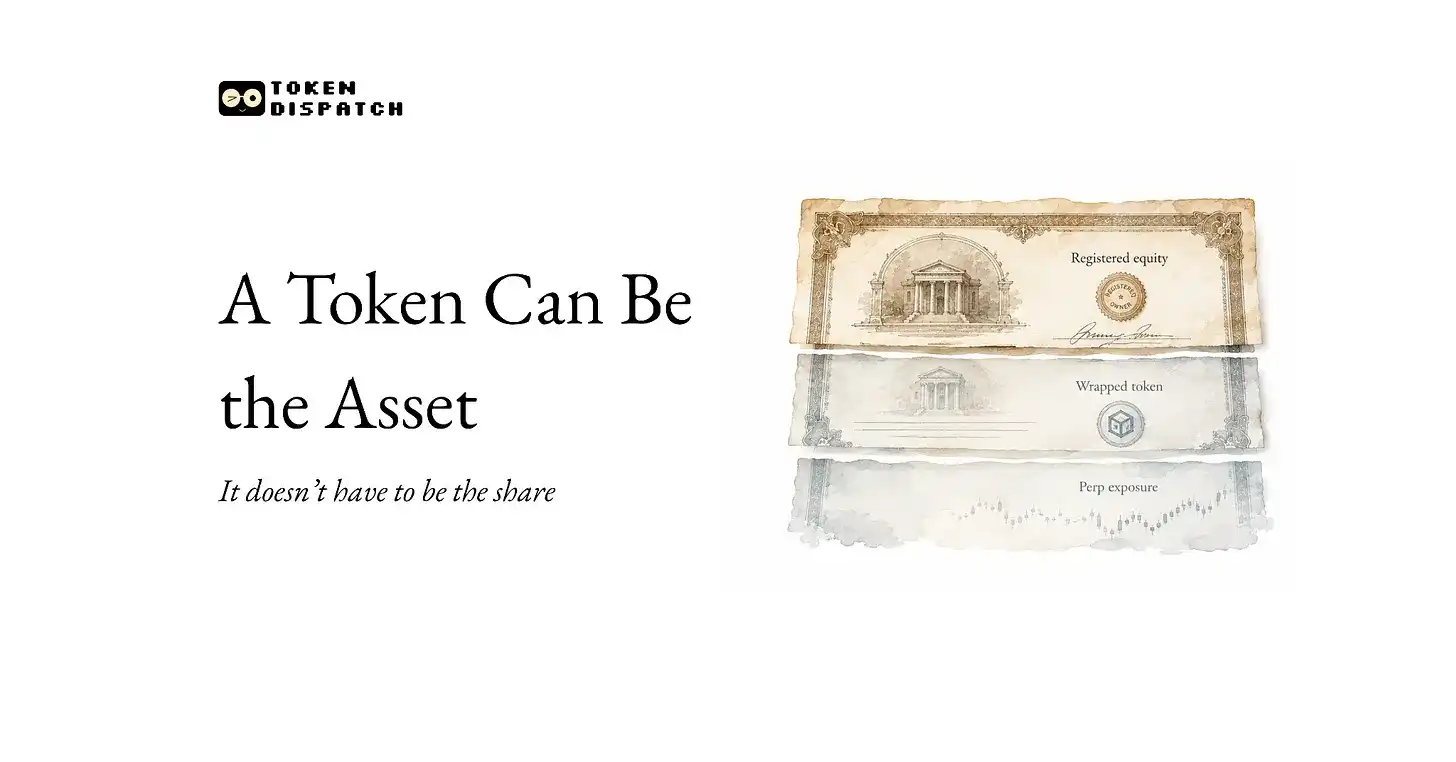
"Tokenized Stocks: Three Types, Which One Fits You? For investors outside the US, buying stocks like SpaceX or Nvidia is difficult, requiring brokers, cross-border transfers, and often accredited investor status. Blockchain offers an alternative through tokenized stocks, a term encompassing three distinct products with vastly different ownership, voting, and profit rights. 1. **Full Real Ownership**: Companies like Superstate register native equity directly on-chain (e.g., Solana). Holders are on the official shareholder registry, with full voting rights, dividends, and legal ownership. This offers maximum rights but potentially less DeFi flexibility. 2. **SPV-Backed Tokens (Surrendered Ownership for DeFi Composability)**: Issuers like Backed (xStocks) and Ondo use offshore Special Purpose Vehicles (SPVs) to hold underlying shares 1:1 and issue tracking tokens. Investors get price exposure and dividends (reinvested as more tokens) but hold a claim on the SPV, not direct stock ownership. This enables use as collateral in DeFi protocols (Kamino, Morpho) and 24/7 minting/redemption, but carries SPV counterparty risk (highlighted by the PreStocks collapse). 3. **Perpetual Futures (Pure Price Speculation)**: Platforms like TradeXYZ (on Hyperliquid) and Ostium offer perpetual contracts. These are synthetic derivatives with no underlying stock ownership, using funding rates to track spot prices. They require only a price oracle, allowing extremely fast listing (e.g., SpaceX pre-IPO) and high leverage, attracting speculators. Their trading volume far exceeds tokenized spot products. The core value of tokens is that they don't need to replicate full stock ownership. Most retail investors never vote. Tokenization creates layered financial tools: full equity for institutions, composable tokens for DeFi users, and perpetuals for leveraged traders."

marsbit9m ago

The Token Itself Is an Asset: Three Types of Tokenized Stocks, Which One Suits You?

marsbit9m ago

AI as the Boss: Nearly Bankrupts 10 Companies...

A recent study from Princeton University tested 14 AI models, including large language models (LLMs) and a rule-based algorithm, in a simulation where they acted as CEOs of a virtual SaaS startup over 500 days. The goal was to grow an initial $1 million capital. The results were stark: only four "CEOs" ended with a profit. The top performer was Claude Fable 5, multiplying the capital 47-fold to $47.15 million. Claude Opus 4.8 and GPT-5.5 followed. Notably, the fourth profitable entity was a simple, pre-programmed rule-based algorithm, which outperformed many advanced LLMs with $15.76 million in profit. Five other models, including several major LLMs, went bankrupt before the simulation ended. Key takeaways from the research highlight that successful AI CEOs demonstrated a tendency for exploration and adaptation over caution. They excelled in discovering hidden information, predicting future cash flow, adapting quickly to changes (like competitor moves), and engaging in strategic "if-then" planning. The study also found that equipping LLMs with programming-agent frameworks, optimized for coding tasks, actually harmed their performance in this CEO role, suggesting a need for domain-specific adaptations. The article concludes by contrasting AI's current operational proficiency within defined frameworks with the type of visionary, intuitive decision-making—exemplified by figures like Steve Jobs—that truly drives transformative business strategy. This critical "matrix-drawing" capability, it argues, remains uniquely human.

marsbit19m ago

AI as the Boss: Nearly Bankrupts 10 Companies...

marsbit19m ago

Tokens as Assets: Which Type of Tokenized Stock Is Right for You?

**Tokenized Stocks: Three Models, Which Suits You?** For investors outside the US, accessing stocks like SpaceX or NVIDIA is often difficult, requiring compliant brokers and cross-border transfers. Blockchain offers an alternative through tokenized stocks, but this term encompasses three distinct models with vastly different ownership, voting rights, and economic benefits. The first model offers full, direct ownership. Platforms like Superstate register shares directly on-chain (e.g., Solana), with holders listed on the official shareholder registry, granting full voting rights, dividends, and legal status. The second model sacrifices direct ownership for DeFi composability. Issuers like Backed and Ondo use offshore Special Purpose Vehicles (SPVs) to issue tokens 1:1 backed by real shares. Holders gain price exposure and automated dividend accruals (via token balance increases), and tokens can be used as collateral in DeFi protocols. However, this introduces SPV counterparty risk, as seen in the PreStocks collapse. The third model abandons ownership entirely for pure price speculation. Perpetual futures platforms like TradeXYZ (on Hyperliquid) and Ostium create synthetic markets using price oracles and funding rates to track stock prices. They require no underlying shares, enabling rapid listing (e.g., SpaceX pre-IPO) and high leverage, which explains their trading volumes being 4-5x higher than tokenized spot markets. The core insight is that tokens derive value without needing to replicate full stock ownership. Most retail investors rarely exercise voting rights. These three models cater to different needs: direct ownership for institutions, DeFi-composable tokens for on-chain users, and perpetuals for leveraged, speculative traders. Tokenization is not a mere stock substitute but a new class of layered financial instruments.

Foresight News21m ago

Tokens as Assets: Which Type of Tokenized Stock Is Right for You?

Foresight News21m ago

Trading

Spot

Hot Articles

Discussions

Welcome to the HTX Community. Here, you can stay informed about the latest platform developments and gain access to professional market insights. Users' opinions on the price of ETH (ETH) are presented below.

活动图片