Победит ли адвокат инвесторов XRP Джон Дитон на предварительных выборах?

cryptonews.ruPublished on 2024-01-03Last updated on 2024-09-03

Сегодня избиратели Массачусетса отправятся на внутрипартийные выборы 2024 года (праймериз), на которых республиканцы намерены выбрать кандидата, который сместит сенатора-демократа Элизабет Уоррен. В свою очередь, Уоррен ни разу не сталкивалась с проблемой предварительных выборов с момента выборов в Сенат в 2012 году. Республиканская партия выдвинула сторонника XRP юриста Джона Дитона, поскольку он выглядит фаворитом на роль претендента на победу в предвыборной гонке, проводимой в пользу криптовалюты.

Джон Дитон рассчитывает на победу на сегодняшних праймериз в Массачусетсе

Ветеран Корпуса морской пехоты, адвокат, защищающий инвесторов XRP, Джон Дитон уверен в своей победе на первичных выборах в Массачусетсе 3 сентября. Дитон готовится выступить перед публикой в ​​качестве кандидата от республиканцев, бросающего вызов сенатору Элизабет Уоррен.

Дитон сказал, что его аккаунт X будет «активен» сегодня, пока избиратели, особенно криптосообщество, ждут результатов первичных выборов. Он намерен бороться за людей и начать их поиски, чтобы вернуть себе место в Сенате у банкиров и групп особых интересов.

Три республиканца ищут возможность на республиканских праймериз в Сенате США победить сенатора Уоррен в Массачусетсе. Примечательно, что Уоррен стремится на третий срок, поскольку она сохранила свое доминирование в штате и Демократической партии с 2012 года.

Вместе с юристом XRP, за первенство будут бороться еще два кандидата от республиканской партии. Однако Дитон получил сильную поддержку от людей, несмотря на то, что только в этом году переехал в Массачусетс из Род-Айленда.

Джон Дитон утверждает, что Элизабет Уоррен отправится в отставку на всеобщих выборах в ноябре. Он возглавил сбор средств среди своих коллег при поддержке криптосообщества. Согласно данным Федеральной избирательной комиссии США , Фонд единства Содружества, созданный адвокатом Джеймсом Мерфи, собрал более 2,5 миллионов долларов для Дитона. Ripple и близнецы Уинклвосс пожертвовали по 1 миллиону долларов каждый. Дитон также собрал еще 1 миллион долларов в ходе предвыборных кампаний.

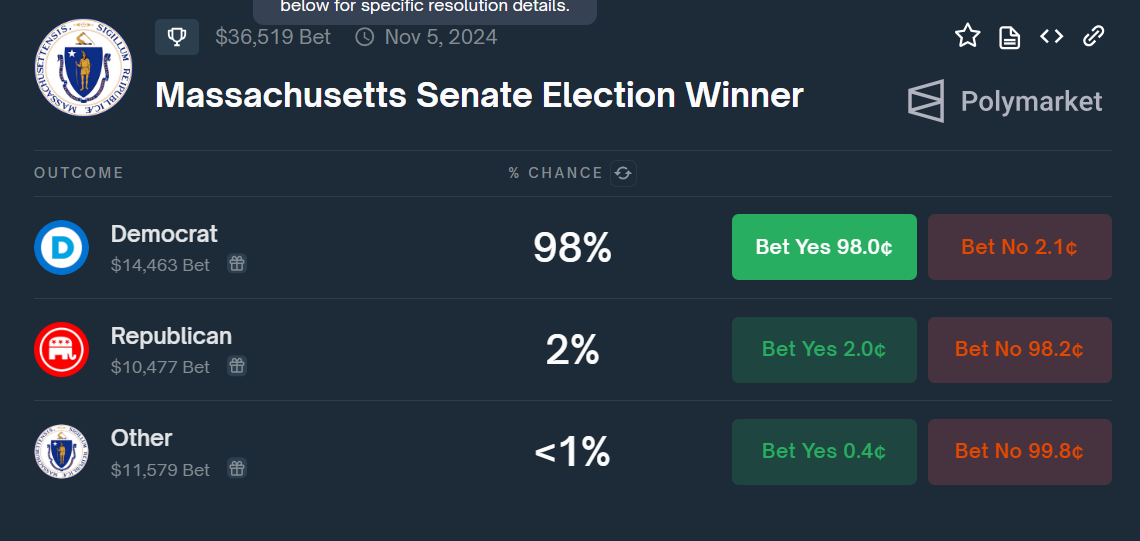
Какая партия победит на в Сенат Массачусетса: Polymarket

Главной проблемой для Республиканской партии является доминирование сторонников демократов в штате. На прошлой неделе госсекретарь Уильям Гэлвин предсказал, что 3 сентября в выборах примут участие 500 000 демократов и 250 000 республиканцев, сообщает Boston Herald.

Согласно прогнозам рынков, у Демократической партии высокие шансы на победу на выборах. Данные Polymarket показывают, что игроки считают, что у демократов есть 98% шансов выиграть выборы в Сенат Массачусетса в ноябре, в отличие от 2% шансов у республиканцев.
Trending Cryptos

Related Reads

Google Shaken, Market Cap Evaporates Hundreds of Billions. Can Gemini Spark Save the Day?

Google is facing a turbulent period marked by a significant brain drain of top AI talent. Key figures like Noam Shazeer, John Jumper, Jonas Adler, and Alexander Pritzel have recently left for competitors OpenAI and Anthropic, causing investor concern and a sharp stock decline wiping hundreds of billions from Alphabet's market cap. Amidst this talent exodus and the delayed launch of the anticipated Gemini 3.5 Pro model, Google has unveiled its major new offering: Gemini Spark. This is not a standard chatbot but a persistent, cloud-based AI agent designed to automate multi-step workflows across Google's ecosystem (Gmail, Calendar, Docs, Drive, etc.) and some third-party apps. Powered by the Antigravity framework with Tasks, Skills, and Schedules, it aims to function as a continuous digital assistant. However, its high price point—exclusive to the $100/month AI Ultra tier—has drawn criticism. The article positions Spark as Google's critical, albeit late, move into the AI agent arena, where AI transitions from a tool to an autonomous workforce. While competitors and startups are already advancing in this space, Google's vast integration with Workspace gives it a potential edge, though its historical caution due to scale and risk may have cost it the lead. Ultimately, Spark represents a necessary shift for Google, but the question remains whether this "digital employee" can compensate for the loss of foundational talent and restore investor confidence in the company's future.

marsbit2m ago

Google Shaken, Market Cap Evaporates Hundreds of Billions. Can Gemini Spark Save the Day?

marsbit2m ago

24/5 Settlement Is Here for US Stocks, but Cryptocurrency Didn't Get a Ticket

The U.S. National Securities Clearing Corporation (NSCC), a subsidiary of the Depository Trust & Clearing Corporation (DTCC), has announced the implementation of 24-hour clearing operations on weekdays. This move, approved by the SEC and being rolled out in phases, fundamentally challenges a core narrative of the cryptocurrency industry: that digital assets offer a unique advantage with their 7x24 trading availability, unlike traditional markets that close at 4 p.m. The transition to near-continuous clearing for stocks and other traditional assets diminishes this perceived crypto edge. While crypto markets still operate on weekends, the article notes that DTCC could potentially expand to weekend clearing in the future if demand warrants. The development is presented as another instance where DTCC has disappointed crypto enthusiasts. Despite frequent speculation from communities supporting Ethereum, XRP Ledger, and others that DTCC would integrate public blockchains, the clearing giant consistently opts for private, permissioned distributed ledger solutions for its projects, such as its Ion platform and a recent U.S. Treasury tokenization initiative on the Canton network. The article concludes that the successful launch of this traditional finance "always-on" market relied entirely on existing mature infrastructure, with the cryptocurrency industry failing to secure a role or "admission ticket" in its implementation.

Foresight News18m ago

24/5 Settlement Is Here for US Stocks, but Cryptocurrency Didn't Get a Ticket

Foresight News18m ago

Karpathy's Genius Strikes Again, Challenging RAG, Turning Your Notes into a Second Brain

Andrej Karpathy has proposed a revolutionary concept for managing personal knowledge: treating notes as immutable "source code" and using LLMs as "compilers" to build a structured, interlinked wiki. This approach fundamentally shifts the cognitive workflow away from the limitations of RAG (Retrieval-Augmented Generation), which merely retrieves and pieces together fragments, leading to contradictions and "digital mummies"—unused, decaying notes. The LLM-Wiki framework introduces a three-layer architecture: the **Raw Layer** for original, immutable notes; the **Schema Layer** defining rules for structuring knowledge; and the **Wiki Layer**, where the LLM continuously compiles and maintains a coherent, cross-referenced knowledge base. Key operations are **Ingest** (adding new material, which triggers updates across related pages), **Query** (asking the compiled wiki, with answers that can become new pages), and **Lint** (periodic AI audits to find contradictions, outdated claims, or gaps). This system automates the tedious maintenance—updating links, resolving conflicts, keeping summaries fresh—that has historically made large-scale personal knowledge management unsustainable. It realizes Vannevar Bush's 1945 "Memex" vision by finally solving the maintenance problem. Karpathy's proposal represents a third piece in human-AI collaboration, following "Vibe Coding" and "Agentic Engineering." It liberates human attention from organizational drudgery, refocusing it on what matters: deciding what to read and deriving meaning.

marsbit27m ago

Karpathy's Genius Strikes Again, Challenging RAG, Turning Your Notes into a Second Brain

marsbit27m ago

Claude Science Completes Two Years' Work in a Few Weeks, Is 10x Research Acceleration Really Here?

Claude Science, a new AI workbench from Anthropic, is being tested by scientists, reportedly accelerating specific research workflows by up to 10x. A neuro-scientist at the Allen Institute completed a lengthy literature review in weeks instead of nearly two years using the tool, which automates tasks like citation verification. The platform is an integrated environment for macOS and Linux, connecting to local or remote computing resources. It streamlines the fragmented research process—literature analysis, computation, visualization, and drafting—into a single, auditable workflow. A key feature is its emphasis on reproducibility: every chart generated includes the exact code, environment, and history used to create it. Claude Science uses a multi-agent system. A coordinator manages over 60 pre-configured skills for life sciences (genomics, proteomics, etc.) and can spawn specialized agents. A dedicated reviewer agent checks citations and calculations for accuracy, creating a form of internal AI peer review. The system operates with a human-in-the-loop, requiring user approval for major steps. Initial applications are in life sciences. Examples include target identification for biotech company Manifold Bio and germline variant analysis for glioma research at UCSF, completing analyses in roughly one-tenth the previous time. The approach contrasts with competitors: Google focuses on proprietary models like AlphaFold, while OpenAI is advancing models' scientific reasoning with benchmarks like GeneBench-Pro. Claude Science differentiates by automating and integrating the practical research pipeline, not just the model's intelligence, aiming to make AI-aided science more reproducible and integrated into daily lab work.

marsbit31m ago

Claude Science Completes Two Years' Work in a Few Weeks, Is 10x Research Acceleration Really Here?

marsbit31m ago

Trading

Spot

Hot Articles

What is XRP 2.0

XRP 2.0: A New Frontier in the Cryptocurrency Landscape Introduction to XRP 2.0 In the ever-evolving realm of cryptocurrency, new projects continuously emerge, vying for attention and adoption. One such promising initiative is XRP 2.0, a novel cryptocurrency project designed to leverage advanced blockchain technology and robust encryption methodologies. While the name draws parallels with Ripple’s XRP, it’s crucial to note that XRP 2.0 operates independently, focusing on enhancing transaction security, privacy, and scalability. As the digital financial landscape increasingly embraces decentralized solutions, XRP 2.0 aims to contribute meaningfully to web3 and the overall expansion of crypto projects. What is XRP 2.0? At its core, XRP 2.0 is a cryptocurrency project that aims to create a secure and decentralized digital currency ecosystem. Its foundational technology integrates sophisticated blockchain principles with cutting-edge encryption techniques. The overarching goal of XRP 2.0 is to establish itself as a reliable and efficient platform enabling swift transaction execution while prioritizing enhanced privacy protections for its users. The project is promoted as a solution to many limitations faced by existing cryptocurrencies, proposing a system that can handle a higher volume of transactions with improved speed and privacy. This versatility positions XRP 2.0 as a significant contender in a marketplace riddled with various digital currencies. Who is the Creator of XRP 2.0? The identity of the creator behind XRP 2.0 has been flagged as ‘Wilbur.’ However, comprehensive details regarding Wilbur or their associated entity remain elusive. The anonymity of many cryptocurrency creators is not an uncommon phenomenon in the industry, often designed to maintain a degree of privacy and security. Who are the Investors of XRP 2.0? As of now, specific information related to the investment foundations or organizations supporting XRP 2.0 is not publicly available. In the cryptocurrency sector, the backing by reputed investors can significantly influence a project's credibility and success, yet the transparency regarding the financial supporters of XRP 2.0 has not been established. How Does XRP 2.0 Work? XRP 2.0 stands out by employing a combination of blockchain technology and advanced encryption algorithms that ensures secure and decentralized transactions. Its innovative structure includes unique features designed to foster user engagement and broaden functionalities beyond conventional cryptocurrency transactions. Among these features, XRP 2.0 incorporates AI-powered capabilities, such as text-to-image and text-to-speech functionalities. These additions are designed to enhance the interactive experience for users, promoting broader applicability across various sectors. By bridging technological advancements with user-centered design, XRP 2.0 aims to capture the attention of a diverse range of individuals and enterprises looking to integrate cryptocurrency solutions into their operational frameworks. Timeline of XRP 2.0 Understanding XRP 2.0 requires examining the milestones that have defined its journey thus far: July 23, 2023: XRP 2.0 is introduced as a novel cryptocurrency project, aiming to revolutionize secure and decentralized transaction capabilities in the blockchain domain. September 8, 2023: The launching of another project, XRP20, occurs, marking the emergence of an ERC-20 token on the Ethereum blockchain that remains unrelated to XRP 2.0. November 13, 2023: The XRP Ledger undergoes a significant update with the release of rippled server software version 2.0.0. It is essential to note that this development is disconnected from the XRP 2.0 cryptocurrency project. Key Points About XRP 2.0 To distill the essence of XRP 2.0, several critical factors emerge: Unique Features: The inclusion of features like AI-powered text-to-image and text-to-speech further diversifies the potential applications of XRP 2.0. Blockchain Technology: The framework utilizes advanced blockchain mechanisms and encryption protocols, ensuring a secure and decentralized environment for transactions. Scalability and Privacy: XRP 2.0 prioritizes enhanced privacy protections in transaction processes and the scalability necessary to accommodate a growing user base. No Affiliation with Ripple: Importantly, despite its name, XRP 2.0 does not have any allegiance or collaboration with Ripple’s XRP, distinguishing its operational framework and objectives within the cryptocurrency ecosystem. Conclusion XRP 2.0 represents an ambitious venture into the cryptocurrency sphere, aiming to offer a combination of security, privacy, and efficiency in digital transactions. By integrating sophisticated technologies and user-friendly features, the project sets out to broaden the horizons of what cryptocurrency can achieve in today's digital economy. While the anonymity of its creator and lack of disclosed investors might raise questions for some, XRP 2.0's focus on advanced functionalities and decentralisation enhances its appeal amidst an increasingly crowded crypto market. As the cryptocurrency landscape continues to evolve, XRP 2.0 may yet emerge as a pivotal player in the expansion of secure and scalable blockchain solutions.

1.0k Total ViewsPublished 2024.04.01Updated 2024.12.03

What is XRP 2.0

Discussions

Welcome to the HTX Community. Here, you can stay informed about the latest platform developments and gain access to professional market insights. Users' opinions on the price of XRP (XRP) are presented below.

活动图片