Виталик Бутерин подтвердил, что не продавал ETH для личных целей с 2018 года

investing.ruPublished on 2024-09-02Last updated on 2024-09-02

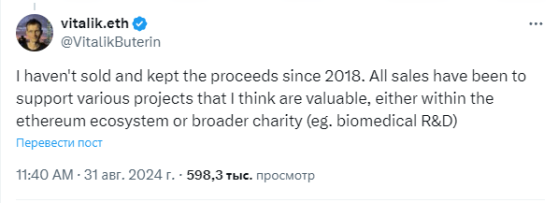
Happycoin.club - Соучредитель блокчейна Ethereum Виталик Бутерин заявил, что не продавал ETH в течение шести лет, исключая участие в благотворительных проектах или поддержку проектов в экосистеме. Таким образом Бутерин ответил на слухи по поводу массовых продаж ETH.

Я не продавал и не оставлял выручку с 2018 года. Все продажи были направлены на поддержку различных проектов, которые я считаю ценными, либо в экосистеме Ethereum, либо в сфере благотворительности (например, биомедицинские исследования и разработки).

По его словам, в прошлом квартале Ethereum Foundation выделил $8,4 млн грантов на экосистемные проекты.

В прошлом месяце Бутерин выделил некоторые криптопроекты, которые он считает перспективными, включая криптоплатформу для ставок Polymarket, использующую также стейблкоины USDC и RAI.

Кроме того, Бутерин подчеркнул, что протоколы децентрализованного финансирования (DeFi) должны доказать свою ценность, не жертвуя основными принципами криптовалюты — истинной децентрализацией и отсутствием разрешений.

Что касается бизнес-моделей, включающих фермерство ликвидности, то их Виталик Бутерин назвал в долгосрочной перспективе неустойчивыми.

Я не уважаю вещи, привлекательность которых исходит из какой-то сиюминутности… Я не был впечатлён помешательством на фермерство ликвидности в 2021 году, потому что было очевидно, что оно базируется на выпуске токенов-однодневок.

Читайте оригинальную статью на сайте Happycoin.club
Trending Cryptos

Related Reads

Top 8 DEXs of July 2026

This article presents the top 8 decentralized exchanges (DEXs) for July 2026, highlighting their key features and evolution within the DeFi space. DEXs, which enable peer-to-peer cryptocurrency trading via smart contracts without intermediaries, are praised for offering users greater control, privacy, transparency, and global access compared to centralized platforms. The listed DEXs are: 1. **Shadow Exchange**: A Sonic-native DEX specializing in concentrated liquidity for efficient trading and reduced slippage. 2. **Uniswap**: A leading protocol using an Automated Market Maker (AMM) model across multiple blockchains. 3. **SushiSwap**: An evolved platform offering token swaps, yield farming, and governance via its SUSHI token across 40+ networks. 4. **Orca**: A user-friendly AMM on Solana featuring capital-efficient "Whirlpools" for concentrated liquidity. 5. **Meteora**: A Solana-based DEX focusing on dynamic liquidity infrastructure and vaults for advanced strategies. 6. **Raydium**: A hybrid exchange on Solana combining AMM pools with a central limit order book for deep liquidity. 7. **Hyperliquid**: A Layer 1 blockchain hosting a non-custodial perpetual futures exchange using an on-chain order book. 8. **PancakeSwap**: A multi-chain AMM hub originating on BNB Chain, now supporting thousands of trading pairs across several networks. The article concludes by noting the significant role of DEXs in crypto, their expansion beyond simple swaps into areas like derivatives and cross-chain interoperability, and advises users to conduct their own research before engaging with any platform.

ambcrypto1h ago

Top 8 DEXs of July 2026

ambcrypto1h ago

USDT Market Cap Approaches Ethereum's: What Signal Does This Convey?

The market capitalization of USDT has nearly reached that of Ethereum, making it the second-largest cryptocurrency after Bitcoin. This prompts an examination of what this signifies and what it does not. Firstly, this does not relate to economic security. Unlike some Web3 systems where a governance token's value must underpin the security of its applications (e.g., oracles), USDT's stability is not backed by the value of the underlying blockchains it operates on. Tether, the issuer, controls the assets, and can freeze, reissue, or abandon tokens on a compromised chain. While stablecoins require functional blockchains, a chain's native token market cap does not provide direct security for the stablecoin. Secondly, USDT's growth does not inherently reflect poorly on Ethereum. USDT is a dollar-pegged store of value, while ETH represents a claim on future Ethereum network revenue. Their valuations are driven by different factors. USDT's rising market cap simply indicates strong demand for stablecoin utility, independent of Ethereum's technological merits or competitive position. The core insight is the overwhelming market demand for permissionless dollar transfers. This is the most established and essential use case in crypto. It requires minimal technological sophistication—essentially just a trusted issuer's promise of redemption on a functional chain. This explains why stablecoin supply has grown exponentially while the combined market cap of major non-stablecoin cryptocurrencies like Bitcoin, Ethereum, and others has stagnated for years. Users primarily seek accessible dollar-denominated assets. They largely disregard the issuer's credibility (as seen with Tether's dominance over more credible alternatives like USDC or BlackRock's BUIDL) and are indifferent to the governance or decentralization of the underlying blockchain. As long as a stablecoin is widely accepted and easy to transfer, users will adopt it across any chain. The trend suggests that the market for permissionless stablecoins could continue to expand far beyond the total value of the smart contract platforms that host them, driven by this singular, powerful use case.

Foresight News1h ago

USDT Market Cap Approaches Ethereum's: What Signal Does This Convey?

Foresight News1h ago

Trading

Spot

Hot Articles

Discussions

Welcome to the HTX Community. Here, you can stay informed about the latest platform developments and gain access to professional market insights. Users' opinions on the price of ETH (ETH) are presented below.

活动图片