Solana Blockchain Suffers A Major Decline In Transaction Fees, What’s Driving It?

bitcoinistPublished on 2024-08-28Last updated on 2024-08-28

Abstract

The Solana Blockchain, one of the leading networks in the dynamic world of cryptocurrency, has witnessed a significant decline in...

The Solana Blockchain, one of the leading networks in the dynamic world of cryptocurrency, has witnessed a significant decline in transaction fees in tandem with the general decline in the cryptocurrency market. This raises worries about how the current market downturn may affect Solana’s ecosystem and prospects for long-term growth.

Solana’s Daily Transactions Fees Drops Nearly 100%

In a recent post on the X (formerly Twitter) platform, Kyle Doops, a market expert and host of the Crypto Banter show, pointed out that the daily transaction fees on the Solana blockchain have fallen drastically. As the market continues to be difficult, the decline in daily transaction costs implies a drop in network activity and a reduction in user demand.

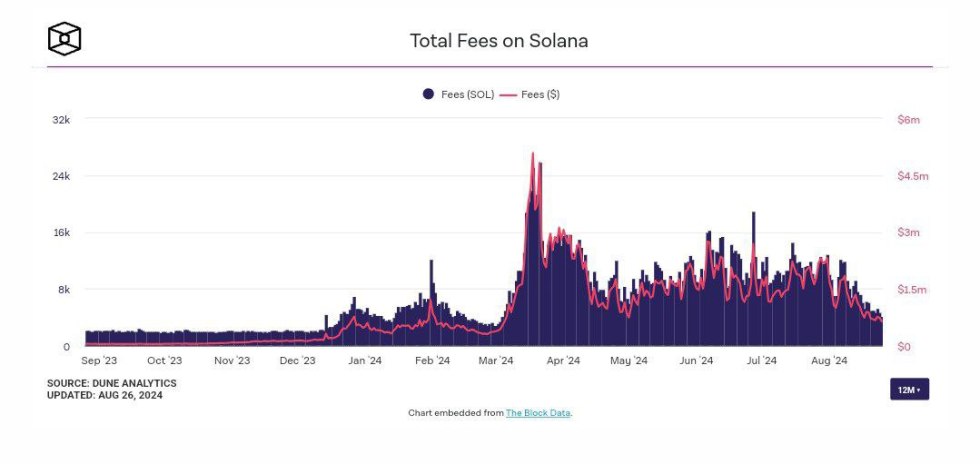
According to the market expert, the daily transaction costs on the Solana blockchain decreased to about $639,000. This drop marks its lowest level in nearly 5 months after reaching an all-time high in March this year, representing an 87% decline from the peak.

Kyle Doops noted that this significant fall in daily transaction fees indicates cooling market hype and is driven by a decrease in meme coin activity. He further highlighted that major meme coins on the SOL blockchain have experienced a substantial drop in value, which has led to a downturn in network activity.
Solana
Solana daily transaction fees drop by 87% | Source: Kyle Doops on X

While meme coin activity on the blockchain has fallen dramatically, Solana’s stablecoin market cap has increased remarkably, approaching $4 billion. This rise marks its greatest point in over 682 days, particularly since October 2022.

According to Kyle Doops, the rise showcases the growing trust in the Solana ecosystem as demand for its stablecoins grows on Decentralized Finance (DeFi) platforms and in the larger cryptocurrency markets.

SOL Poised For Major Rally Based On Past Scenario

These developments coincide with a notable drop in the value of SOL, as the altcoin has fallen from about $161 to the $146 price level. Although the token demonstrates a bearish sentiment amid larger market pessimism, several analysts are optimistic about a price recovery in the upcoming days.

After the drop in the price of Solana, Trader Tardigrade, a crypto analyst and enthusiast, predicted a potentially massive rally for SOL shortly. The expert’s positive prediction is based on forming a bullish Symmetrical Triangle pattern on the weekly chart of SOL.

Tardigrade asserted that SOL is currently moving in a triangle pattern akin to that of middle 2021. Before that, the crypto asset witnessed a huge rally, which took its price from the $30 to $250 level after breaking out of the bullish pattern, reflecting an over 8x growth.

With the same pattern developing on the weekly chart, the analyst anticipates similar price growth for SOL in the upcoming weeks following a breakout from the zone. Should SOL mirror this increase, its price could surge to nearly $1,200, considering the digital asset’s current price level.

Solana
SOL trading at $145 on the 1D chart | Source: SOLUSDT on Tradingview.com
Featured image from Adobe Stock, chart from Tradingview.com
Godspower Owie

Godspower Owie

Godspower Owie is my name, and I work for the news platforms NewsBTC and Bitcoinist. I sometimes like to think of myself as an explorer since I enjoy exploring new places, learning new things, especially valuable ones, and meeting new people who have an impact on my life, no matter how small. I value my family, friends, career, and time. Really, those are most likely the most significant aspects of every person's existence. Not illusions, but dreams are what I pursue.

Trending Cryptos

Related Reads

Just now, DeepSeek V4 updates with DSpark, improving inference speed by 80%

DeepSeek has updated its DeepSeek V4 model with the DSpark speculative decoding framework, achieving a significant 60-85% speedup in generation for Flash models and 57-78% for Pro models while maintaining the same overall throughput. This engineering-focused update, rather than a core architectural change, introduces DSpark to address latency and throughput bottlenecks in high-concurrency production environments. DSpark combines high-throughput parallel generation with adaptive load-aware verification. Its key innovations include a semi-autoregressive generation architecture to model dependencies within token blocks and a hardware-aware confidence-scheduled verification system. This system uses a confidence head to predict token acceptance probabilities, allowing it to dynamically optimize verification length per request and allocate compute only to tokens with the highest expected payoff. The asynchronous scheduler is designed for real-world deployment, ensuring zero-overhead scheduling and continuous CUDA graph replay while preserving the target model's output distribution. In tests across mathematical reasoning, code generation, and daily dialogue, DSpark outperformed state-of-the-art models like Eagle3 and DFlash, increasing average acceptance length by 26.7%-30.9% and 16.3%-18.4% respectively on Qwen3 target models. DeepSeek also open-sourced DeepSpec, a full-stack codebase for training and evaluating speculative decoding draft models, providing a standardized toolkit that includes data preparation tools, model implementations, training code, and evaluation scripts.

marsbit2h ago

Just now, DeepSeek V4 updates with DSpark, improving inference speed by 80%

marsbit2h ago

BIT Research: The 2028 Halving Is Not the End, the Real Shake-Up of the Bitcoin Mining Industry Is Just Beginning

The Bitcoin mining industry is undergoing its most complex structural adjustment since inception. Despite Bitcoin's price holding near $61,000 and the network hash rate approaching a record 1 ZH/s, miner profitability is deteriorating. The industry is operating close to its breakeven point, with the 2028 halving expected to accelerate consolidation. The challenges extend beyond the halving's subsidy reduction; the industry's revenue model has yet to successfully transition towards a fee-driven structure. Increasingly, mining companies are evolving from simple Bitcoin producers into infrastructure and energy operators, including providers of AI/HPC computing power. Competition is shifting from pure hash rate expansion to business model upgrades. Economic pressure is evident. The theoretical daily mining revenue at current prices is around $78 million, yet the actual figure is only about $33 million—a 136% gap. Transaction fees remain low at roughly $220k daily, far below historical implied levels. With a current estimated industry-wide breakeven price near $65,000, mining alone is struggling to generate ideal profits. The 2028 halving is projected to push the fundamental production cost floor to approximately $93,289. This will likely accelerate a shift towards consolidation among larger, well-capitalized miners with diversified revenue streams. Competitive advantage will belong to institutionalized players with access to low-cost energy, AI/HPC hosting operations, and stronger balance sheets. In essence, Bitcoin mining is transitioning from a "mining business" to an "infrastructure business." Future profitability and resilience will depend less on block rewards and more on diversified income sources like energy management and computational infrastructure services. For investors, the key question is not the halving itself, but which miners can successfully navigate this business model transformation.

marsbit3h ago

BIT Research: The 2028 Halving Is Not the End, the Real Shake-Up of the Bitcoin Mining Industry Is Just Beginning

marsbit3h ago

This is How God Karpathy Uses Claude?

Andrej Karpathy, a prominent figure in AI, has reportedly joined Anthropic, leading to a noticeable decrease in his open-source contributions and social media activity. A document claiming to be his personal "CLAUDE.md" file—a set of instructions for the Claude AI to follow within a specific codebase—has been circulating online. While its authenticity is unverified, the content aligns closely with Karpathy's publicly shared principles on effective AI-assisted programming. The document outlines key rules for AI coding assistants, emphasizing the importance of reading existing code thoroughly before writing new code to maintain consistency. It advises against over-engineering, advocating for simple, surgical modifications that match the project's existing style. Other guidelines include clarifying assumptions upfront, writing meaningful tests, thoughtful debugging, and carefully considering dependencies. The core message is that these principles help prevent common AI coding failures, such as introducing unnecessary abstractions, style drift, or making invisible architectural decisions. The community has noted that even experts like Karpathy require detailed instructions to guide AI effectively, akin to managing a junior developer. A related GitHub repository, "andrej-karpathy-skills," which encapsulates these ideas, is reported to significantly reduce Claude's code error rate. Ultimately, the advice stresses that the best CLAUDE.md is tailored to one's own tech stack and coding practices.

marsbit3h ago

This is How God Karpathy Uses Claude?

marsbit3h ago

Trading

Spot

Hot Articles

Discussions

Welcome to the HTX Community. Here, you can stay informed about the latest platform developments and gain access to professional market insights. Users' opinions on the price of SOL (SOL) are presented below.

活动图片