Ethereum ‘Is Dying While L2’s Dance On Its Grave’, Claims Investment Firm CEO

bitcoinistPublished on 2024-08-27Last updated on 2024-08-27

Abstract

In a charged statement on X, Justin Bons, founder and Chief Investment Officer of Cyber Capital, one of Europe's oldest...

In a charged statement on X, Justin Bons, founder and Chief Investment Officer of Cyber Capital, one of Europe’s oldest cryptocurrency funds, has voiced a critical view of Ethereum’s current trajectory, asserting that “Ethereum is dying while L2’s dance on its grave.” Bons argues that Ethereum (ETH) is struggling to maintain its fee revenue due to inadequate network capacity, while Layer 2 (L2) solutions are capitalizing on this limitation by keeping Ethereum’s capacity constrained.

Bons claims, “ETH cannot sustain high fee revenue because it lacks the capacity. At the same time, L2s are seeing record highs in usage & fees while they lobby to keep ETH’s capacity down!” He characterizes this dynamic as parasitic, where L2s benefit at Ethereum’s expense, particularly post the EIP-4844 (Proto-Danksharding) implementation, which Bons claims has precipitated a collapse in fee revenue for Ethereum. His commentary suggests that the fee burning mechanism, meant to offset inflation by making Ethereum deflationary, can no longer keep pace due to the fee diversion to L2s.

Is Ethereum Dying Because Of L2’s?

Bons argues that this scenario has created a “parasitic relationship” between Ethereum and its L2 counterparts. He believes that L2s, while designed to scale Ethereum’s capacity by handling transactions off the main chain, are now operating almost independently, thereby fragmenting the ecosystem. This fragmentation, according to Bons, is breaking up liquidity and composability, crucial elements that facilitate seamless operations across the Ethereum network.

The shift towards L2 solutions, in Bons’ view, has led to a rise in centralized tendencies within platforms that were originally promoted as decentralized. “This also pushes the users into centralized L2s. As every single L2 in the top 10 (stopped counting after 10) can now steal user funds & censor. This is ironic, considering that the entire ‘L2 scaling’ roadmap was justified in the name of decentralization… A bait & switch,” Bons elaborated.

The critique extends to the governance model of Ethereum, which Bons claims eschews on-chain governance leading to what he perceives as centralized control over its development. “The total rejection of on-chain governance by the ETH community could only have one outcome: Capture, resulting in what is effectively centralized control over ETH development!” he asserted, suggesting that this governance model has enabled L2 entities to exert disproportionate influence over the network.

If Ethereum were to scale at the L1 level with new technological breakthroughs, Bons speculates that it would “crash the token & equity price of all L2s overnight by making them obsolete & unnecessary,” illustrating a conflict of interest where L2 entities may prefer to suppress L1 advancements to maintain their market position.

Contributing to the debate, Pengu Aaron, lead of the ICP Hub Singapore, remarked, “IMO the L2s have to find a way to contribute back to Eth or else we will see a potential collapse in value.” Bons’ response underscored a systemic issue: “L2s only have to contribute back to ETH from ETH’s perspective. From the L2s perspective, it makes far more sense to keep all of that value for themselves. That is the problem as you are setting up a system with opposing & perverse incentives. Making it entirely unfixable & broken.”

In a contrasting view, a user named @bowtied3hbt drew an analogy to the United States, where the federal system allows states considerable autonomy yet remains functional. Bons countered this comparison, highlighting historical conflicts that were necessary to maintain the federation, such as the Civil War, thus illustrating the enforceability challenges in decentralized systems which lack overarching compulsion mechanisms.

“Multiple wars were fought to keep the US federation together! From the Civil War to the Utah War, to name a few. The difference is that in cryptocurrency, nobody can force an L2 to stay on ETH if it goes against the L2s interests. That is where your analogy totally falls apart!, Bons concluded.

At press time, ETH traded at $2,687.
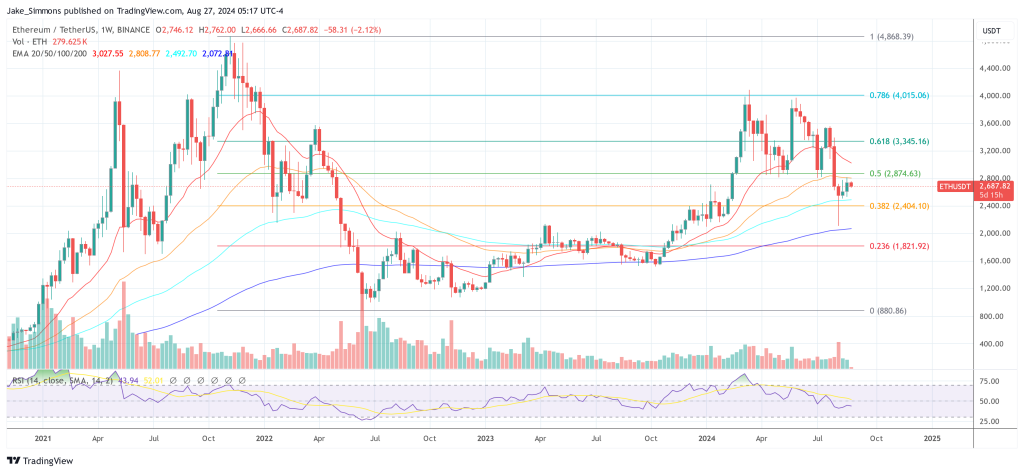
Ethereum price
Ether price, 1-week chart | Source: ETHUSDT on TradingView.com
Featured image created with DALL.E, chart from TradingView.com
Jake Simmons

Jake Simmons

Jake Simmons has been a Bitcoin enthusiast since 2016. Ever since he heard about Bitcoin, he has been studying the topic every day and trying to share his knowledge with others. His goal is to contribute to Bitcoin's financial revolution, which will replace the fiat money system. Besides BTC and crypto, Jake studied Business Informatics at a university. After graduation in 2017, he has been working in the blockchain and crypto sector. You can follow Jake on Twitter at @realJakeSimmons.

Trending Cryptos

Related Reads

BIT Research: The 2028 Halving Is Not the End, the Real Shake-Up of the Bitcoin Mining Industry Is Just Beginning

The Bitcoin mining industry is undergoing its most complex structural adjustment since inception. Despite Bitcoin's price holding near $61,000 and the network hash rate approaching a record 1 ZH/s, miner profitability is deteriorating. The industry is operating close to its breakeven point, with the 2028 halving expected to accelerate consolidation. The challenges extend beyond the halving's subsidy reduction; the industry's revenue model has yet to successfully transition towards a fee-driven structure. Increasingly, mining companies are evolving from simple Bitcoin producers into infrastructure and energy operators, including providers of AI/HPC computing power. Competition is shifting from pure hash rate expansion to business model upgrades. Economic pressure is evident. The theoretical daily mining revenue at current prices is around $78 million, yet the actual figure is only about $33 million—a 136% gap. Transaction fees remain low at roughly $220k daily, far below historical implied levels. With a current estimated industry-wide breakeven price near $65,000, mining alone is struggling to generate ideal profits. The 2028 halving is projected to push the fundamental production cost floor to approximately $93,289. This will likely accelerate a shift towards consolidation among larger, well-capitalized miners with diversified revenue streams. Competitive advantage will belong to institutionalized players with access to low-cost energy, AI/HPC hosting operations, and stronger balance sheets. In essence, Bitcoin mining is transitioning from a "mining business" to an "infrastructure business." Future profitability and resilience will depend less on block rewards and more on diversified income sources like energy management and computational infrastructure services. For investors, the key question is not the halving itself, but which miners can successfully navigate this business model transformation.

marsbit53m ago

BIT Research: The 2028 Halving Is Not the End, the Real Shake-Up of the Bitcoin Mining Industry Is Just Beginning

marsbit53m ago

This is How God Karpathy Uses Claude?

Andrej Karpathy, a prominent figure in AI, has reportedly joined Anthropic, leading to a noticeable decrease in his open-source contributions and social media activity. A document claiming to be his personal "CLAUDE.md" file—a set of instructions for the Claude AI to follow within a specific codebase—has been circulating online. While its authenticity is unverified, the content aligns closely with Karpathy's publicly shared principles on effective AI-assisted programming. The document outlines key rules for AI coding assistants, emphasizing the importance of reading existing code thoroughly before writing new code to maintain consistency. It advises against over-engineering, advocating for simple, surgical modifications that match the project's existing style. Other guidelines include clarifying assumptions upfront, writing meaningful tests, thoughtful debugging, and carefully considering dependencies. The core message is that these principles help prevent common AI coding failures, such as introducing unnecessary abstractions, style drift, or making invisible architectural decisions. The community has noted that even experts like Karpathy require detailed instructions to guide AI effectively, akin to managing a junior developer. A related GitHub repository, "andrej-karpathy-skills," which encapsulates these ideas, is reported to significantly reduce Claude's code error rate. Ultimately, the advice stresses that the best CLAUDE.md is tailored to one's own tech stack and coding practices.

marsbit54m ago

This is How God Karpathy Uses Claude?

marsbit54m ago

Trading

Spot

Hot Articles

Discussions

Welcome to the HTX Community. Here, you can stay informed about the latest platform developments and gain access to professional market insights. Users' opinions on the price of ETH (ETH) are presented below.

活动图片