Когда биткоин по $100 000 и что для этого нужно — прогнозы

cryptonews.ruPublished on 2024-01-26Last updated on 2024-08-26

На фоне восстановления BTC от августовских минимумов участники криптосообщества поделились мнением о том, к каким уровням стремится монета. Редакция BeInCrypto собрала прогнозы в одном обзоре

Рассказываем, чего инвесторы ждут от биткоина и на какие уровни стоит обратить внимание.

Что происходит с биткоином

Биткоин начал новую рабочую неделю с небольшого роста. По состоянию на момент написания обзора, криптовалюта торгуется по $64 161, что почти на 13% ниже абсолютного максимума, зафиксированного на уровне $73 750 в марте 2024 года.

График биткоина. Источник: TradingView

Напомним, еще в начале августа BTC опускался ниже $50 000 на фоне неожиданного решения ЦБ Японии по ставке, оттока из криптовалютных ETF, роста неопределенности в макроэкономике и ряда других факторов. Биткоин начал восстанавливаться по мере приближения ожидаемого снижения ключевой ставки в США, выплаты кредиторам FTX и выборов президента Америки, в которых победу может одержать сторонник криптосообщесива Дональд Трамп.

Прогноз биткоина

Многие участники криптосообщества считают, что биткоин уже прошел через все возможные преграды, которые останавливали рост монеты. Например, такой точки зрения придерживается криптоэнтузиаст Elja Boom. Он считает, что на графике криптовалюты сформировалась фигура теханализа «чаша с ручкой». Выход из нее может открыть биткоину путь с росту. По мнению Elja, уже в сентябре 2024 года инвесторы увидят BTC по $100 000.
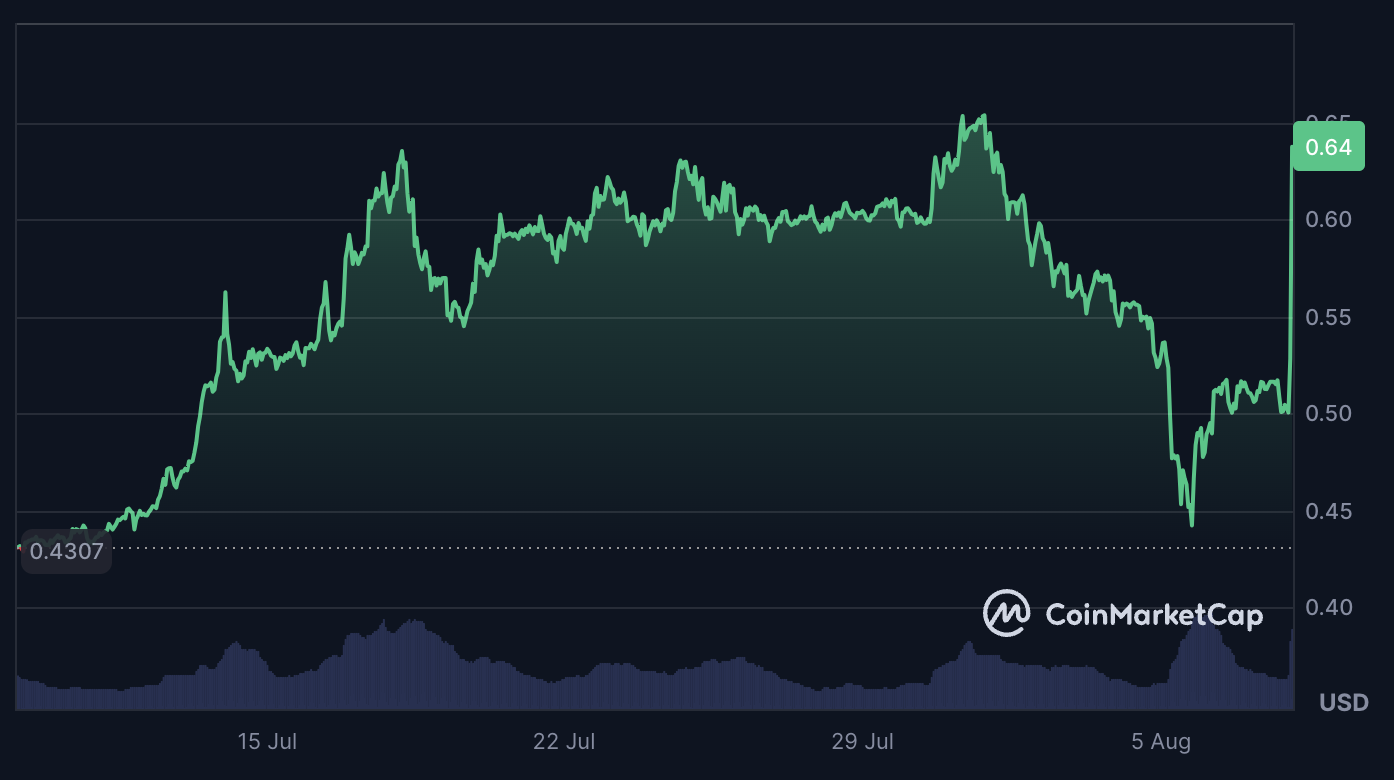
Прогноз биткоина от Elja Boom

Похожий прогноз курса биткоина поддержал аналитик MartyParty. Результаты его теханализа положения BTC не исключают выход криптовалюты параболический рост в ближайшее время. По его мнению, главным триггером позитивного движения биткоина станут выборы президента США, которые состоятся в ноябре 2024 года.

Позитивным прогнозом поделился аналитик Бенджамин Коуэн. Он обратил внимание на то, что BTC закрыл очередную торговую неделю выше уровня поддержки, пробой которого мог бы указывать на потенциал снижения курса криптовалюты. С точки зрения теханализа такое поведение биткоина говорит о возможностях роста монеты.

К коллегам присоединился криптоинвестор Sensei. Он считает, что в начале августа BTC прошел через «медвежью ловушку» и теперь перед криптовалтой открыт путь к росту.
Интерпретация положения биткоина с точки зрения психологии рыночных циклов по версии Sensei

Перспективы скорого выхода BTC в рост также видит трейдер Кевин Свонсон. По его мнению, на графике криптовалюты просматривается фигура «расширяющийся клин», прорыв верхней грани которой откроет биткоину путь к $100 000 в сентябре.
Прогноз биткоина от Кевина Свонсона

Коллег поддержал аналитик Doctor Profit. Он считает, что ближайшей целью биткоина станет $68 000. При этом он отметил, что потеря текущих уровней может отсрочить выход BTC в рост.

Напомним, ранее редакция BeInCrypto писала о том, что по мнению авторитетного аналитика Питера Брандта биткоин теряет шансы на обновление максимума в этом бычьем цикле.


Trending Cryptos

Related Reads

Will There Be a Next Wave of Web3 Games? Veteran Player's Review: At the Peak of Hype, You Should at Least Sell Half

**Title: Is There Another Wave for Web3 Gaming? A Veteran Player's Review: When Hype Peaks, You Must Exit at Least Half** **Summary:** In an interview, veteran player "Earn Money Chicken" shares his journey and reflections on Web3 gaming. He transitioned from being a traditional in-game trader to a Web3 gamer, having profited from games like Mobox, StepN, and Seraph, but also experiencing significant losses. He defines himself primarily as a player, not an investor, attracted to Web3 games for the blend of earning potential, engaging gameplay, and the satisfaction of researching game mechanics. While he enjoys strategic "gambling" within games, he emphasizes it's not about zero-sum competition with other players. The interview explores the complex, often adversarial relationship between players, projects, and major investors (whales). The player's experience as a traditional game merchant helped develop his analytical mindset for spotting opportunities, but wasn't directly transferable. He identifies the core sources of profit in early Web3 gaming as **"era红利" (era-specific红利)** and strategic foresight, not just simple calculations. He warns that the biggest mistake ordinary players make is calculating their return-on-investment (ROI) period at peak hype, as asset and yield depreciation can trap them. Reflecting on his wins and losses, he now advocates for managing expectations. His most successful exit was from Seraph, where he sold at a relatively good time. The key problem with current Web3 games, he argues, is that most are not mature games first. A successful Web3 game must primarily be a **good, fun game** with a genuine player base willing to spend money for enjoyment, not just participants seeking profit. The blockchain element should solve problems within that context, not be the primary driver. While he believes the sector might see another speculative boom (possibly another strong "Ponzi" model attracting hype), a truly mature and sustainable Web3 game likely needs to come from a traditional major game studio. It would leverage a proven IP, mature content, a functional NFT trading system, and attract both traditional and crypto-native players, offering more normalized returns rather than extreme暴利. His final advice: Newcomers without prior experience should avoid the space now, as it's like searching for a diamond in the rough. For those remaining, the rule is: be brave when assets are low and overlooked, but **when everyone is talking about it (at peak hype), you must sell at least half your holdings.**

marsbit43m ago

Will There Be a Next Wave of Web3 Games? Veteran Player's Review: At the Peak of Hype, You Should at Least Sell Half

marsbit43m ago

The Most Hidden AI Winners

"The Most Under-the-Radar AI Winners" While core AI giants and their direct suppliers have dominated headlines, a group of seemingly unrelated, decades-old manufacturing companies have emerged as major beneficiaries. A key example is Japan's TOTO, famous for bathroom fixtures. Its stock soared 145% in a year, driven not by its mainstay toilet business but by its nearly 40-year-old semiconductor ceramic component unit. Specifically, TOTO manufactures electrostatic chucks—critical, hard-to-replace parts for advanced chip manufacturing processes like etching and EUV lithography. This segment, though only 9% of revenue, contributed over 54% of operating profit in FY2025 with a 43% margin. High barriers to entry, including deep know-how in high-purity ceramic sintering and long supplier certification cycles (5+ years), secure its position. This pattern repeats across industries. Nitto Boseki, a 128-year-old glass fiber maker, saw its stock rise 325% due to near-monopoly supply of T-glass, an essential low-expansion material for AI chip substrates. Similarly, Ajinomoto, the global MSG leader, commands 80-95% of the market for ABF film, a vital insulating layer in chip packaging. These "hidden" segments, often born from deep materials science expertise, are now bottleneck supplies in the AI hardware chain, enjoying pricing power and high margins. In China's A-share market, the theme combines this AI-driven demand with domestic substitution. Companies like Zhongci Electronic (advancing in electrostatic chucks) and Honghe Technology & Feilihua (in high-end electronic glass fabrics) are gaining traction. The investment thesis hinges on whether these domestic players can rapidly scale qualified capacity to capture the supply gap within the critical time window. Ultimately, these cases show that in the AI supply chain, high-profit concentrations exist not only at the cutting-edge tech frontier but also in indispensable, difficult-to-replicate materials and components. Market recognition often lags behind fundamental profit shifts, creating potential for significant re-ratings as traditional industrial firms are re-evaluated as key enablers of advanced semiconductor manufacturing.

marsbit1h ago

The Most Hidden AI Winners

marsbit1h ago

The Most Secretive Winners of the AI Boom

"The Most Hidden AI Winners" An unlikely group of companies are emerging as major beneficiaries of the AI boom, not from designing chips, but from supplying critical materials and components essential for advanced semiconductor manufacturing. These 'hidden winners' are traditional manufacturers whose deep expertise in materials science has become indispensable. Japanese companies are leading this trend. Toto, globally known for bathroom fixtures, has seen its stock surge 145% over the past year, driven by its 40-year-old semiconductor ceramics business, which now contributes over half of its operating profit. Its electrostatic chucks are vital for advanced chip production and require years of expertise to manufacture. Similarly, Nittobo, a 128-year-old textile firm, controls 90% of the market for T-glass, a low-expansion glass fiber essential for AI chip substrates. Ajinomoto, the world's largest MSG producer, dominates the market (80-95% share) for ABF insulating film used in chip packaging. The core insight is that chasing "advanced" chips paradoxically increases reliance on traditional, high-precision material science where supply cannot be quickly replicated. These materials are now critical bottlenecks in the AI supply chain. This trend is mirrored in China's A股 market, framed by the theme of 'import substitution'. Companies like Zhongci Dianzi (electrostatic chucks) and Honghe Technology (ultra-thin electronic cloth) are making progress, but face the test of scaling production and matching Japanese rivals' quality. The key tension lies in the slow change of market perception. While profit structures rapidly shift towards high-margin tech components, these firms retain their traditional industry classifications, creating a valuation gap that is gradually closing as their roles in the AI ecosystem become undeniable.

链捕手1h ago

The Most Secretive Winners of the AI Boom

链捕手1h ago

Trading

Spot

Hot Articles

What is $BITCOIN

DIGITAL GOLD ($BITCOIN): A Comprehensive Analysis Introduction to DIGITAL GOLD ($BITCOIN) DIGITAL GOLD ($BITCOIN) is a blockchain-based project operating on the Solana network, which aims to combine the characteristics of traditional precious metals with the innovation of decentralized technologies. While it shares a name with Bitcoin, often referred to as “digital gold” due to its perception as a store of value, DIGITAL GOLD is a separate token designed to create a unique ecosystem within the Web3 landscape. Its goal is to position itself as a viable alternative digital asset, although specifics regarding its applications and functionalities are still developing. What is DIGITAL GOLD ($BITCOIN)? DIGITAL GOLD ($BITCOIN) is a cryptocurrency token explicitly designed for use on the Solana blockchain. In contrast to Bitcoin, which provides a widely recognized value storage role, this token appears to focus on broader applications and characteristics. Notable aspects include: Blockchain Infrastructure: The token is built on the Solana blockchain, known for its capacity to handle high-speed and low-cost transactions. Supply Dynamics: DIGITAL GOLD has a maximum supply capped at 100 quadrillion tokens (100P $BITCOIN), although details regarding its circulating supply are currently undisclosed. Utility: While precise functionalities are not explicitly outlined, there are indications that the token could be utilized for various applications, potentially involving decentralized applications (dApps) or asset tokenization strategies. Who is the Creator of DIGITAL GOLD ($BITCOIN)? At present, the identity of the creators and development team behind DIGITAL GOLD ($BITCOIN) remains unknown. This situation is typical among many innovative projects within the blockchain space, particularly those aligning with decentralized finance and meme coin phenomena. While such anonymity may foster a community-driven culture, it intensifies concerns about governance and accountability. Who are the Investors of DIGITAL GOLD ($BITCOIN)? The available information indicates that DIGITAL GOLD ($BITCOIN) does not have any known institutional backers or prominent venture capital investments. The project seems to operate on a peer-to-peer model focused on community support and adoption rather than traditional funding routes. Its activity and liquidity are primarily situated on decentralized exchanges (DEXs), such as PumpSwap, rather than established centralized trading platforms, further highlighting its grassroots approach. How DIGITAL GOLD ($BITCOIN) Works The operational mechanics of DIGITAL GOLD ($BITCOIN) can be elaborated on based on its blockchain design and network attributes: Consensus Mechanism: By leveraging Solana’s unique proof-of-history (PoH) combined with a proof-of-stake (PoS) model, the project ensures efficient transaction validation contributing to the network's high performance. Tokenomics: While specific deflationary mechanisms have not been extensively detailed, the vast maximum token supply implies that it may cater to microtransactions or niche use cases that are still to be defined. Interoperability: There exists the potential for integration with Solana’s broader ecosystem, including various decentralized finance (DeFi) platforms. However, the details regarding specific integrations remain unspecified. Timeline of Key Events Here is a timeline that highlights significant milestones concerning DIGITAL GOLD ($BITCOIN): 2023: The initial deployment of the token occurs on the Solana blockchain, marked by its contract address. 2024: DIGITAL GOLD gains visibility as it becomes available for trading on decentralized exchanges like PumpSwap, allowing users to trade it against SOL. 2025: The project witnesses sporadic trading activity and potential interest in community-led engagements, although no noteworthy partnerships or technical advancements have been documented as of yet. Critical Analysis Strengths Scalability: The underlying Solana infrastructure supports high transaction volumes, which could enhance the utility of $BITCOIN in various transaction scenarios. Accessibility: The potential low trading price per token could attract retail investors, facilitating wider participation due to fractional ownership opportunities. Risks Lack of Transparency: The absence of publicly known backers, developers, or an audit process may yield skepticism regarding the project's sustainability and trustworthiness. Market Volatility: The trading activity is heavily reliant on speculative behavior, which can result in significant price volatility and uncertainty for investors. Conclusion DIGITAL GOLD ($BITCOIN) emerges as an intriguing yet ambiguous project within the rapidly evolving Solana ecosystem. While it attempts to leverage the “digital gold” narrative, its departure from Bitcoin's established role as a store of value underscores the need for a clearer differentiation of its intended utility and governance structure. Future acceptance and adoption will likely depend on addressing the current opacity and defining its operational and economic strategies more explicitly. Note: This report encompasses synthesised information available as of October 2023, and developments may have transpired beyond the research period.

552 Total ViewsPublished 2025.05.13Updated 2025.05.13

What is $BITCOIN

Discussions

Welcome to the HTX Community. Here, you can stay informed about the latest platform developments and gain access to professional market insights. Users' opinions on the price of BTC (BTC) are presented below.

活动图片