CKB:闪电网络促新局 落地场景需发力

币界网Published on 2024-08-24Last updated on 2024-08-24

币界网报道:

8月23日,CKB公布了其闪电网络 Fiber Network轻皮书,最近一段时间我在深入学习闪电网络并有一定的所得,于是第一时间对Fiber做了调研,遂有此文。

一、Fiber的改进点

相对于BTC上的闪电网络,Fiber在设计上有自己的考量,同时由于eUTXO及CKB网络的特性,也为其带来了一些独特的技术点。

1、资产在通道内转移

自Lightning Labs开发了Taproot asset之后,闪电网络终于迎来了资产发行层面的拓展,但是在一般的Lightning Channel中进行的Taproot 资产转移,其实现逻辑是这样的:

制作 by Dapangdun

Taproot asset是在通道的两侧通过“汇率兑换”的形式实现进入和离开通道的,在通道内实际走的还是BTC。如果要想实现在通道内走的就是Taproot asset,那么需要改进通道成为“Taproot Channel”,这可能需要通过类似于sidechain的形式来解决。

而在Fiber中,资产是直接在通道内转移的,其实现概念图如下:

Taproot asset是在通道的两侧通过“汇率兑换”的形式实现进入和离开通道的,在通道内实际走的还是BTC。如果要想实现在通道内走的就是Taproot asset,那么需要改进通道成为“Taproot Channel”,这可能需要通过类似于sidechain的形式来解决。

而在Fiber中,资产是直接在通道内转移的,其实现概念图如下:

2、PTLC的采用

BTC上的闪电网络采用的是HTLC技术,HTLC在实际使用中其实足够好的,但是它还是存在着破坏闪电网络隐私性的可能性。

在技术环节上,HTLC在整个“多跳”路径中使用的是同一个原像。同时,鉴于原像由收款方随机生成,两笔不同付款使用同一个原像的可能性不大。因此,如果一个实体(个体、公司等等)控制了某条付款路径上的多个节点,就可以根据某个节点得到的输入和另一个节点的输出获得完整的交易信息。然后,这个实体可以使用某种启发法(根据路径长度或节点类型)猜出路径中的哪个节点是付款方,哪个节点是收款方。洋葱路由在隐私性方面所做的努力就会被破坏。

而采用PTLC,路径中的每一跳都使用不同的秘密值。这样一来,通过洋葱路由实现的隐私性就得到了保护。

3、缓解了BTC闪电网络遇到的问题

Fiber整体的设计上脱胎于BTC的闪电网络,所以当下闪电网络的一些问题也随之“继承了”下来,比如非常重要的“流动性管理”问题。

在BTC闪电网络中,通道流动性的管理是一个非常麻烦的事情,但是因为入账需要流动性,收款也需要流动性,我们不可避免要涉及到调整通道流动性的场景,现在的解决方案,不论是“潜水艇互换”,还是“JIT”、“通道拼接”,都会涉及到需要让用户在主网上进行1-2笔交易的问题,BTC主网确认又慢,有可能gas还高,这就会让人疑惑或者体验很不好。

而在Fiber中,目前透露的“LSP+潜水艇互换”的方案虽然没有摆脱这种流动性解决方案存在的问题,但是提交一笔ckb交易的花费很低,等待时间也很短,用户的体验上会好很多。

4、可以与BTC闪电网络达成互通

Fiber并没有只限制于CKB网络,其通过“中间承兑商”的模式可以实现BTC和CCBTC之间的1:1转换,这种方式有点类似于构建了“一个闪电桥”,而且这种方案可以做成去中心化的,即普通人如果有这种资产也可以参与到提供这种服务中去,充当“承兑商”。

如果再进一步思考,BTC就可以通过这种方式直接swap CKB网络中的其他资产,只需要接受公开Oracle的汇率报价即可。

当然,目前属于概念设计阶段,还需要观察实际开发情况。

二、Fiber的问题

当然,除了因“继承”而需要共同面对的问题之外,Fiber也有一些问题需要探讨。

1、必要性问题

BTC的闪电网络开发是因为“小区块限制”及“主网极高的确认时间”而诞生的方案,目标是在支付领域改善这些问题,实现资费大幅降低、TPS大幅提升。

而对于CKB网络,通过测试,当前一笔转账的手续费大概是0.0000183ckb,结合当前ckb的价格(~0.01U),资费约0.000000183U,这个资费已经非常非常非常低了,即使我们考虑ckb的价格增长10倍,ckb网络拥堵10倍,一笔交易的费用也仅仅为0.0000183U,依然是很低的,那么闪电网络的必要性相对于BTC网络是明显不足的。

同时,考虑到闪电支付还存在【运维节点难度】【需双方在线支付】【资金利用率不足】等问题,虽然也存在一定的手段去改善,但似乎必要性没有那么强烈。

当然,我们也可以换几个角度来看待这个问题:

1)从支付速度角度考虑,CKB网络的出块时间是8~48s,闪电网络基本接近于“立即支付”,支付速度上是提升的;

2)从技术发展角度考虑,CKB网络本身自有生态,闪电网络的开发有助于整个生态技术图谱的发展和扩充,未来也可能引入ZK等其他技术,也可以从这方面看待。

2、闪电模型问题

Fiber用的闪电模型是基于“Daric”的,这个模型是传统的P2P模型,但是如果从最近BTC闪电网络的发展来看,P2P模型遇到了极大的问题,整个市场在转向LSP托管,Mutiny wallet的关闭也印证了这一点。

当下的闪电模型是否会发生重大的方向变革,我认为是可能的。一旦这种情况发生,未来的框架就有可能发生较大的变化,基于Daric模型的Fiber就可能需要重塑。

所以,针对闪电行业的深入思考应该是十分必要的,从而找到“终局”。

三、对Fiber的展望

我对于CKB的开发团队一直是保有敬意的,我之前也说过原因,即我尊重还依然愿意探索、开发的团队,特别是东方团队,不论成败如何。所以,我对Fiber是有期望的,我思考了可能是可以展望或者思考的方向,这里分享一下。

1、如何发挥ckb网络的优势做创新

CKB网络在设计之初就引入了新的架构,那么是否可以发挥其网络特性在闪电网络上做更多的创新是我比较期待的方向。比如:

1)离线支付的问题如何完美解决?

2)流动性管理问题是否可以从根本上的设计框架来处理?

3)多人通道的交互难度能否得到根治?

4)……

创新永远是第一生产力,也是这个市场的聚宝盆!

2、构建更多的闪电需求场景

闪电网络存在一个通用性的问题,即闪电网络的应用场景到底应该在哪里?我们空有几百万的TPS,但是现实中有哪些情况存在这么强的交互需求?或者说什么场景是非常需要甚至只能通过闪电网络来解决的?

我曾经考虑过“流媒体付费”,也考虑过“game”,也一度衍生有“LAPP”,但是市面上这类型的项目要么没有起色,要么就是已经“死掉了”,所以场景应该落在那里,Fiber也会遇到这样一个问题。

我希望Fiber能够挖掘甚至“构建”更多的闪电需求场景,技术只有落在实处才能体现价值,否则很容易变成“极客的玩物”,不过在我与相关人员的交谈中得知,CKB团队很看重这一点,希望能够看到他们在这方面的不断进展。


Trending Cryptos

Related Reads

Xing Bo Strikes Again: Last Time 'Critiquing' World Models, This Time It's Agents' Turn

Xing Bo, President of MBZUAI and professor at Carnegie Mellon University, along with co-authors Mingkai Deng and Jinyu Hou, has released a new paper, "Critique of Agent Model," critiquing the current state of artificial intelligence agents. The paper draws a crucial distinction between "agentic" systems, which rely on external toolchains, prompts, and workflows, and truly "agentive" systems capable of genuine autonomy driven by internal decision-making structures. To illustrate this, it references a real-world incident where an AI programming assistant, following an external prompt but lacking internalized judgment, caused a catastrophic data deletion. The authors propose a detailed analysis and a new framework, "Goal-Identity-Configurator" (GIC), for building truly autonomous agents. This framework systematically addresses five key dimensions where current "Agent" designs fall short: 1. **Goal:** Moving from step-by-step human instruction to a system capable of autonomously decomposing a single long-term goal and adapting sub-goals based on new information. 2. **Identity:** Evolving self-assessment updated by experience, rather than a static description in a system prompt. 3. **Decision Making:** Replacing textual Chain-of-Thought reasoning with "simulative reasoning" that uses a dedicated world model to predict real-world consequences before selecting actions. 4. **Cognitive Control:** Introducing a separate "System III" metacognitive module that dynamically decides when to deliberate, stick to a plan, or act quickly. 5. **Learning:** Enabling "continual autonomous learning," where the agent itself decides when to act, practice in simulation, or update its world model and self-perception. The GIC architecture integrates six components—a belief encoder, goal decomposer, identity evolver, configurator (System III), simulation-based planner (System II), and executor (System I)—to embody these principles. The paper argues that a growth path akin to pilot training (ground theory, simulator practice, real deployment) should be underpinned by a unified cognitive architecture, not separate workflows. On safety, the authors contend that the GIC framework's modular, explicit design enhances inspectability, allowing problematic behavior to be traced to specific components (e.g., flawed goal or poorly trained module) rather than emerging opaquely. However, they acknowledge that ultimate safety depends on correctly training these modules in the first place. In conclusion, the paper challenges the loose application of the term "Agent," asserting that task completion alone does not equal true autonomy. True autonomy requires goals, identity, and judgment to be genuinely internalized within the agent's architecture, not merely enforced by external scripts.

marsbit5m ago

Xing Bo Strikes Again: Last Time 'Critiquing' World Models, This Time It's Agents' Turn

marsbit5m ago

How Collector Crypt Uses 'Recirculating Buybacks' to Create an Illusion of Growth

Title: How Collector Crypt Creates a Growth Illusion with "Buyback Loops" Key Findings: Collector Crypt's (CC) net take rate has halved from 11.2% in Q3 2025 to 5.6% in Q2 2026, while GMV grew 4.7x. This growth is driven by higher-tier card packs ($250, $1,000, $2,500) which have lower platform dollar retention rates. The newly launched $2,500 Mythic tier captured 36.7% of June GMV within 13 days. Growth is fueled by a small cohort of high-spending, high-frequency wallets rather than broad user base expansion. The economic model faces pressure from three key areas: 1) **Shifting GMV Mix**: Pushing users towards larger, lower-retention card packs increases GMV but reduces overall profitability. 2) **Physical Redemptions**: Card redemptions for physical items remove reusable inventory from the system, creating costly replenishment needs. In May, redemptions consumed 41.6% of pre-redemption net income. Only 75 wallets drove redemptions in June. 3) **B2B/API Strategy**: Partner revenue remains negligible (cumulatively $1.83M) and dependent on CC for inventory, vaulting, and buyback services, failing to create a scalable, asset-light recurring revenue stream. The core product is a repetitive pack-buyback loop with limited secondary market activity and token value accrual. Sensitive modeling shows CC's economics turn negative when any two of the following pressures coincide: replenishment costs near market price, redemption rates exceeding 9%, or high-tier buyback rates around 93%. While CC operates in a large and growing collectibles market, its current growth levers—bigger packs, high buyback rates, and capital recycling by a few wallets—create a volume illusion without demonstrating sustainable collector engagement, deep secondary markets, or a viable path to improved margins. Future proof points include broadening collector participation, deepening secondary trading, and developing true asset-light B2B revenue channels.

Foresight News28m ago

How Collector Crypt Uses 'Recirculating Buybacks' to Create an Illusion of Growth

Foresight News28m ago

Grayscale's Latest Research: What is Solana's Next Growth Engine?

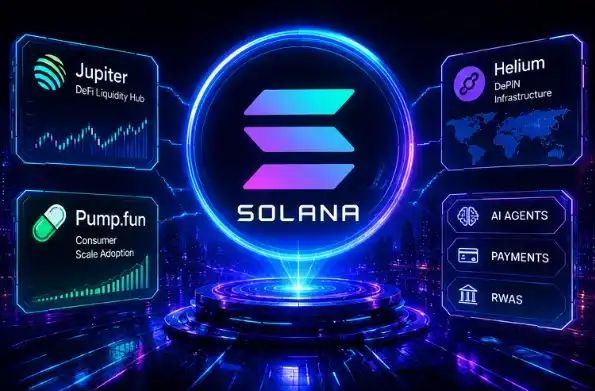
Grayscale's latest report, "Solana: Crypto's Financial Bazaar," signals a shift in how the market views Solana, moving beyond its high-performance and meme-centric reputation. The report frames Solana as an evolving application platform for large-scale economic activity, akin to a bustling digital marketplace. The analysis highlights that public chain competition has moved past raw throughput (TPS) to focus on genuine economic activity—daily users, transaction volume, and real revenue. Solana's metrics, such as over 1,000 dApps, 100M+ daily transactions, and ~4.3M daily active users, showcase this shift toward application-layer prosperity. The report identifies three key growth drivers: 1. **Jupiter**: Evolving from a DEX aggregator to a core liquidity hub and comprehensive financial platform for Solana's DeFi. 2. **Pump.fun**: Demonstrates Solana's capacity for consumer-scale applications, attracting millions of users and generating significant, sustainable revenue, validating network stability under high load. 3. **Helium & DePIN**: Represents expansion into real-world infrastructure, connecting blockchain to physical resources like wireless networks and positioning services, opening new long-term use cases. Solana Foundation's recent focus aligns with this broader vision, emphasizing AI Agents (for machine-to-machine transactions), payments, stablecoins, and Real-World Assets (RWA) to build a sustainable growth model beyond cyclical trends. While challenges remain—such as value capture for SOL and maintaining ecosystem sustainability beyond hot trends—institutional interest is growing due to Solana's maturing application business models, expanding payment/stablecoin ecosystem, and persistent developer activity. The competition is no longer about speed alone, but about which network can foster the most vibrant and valuable digital economy.

marsbit49m ago

Grayscale's Latest Research: What is Solana's Next Growth Engine?

marsbit49m ago

Trading

Spot

Hot Articles

How to Buy CKB

Welcome to HTX.com! We've made purchasing Nervos (CKB) simple and convenient. Follow our step-by-step guide to embark on your crypto journey.Step 1: Create Your HTX AccountUse your email or phone number to sign up for a free account on HTX. Experience a hassle-free registration journey and unlock all features.Get My AccountStep 2: Go to Buy Crypto and Choose Your Payment MethodCredit/Debit Card: Use your Visa or Mastercard to buy Nervos (CKB) instantly.Balance: Use funds from your HTX account balance to trade seamlessly.Third Parties: We've added popular payment methods such as Google Pay and Apple Pay to enhance convenience.P2P: Trade directly with other users on HTX.Over-the-Counter (OTC): We offer tailor-made services and competitive exchange rates for traders.Step 3: Store Your Nervos (CKB)After purchasing your Nervos (CKB), store it in your HTX account. Alternatively, you can send it elsewhere via blockchain transfer or use it to trade other cryptocurrencies.Step 4: Trade Nervos (CKB)Easily trade Nervos (CKB) on HTX's spot market. Simply access your account, select your trading pair, execute your trades, and monitor in real-time. We offer a user-friendly experience for both beginners and seasoned traders.

1.7k Total ViewsPublished 2024.03.29Updated 2026.06.02

How to Buy CKB

Discussions

Welcome to the HTX Community. Here, you can stay informed about the latest platform developments and gain access to professional market insights. Users' opinions on the price of CKB (CKB) are presented below.

活动图片