Капитализация SUNDOG взлетела на 9 000%

cryptonews.ruPublished on 2023-11-21Last updated on 2024-08-23

Abstract

Криптовалютный рынок неожиданно взорвал мемкоин Sundog (SUNDOG), запущенный на блокчейне TRON. За несколько дней его капитализация выросла с $2 млн до $200 млн


Благодаря поддержке со стороны основателя TRON Джастина Сана популярность Sundog затмевает аналогичные проекты на базе Solana.
Джастин Сан пампит мемкоины
Известность к SUNDOG пришла после того, как Джастин Сан объявил о запуске платформы SunPump для генерации мемкоинов на TRON. За несколько дней площадка отобрала заметную долю у аналогичного проекта на базе Solana — pump.fun.
Сначала многие сомневались в потенциале SunPump. Участники криптосообщества считали, что ажиотаж к платформе быстро угаснет. Однако этого не случилось. Площадка заручилась поддержкой Сана, который заявил, что SUNDOG может стать первым «миллиардным» мемкоином на TRON.
По данным CoinGecko, на момент написания материала актив торгуется по $0,2678. За последние сутки котировки актива выросли почти на 60%.
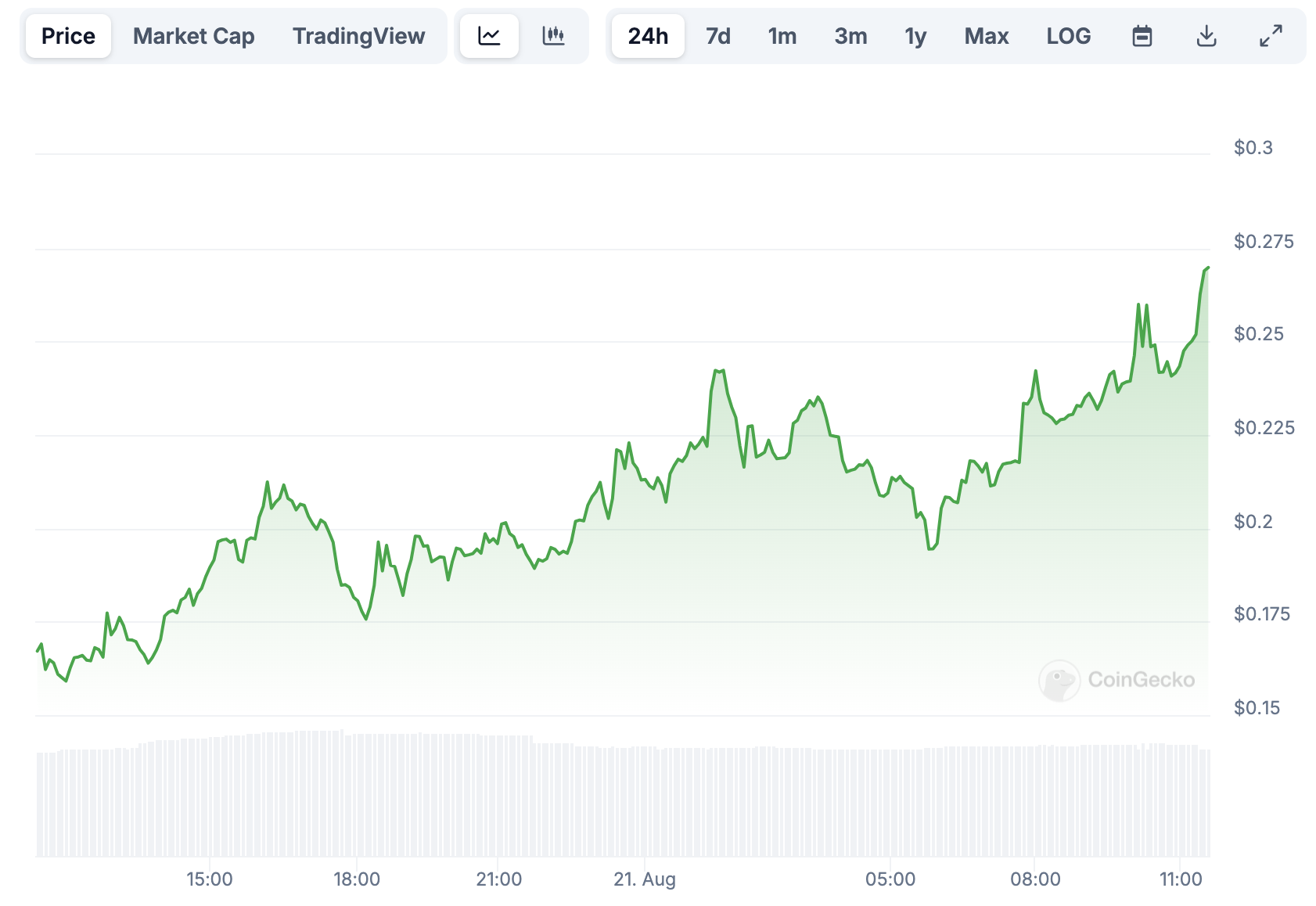
График стоимости Sundog. Источник: CoinGecko

Из-за стремительного роста новый мемкоин начали сравнивать с монетой dogwifhat (WIF). Многие пользователи X (бывш. «Твиттер») считают, что токен на базе TRON может повторить успех «собаки в шляпе».
Для того, чтобы рыночная стоимость Sundog пробила отметку в $1 млрд, необходимо перенести часть ликвидности WIF мемкоину на TRON. Некоторые держатели актива считают, что это вполне возможно.
«Спекуляции о том, что TRON справится с привлечением ликвидности лучше, чем Avax, оказались верными. TRX показал новый максимум, настроения в этом году не были лучше, чем сейчас», — написал в X (бывш. «Твиттер») трейдер под ником ANBESSA.
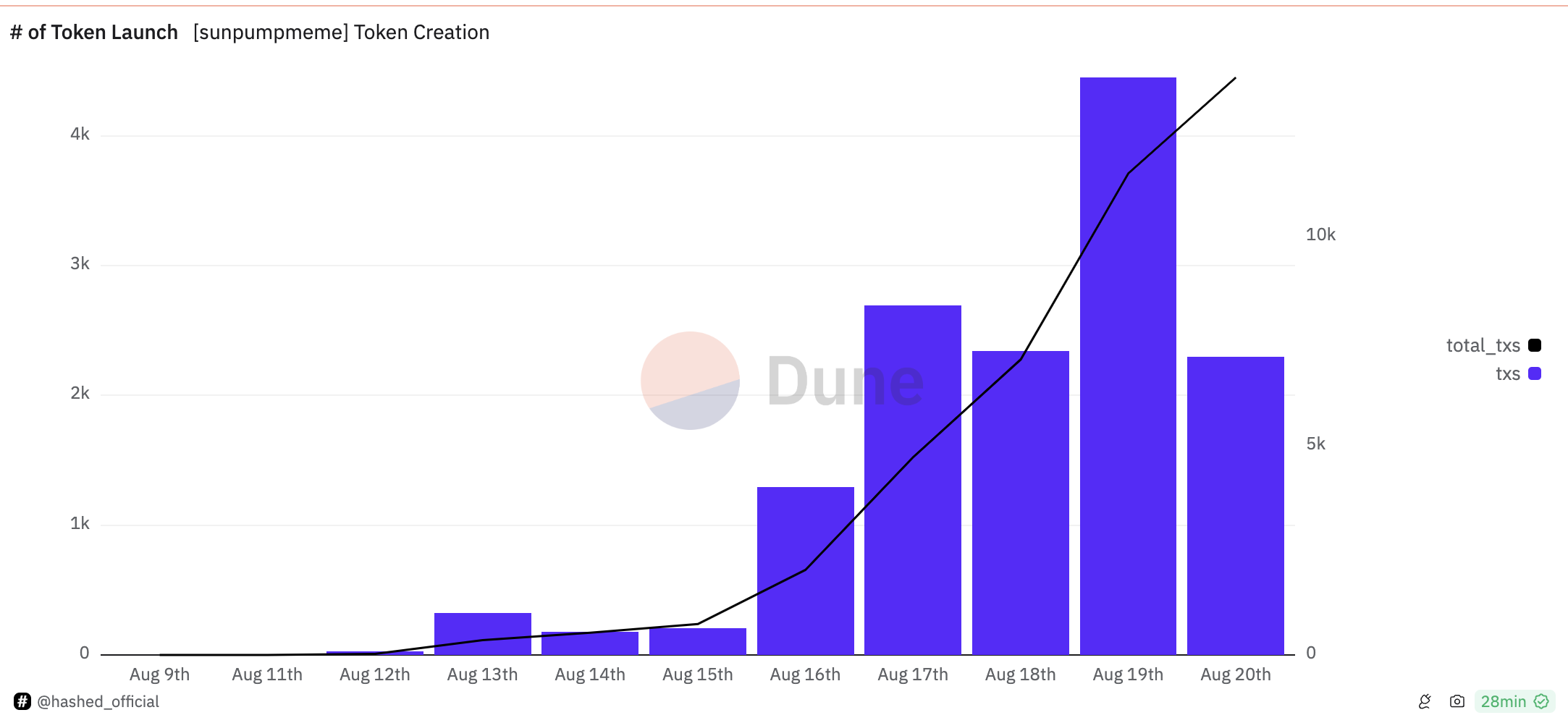
График запущенных мемкоинов на TRON. Источник: Dune

Впечатляющие результаты Sundog способствовали росту числа токенов, запущенных на SunPump. По данным Dune, 18 августа на TRON появилось не менее шести тысяч новых мемкоинов. К сегодняшнему дню этот показатель увеличился до 13 815.
Если такая динамика продолжится, к SunPump может перейти больше ликвидности от pump.fun. Это, в свою очередь, спровоцирует рост спроса на TRX и SUNDOG.
Ранее редакция BeInCrypto рассказала о том, как трейдеру удалось превратить токены SUNDOG на $1 690 в $20 млн.


Trending Cryptos

Related Reads

Why Do We Need an AI Content Perspective Today?

The article "Why Do We Need an AI Content Perspective Today?" explores the complex and often contentious integration of AI into the cultural and creative industries, particularly film and television. It begins with the cancellation of Amazon's AI-generated animation "Punky Duck," highlighting the ethical debates surrounding AI content. AI's rapid advancement is transforming video production, enabling cost-effective, full-length AI films (e.g., "RAPHAEL," "Dreams of Violets") while sparking industry resistance over issues like "synthetic actors." The core debate has shifted from whether to use AI to how to use it responsibly. The article analyzes why AI's entry into film is uniquely unsettling. It distinguishes between "cultural fast food" (short-form, fast-paced content like micro-dramas) and "cultural main courses" (traditional, long-form film/TV). AI currently excels at the former, matching its fragmented narratives, shallow emotional needs, and free-to-consumer models. However, venturing into the latter challenges the human-centric essence of storytelling—creativity, emotional depth, and the unique value of human labor and experience. While AI can generate massive volumes of content and lower costs, it risks devaluing human creativity, leading to homogenized output, and creating unfair competition through potential intellectual property infringement. Its efficiency also amplifies content safety risks, making preemptive governance crucial. To counter these risks, the article proposes establishing clear boundaries guided by a human-centered AI content perspective. It outlines four principles: 1) Amplify, rather than displace, human creative space; 2) Respect and protect human creative output; 3) Ensure human creative control and responsibility remain paramount; and 4) Guarantee transparency and traceability in AI creation. The conclusion emphasizes that humans must act as the "helmsmen" of technology, steering AI development to enhance, not replace, the core human values at the heart of cultural expression.

marsbit23m ago

Why Do We Need an AI Content Perspective Today?

marsbit23m ago

Planck Retracted? The Father of Quantum Tripped by an Algorithm

The recent discovery that two articles (published in 1940 and 1942) by Max Planck, the Nobel laureate and founder of quantum theory, are marked as "retracted" on Springer's digital platform highlights a curious clash between historical publishing practices and modern automated systems. An investigation suggests these retractions are algorithmic errors, not due to fraud or misconduct. The papers, philosophical reflections on science published in *Die Naturwissenschaften*, were likely flagged by the platform's systems. One article, a republished lecture, may have been mistaken for duplicate publication. Another, sharing a title with a prior article by a different author (a common practice for continuing debates at the time), may have triggered a similar automated check. The digital versions have even been replaced with blank pages, contrary to normal practice of preserving retracted texts. This incident underscores how contemporary digital infrastructure, built around concepts like "self-plagiarism" and strict copyright, can misclassify and obscure legitimate historical scholarly communication. It serves as a warning that digital archives are not neutral mirrors of the past but are filtered by platform rules, potentially distorting the scientific record. As AI systems increasingly rely on such databases, such erroneous metadata could propagate, affecting how future tools interpret and access historical knowledge.

marsbit27m ago

Planck Retracted? The Father of Quantum Tripped by an Algorithm

marsbit27m ago

Refunds! Claude 4.8 Sees Overnight Major 'Dumb-Down', GPT-5.6's Computational Power Reportedly 'Halved'

The AI community is currently alarmed by widespread reports of significant performance degradation in two leading models. This article details a "mass self-testing frenzy" triggered by a mysterious prompt designed to detect a hidden "Juice" value, representing a model's reasoning compute budget. On OpenAI's side, users suspect a covert, limited test of a "GPT-5.6-sol" model is underway. When using a specific XML prompt on the Codex platform, a normal "gpt-5.5 xhigh" model reportedly returns a Juice value of 768. However, some users routed to the suspected GPT-5.6 test receive a drastically reduced value of 128—a six-fold decrease. This has sparked debate on whether it signifies a major efficiency leap or a "watered-down, low-cost version" achieved by slashing reasoning depth to save computational expenses. Simultaneously, Anthropic's Claude models, particularly the flagship Opus 4.8 Max, are facing intense user backlash for a perceived "physical brain cut." Users on platforms like Reddit report a dramatic decline in the model's once-impressive reasoning, with complaints of it becoming "absurdly" weakened, performing worse than older, lighter models like Haiku. Specific criticisms include: losing long-context memory, refusing to think deeply even in high-reasoning modes, providing instant incorrect answers, and engaging in unhelpful, argumentative, or "gaslighting" behavior where it contradicts users unnecessarily. The article speculates these "stealth downgrades" might be a calculated corporate strategy. Companies could initially release models with temporarily boosted compute to create an illusion of a major breakthrough, then silently scale back parameters later to manage unsustainable inference costs. A proposed underlying cause is a tightened funding environment, potentially exacerbated by SpaceX's massive IPO soaking up market liquidity, which could delay AI company IPOs and force cost-cutting measures like model "nerfing." The core issue highlighted is the asymmetry of information: subscribers pay for a service that can be silently and fundamentally altered without notification or explanation. The viral "Juice test" resonates because it represents users' desire for transparency about what they are actually paying for.

marsbit1h ago

Refunds! Claude 4.8 Sees Overnight Major 'Dumb-Down', GPT-5.6's Computational Power Reportedly 'Halved'

marsbit1h ago

Trading

Spot

Hot Articles

How to Buy SUNDOG

Welcome to HTX.com! We've made purchasing Sundog (SUNDOG) simple and convenient. Follow our step-by-step guide to embark on your crypto journey.Step 1: Create Your HTX AccountUse your email or phone number to sign up for a free account on HTX. Experience a hassle-free registration journey and unlock all features.Get My AccountStep 2: Go to Buy Crypto and Choose Your Payment MethodCredit/Debit Card: Use your Visa or Mastercard to buy Sundog (SUNDOG) instantly.Balance: Use funds from your HTX account balance to trade seamlessly.Third Parties: We've added popular payment methods such as Google Pay and Apple Pay to enhance convenience.P2P: Trade directly with other users on HTX.Over-the-Counter (OTC): We offer tailor-made services and competitive exchange rates for traders.Step 3: Store Your Sundog (SUNDOG)After purchasing your Sundog (SUNDOG), store it in your HTX account. Alternatively, you can send it elsewhere via blockchain transfer or use it to trade other cryptocurrencies.Step 4: Trade Sundog (SUNDOG)Easily trade Sundog (SUNDOG) on HTX's spot market. Simply access your account, select your trading pair, execute your trades, and monitor in real-time. We offer a user-friendly experience for both beginners and seasoned traders.

4.9k Total ViewsPublished 2024.08.20Updated 2026.06.02

How to Buy SUNDOG

Discussions

Welcome to the HTX Community. Here, you can stay informed about the latest platform developments and gain access to professional market insights. Users' opinions on the price of SUNDOG (SUNDOG) are presented below.

活动图片