Tron稳定币供应与转账量激增

marsbitPublished on 2024-08-16Last updated on 2024-08-17

Tron在稳定币市场的份额持续增长,截至7月份,网络上USDT的调整后转账量达到了3840亿美元。

Tron

Tron已经成长为稳定币市场份额中仅次于以太坊的第二大区块链。

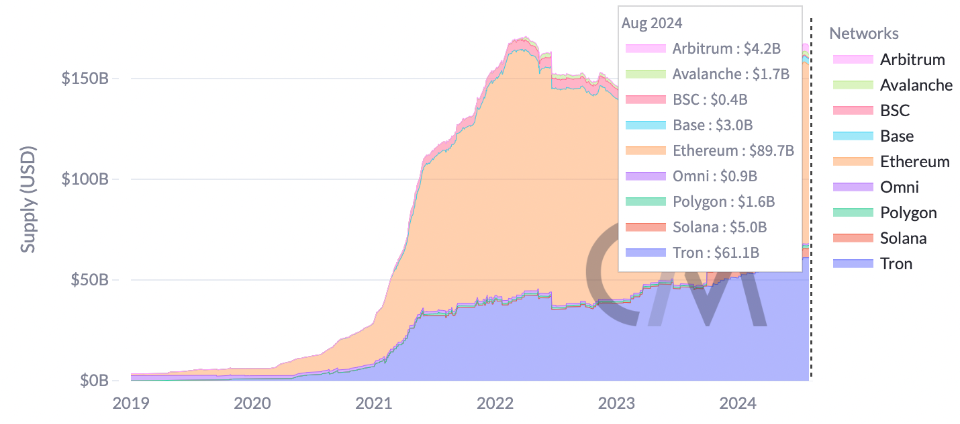
根据Coin Metrics Network的数据,Tron上的稳定币供应量达到了611亿美元,占总稳定币市场份额的37.9%,而目前总市场规模为1611亿美元。相比一年前的466亿美元供应量,这是一个显著的增长。

Tron紧随以太坊网络,后者在稳定币市场供应量上占据主导地位,达到了897亿美元,占总供应量的55.7%。
Tron

Stablecoin supply by network. Source: Coin Metrics Network

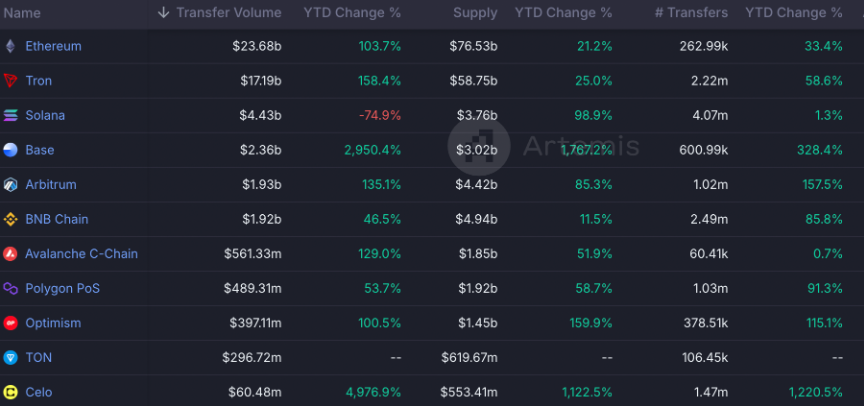
Tron上稳定币供应量的增长与转账量的增加同步,过去30天内增长了5.1%,年初至今增长了158%,达到了587.5亿美元。其他区块链如以太坊和BNB Chain的年初至今交易量分别增长了103%和46.5%。相比之下,Solana上的稳定币转账量在同期下降了75%。
Tron

Stablecoin year-to-date transfer volumes. Source: Artemis

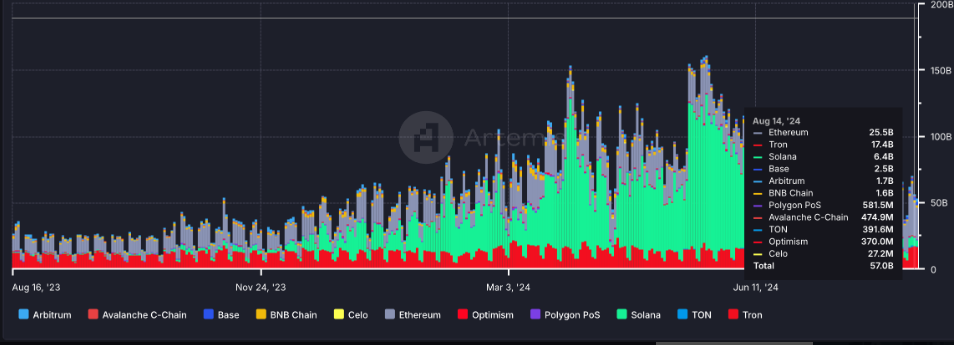
Tron的主导地位还体现在日均稳定币转账量上,8月15日的日均转账量为174亿美元,远远超过了Solana的64亿美元和BNB Chain的16亿美元。

此外,8月15日Tron上转移的稳定币达到了174亿美元,比2023年8月15日的54亿美元增长了222%。
Tron

Stablecoin transfer volumes one year. Source: Artemis

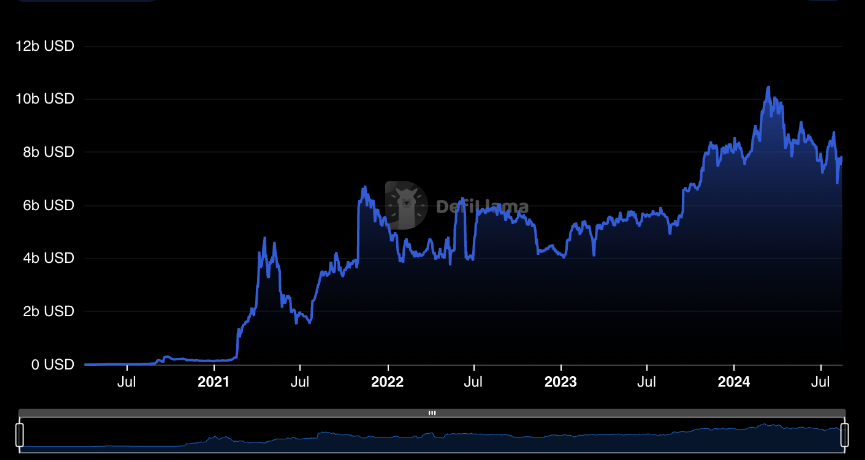
除了稳定币交易量的增加,Tron上的去中心化金融(DeFi)活动也有所上升,使其锁定的总价值(TVL)在2024年3月14日达到了105.5亿美元的历史最高水平。根据DefiLlama的数据,自8月5日以来,TVL增加了12%,达到了当前的76.17亿美元。
Tron

Total value locked on Tron. Source: DefiLlama

这也体现在链上收入的增加上,Tron在过去一年中收入显著增长。

截至8月16日,Tron网络上的日收入增长了27%,达到了150万美元。

同期,基于Tron的去中心化应用的日交易量增长了超过672%,从461万美元增至3557万美元。

Tron原生代币的价格在过去12个月内也上涨了超过80%,在撰写本文时交易价格为0.133美元。目前,该一层代币的价格距离2018年1月创下的0.30美元历史最高点下跌了55%。

Trending Cryptos

Related Reads

Google's 'Reasoning King' Also Departs for Meta, Originally Recruited by Fei-Fei Li

"Google's 'King of Reasoning' Leaves for Meta, Quietly Departing After Over Eight Years. Denny Zhou, a key figure behind Google's AI reasoning advancements including work showcased by CEO Sundar Pichai, has joined Meta's MSL as a research scientist. His low-profile move, discovered via a LinkedIn update, occurred months before the high-profile departures of Noam Shazeer to OpenAI and Nobel laureate John Jumper to Anthropic. Zhou was originally recruited to Google by Fei-Fei Li's China center initiative after nearly 11 years at Microsoft. This is part of a significant talent drain at Google, with top researchers like Shazeer (co-author of the Transformer paper) and Jumper (AlphaFold lead) recently leaving for rivals. Reports suggest internal friction is a contributing factor, particularly around Google's strategic shift. The company has reportedly formed a high-priority 'AI Coding Strike Team,' involving co-founder Sergey Brin, to urgently bridge the gap in AI coding agents, potentially reallocating resources and focus away from other research directions like DeepMind's 'world model' AGI approach. This pivot towards commercially-proven coding applications may have influenced departures, as hinted by Shazeer's comment about his compute allocation being given to another team. Meanwhile, Meta continues to bolster its team, also recently hiring UC Berkeley professor and 'security godmother' Dawn Song, along with her startup Virtue AI team, as a VP of AI research."

marsbit49m ago

Google's 'Reasoning King' Also Departs for Meta, Originally Recruited by Fei-Fei Li

marsbit49m ago

How Did Hundreds of Billions of Dollars Flow into SpaceX After Its Index Inclusion on June 26th? Will SpaceX Experience a Massive Price Surge?

Will SpaceX ($SPCX) stock surge when billions in passive index fund money flows in on the effective date? A common retail investor belief is that a massive wave of buying will hit on July 6th, when SpaceX joins the Nasdaq-100, potentially causing a huge price spike. However, the reality is far more complex and less dramatic. The anticipated billions are not controlled by a single entity but are spread across hundreds of passive fund managers (e.g., BlackRock, Vanguard) whose sole mandate is to minimize "tracking error." They aim to buy shares at prices as close as possible to the index's closing price on the effective date, not to aggressively drive the price up. There are two key index inclusion scripts: 1) For the Russell US Index (effective June 26th at close), buying is compressed into the final minutes via Market-On-Close (MOC) orders. 2) For the Nasdaq-100 (announced June 26th, effective July 6th), a 10-day window creates a layered game. Arbitrage funds buy early, betting on selling to passive funds later. Some index funds "front-run" by accumulating shares gradually before the deadline. The bulk of passive funds execute large MOC orders at the July 6th close, often trading directly with arbitrageurs. A critical wildcard is SpaceX's limited free float due to a standard 180-day post-IPO lockup. To avoid causing a massive price spike by competing for scarce shares on the open market, large funds will likely use off-exchange methods: 1) Negotiating large block trades (over-the-counter) with major holders. 2) Using derivatives like total return swaps with locked-up shareholders to gain economic exposure without physically buying the stock. Most of the index-driven buying will thus happen invisibly, not on public exchanges. For retail investors, trying to front-run these sophisticated flows is risky. More viable strategies include: waiting for post-inclusion volatility to subside before establishing a long-term position, or employing options strategies like selling strangles to profit from elevated, but potentially overstated, implied volatility around the event. In conclusion, while price appreciation may occur in the days following the announcement due to arbitrage and front-running activity, a single-day "explosive pump" on July 6th is highly unlikely. The major index fund buying will be executed efficiently and discreetly, often away from public markets, turning the anticipated climax into a well-orchestrated, anti-climactic settlement.

marsbit1h ago

How Did Hundreds of Billions of Dollars Flow into SpaceX After Its Index Inclusion on June 26th? Will SpaceX Experience a Massive Price Surge?

marsbit1h ago

Trading

Spot

Hot Articles

Discussions

Welcome to the HTX Community. Here, you can stay informed about the latest platform developments and gain access to professional market insights. Users' opinions on the price of ETH (ETH) are presented below.

活动图片