ApeCoin多头能否在APE历史低点后卷土重来?

币界网Published on 2024-08-14Last updated on 2024-08-14

币界网报道:
    ApeCoin最近的价格走势在其日线图上显示出下降的通道模式。山寨币的衍生品数据显示出明显的看跌趋势,币安的多头/空头比率重新点燃了买家的一些复苏希望。

ApeCoin(APE)一直处于持续的抛售压力之下,随着空头继续控制市场,其下跌轨迹仍在继续。

加密货币最近的价格走势表明,卖家已经控制住了局面,APE在关键水平上难以找到支撑。

在经历了今年3月的上升趋势后,APE在其图表上持续下跌,并在8月5日达到0.473美元的历史最低点。

价格最近形成了一个下降通道,表明趋势逆转的可能性。截至发稿时,APE交易价格为0.602美元,在过去24小时内下跌了约2.5%。

ApeCoin空头继续施加压力

20日均线(指数移动平均线)和50日均线分别为0.656美元和0.771美元。两者均呈下跌趋势,证实了强劲的看跌势头。

200天均线报1.197美元,远高于当前价格,进一步重申了看跌情绪。

值得注意的是,MACD(移动平均线收敛发散)指标也处于看跌区间,MACD线和信号线均低于零。

直方图显示看跌势头略有下降,表明抛售压力可能会缓解。

为了实现看涨逆转,APE需要回升并维持在20天均线之上。高于这一水平可能会鼓励更多的购买,并可能导致对0.87美元阻力位的测试。

然而,鉴于当前的市场状况和下行势头,这种情况在短期内似乎不太可能发生。

相对强弱指数(RSI)徘徊在超卖区附近,这可能表明有反弹的潜力。

需要关注的关键级别

当前支撑位在0.541美元,价格可能会出现一些买入兴趣。

然而,如果空头继续占据主导地位,跌破这一水平可能会导致APE进入未知领域,第一个主要支撑位为0.35美元。

从好的方面来看,如果多头设法将价格推高到20均线以上,我们可能会看到短期反弹到0.771美元和0.87美元的阻力位。

公牛队能卷土重来吗?

PER AMBCrypto查看衍生品数据后发现,总体交易量下降了23.36%,未平仓合约下降了3.11%,表明交易员正在减少其在APE中的头寸。

过去24小时的多头/空头比率为0.9205,表明交易员有轻微的看跌倾向。


你的投资组合是绿色的吗?查看APE利润计算器


然而,币安的APE/USDT多头/空头比率为2.427,表明币安上有大量交易者押注于潜在的逆转。

买家在做出任何交易决定之前,还应该考虑比特币的走势和整体市场情绪。

免责声明:所提供的信息不构成财务、投资、交易或其他类型的建议,仅代表作者的意见。

Trending Cryptos

Related Reads

DRAM ETF Issuer: Samsung, SK Hynix, Micron All Surpass $1 Trillion, the AI Era of Memory Chips Has Only Just Begun

Authors: Dave Mazza, Thomas DiFazio | Source: Deep Tide TechFlow The article, written by Roundhill Investments (issuer of the DRAM ETF), responds to Morningstar's caution about investing in memory chip stocks. Morningstar warns of the sector's history of boom-bust cycles, a lack of economic moats, and potential momentum-driven overvaluation. Roundhill argues the current situation is structurally different due to AI. Key points in Roundhill's rebuttal include: * **Changed Demand & Supply Dynamics:** AI infrastructure, not consumer electronics, is now the primary growth driver for memory demand. New, strict long-term supply agreements with hyperscalers reflect the high capital intensity of advanced manufacturing. * **Existence of a Moat:** High-Bandwidth Memory (HBM), essential for AI, has extremely high manufacturing barriers. The market is dominated by Samsung, SK Hynix, and Micron, with new entrants blocked by technological complexity and long lead times for equipment like ASML's EUV machines. * **Strong Fundamental Outlook:** Analyst consensus projects the three companies will rank among the world's most profitable by 2027, with combined profits of $704 billion on over $1 trillion in revenue. Their operating margins have already reached record highs. * **Valuation Re-rating:** Despite significant stock price gains, memory stocks trade at attractive valuations (e.g., a median NTM P/E of 8.37x for the DRAM ETF) relative to projected explosive EPS growth. Roundhill suggests historical valuation frameworks may no longer apply given the new profitability paradigm. Conclusion: Roundhill contends the rally is justified by fundamentals, marking a structural shift for the memory industry into a new era of sustained, AI-driven demand against constrained supply, rather than a repeat of past cycles.

marsbit10m ago

DRAM ETF Issuer: Samsung, SK Hynix, Micron All Surpass $1 Trillion, the AI Era of Memory Chips Has Only Just Begun

marsbit10m ago

EF's Epic Reorganization: 20% Layoffs, Budget Halved, Is Ethereum Gearing Up for a Leaner Future?

The Ethereum Foundation (EF) has announced a major organizational restructuring, involving a 20% staff reduction (approx. 54 employees) and a division into functional clusters like Protocol, Access, User, Community, and Institutional layers. Co-founder Vitalik Buterin further revealed plans to cut the EF's budget by around 40% over the coming years, aiming to reduce its annual spending rate from about 15% to roughly 5% by 2030, transitioning to an endowment-driven model. This overhaul is seen as a long-overdue correction to the EF's ambiguous role. As Ethereum grew, the foundation faced persistent criticism over ETH sales, perceived lack of execution, and unclear strategy, often becoming a focal point for community frustration amid ETH's price stagnation. The reform aims to redefine the EF's boundaries, narrowing its focus to core protocol research, public goods funding, and ecosystem coordination, while offloading more applied development work to the broader market. Concurrently, ecosystem forces like the newly formed Ethlabs (founded by ex-EF researchers) and other independent groups are stepping in to fill the space, signaling a shift from a centralized model to a more distributed, collaborative ecosystem structure. The move was notably praised by Solana co-founder toly, who viewed a "leaner" EF as potentially more decisive and agile.

Odaily星球日报51m ago

EF's Epic Reorganization: 20% Layoffs, Budget Halved, Is Ethereum Gearing Up for a Leaner Future?

Odaily星球日报51m ago

Dragonfly Partner Haseeb: The Fastest-Growing Companies of the Future May All Get Stuck at 149 Employees

Dragonfly partner Haseeb explores the distorted economics of AI model pricing, drawing parallels to tax policy. He notes that startups and small teams (under 150 users) enjoy heavily subsidized, fixed-price AI subscriptions (like Claude Code), where the marginal cost of an additional token is effectively zero. This creates a powerful incentive for them to maximize token usage ("token-maxxing") and innovate aggressively with AI automation. In contrast, large enterprises (over 150 users) are forced onto "Enterprise" plans, paying per-token API fees with high (~75%) markups. This acts like a steep "tax" on AI-powered labor, disincentivizing marginal automation and experimental use, and encouraging them to retain more human workers. Haseeb argues this pricing creates a "150-person cliff," a regulatory notch similar to labor laws in France that discourage firms from growing past 50 employees. He predicts the fastest-growing future companies may deliberately cap their headcount at 149 to avoid the punitive enterprise pricing. This would foster an "AI-first" management philosophy obsessed with automation and outsourcing to stay lean. While not intentionally designed, this bifurcated pricing could become one of the most influential de facto tax policies, shaping how AI replaces labor—not through mass layoffs at big firms, but through agile, AI-native startups outcompeting them.

marsbit1h ago

Dragonfly Partner Haseeb: The Fastest-Growing Companies of the Future May All Get Stuck at 149 Employees

marsbit1h ago

How xBubble Breaks Through in the VC-Heavily-Backed OPC Economy

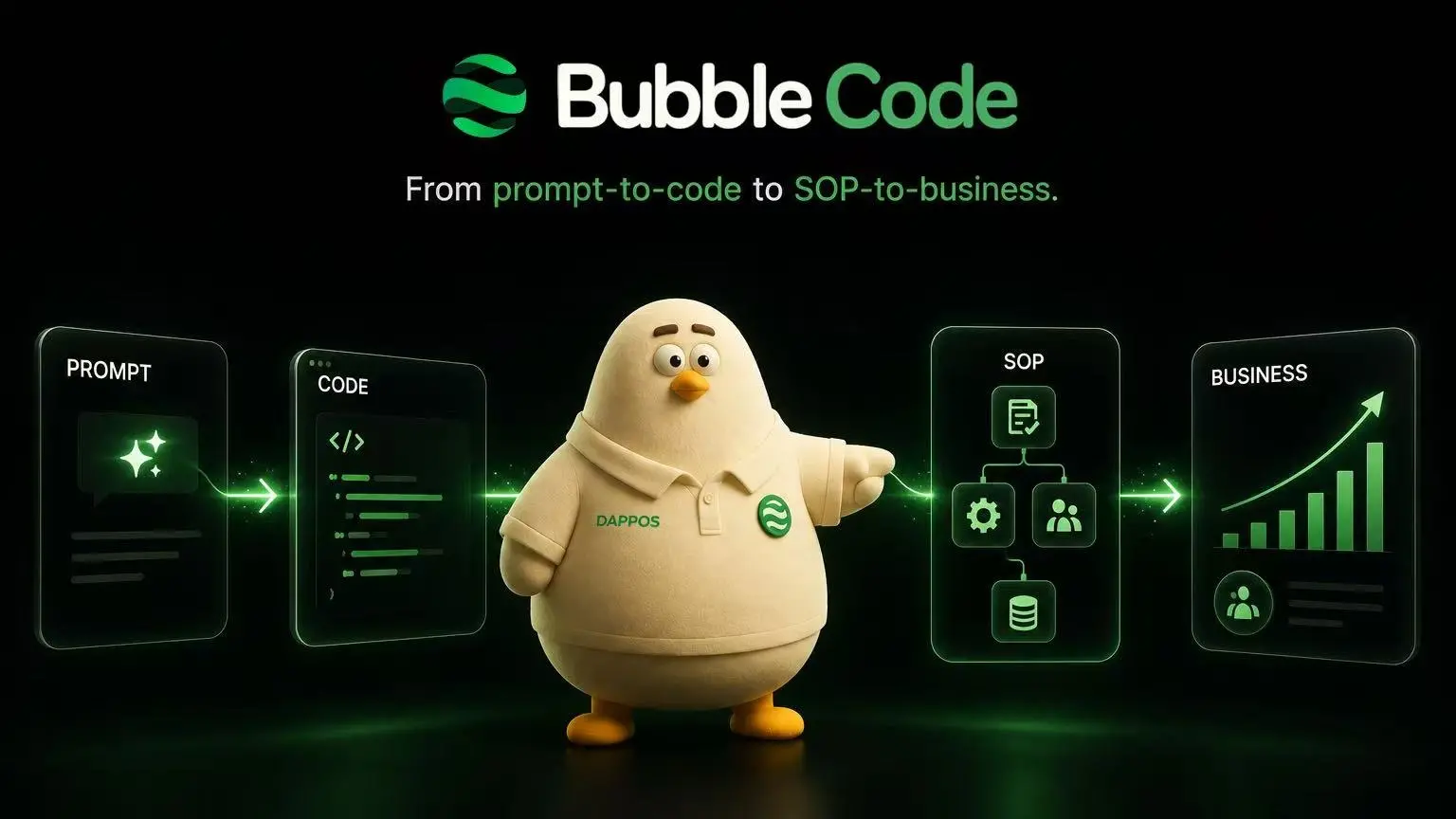
xBubble: Addressing the Structural Gap in the VC-Backed OPC Economy The concept of OPC (One Person Company) is evolving from a buzzword to a significant AI-driven market. While AI coding tools like Replit and Lovable have validated demand from non-technical users wanting to build applications, a key gap remains: the leap from creating a demo to running a stable, evolving business. These tools still require users to manage the development process, including technical judgments for integrations, modifications, and deployments—a major hurdle for OPCs. xBubble, by DAPPOS, tackles this by shifting from "Prompt-to-Code" to "SOP-to-Business." Instead of generating code from instructions, its core is a system of pre-organized SOPs (Standard Operating Procedures) that translate business goals—like "sell World Cup merchandise"—into complete, executable workflows. This includes generating cohesive assets, pages, payment systems, and backend logic. The platform is augmented by a network of third-party service providers who handle infrastructure (hosting, domains, payment setup), acting like "on-site service engineers." Users can pay for these services directly with xBubble credits, simplifying onboarding. This ecosystem aims to deliver not just an app, but a complete, modifiable business launch path. xBubble targets a clear OPC segment: small commercial nodes (e.g., creators, merchants) with existing products, customers, or channels, but for whom a full tech team is unjustifiable. Its potential lies in SOPs accumulating expertise from real cases, improving reliability and reducing delivery costs over time. Additionally, its native support for crypto payments caters to global or digital-native OPCs. In summary, as AI democratizes software creation, xBubble's opportunity is to prove that "SOP-to-Business" provides more immediate value for launching a real, operational business than a powerful but unstructured AI coding tool.

链捕手1h ago

How xBubble Breaks Through in the VC-Heavily-Backed OPC Economy

链捕手1h ago

Trading

Spot
Futures

Hot Articles

How to Buy APE

Welcome to HTX.com! We've made purchasing ApeCoin (APE) simple and convenient. Follow our step-by-step guide to embark on your crypto journey.Step 1: Create Your HTX AccountUse your email or phone number to sign up for a free account on HTX. Experience a hassle-free registration journey and unlock all features.Get My AccountStep 2: Go to Buy Crypto and Choose Your Payment MethodCredit/Debit Card: Use your Visa or Mastercard to buy ApeCoin (APE) instantly.Balance: Use funds from your HTX account balance to trade seamlessly.Third Parties: We've added popular payment methods such as Google Pay and Apple Pay to enhance convenience.P2P: Trade directly with other users on HTX.Over-the-Counter (OTC): We offer tailor-made services and competitive exchange rates for traders.Step 3: Store Your ApeCoin (APE)After purchasing your ApeCoin (APE), store it in your HTX account. Alternatively, you can send it elsewhere via blockchain transfer or use it to trade other cryptocurrencies.Step 4: Trade ApeCoin (APE)Easily trade ApeCoin (APE) on HTX's spot market. Simply access your account, select your trading pair, execute your trades, and monitor in real-time. We offer a user-friendly experience for both beginners and seasoned traders.

3.9k Total ViewsPublished 2024.03.29Updated 2026.06.02

How to Buy APE

What is APECOIN

Understanding Asia Pacific Electronic Coin ($APECoin) In an era where the intersection of technology and environmentalism is becoming increasingly critical, cryptocurrencies are making their mark as potential catalysts for change. Among these innovations, Asia Pacific Electronic Coin ($APECoin) stands out as a distinct project designed to support environmental initiatives across the Asia Pacific region. This article delves into the foundation, unique features, and impact of $APECoin within the broader blockchain landscape. What is Asia Pacific Electronic Coin ($APECoin)? Asia Pacific Electronic Coin ($APECoin) is an ERC20 and TRC20 token, brought to fruition in April 2020 after its conceptualization in December 2019. This innovation was born out of a desire to foster eco-friendly practices and support a suite of environmental projects aimed at sustainability and green initiatives. Aims and Objectives $APECoin is not merely a digital currency; it is envisioned as a medium of exchange that enables users to engage in transactions that directly benefit environmental causes. Its ecosystem is designed to facilitate various financial activities while promoting the adoption of eco-friendly practices. The currency aims primarily to: Support Environmental Initiatives: Through every transaction, a portion is allocated to funding sustainable projects aimed at conservation and renewable energy. Promote Eco-Friendly Innovations: Encouraging startups and projects that align with environmental sustainability through the use of its token as a means of value. Create a Sustainable Marketplace: The platform includes an e-marketplace where financial transactions can occur within a framework dedicated to promoting green practices. Creator of Asia Pacific Electronic Coin ($APECoin) While the details regarding the individual creator of $APECoin are not publicly disclosed, the project is significantly backed by the APEC Group, a consortium focused on advocating for environmental initiatives. This backing adds credibility and significance to the project, connecting it to a broader network committed to sustainability and eco-friendly practices. Investors of Asia Pacific Electronic Coin ($APECoin) The investment landscape surrounding $APECoin remains largely undisclosed. Specific names of investment foundations or organizations supporting this cryptocurrency have yet to be revealed. However, what is evident is a growing interest among investors keen on supporting sustainable projects that demonstrate potential for impact in the crypto space. How does Asia Pacific Electronic Coin ($APECoin) work? $APECoin stands out due to its innovative operational model, which leverages blockchain technology and smart contracts. This combination not only ensures transactional efficiency but also enforces adherence to regulatory frameworks, enhancing the security and transparency of transactions. Unique Features of $APECoin Blockchain-Based Operations: By establishing its operations on a blockchain platform, $APECoin ensures that all transactions are immutable and secured through advanced cryptographic techniques. This decentralization underscores the integrity of the token within its ecosystem. Smart Contracts: $APECoin employs smart contracts that facilitate seamless transactions while ensuring compliance with applicable regulations. These automated agreements minimize the possibility of disputes, streamline processes, and contribute to a reliable transaction framework. E-Marketplace: One of the hallmark features of $APECoin is its dedicated e-marketplace. This digital environment serves as a hub for services that endorse eco-friendly practices, providing a platform for exchanges that further the project's green vision. Through these attributes, $APECoin carves a niche for itself within the vast expanse of the cryptocurrency market, effectively marrying the principles of blockchain with environmental stewardship. Timeline of Asia Pacific Electronic Coin ($APECoin) Understanding the trajectory of $APECoin provides insight into its developmental milestones and future aspirations. Here’s a timeline highlighting significant events in the project’s history: December 2019: Conceptualization of Asia Pacific Electronic Coin, initiated with an ambition to drive sustainability through cryptocurrency. April 2020: Official launch of $APECoin, marking its entry into the marketplace as a dedicated token for environmental projects. 2020-2021: Conducting of the Initial Exchange Offering (IEO), enabling users to purchase $APECoin, alongside the registration with various electronic exchange platforms to enhance accessibility. In its relatively short journey, $APECoin has made significant strides in laying the groundwork for a secure and impactful cryptocurrency driven by environmental goals. Conclusion Asia Pacific Electronic Coin ($APECoin) embodies the marriage of technology and environmental responsibility, fostering growth in the crypto ecosystem while championing sustainability. With its unique structure, backing by reputable entities, and vision for a greener future, $APECoin is more than just a cryptocurrency; it is a pioneering project aimed at nurturing responsible innovation in the Asia Pacific region. Through its commitment to financial inclusion and its support of environmental initiatives, it stands as a formidable example of how digital currencies can be leveraged for positive societal impact. As the project continues to evolve, stakeholders within the crypto community and beyond will be eagerly watching how $APECoin shapes the conversation around sustainable practices in the burgeoning world of cryptocurrency.

918 Total ViewsPublished 2024.12.03Updated 2024.12.03

What is APECOIN

Discussions

Welcome to the HTX Community. Here, you can stay informed about the latest platform developments and gain access to professional market insights. Users' opinions on the price of APE (APE) are presented below.

活动图片