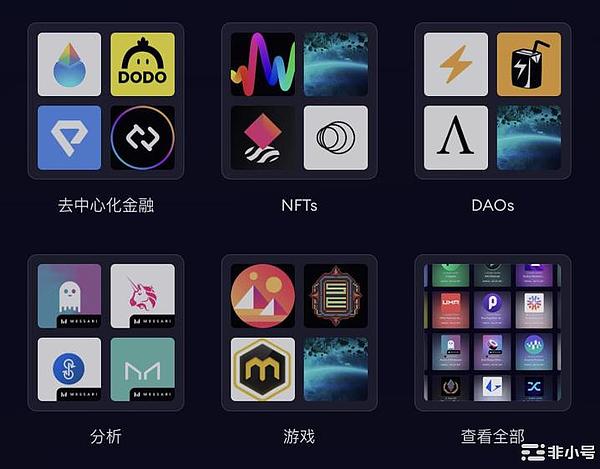
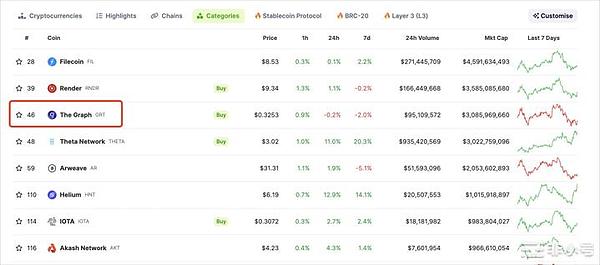
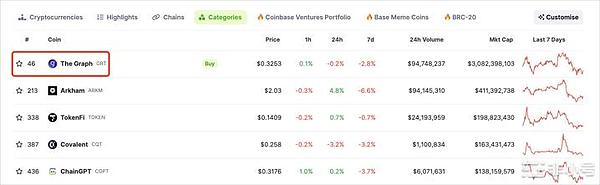
GRT: Web3谷歌

金色财经Published on 2024-08-12Last updated on 2024-08-12

一、The Graph项目是做啥的&特别之处?

定位:Graph 是一种用于索引和查询区块链数据的去中心化协议。

需求:区块链无时无刻在各个链的各个合约中产生数据,对于区块链中数据获取以及数据加工整理等非常困难,需求巨大的基建。

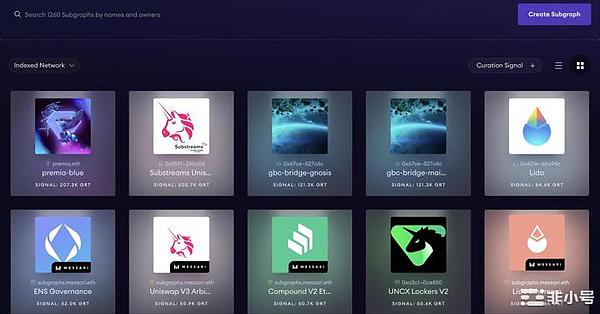
运作原理:The Graph 就是web3 的索引和查询层,子图是 The Graph 上的开放 API,用于组织区块链数据并将其提供给应用程序。使用子图,开发人员和数据消费者都可以从快速访问索引数据中受益。

1、dapp 通过智能合约上的交易将数据添加到以太坊。

2、智能合约在处理交易时发出一个或多个事件。

3、Graph Node不断扫描以太坊以查找新块以及它们可能包含的子图的数据。

4、Graph Node在这些块中查找子图的以太坊事件并运行提供的映射处理程序。映射是一个 WASM 模块,用于创建或更新 Graph Node 存储的数据实体以响应以太坊事件。

5、dapp 使用Graph Node的GraphQL 端点向Graph Node查询从区块链索引的数据,Graph Node反过来将 GraphQL 查询转换为其底层数据存储的查询,以便利用存储的索引功能来获取此数据,该 dapp 在丰富的 UI 中为最终用户显示这些数据,他们用这些数据在以太坊上发出新交易,循环重复。f3be1a51a2764cc1a66e63a9bba4e503.jpg?638484507222
角色构成:

1、索引器:索引器是图网络中的节点运营商,它们抵押代币GRT以提供索引和查询处理服务,通过其服务赚取查询费用和索引奖励。消费者(例如应用程序)可以设置索引器处理其子图查询的参数,并设置查询费用定价的偏好。

2、策展者:利用 web3 生态系统的知识来评估高质量子图,通过抵押 GRT 来指示索引器应该优先考虑的子图并发出信号,Graph网络奖励那些发出高质量子图信号的策展人,并分享子图产生的查询费用。

3、委托人:委托人是指将 GRT 委托(即“质押”)给一个或多个索引器的网络参与者,委托人无需自己运行图节点即可保护网络安全。通过委托给索引器,委托者可以获得索引器的部分查询费用和奖励。索引器可以处理的查询量取决于索引器自己的(和委托的)权益以及索引器对每个查询收取的价格,因此分配给索引器的权益越多,它们可以处理的潜在查询就越多。

4、开发者:创建子图并在你的dapp中使用。

5、数据消费者:在你的项目中查询现存的子图。

生态数据:8fab91bb741144e78425a2fc9ed424b8.jpg?63848450722321bd4113d60f44d08b7e05b793cca564.jpg?638484507225

5fc13f7815234220b9591816d392973c.jpg?638484507227

商业模式:

无合同,无月费,只需为使用的查询付费,每个查询的平均成本为每百万次查询 40 美元(每个查询约 0.00004 美元),以美元定价并以 GRT 或信用卡支付。

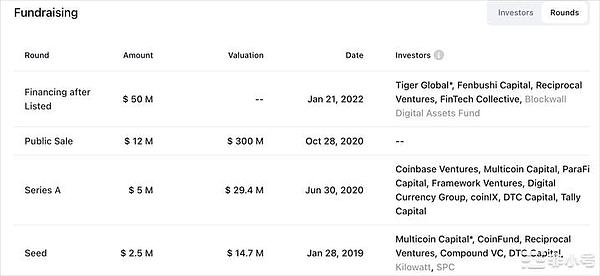
团队和融资:

Yaniv Tal :Geo 的创始人、The Graph 联合创始人、Edge & Node 的前首席执行官,南加州大学电气工程学士学位。

Brandon Ramirez :The Graph 联合创始人,设计了协议的系统级架构和经济学,并定义了 The Graph 的第一批用户用于高效学习和使用网络的产品和开发人员体验。布兰登认为,去中心化应用程序堆栈即将达到一个拐点,这将开启基于公共基础设施的新应用程序的寒武纪爆发。这些应用程序将是不可阻挡的,默认情况下是可互操作的,并将把权力从大型技术平台重新分配给最终用户。

Jannis Pohlmann :Edge & Node 的联合创始人兼工程主管,The Graph 的前联合创始人兼技术主管。d910792b05a4482db9bc818c0ccfc51e.jpg?638484507230
二、代币GRT

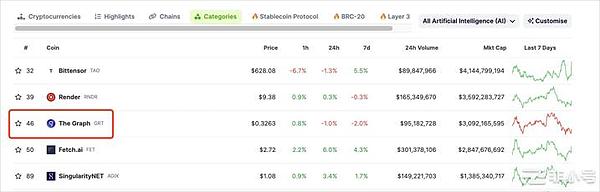
目前市值30亿美元

历史最高价:$2.84(2021.2.12)

历史最低价:$0.05205(2022.11.12)

当前价格:$0.3206(2024.4.11)

初始代币供应量为100 亿个GRT,目标是每年新发行 3%,以奖励分配子图权益的索引者。2020年10月23日GRT公开销售(仅对非美国用户开放),按照0.03U的价格总计销售4亿枚GRT,筹集1200万美元。据悉此次公开销售,总计超过1万人参与注册,发售仅仅11分钟,就被来自全球的90多个国家的4500人将所有额度全部抢购一空。

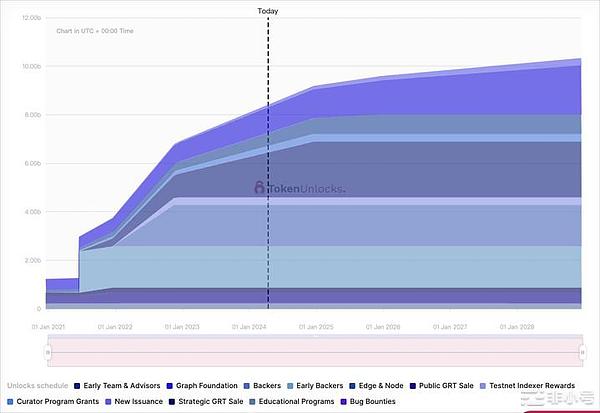
当前最大供应量10,788,004,319个

当前流通量9,457,079,950个(总流通90%左右)

代币解锁:
ff2509e1b6c641af9f1fc582f61d6768.jpg?638484507233

GRT是很重要很重要的基建项目,手握数据分析层,对Defi也会有辐射。

关于AI,有人说GRT和ChatGPT一样都做索引的,不敢苟同,但今年AI元年,任何与人工智能有丁点关系的加密项目都会引起投资者和交易者的关注。
74486a77a0bb496ab28dd0577b83ac13.jpg?638484507235关于Depin:

28b0a9a81d7b4953a6de2a5b1e817b1c.jpg?638484507238

关于数据分析:dc4bf98cc515429693c197a2268507e8.jpg?638484507240

近期回调到0.3左右,较安全。

Related Reads

Has the 'Digital Gold' Narrative for BTC Failed?

**Title: Has the "Digital Gold" Narrative for Bitcoin Failed?** The article argues that Bitcoin's "digital gold" narrative remains valid despite a recent sharp price decline (from a peak near $126k in Oct 2025 to briefly under $61k in Feb 2026). It presents a long-term investment framework based on three core points: **1. Viewing Bitcoin as an Asset:** Bitcoin is presented as a superior potential store of value compared to gold. Key arguments are its absolute scarcity (21 million cap), superior portability, and transparent auditability via its public ledger. While acknowledging its current use in early, volatile stages (~3-4% global adoption), the author draws parallels to the early, disruptive phases of the internet and e-commerce. **2. Understanding the Recent Downturn:** The current ~50% correction is framed as a predictable, consensus-driven cycle following its post-halving peak (the 2024 halving preceded the Oct 2025 high). A crucial factor is a historic "changing of hands": the influx of new institutional buyers via ETFs allowed early, low-cost holders (miners, OG believers) to take profits. The author notes that while severe, Bitcoin's historical drawdowns (e.g., 93% in 2011, 77% in 2021-22) have been progressively smaller, suggesting maturing holder structure and decreasing volatility over time. **3. The Long-Term Perspective:** The long-term thesis hinges on Bitcoin capturing a portion of gold's market value. With Bitcoin's market cap at ~$1.4 trillion (at $70k) versus gold's ~$20 trillion, significant upside potential exists if the "digital gold" narrative is partially realized. However, the author strongly cautions that short-term risks remain, the bottom is unpredictable, and high volatility is inherent. The real risk is not Bitcoin failing but poor personal position management (over-leverage, wrong capital) and a lack of deep understanding, which can force investors out during severe downturns. The conclusion uses Amazon's 95% crash post-2000 dot-com bubble and subsequent 42x recovery as an analogy. The ultimate question is not if Bitcoin's price will rise, but if an investor's strategy and conviction can withstand the volatility to see the long-term play out. The recent divergence (gold up, Bitcoin down) is posed not as a narrative failure, but as potential evidence of this ongoing, painful transition from a speculative asset to a mainstream allocation.

marsbit1h ago

Has the 'Digital Gold' Narrative for BTC Failed?

marsbit1h ago

Has BTC's 'Digital Gold' Narrative Failed?

The article discusses Bitcoin's "digital gold" narrative, its recent price drop, and long-term outlook through the perspective of "Jason". It argues the narrative is not a failure but that Bitcoin represents a superior, new asset class due to its fixed supply (21 million), portability, and auditability. The piece compares its current ~3-4% global adoption rate to early internet/e-commerce, suggesting significant growth potential. Regarding the 2025-2026 price decline (from ~$126k to briefly under $61k), the author views it as a predictable, consensus-driven sell-off within Bitcoin's ~4-year cycle post-halving, exacerbated by a major "handover" from early, low-cost holders to new institutional buyers via ETFs. A key observation is that historical peak-to-trough drawdowns have lessened over time (e.g., 93% in 2011 to ~50% in 2026), indicating maturing volatility as holder structure changes. For the long term, the author uses a simple framework: Bitcoin's total market cap (~$1.4T at $70k) is only about 7% of gold's (~$20T). Even capturing 30-50% of gold's value would imply substantial upside. However, the article strongly cautions against viewing this as investment advice, emphasizing extreme volatility and the critical importance of risk management, position sizing, and deep fundamental understanding to survive severe drawdowns. It concludes by drawing a parallel to Amazon's 95% crash in 2000 and subsequent 42x recovery, stressing that the key is surviving market cycles to realize long-term potential.

链捕手1h ago

Has BTC's 'Digital Gold' Narrative Failed?

链捕手1h ago

From Code to Cognition: A Ten-Thousand-Word Guide to the Evolution of the Robot Brain

"From Code to Cognition: The Evolution of Robot Brains" The journey of robotic intelligence has shifted dramatically from manually coded systems to AI-driven brains. For decades, robots relied on layered software stacks—perception, state estimation, planning, control—each handcrafted. While predictable, they lacked adaptability. The 2010s saw deep learning revolutionize perception (e.g., object detection) and control (via reinforcement learning), but learned skills remained narrow. The arrival of Large Language Models (LLMs) marked a turning point. LLMs acted as high-level planners, interpreting natural language instructions and generating sequences of actions for traditional robotic systems to execute. However, true integration came with Visual-Language-Action (VLA) models, which fused vision, language, and motion prediction into a single network. Pioneered by models like RT-2 and open-source projects like OpenVLA, VLAs enable robots to reason and act directly from visual input and commands. The most advanced humanoid robots now employ a "dual-brain" architecture: a slow-thinking, large VLA (System 2) for reasoning and planning, and a fast-reacting, small network (System 1) for high-frequency motion control, sometimes with an even lower-level System 0 for balance. This split balances cognition with the physics of real-time movement. Computation is split between onboard hardware (e.g., NVIDIA Jetson) for safety-critical control loops and cloud/edge servers for non-critical tasks like learning and interfaces. A crucial driver is the open-source ecosystem—models like GR00T and OpenVLA allow startups to build upon pre-trained brains and fine-tune them with their own data, accelerating development. Despite progress, current systems struggle with recovery from errors, sample inefficiency, and long-horizon tasks. This has spurred the rise of **World Models**—neural networks that predict the consequences of actions. By simulating possible futures before acting (like NVIDIA Cosmos or Meta V-JEPA), robots can plan, recover, and generalize better. This represents the next frontier: shifting intelligence from learned reactions to an internal model of physics and cause-and-effect. The field is rapidly evolving. While not yet at its "ChatGPT moment," the convergence of cheaper hardware, scalable simulation, and world models points toward robots that are increasingly capable, adaptive, and useful. The question is shifting from "what can robots do?" to "what *should* they do?"

marsbit1h ago

From Code to Cognition: A Ten-Thousand-Word Guide to the Evolution of the Robot Brain

marsbit1h ago

AI Bubble Is Bursting

The AI Bubble is Bursting: A Necessary Purge on the Path to Ubiquitous Intelligence Market volatility has reignited debates about an AI bubble, with figures like Ray Dalio pointing to high valuations. However, this parallels the dot-com bubble, which, despite its crash, laid the physical infrastructure for today's internet era. The current AI investment frenzy, with tech giants planning trillions in infrastructure spending far outstripping current AI application revenues, appears similarly imbalanced. This 'bubble' is seen as an inevitable phase for a disruptive technology, paying the "innovation tax." Critically, AI inference costs have plummeted over 99.7% since 2023, making intelligence nearly free at the margin. This hasn't reduced spending but has instead unlocked massive new demand, as seen in enterprise AI cloud expenditure tripling. This follows the Jevons Paradox: efficiency gains lead to greater total consumption. The market is now entering a cleansing phase, weeding out speculative ventures lacking real moats. The deeper shift is a move from capital expenditure (CapEx) on hardware to value creation in operational expenditure (OpEx) through AI applications that solve real industry problems. While infrastructure valuations are high, rapid earnings growth from widespread AI adoption across sectors—from manufacturing and finance to law and healthcare—may digest these valuations over time. Ultimately, this creative destruction will leave behind robust infrastructure and optimized models, cheaply powering an AI-augmented future for all industries, much as the internet became indispensable after its own bubble burst. The core productive potential remains undiminished.

链捕手1h ago

AI Bubble Is Bursting

链捕手1h ago

Trading

Spot
Futures

Hot Articles

How to Buy GRT

Welcome to HTX.com! We've made purchasing The Graph (GRT) simple and convenient. Follow our step-by-step guide to embark on your crypto journey.Step 1: Create Your HTX AccountUse your email or phone number to sign up for a free account on HTX. Experience a hassle-free registration journey and unlock all features.Get My AccountStep 2: Go to Buy Crypto and Choose Your Payment MethodCredit/Debit Card: Use your Visa or Mastercard to buy The Graph (GRT) instantly.Balance: Use funds from your HTX account balance to trade seamlessly.Third Parties: We've added popular payment methods such as Google Pay and Apple Pay to enhance convenience.P2P: Trade directly with other users on HTX.Over-the-Counter (OTC): We offer tailor-made services and competitive exchange rates for traders.Step 3: Store Your The Graph (GRT)After purchasing your The Graph (GRT), store it in your HTX account. Alternatively, you can send it elsewhere via blockchain transfer or use it to trade other cryptocurrencies.Step 4: Trade The Graph (GRT)Easily trade The Graph (GRT) on HTX's spot market. Simply access your account, select your trading pair, execute your trades, and monitor in real-time. We offer a user-friendly experience for both beginners and seasoned traders.

3.7k Total ViewsPublished 2024.03.29Updated 2026.06.02

How to Buy GRT

Discussions

Welcome to the HTX Community. Here, you can stay informed about the latest platform developments and gain access to professional market insights. Users' opinions on the price of GRT (GRT) are presented below.

活动图片