链上检测到104156526 XRP转账,随后价格下跌3.9%

币界网Published on 2024-08-12Last updated on 2024-08-12

币界网报道:

在发现大量XRP在未知钱包之间转移后,加密货币社区一直充斥着猜测。

XRPL网络上最近的一次大规模转账涉及104156546 XRP的巨额调度,价值约59019563美元。该交易由领先的加密鲸鱼追踪服务whale Alert检测到,发生在8月11日星期日15:04:10 UTC。

Trending Cryptos

Related Reads

Annualized Revenue Exceeds $20 Billion, Kalshi Aims to Become the First Prediction Platform IPO?

Kalshi, a leading U.S. prediction markets platform, is reportedly in early, informal discussions for an Initial Public Offering (IPO). The company's annualized revenue now exceeds $2 billion, fueled by its dominance of over 90% of the domestic prediction market activity. This growth stems from a surge in trading volume—reaching a total of $52.7 billion—and an increase in fee rates, largely driven by sports event contracts like the NBA playoffs and the 2026 FIFA World Cup. Monthly active users are approximately 2 million. Kalshi recently raised $1 billion in a funding round led by Coatue Management, valuing the company at $22 billion. It has also expanded its offerings to include Bitcoin perpetual contracts and plans to launch a dedicated trading platform, Kalshi Pro. However, Kalshi's path to an IPO faces significant regulatory hurdles. The core risk involves jurisdictional conflicts, as multiple U.S. states are challenging its operations under local gambling laws. For instance, Arizona has filed criminal charges against the platform, while states like Kentucky have filed lawsuits. Kalshi and the Commodity Futures Trading Commission (CFTC) argue that its event contracts fall under exclusive federal jurisdiction as "swaps." The outcomes of these ongoing legal battles could critically impact Kalshi's core revenue and its IPO timeline. Analysts suggest that while an IPO could theoretically occur by late 2026, a more likely timeframe is late 2027 or 2028, contingent on resolving legal issues and favorable market conditions. If successful, its fundraising could significantly exceed $1 billion, given its current valuation and revenue multiple.

Foresight News14m ago

Annualized Revenue Exceeds $20 Billion, Kalshi Aims to Become the First Prediction Platform IPO?

Foresight News14m ago

Financing Weekly Report | 11 Public Financing Events, Stablecoin Payment Infrastructure Company Trace Finance Completes $32 Million Series A Round Led by CoinFund

Financing Weekly Report | 11 public funding events recorded, with a total scale exceeding $264 million. The stablecoin payment infrastructure sector remains a hot spot. Key Deals: - Trace Finance, a stablecoin payment infrastructure firm, raised $32 million in a Series A round led by CoinFund to expand in Latin America and Asia-Pacific. - Galaxy Ventures co-led a $140 million Series A round for Karta, a US credit card provider for global travelers without requiring an SSN. - Instant payment platform Interchecks completed a $50 million Series C round. - Paradigm led a $9 million Series A for Latin American cross-border payment app El Dorado. - Range, a stablecoin compliance startup, raised $8.3 million in an oversubscribed Series A. - RWA infrastructure project Renaiss raised $1.5 million to expand its on-chain collectibles platform. Sector Breakdown: - Infrastructure & Tools: 6 deals, including the above-mentioned Trace Finance, Range, and Renaiss. - Centralized Finance (CeFi): 3 deals, led by Karta's $140 million round. - DeFi: 1 deal – reinsurance protocol Re secured strategic investment from Coinbase Ventures. - Prediction Markets: 1 deal – K25.ai completed a $10 million Pre-A round from NewGen. Other notable transactions include digital asset depository RDC raising $7 million, ad-tech startup EarnOS securing $6 million, and a $1 million strategic investment in LitVM, a ZK Layer 2 for Litecoin. The report highlights sustained investor interest in stablecoin payment infrastructure, compliant on-chain finance, and real-world asset (RWA) tokenization.

marsbit56m ago

Financing Weekly Report | 11 Public Financing Events, Stablecoin Payment Infrastructure Company Trace Finance Completes $32 Million Series A Round Led by CoinFund

marsbit56m ago

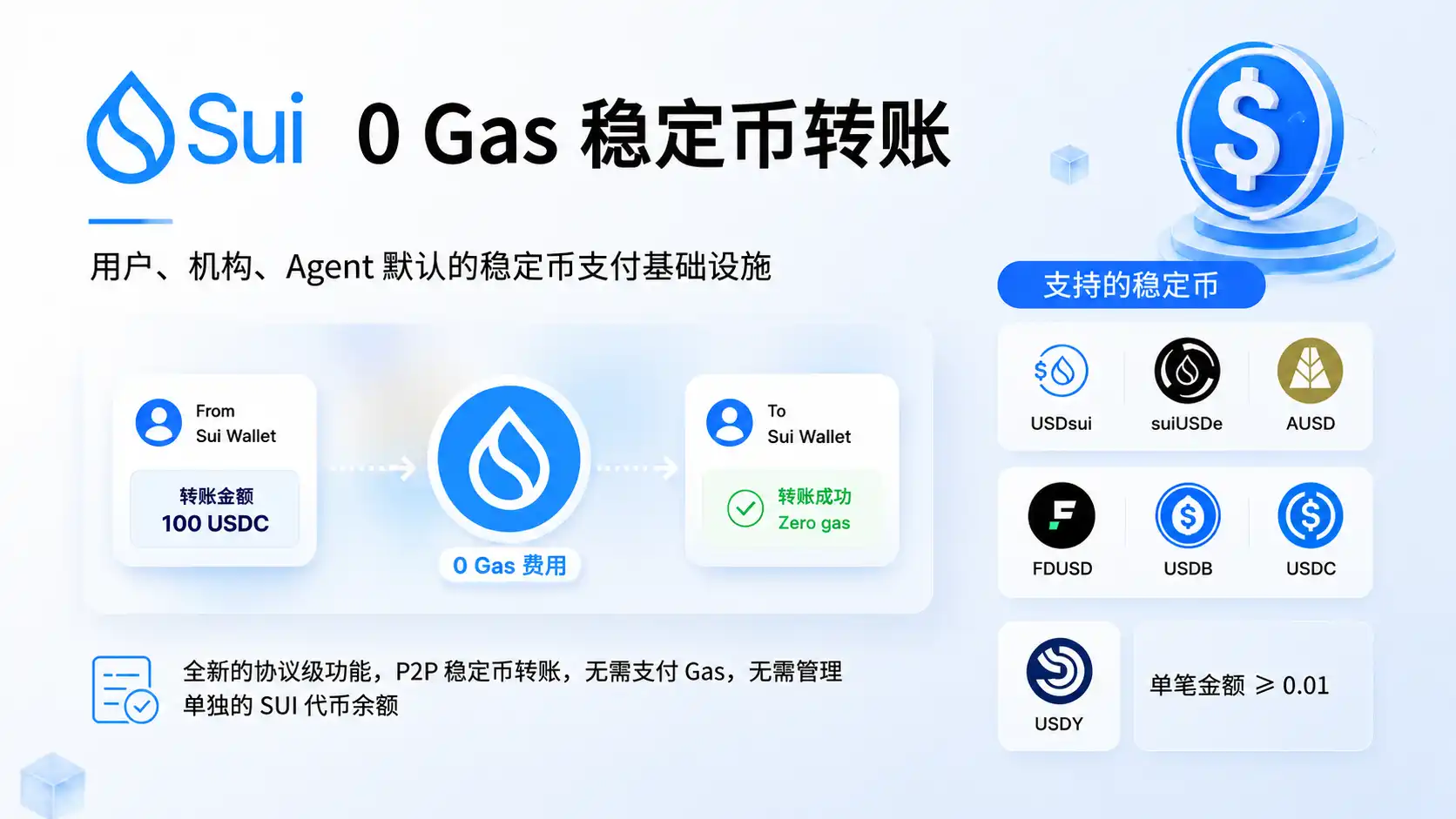
When Transfers Become Truly Frictionless: How Sui Uses 'Zero Gas' to Become the Underlying Infrastructure for Stablecoin Payments

Title: Sui Launches Zero-Gas Stablecoin Transfers to Become the Foundation for Stablecoin Payments Sui has introduced a zero-gas fee feature for peer-to-peer stablecoin transfers, eliminating the need for users or businesses to hold separate SUI tokens to pay transaction costs. This innovation, built on a new underlying account architecture called Address Balances, significantly reduces validator processing costs for eligible transactions. Currently, the feature applies to a whitelist of stablecoins for transfers meeting a minimum amount, effectively preventing spam. This development aims to unlock mainstream payment use cases for stablecoins—such as everyday purchases, remittances, and subscriptions—by removing cost and complexity barriers. It is also positioned to benefit high-frequency micro-payments for AI agents and institutional B2B payments, reducing operational friction. Major custody provider Fireblocks has already announced support. The move follows Sui processing over $1 trillion in stablecoin transfer volume since August 2025. Looking ahead, Sui plans to enhance this infrastructure with protocol-level confidential transactions later in 2026, aiming to provide scalable, free, and privacy-preserving payments. Together, these advancements strengthen Sui's goal of becoming the default settlement layer for stablecoin payments.

marsbit58m ago

When Transfers Become Truly Frictionless: How Sui Uses 'Zero Gas' to Become the Underlying Infrastructure for Stablecoin Payments

marsbit58m ago

Ethereum Is Retracing the Path of the Internet and Linux: No One Yields, and the Neutral Party Ultimately Prevails

This article argues that Ethereum is following the historical path of open, neutral systems like the Internet and Linux, which eventually triumphed over proprietary, centrally-controlled alternatives. Major financial institutions like JPMorgan, Stripe, and Circle are building their own proprietary blockchains or networks (e.g., Tempo, Arc), but will never agree to build on a competitor's controlled infrastructure. This creates the perfect opportunity for Ethereum as the only neutral, credibly neutral settlement layer that no single entity controls. The piece draws parallels to the 1990s, when experts like Bill Gates predicted proprietary networks (from Microsoft, Oracle) would win over the open Internet, and when Sun Microsystems' Unix lost to the open-source "bazaar" development model of Linux. This model, described in Eric Raymond's "The Cathedral and the Bazaar," thrives on permissionless innovation where countless contributors improve the system, outpacing any centralized competitor. Ethereum embodies this through its decentralized development, broad validator distribution, and credible neutrality—rules that are transparent, equally applied, hard to change, and open to all. This has attracted over a million developers and major institutions like Coinbase, BlackRock, and JPMorgan, who choose Ethereum for its security, ecosystem, and sovereignty (the inability of any single party to change the rules). While proprietary chains offer initial speed and control, they inherit the downsides of both centralization and decentralization without the long-term innovation benefits. The article concludes that, just as open systems historically win, Ethereum is poised to become the foundational, neutral settlement layer for global finance.

marsbit1h ago

Ethereum Is Retracing the Path of the Internet and Linux: No One Yields, and the Neutral Party Ultimately Prevails

marsbit1h ago

Trading

Spot
Futures

Hot Articles

What is XRP 2.0

XRP 2.0: A New Frontier in the Cryptocurrency Landscape Introduction to XRP 2.0 In the ever-evolving realm of cryptocurrency, new projects continuously emerge, vying for attention and adoption. One such promising initiative is XRP 2.0, a novel cryptocurrency project designed to leverage advanced blockchain technology and robust encryption methodologies. While the name draws parallels with Ripple’s XRP, it’s crucial to note that XRP 2.0 operates independently, focusing on enhancing transaction security, privacy, and scalability. As the digital financial landscape increasingly embraces decentralized solutions, XRP 2.0 aims to contribute meaningfully to web3 and the overall expansion of crypto projects. What is XRP 2.0? At its core, XRP 2.0 is a cryptocurrency project that aims to create a secure and decentralized digital currency ecosystem. Its foundational technology integrates sophisticated blockchain principles with cutting-edge encryption techniques. The overarching goal of XRP 2.0 is to establish itself as a reliable and efficient platform enabling swift transaction execution while prioritizing enhanced privacy protections for its users. The project is promoted as a solution to many limitations faced by existing cryptocurrencies, proposing a system that can handle a higher volume of transactions with improved speed and privacy. This versatility positions XRP 2.0 as a significant contender in a marketplace riddled with various digital currencies. Who is the Creator of XRP 2.0? The identity of the creator behind XRP 2.0 has been flagged as ‘Wilbur.’ However, comprehensive details regarding Wilbur or their associated entity remain elusive. The anonymity of many cryptocurrency creators is not an uncommon phenomenon in the industry, often designed to maintain a degree of privacy and security. Who are the Investors of XRP 2.0? As of now, specific information related to the investment foundations or organizations supporting XRP 2.0 is not publicly available. In the cryptocurrency sector, the backing by reputed investors can significantly influence a project's credibility and success, yet the transparency regarding the financial supporters of XRP 2.0 has not been established. How Does XRP 2.0 Work? XRP 2.0 stands out by employing a combination of blockchain technology and advanced encryption algorithms that ensures secure and decentralized transactions. Its innovative structure includes unique features designed to foster user engagement and broaden functionalities beyond conventional cryptocurrency transactions. Among these features, XRP 2.0 incorporates AI-powered capabilities, such as text-to-image and text-to-speech functionalities. These additions are designed to enhance the interactive experience for users, promoting broader applicability across various sectors. By bridging technological advancements with user-centered design, XRP 2.0 aims to capture the attention of a diverse range of individuals and enterprises looking to integrate cryptocurrency solutions into their operational frameworks. Timeline of XRP 2.0 Understanding XRP 2.0 requires examining the milestones that have defined its journey thus far: July 23, 2023: XRP 2.0 is introduced as a novel cryptocurrency project, aiming to revolutionize secure and decentralized transaction capabilities in the blockchain domain. September 8, 2023: The launching of another project, XRP20, occurs, marking the emergence of an ERC-20 token on the Ethereum blockchain that remains unrelated to XRP 2.0. November 13, 2023: The XRP Ledger undergoes a significant update with the release of rippled server software version 2.0.0. It is essential to note that this development is disconnected from the XRP 2.0 cryptocurrency project. Key Points About XRP 2.0 To distill the essence of XRP 2.0, several critical factors emerge: Unique Features: The inclusion of features like AI-powered text-to-image and text-to-speech further diversifies the potential applications of XRP 2.0. Blockchain Technology: The framework utilizes advanced blockchain mechanisms and encryption protocols, ensuring a secure and decentralized environment for transactions. Scalability and Privacy: XRP 2.0 prioritizes enhanced privacy protections in transaction processes and the scalability necessary to accommodate a growing user base. No Affiliation with Ripple: Importantly, despite its name, XRP 2.0 does not have any allegiance or collaboration with Ripple’s XRP, distinguishing its operational framework and objectives within the cryptocurrency ecosystem. Conclusion XRP 2.0 represents an ambitious venture into the cryptocurrency sphere, aiming to offer a combination of security, privacy, and efficiency in digital transactions. By integrating sophisticated technologies and user-friendly features, the project sets out to broaden the horizons of what cryptocurrency can achieve in today's digital economy. While the anonymity of its creator and lack of disclosed investors might raise questions for some, XRP 2.0's focus on advanced functionalities and decentralisation enhances its appeal amidst an increasingly crowded crypto market. As the cryptocurrency landscape continues to evolve, XRP 2.0 may yet emerge as a pivotal player in the expansion of secure and scalable blockchain solutions.

980 Total ViewsPublished 2024.04.01Updated 2024.12.03

What is XRP 2.0

Discussions

Welcome to the HTX Community. Here, you can stay informed about the latest platform developments and gain access to professional market insights. Users' opinions on the price of XRP (XRP) are presented below.

活动图片