UTXO绑定:详解BTC智能合约方案RGB、RGB++和Arch Network

Odaily星球日报Published on 2024-08-11Last updated on 2024-08-11

Abstract

随着更多开发者加入,比特币生态将继续发展,UTXO绑定方法可能成为扩展编程方式的关键。

介绍

比特币是目前流动性最好且最安全的区块链。在铭文爆发后,BTC 生态吸引了大量开发者涌入,他们很快关注到了 BTC 的可编程性问题与扩容问题。通过引入不同的思路,如 ZK、DA、侧链、rollup、restaking 等方案,BTC 生态的繁荣正迎来全新高点,俨然已经成为本轮牛市的主线剧情。

然而,在这些设计中,许多都延续了 ETH 等智能合约的扩容经验,且必须依赖一个中心化的跨链桥,这是系统的薄弱点。少有方案是基于 BTC 本身的特点设计的,这与 BTC 本身的开发者体验并不友好有关。由于一些原因使得它没法像以太坊一样运行智能合约:

  • 比特币的脚本语言为了安全性而限制了图灵完备性,这使得没法像以太坊一样执行智能合约。

  • 同时比特币区块链的存储是针对简单的交易而设计,没有对复杂的智能合约进行优化。

  • 最重要的是比特币没有虚拟机来运行智能合约。

2017 年隔离见证 (SegWit) 的引入增加了比特币的区块大小限制;2021 年的 Taproot 升级使得批量签名验证成为可能,从而更轻松、更快速地处理交易(解锁原子交换、多重签名钱包和有条件付款)。这都使的比特币上的可编程性成为可能。

2022 年,开发者 Casey Rodarmor 提出了他的“Ordinal Theory”,概述了聪的编号方案,可以将图像等任意数据放入比特币交易中,为直接在比特币链上嵌入状态信息和元数据开辟了新的可能性,这对于需要可访问和可验证状态数据的智能合约等应用程序来说,开辟了一条新的思路。

目前,大多数扩展比特币编程性的项目依赖于比特币的二层网络(L2),这使得用户必须信任跨链桥,成为L2获取用户和流动性的一大挑战。此外,比特币目前缺乏原生的虚拟机或可编程性,无法在无需额外信任假设的情况下实现L2与L1的通信。

Arch Network、RGB 和 RGB++ 都尝试从 BTC 原生属性出发,增强比特币的可编程性,通过不同的方法提供智能合约和复杂交易的能力:

  • RGB 是一种通过链下客户端验证的智能合约方案,智能合约的状态变化被记录在比特币的 UTXO 中。虽然具有一定的隐私优势,但使用起来繁琐,且缺乏合约的可组合性,目前发展非常缓慢。

  • RGB++ 是 Nervos 在 RGB 的思路下的另一条扩展路线,依然基于 UTXO 绑定,但通过将链本身作为一个具备共识的客户端验证者,这提供了一种元数据资产跨链的解决方案,并允许其支持任意 UTXO 结构链的转移。

  • Arch Network 为 BTC 提供了一个原生的智能合约方案,创建了一个 ZK 虚拟机和对应的验证者节点网络,通过聚合交易将状态变化与资产阶段记录在 BTC 交易中。

Arch Network

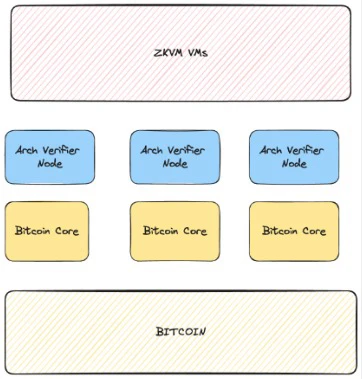
Arch Network 主要由 Arch zkVM 和 Arch 验证节点网络组成,利用零知识证明 (zk-proofs) 和去中心化验证网络确保智能合约的安全和隐私,比 RGB 更加易用,并没有像 RGB++ 一样需要另一条 UTXO 链进行绑定。

Arch zkVM 使用 RISC Zero ZKVM 执行智能合约并生成零知识证明,由去中心化的验证节点网络进行验证。该系统基于 UTXO 模型运行,将智能合约状态封装在 State UTXOs 中,以提高安全性和效率。

Asset UTXOs 则用于代表比特币或其他代币,并可通过委托的方式进行管理。Arch 验证网络通过随机选出的 leader 节点对 ZKVM 内容进行验证,并使用 FROST 签名方案聚合节点签名,最终将交易广播到比特币网络。
UTXO绑定:详解BTC智能合约方案RGB、RGB++和Arch Network

Arch zkVM 为比特币提供了一个图灵完备的虚拟机,能够执行复杂的智能合约。每次智能合约执行后,Arch zkVM 会生成零知识证明,这些证明用于验证合约的正确性和状态变化。

Arch 也使用了比特币的 UTXO 模型,状态和资产被封装在 UTXO 中,通过单次使用的概念进行状态转换。智能合约的状态数据被记录为 state UTXOs,而原数据资产被记录为 Asset UTXOs。Arch 确保每个 UTXO 只能被花费一次,从而提供安全的状态管理。

Arch 虽然没有创新区块链结构,但也需要一个验证节点网络。在每个 Arch Epoch 期间,系统会根据权益随机选择一个 Leader 节点,Leader 节点负责将收到的信息传播到网络内的所有其他验证者节点。所有 zk-proofs 都由去中心化的验证节点网络进行验证,确保系统的安全性和抗审查性,并生成签名给 Leader 节点。一旦交易由所需数量的节点签署,就可以在比特币网络上对广播。

RGB

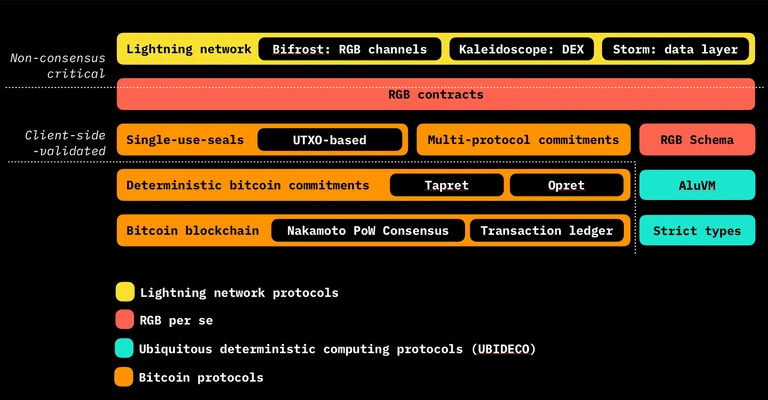
RGB 是 BTC 社区早期的智能合约扩展思路,其通过 UTXO 封装的方式记录状态数据,为后续 BTC 原生扩容提供了重要思路。
UTXO绑定:详解BTC智能合约方案RGB、RGB++和Arch Network

RGB 采用链下验证方式,将代币转移的验证从比特币的共识层移到链下,由特定交易相关的客户端进行验证。这种方式减少了对全网广播的需求,增强了隐私和效率。然而,这种隐私增强方式也是一把双刃剑。通过仅让和特定交易相关的节点参与验证工作,虽然增强了隐私保护,但也导致第三方不可见,使得实际操作过程复杂且难以开发,用户体验较差。

并且,RGB 引入了单次使用密封条的概念。每个 UTXO 只能被花费一次,相当于在创建 UTXO 时上锁,在花费它时解锁。智能合约的状态通过 UTXO 封装并通过密封条管理,从而提供了一种有效的状态管理机制。

RGB++

RGB++ 是 Nervos 在 RGB 的思路下的另一条扩展路线,依然基于 UTXO 绑定。

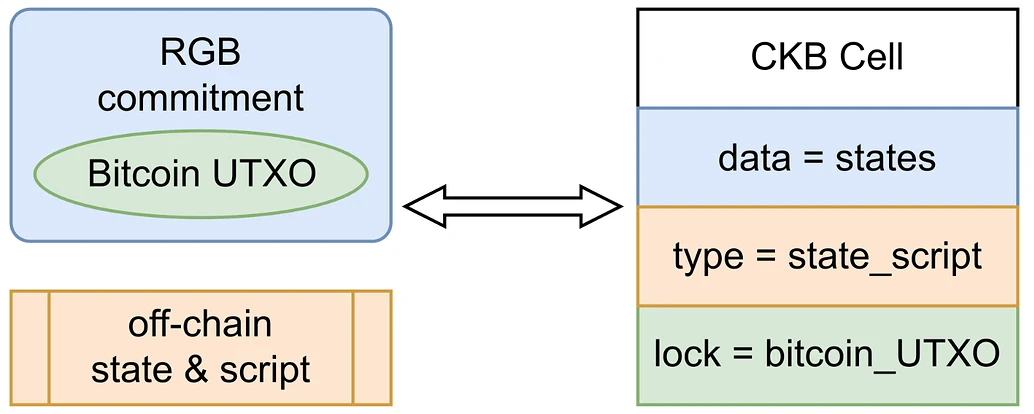
RGB++ 利用图灵完备的 UTXO 链(例如 CKB 或其他链)来处理链下数据和智能合约,进一步提升了比特币的可编程性,并通过同构绑定 BTC 来保证安全性。
UTXO绑定:详解BTC智能合约方案RGB、RGB++和Arch Network

RGB++采用图灵完备的 UTXO 链。通过使用像 CKB 这样的图灵完备 UTXO 链作为影子链,RGB++能够处理链下数据和智能合约。这种链不仅可以执行复杂的智能合约,还可以与比特币的 UTXO 进行绑定,从而增加了系统的编程性和灵活性。此外,比特币的 UTXO 和影子链的 UTXO 同构绑定,确保了状态和资产在两条链之间的一致性,从而保证了交易的安全性。

除此之外,RGB++不仅扩展到所有图灵完备的 UTXO 链,不再局限于 CKB,从而提升了跨链互操作性和资产流动性。这种多链支持允许 RGB++与任何图灵完备的 UTXO 链结合,增强了系统的灵活性。同时,RGB++通过 UTXO 同构绑定实现无桥跨链,与传统的跨链桥不同,这种方式避免了“假币”问题,确保了资产的真实性和一致性。

通过影子链进行链上验证,RGB++简化了客户端验证过程。用户只需检查影子链上的相关交易,即可验证 RGB++的状态计算是否正确。这种链上验证方式不仅简化了验证过程,还优化了用户体验。由于使用图灵完备的影子链,RGB++避免了 RGB 复杂的 UTXO 管理,提供了更加简化和用户友好的体验。

结论

在 BTC 可编程性设计方面,RGB、RGB++ 和 Arch Network 各有特色,但都延续了绑定 UTXO 的思路,UTXO 的仅一次使用的鉴权属性更适合智能合约用于记录状态。

但其劣势也非常明显,即糟糕的用户体验,与 BTC 一致的确认延迟与低性能,即只扩展了功能,但没有提升性能,这在 Arch 与 RGB 中较为明显;而 RGB++ 的设计虽然通过引入更高性能的 UTXO 链提供了更好的用户体验,但也提出了额外的安全性假设。

随着跟多开发者加入 BTC 社区,我们会见到更多的扩容方案,如 op-cat 的升级提案也在积极讨论中。而切合 BTC 原生属性的方案是需要重点关注的,UTXO 绑定方法是不升级 BTC 网络的前提下,扩展 BTC 编程方式的最有效方法,只要能解决好用户体验问题,将是 BTC 智能合约的巨大进步。


Trending Cryptos

Related Reads

Outlook for the Post-Encryption Era: Asset Valuation Returns, What to Watch in the Next Decade?

The crypto economy is undergoing its most significant transformation in eight years, characterized by a shift from speculative frenzy to fundamental-driven growth. After the extreme overvaluation and unrealistic expectations of 2021, asset prices, including Bitcoin relative to gold, have corrected significantly. This reset has exposed structural industry weaknesses such as cyclical revenues, regulatory uncertainty, misaligned incentives between equity and token holders, poor disclosure, and a lack of common valuation frameworks, leading to widespread investor fatigue. However, this correction is healthy and has set the stage for a more mature phase. Numerous real-world use cases have emerged and are exhibiting compound growth, independent of token prices. These include peer-to-peer internet platforms, global digital dollars, permissionless exchanges, novel derivatives, global collateral markets, democratized asset creation, open fundraising platforms, and decentralized physical infrastructure networks. Key issues like dual-token models are being resolved, disclosure is improving, and a consensus is forming that most assets must generate cash flow. The leading blockchains (e.g., Ethereum, Solana) are becoming the monetary and financial base layer of the internet, with entrenched network effects. Established Wall Street and Silicon Valley institutions are now launching production-grade products on public chains, a shift accelerated by clearer regulations. While valuations have reset and growth models remain conservative, the potential for exponential growth remains. The broader macro environment—declining institutional trust, unsustainable sovereign debt, currency debasement, deglobalization, and a generational wealth transfer—is uniquely favorable for crypto's adoption. The market is not uniformly maturing; it consists of various products at different adoption stages where speculation will persist in cycles. The core opportunity lies in identifying the few native projects that will become foundational winners as the world rebuilds its economic systems. The current period of disillusionment conceals a generational opportunity for those betting on the new paradigm rather than mourning the old one.

Odaily星球日报28m ago

Outlook for the Post-Encryption Era: Asset Valuation Returns, What to Watch in the Next Decade?

Odaily星球日报28m ago

Cache hit rate reaches 99.93%, the best Harness for DeepSeek is here, GitHub pulls in 86k Stars

The open-source programming agent "Pi" has surged in popularity on GitHub, amassing around 86,000 stars, largely due to its exceptional efficiency when paired with DeepSeek's models. A key highlight is its remarkably high cache hit rate of approximately 99.93% for input tokens when using DeepSeek. This minimal cache miss rate of 0.07% means most repeated context is reused, drastically reducing computational costs. In a benchmark test by Composio comparing eight major agent harnesses running DeepSeek V4 Flash, Pi achieved the lowest average cost per successful task at about $0.028, significantly outperforming others like Claude Code, which was nearly seven times more expensive. Pi functions as a streamlined "harness" or workspace for AI models, providing core tools like file read/write and command execution while allowing users to add extensions. Its simplicity and specific adaptation for DeepSeek's API—handling its unique reasoning content and tool call formats—make it highly compatible. This design maximizes the efficiency of DeepSeek's low-cost tokens and powerful caching mechanism, as the agent's linear workflow avoids unnecessary changes to earlier prompt sections. While DeepSeek has officially announced its own harness project targeting Claude Code, Pi remains a versatile, user-customizable platform supporting multiple AI providers. It offers developers a cost-effective and flexible alternative, setting a high bar for future official solutions.

marsbit59m ago

Cache hit rate reaches 99.93%, the best Harness for DeepSeek is here, GitHub pulls in 86k Stars

marsbit59m ago

When Meme Traffic Meets RWA: The Financial Ambitions of Hyperliquid and Robinhood

When Meme traffic meets RWA: Hyperliquid and Robinhood's Financial Ambitions This article explores the transformative role of speculation in financial market evolution, arguing it can provide the liquidity and capital foundation for mature, compliant businesses. The analysis draws parallels to historical examples, like 19th-century Chicago grain markets, where speculators provided necessary counterparty liquidity for farmers, eventually establishing a global pricing infrastructure. The author examines contemporary cases in crypto. The launch of Uniswap's Pools meme token platform on Robinhood Chain—originally built for tokenized stock trading—demonstrates how speculative meme trading can drive significant user adoption and liquidity. Despite initial volatility, this traffic can seed future, more substantial financial activities. Similarly, Hyperliquid, which began with high-leverage crypto trading, has successfully migrated its speculative model to real-world assets (RWAs) like equities, commodities, and indices. By July, RWA perpetual contract volumes on Hyperliquid surpassed its crypto trading for the first time, showcasing how speculation can build new, all-weather pricing layers. The core thesis is that speculation itself is neutral. Its long-term value and sustainability are determined by the underlying assets it engages with. While pure bubbles collapse, speculation anchored to valuable assets—be it wheat, gold, or equities—can evolve into foundational market infrastructure. Both Hyperliquid’s RWA platform and Robinhood’s strategy of leveraging meme coin enthusiasm to build towards on-chain securities trading exemplify this potential pathway from speculative frenzy to structured financial utility.

marsbit1h ago

When Meme Traffic Meets RWA: The Financial Ambitions of Hyperliquid and Robinhood

marsbit1h ago

NVIDIA HBM in Short Supply, Next-Gen GPUs Limited, but This Storage Drive Steals the Spotlight

The article discusses how AI Agents are transforming storage from a passive repository into an active component within AI inference and operation loops. As Agents perform continuous tasks involving models, memory, tools, and logs, data storage needs to evolve beyond simple block devices. The concept of "functional SSDs" is introduced, where capabilities like automatic encryption, compression, indexing, and memory management are embedded closer to the storage medium. This shift is driven by the need to handle Agent-specific data chains—including context, tool trajectories, and long-term memory—more efficiently. The piece analyzes current trends like AI SSDs from companies such as Phison (aiDAPTIV), Longsys (SPU+iSA), and Maxio, which are beginning to participate in the AI data path by managing model weights, KV cache, and prefetching. It further explores the future re-division of labor across the memory hierarchy: HBM for core compute, emerging High Bandwidth Flash (HBF) for read-intensive workloads, DRAM/CXL for mutable state, and functional SSDs for persistent, governed objects like Agent Memory. The conclusion is that storage will become integral to Agent capability, moving from just saving data to enabling next-step actions. The industry is poised to develop along three paths: functionalized SSDs, storage nodes tailored for Agents, and a re-architected, tiered memory system optimized for access patterns, security, and cost-per-token efficiency.

marsbit1h ago

NVIDIA HBM in Short Supply, Next-Gen GPUs Limited, but This Storage Drive Steals the Spotlight

marsbit1h ago

Trading

Spot

Hot Articles

What is $BITCOIN

DIGITAL GOLD ($BITCOIN): A Comprehensive Analysis Introduction to DIGITAL GOLD ($BITCOIN) DIGITAL GOLD ($BITCOIN) is a blockchain-based project operating on the Solana network, which aims to combine the characteristics of traditional precious metals with the innovation of decentralized technologies. While it shares a name with Bitcoin, often referred to as “digital gold” due to its perception as a store of value, DIGITAL GOLD is a separate token designed to create a unique ecosystem within the Web3 landscape. Its goal is to position itself as a viable alternative digital asset, although specifics regarding its applications and functionalities are still developing. What is DIGITAL GOLD ($BITCOIN)? DIGITAL GOLD ($BITCOIN) is a cryptocurrency token explicitly designed for use on the Solana blockchain. In contrast to Bitcoin, which provides a widely recognized value storage role, this token appears to focus on broader applications and characteristics. Notable aspects include: Blockchain Infrastructure: The token is built on the Solana blockchain, known for its capacity to handle high-speed and low-cost transactions. Supply Dynamics: DIGITAL GOLD has a maximum supply capped at 100 quadrillion tokens (100P $BITCOIN), although details regarding its circulating supply are currently undisclosed. Utility: While precise functionalities are not explicitly outlined, there are indications that the token could be utilized for various applications, potentially involving decentralized applications (dApps) or asset tokenization strategies. Who is the Creator of DIGITAL GOLD ($BITCOIN)? At present, the identity of the creators and development team behind DIGITAL GOLD ($BITCOIN) remains unknown. This situation is typical among many innovative projects within the blockchain space, particularly those aligning with decentralized finance and meme coin phenomena. While such anonymity may foster a community-driven culture, it intensifies concerns about governance and accountability. Who are the Investors of DIGITAL GOLD ($BITCOIN)? The available information indicates that DIGITAL GOLD ($BITCOIN) does not have any known institutional backers or prominent venture capital investments. The project seems to operate on a peer-to-peer model focused on community support and adoption rather than traditional funding routes. Its activity and liquidity are primarily situated on decentralized exchanges (DEXs), such as PumpSwap, rather than established centralized trading platforms, further highlighting its grassroots approach. How DIGITAL GOLD ($BITCOIN) Works The operational mechanics of DIGITAL GOLD ($BITCOIN) can be elaborated on based on its blockchain design and network attributes: Consensus Mechanism: By leveraging Solana’s unique proof-of-history (PoH) combined with a proof-of-stake (PoS) model, the project ensures efficient transaction validation contributing to the network's high performance. Tokenomics: While specific deflationary mechanisms have not been extensively detailed, the vast maximum token supply implies that it may cater to microtransactions or niche use cases that are still to be defined. Interoperability: There exists the potential for integration with Solana’s broader ecosystem, including various decentralized finance (DeFi) platforms. However, the details regarding specific integrations remain unspecified. Timeline of Key Events Here is a timeline that highlights significant milestones concerning DIGITAL GOLD ($BITCOIN): 2023: The initial deployment of the token occurs on the Solana blockchain, marked by its contract address. 2024: DIGITAL GOLD gains visibility as it becomes available for trading on decentralized exchanges like PumpSwap, allowing users to trade it against SOL. 2025: The project witnesses sporadic trading activity and potential interest in community-led engagements, although no noteworthy partnerships or technical advancements have been documented as of yet. Critical Analysis Strengths Scalability: The underlying Solana infrastructure supports high transaction volumes, which could enhance the utility of $BITCOIN in various transaction scenarios. Accessibility: The potential low trading price per token could attract retail investors, facilitating wider participation due to fractional ownership opportunities. Risks Lack of Transparency: The absence of publicly known backers, developers, or an audit process may yield skepticism regarding the project's sustainability and trustworthiness. Market Volatility: The trading activity is heavily reliant on speculative behavior, which can result in significant price volatility and uncertainty for investors. Conclusion DIGITAL GOLD ($BITCOIN) emerges as an intriguing yet ambiguous project within the rapidly evolving Solana ecosystem. While it attempts to leverage the “digital gold” narrative, its departure from Bitcoin's established role as a store of value underscores the need for a clearer differentiation of its intended utility and governance structure. Future acceptance and adoption will likely depend on addressing the current opacity and defining its operational and economic strategies more explicitly. Note: This report encompasses synthesised information available as of October 2023, and developments may have transpired beyond the research period.

1.7k Total ViewsPublished 2025.05.13Updated 2025.05.13

What is $BITCOIN

Discussions

Welcome to the HTX Community. Here, you can stay informed about the latest platform developments and gain access to professional market insights. Users' opinions on the price of BTC (BTC) are presented below.

活动图片