突发 Ripple赢得与SEC的诉讼 XRP币上涨30% 未来如何发展?

币界网Published on 2024-08-08Last updated on 2024-08-08

币界网报道:

美国证券监管机构与Ripple公司之间长达4年的争斗终于结束了。

Ripple 是一家总部位于旧金山的金融科技公司,以其区块链和 XRP 加密货币驱动的高效支付服务而闻名。2020 年 12 月,美国证券交易委员会 (SEC) 起诉 Ripple 通过 XRP 加密货币运营支付服务并出售 XRP,以及针对 Ripple 的其他多项指控。SEC 还对 XRP 加密的性质提出了质疑,声称其使用违反了《证券法》,因为 XRP 被视为 SEC 职权范围内的证券代币。

根据最新的法院裁决,Ripple 赢得了对 SEC 的指控和指控,但面临 1.23 亿美元的民事处罚。

法院裁定,Ripple 通过其对 XRP 加密的“机构销售”违反了证券法,这些销售被视为未经注册的投资合约。但是,法院裁定 Ripple 对 XRP 的“程序化销售”和“其他分销”并不构成未经注册的证券发行。

加密货币法专家 Jeremy Hogan 称,这项法庭裁决对 Ripple 公司来说是一次巨大的胜利。

结束了SEC 诉 Ripple 案经历了一段漫长的历程——感谢您与我分享。1.25 亿美元罚款和通用禁令。毫无疑问,这是 Ripple 的一次重大胜利。祝您有美好的一天https://t.co/hCZZYsMl7E pic.twitter.com/7uuuwsx0Dw

– Jeremy Hogan (@attorneyjeremy1) 2024 年 8 月 7 日

Ripple 首席执行官布拉德·加林豪斯 (Brad Garlinghouse) 表示,SEC 以虚假欺诈指控为由要求对 Ripple 处以 20 亿美元罚款,但法院的裁决澄清了 SEC 如何滥用其权力。

SEC 要求赔偿 20 亿美元,法院认为他们已经过度行动,因此将索赔金额降低了约 94%。我们尊重法院的判决,并明确表示将继续发展我们的公司。这是 Ripple、行业和法治的胜利。SEC 的……

– Brad Garlinghouse (@bgarlinghouse) 2024 年 8 月 7 日

Ripple 的法律专家 Stuart Alderoty 还表示,法院驳回了 SEC 指控 Ripple 行为鲁莽的指控,并指出没有欺诈或财务损害的指控。法院驳回了 SEC 要求的 20 亿美元罚款,而是对过去向精明第三方出售的特定产品处以 1.25 亿美元的罚款。

最终判决。法院驳回了 SEC 提出的 Ripple 鲁莽行事的建议,并提醒 SEC,此案不涉及任何欺诈或故意不当行为的指控,也没有人遭受任何经济损失。她拒绝了 SEC 提出的 20 亿美元荒谬要求……https://t.co/RbwpBnoXJG

— Stuart Alderoty (@s_alderoty) 2024 年 8 月 7 日

XRP 价格走势

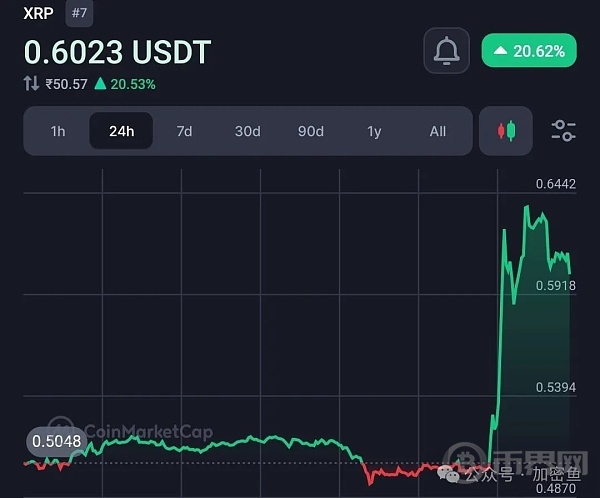
受此消息影响,XRP 币的交易价格从 0.49 美元飙升至 0.64 美元,涨幅达 30%。截至撰写本文时,XRP 币的交易价格已上涨 20%。

图片

Trending Cryptos

Related Reads

U.S. Stock Market Trend (August 11): Oil Prices Surge, Treasury Yields Rise, Tech Stocks Under Pressure, Optical Communication Plummets

U.S. Stock Market Trends (August 11): Oil Surge and Rising Bond Yields Pressure Tech; Optical Communication Stocks Plunge. U.S. stock indices closed slightly lower on Monday, with the S&P 500 and Dow Jones retreating from recent record highs. The primary market pressures were a significant oil price jump of over 5% amid unresolved negotiations to reopen the Strait of Hormuz and a consequent rise in U.S. Treasury yields, which weighed on growth stock valuations. The technology sector faced pressure, with Nvidia falling nearly 3% despite news of its pursuit of a $500 billion AI infrastructure financing consortium with major Wall Street firms. The optical communication sector saw a sharp sell-off, with Coherent dropping over 14%. In contrast, Chinese stocks listed in the U.S. were a notable bright spot, as the Nasdaq Golden Dragon China Index rose nearly 2%. Gold prices advanced for a second consecutive session on inflation hedging demand, while Bitcoin fell below $64,000. Key market movers included surging oil prices (WTI and Brent up ~5%) due to stalled Strait of Hormuz talks and heightened supply concerns, pushing the 10-year Treasury yield near 4.71%. Major tech stocks were mixed. Beyond Nvidia's decline, Intel fell over 4% on a new share offering plan. The Philadelphia Semiconductor Index dropped approximately 1.2%. Market attention remains on oil price dynamics, the impact of rising yields, and the forthcoming U.S. CPI data.

marsbit15m ago

U.S. Stock Market Trend (August 11): Oil Prices Surge, Treasury Yields Rise, Tech Stocks Under Pressure, Optical Communication Plummets

marsbit15m ago

JP Morgan Research Report Analysis: SK Hynix Fell 15% Last Week, Concerns Over HBM Pricing Overblown and Shareholder Returns to Land Ahead of Schedule

JPMorgan Research Report Interpretation: Addressing Concerns on SK Hynix's Recent Share Price Decline SK Hynix's stock fell 15% last week, underperforming the KOSPI (-5%) and Samsung (-9%). Key investor concerns centered on HBM pricing uncertainty, unclear shareholder return timelines, and a recently disclosed ₩54 trillion capital expenditure plan. JPMorgan's August 9 report addresses each point. Regarding HBM, JPMorgan refutes inaccurate media reports suggesting potential 50% price discounts for HBM4 in 2027. The firm's conservative model assumes <40% average HBM price growth by 2027, based on factors including memory suppliers prioritizing high-margin DDR5/LPDDR5/NAND in LTA allocations and the long-term partnership with key customer NVIDIA. The most significant near-term catalyst is shareholder returns. SK Hynix has committed to announcing additional shareholder return measures before the end of Q3 (September), earlier than its prior "year-end" guidance. JPMorgan anticipates a progressive policy, supported by an estimated cumulative free cash flow exceeding ₩800 trillion over three years and proceeds from the Kioxia stake sale. The substantial ₩54 trillion capex plan is for two new memory fabs to support its 2030 roadmap, not short-term aggressive expansion. The Yongin Y2 DRAM fab (₩35.2tn) and Cheongju M17 NAND fab (₩19.1tn) have construction starts scheduled for 2027, with clean room completion and investments stretching to 2028-2031. JPMorgan sees limited strategic value in a potential IPO for subsidiary Solidigm, noting SK Hynix's strong internal cash flow can fund capex without dilution, and an IPO might trigger dual-listing rule constraints in Korea. The report concludes last week's sell-off was an overreaction. JPMorgan maintains its Overweight rating and ₩2.75 million price target (~7x avg. 2026-2027 EPS), asserting the memory super-cycle thesis and SK Hynix's fundamentals remain intact.

marsbit19m ago

JP Morgan Research Report Analysis: SK Hynix Fell 15% Last Week, Concerns Over HBM Pricing Overblown and Shareholder Returns to Land Ahead of Schedule

marsbit19m ago

The Post-Crypto Era Outlook: Asset Valuation Returns to Fundamentals, What to Watch for the Next Decade?

Cryptoeconomy at a Turning Point: Valuations Reset, Focus Shifts to Real Value The cryptoeconomy is undergoing its most significant transformation yet, moving from speculative excess to a focus on sustainable, value-generating applications. After the 2021 hype cycle, which saw unsustainable valuations, the market has experienced a prolonged "reversion to the mean." Structural issues like cyclical revenues, regulatory uncertainty, and misaligned incentives between equity and token holders led to widespread fatigue. However, these problems are now widely recognized and are being addressed. A key shift is the emergence of applications demonstrating real, compounding growth independent of token prices. These include peer-to-peer internet platforms, global digital dollars, permissionless exchanges, novel derivatives, global collateral markets, and open financing platforms. Leading blockchains like Ethereum and Solana are solidifying their positions as foundational monetary and financial layers for the internet. Simultaneously, traditional financial and tech institutions are accelerating their blockchain integration with production-grade products, moving beyond mere experiments. Clearer regulations are enabling a shift from compliance concerns to exploring new business models. While the broader cryptoeconomy's emergence appears inevitable—driven by declining institutional trust, monetary devaluation, and a desire for fairer systems—intense competition means only a few native projects will become the dominant winners. The current phase offers a unique opportunity for investors, as leading projects are potentially undervalued after years of consolidation. The task is no longer to debate the technology's viability but to identify and capitalize on the real value being built for the next decade.

marsbit19m ago

The Post-Crypto Era Outlook: Asset Valuation Returns to Fundamentals, What to Watch for the Next Decade?

marsbit19m ago

Outlook for the Post-Encryption Era: Asset Valuation Returns, What to Watch in the Next Decade?

The crypto economy is undergoing its most significant transformation in eight years, characterized by a shift from speculative frenzy to fundamental-driven growth. After the extreme overvaluation and unrealistic expectations of 2021, asset prices, including Bitcoin relative to gold, have corrected significantly. This reset has exposed structural industry weaknesses such as cyclical revenues, regulatory uncertainty, misaligned incentives between equity and token holders, poor disclosure, and a lack of common valuation frameworks, leading to widespread investor fatigue. However, this correction is healthy and has set the stage for a more mature phase. Numerous real-world use cases have emerged and are exhibiting compound growth, independent of token prices. These include peer-to-peer internet platforms, global digital dollars, permissionless exchanges, novel derivatives, global collateral markets, democratized asset creation, open fundraising platforms, and decentralized physical infrastructure networks. Key issues like dual-token models are being resolved, disclosure is improving, and a consensus is forming that most assets must generate cash flow. The leading blockchains (e.g., Ethereum, Solana) are becoming the monetary and financial base layer of the internet, with entrenched network effects. Established Wall Street and Silicon Valley institutions are now launching production-grade products on public chains, a shift accelerated by clearer regulations. While valuations have reset and growth models remain conservative, the potential for exponential growth remains. The broader macro environment—declining institutional trust, unsustainable sovereign debt, currency debasement, deglobalization, and a generational wealth transfer—is uniquely favorable for crypto's adoption. The market is not uniformly maturing; it consists of various products at different adoption stages where speculation will persist in cycles. The core opportunity lies in identifying the few native projects that will become foundational winners as the world rebuilds its economic systems. The current period of disillusionment conceals a generational opportunity for those betting on the new paradigm rather than mourning the old one.

Odaily星球日报53m ago

Outlook for the Post-Encryption Era: Asset Valuation Returns, What to Watch in the Next Decade?

Odaily星球日报53m ago

Trading

Spot

Hot Articles

What is XRP 2.0

XRP 2.0: A New Frontier in the Cryptocurrency Landscape Introduction to XRP 2.0 In the ever-evolving realm of cryptocurrency, new projects continuously emerge, vying for attention and adoption. One such promising initiative is XRP 2.0, a novel cryptocurrency project designed to leverage advanced blockchain technology and robust encryption methodologies. While the name draws parallels with Ripple’s XRP, it’s crucial to note that XRP 2.0 operates independently, focusing on enhancing transaction security, privacy, and scalability. As the digital financial landscape increasingly embraces decentralized solutions, XRP 2.0 aims to contribute meaningfully to web3 and the overall expansion of crypto projects. What is XRP 2.0? At its core, XRP 2.0 is a cryptocurrency project that aims to create a secure and decentralized digital currency ecosystem. Its foundational technology integrates sophisticated blockchain principles with cutting-edge encryption techniques. The overarching goal of XRP 2.0 is to establish itself as a reliable and efficient platform enabling swift transaction execution while prioritizing enhanced privacy protections for its users. The project is promoted as a solution to many limitations faced by existing cryptocurrencies, proposing a system that can handle a higher volume of transactions with improved speed and privacy. This versatility positions XRP 2.0 as a significant contender in a marketplace riddled with various digital currencies. Who is the Creator of XRP 2.0? The identity of the creator behind XRP 2.0 has been flagged as ‘Wilbur.’ However, comprehensive details regarding Wilbur or their associated entity remain elusive. The anonymity of many cryptocurrency creators is not an uncommon phenomenon in the industry, often designed to maintain a degree of privacy and security. Who are the Investors of XRP 2.0? As of now, specific information related to the investment foundations or organizations supporting XRP 2.0 is not publicly available. In the cryptocurrency sector, the backing by reputed investors can significantly influence a project's credibility and success, yet the transparency regarding the financial supporters of XRP 2.0 has not been established. How Does XRP 2.0 Work? XRP 2.0 stands out by employing a combination of blockchain technology and advanced encryption algorithms that ensures secure and decentralized transactions. Its innovative structure includes unique features designed to foster user engagement and broaden functionalities beyond conventional cryptocurrency transactions. Among these features, XRP 2.0 incorporates AI-powered capabilities, such as text-to-image and text-to-speech functionalities. These additions are designed to enhance the interactive experience for users, promoting broader applicability across various sectors. By bridging technological advancements with user-centered design, XRP 2.0 aims to capture the attention of a diverse range of individuals and enterprises looking to integrate cryptocurrency solutions into their operational frameworks. Timeline of XRP 2.0 Understanding XRP 2.0 requires examining the milestones that have defined its journey thus far: July 23, 2023: XRP 2.0 is introduced as a novel cryptocurrency project, aiming to revolutionize secure and decentralized transaction capabilities in the blockchain domain. September 8, 2023: The launching of another project, XRP20, occurs, marking the emergence of an ERC-20 token on the Ethereum blockchain that remains unrelated to XRP 2.0. November 13, 2023: The XRP Ledger undergoes a significant update with the release of rippled server software version 2.0.0. It is essential to note that this development is disconnected from the XRP 2.0 cryptocurrency project. Key Points About XRP 2.0 To distill the essence of XRP 2.0, several critical factors emerge: Unique Features: The inclusion of features like AI-powered text-to-image and text-to-speech further diversifies the potential applications of XRP 2.0. Blockchain Technology: The framework utilizes advanced blockchain mechanisms and encryption protocols, ensuring a secure and decentralized environment for transactions. Scalability and Privacy: XRP 2.0 prioritizes enhanced privacy protections in transaction processes and the scalability necessary to accommodate a growing user base. No Affiliation with Ripple: Importantly, despite its name, XRP 2.0 does not have any allegiance or collaboration with Ripple’s XRP, distinguishing its operational framework and objectives within the cryptocurrency ecosystem. Conclusion XRP 2.0 represents an ambitious venture into the cryptocurrency sphere, aiming to offer a combination of security, privacy, and efficiency in digital transactions. By integrating sophisticated technologies and user-friendly features, the project sets out to broaden the horizons of what cryptocurrency can achieve in today's digital economy. While the anonymity of its creator and lack of disclosed investors might raise questions for some, XRP 2.0's focus on advanced functionalities and decentralisation enhances its appeal amidst an increasingly crowded crypto market. As the cryptocurrency landscape continues to evolve, XRP 2.0 may yet emerge as a pivotal player in the expansion of secure and scalable blockchain solutions.

1.4k Total ViewsPublished 2024.04.01Updated 2024.12.03
What is XRP 2.0

Discussions

Welcome to the HTX Community. Here, you can stay informed about the latest platform developments and gain access to professional market insights. Users' opinions on the price of XRP (XRP) are presented below.

活动图片