AR飙升40%,看好本轮牛市上一百

金色财经Published on 2024-08-08Last updated on 2024-08-08

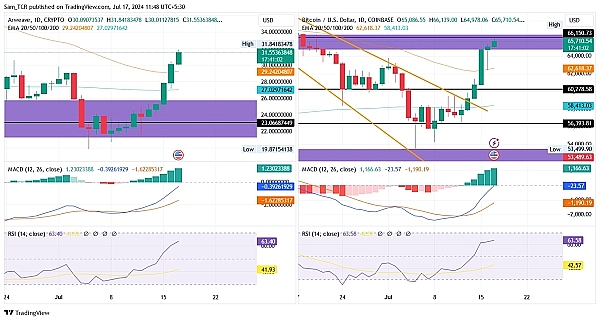
Arweave (AR) 似乎受到 BTC 飙升的极大影响,其市场本周上涨了 40%,最新盘中涨幅为 5%。BTC 的价格已超过 65,500 美元,市场大部分呈现绿色。

全球市值飙升2.21%,达到2.41万亿美元。
YgzK3jK8TYuujaCwDzSypOilMSSxWifs5YNRxBrf.jpeg

随着 AR 价格上涨,其市值也大幅上涨,跻身全球加密货币前 50 名。其市值排名第 49 位。在过去 24 小时内,Arweave 代币的市值飙升 13.77%,达到 20.82 亿美元。

所有可交易平台的 24 小时交易量为 1.4191 亿美元,增长 43.44%。

同时,AR crypto 的交易量与市值比率突出了低至中等流动性,比率为 6.92%。其代币经济学表明,在总共 6600 万 AR 中,有 6565 万 AR(99.47%)在人们手中流通。

根据 TradingView 平台,AR 代币在 2020 年 5 月 1 日创下了历史最低价 (ATL) 0.4860 美元。从这个低点开始,目前的价格已经上涨了 4300%。同样,在日线图上,2021 年 11 月 1 日创下了历史最高价 (新高) 90.94 美元。

Aweave 的总锁定价值 (TVL) 正在上涨

在 2023 年 10 月结束 TVL 的长期下滑之后,出现了复苏。随着时间的推移,这反映了对 Arweave项目的需求增加和市场参与动态的变化。

根据其数据,AR 的 TVL 为 1067.8 亿美元,2023 年 10 月 14 日从 407.8 亿美元大幅上涨,增长了近 2.5 倍。

这表明 AR 加密的增长规模令人印象深刻。这反映出更高的 TVL 使得 Arweave 加密货币资产更加可靠且风险更低。

衍生品数据分析对 Arweave(AR)价格有何亮点?

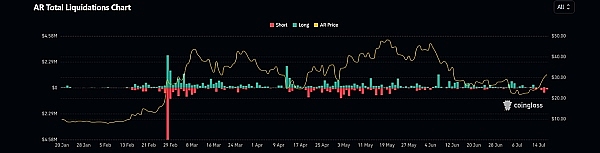
根据数据,Arweave (AR) 衍生品数据分析显示,其 24 小时内未平仓合约 (OI) 达到 7057 万美元,合约数量比前期增加 10.74%。与此同时,衍生品交易量增加了 48.28%,达到 2.3469 亿美元。
1lXYutok1AvSWpgs41MMvfabhDi89njJPtvOLd4E.jpeg

此外,其 24 小时多空比率为 0.9635,表明加密的空头多于多头。在长期看跌主导之后,清算的空头多于多头。

空头头寸为 347.18 万美元,多头头寸为 54.34 万美元。总体而言,衍生品数据分析表明 AR 呈向上增长趋势。

在经历了令人着迷的 500% 以上的涨幅(从 2 月 7 日的 7.68 美元涨至 3 月 9 日的 47.11 美元)之后,价格最终处于略微向下倾斜的区间。AR 价格已在楔形中移动了近 140 天。

价格曾四次试图突破楔形的上边界和楔形中 46-49 美元的阻力区。然而,它失败了,跌至楔形的下边界,即 25-20 美元的支撑区。

自 7 月 5 日以来,价格表现出持续性,与 BTC 相比,过去 12 天内上涨了 58%。与此同时,BTC 在过去 12 天内小幅上涨了 23%。

截至发稿时,Arweave (AR) 可能从楔形的下边界走向上边界,交易价为 31.39 美元,盘中上涨 4.36%。

EMA 带在价格经过时为其提供支撑。MACD 显示直方图为 1.22,RSI 为 63.26。撰写本文时,这些指标呈看涨趋势。

因此,如果这种势头持续下去,价格可能会延续涨势,而中断可能分别出现在 35.0 美元和 40.0 美元。

然而,涨幅的下滑将使控制权重新回到空头手中,这可能分别推向 25.0 美元和 20.0 美元的支撑位。

结论

Arweave (AR) 本周飙升 40%,可能是受到比特币上涨的影响。AR 市值飙升,在全球排名第 49 位。

撰写本文时,我的情绪还是很乐观的,但有些人预测会出现突破性反弹。AR 价格目前比其历史最低价高出 4300%。AR 的技术指标看起来看涨。

Trending Cryptos

Related Reads

1996 or 1999? Walsh's First Test is 'How to View AI'

"1996 or 1999? Wall's First Big Test Is 'How to View AI'" Federal Reserve Chairman Wall's initial challenge is not whether to raise or cut rates, but a more fundamental judgment: what kind of boom is the current AI boom? This will determine the Fed's policy path and define his legacy. Economics is split between two opposing views, according to reporter Nick Timiraos. One sees imminent productivity gains that will increase supply and cool inflation, allowing the Fed to hold steady. The other argues that while productivity benefits are distant, demand shocks are here now, and waiting for data confirmation risks missing the intervention window, forcing sharper rate hikes later. Wall has signaled a leaning toward the first view, echoing 1996-era Alan Greenspan, who embraced strong, productivity-driven growth without fear of inflation. However, Wall faces a different macro environment than Greenspan did, with tariff pressures, expanding fiscal deficits, and diminishing globalization benefits, which could force more significant inflation pressures even if AI benefits materialize. Wall's logic, expressed before taking office, is that AI-driven productivity gains won't show in official data for years. If the Fed waits for confirmation, it might mistakenly tighten policy and choke off the very growth that could suppress inflation. This argues for using forward-looking narratives over lagging data. Chicago Fed President Austan Goolsbee presents a key counter-argument. He distinguishes between expected and unexpected productivity booms. A widely anticipated boom, like the current AI wave, can cause people to spend future wealth gains in advance, overheating the economy before productivity actually rises, thus requiring preemptive rate hikes. He cites rising costs for AI data centers as evidence of such overheating. Fed Governor Christopher Waller offers a rebuttal to Goolsbee, noting the "expected spending" mechanism only works if people can borrow against future income, which many households cannot do due to borrowing constraints. Wall also faces a paradox related to his desire to reduce the Fed's use of "forward guidance" (pre-announcing policy moves). This practice was established in 1999 when Greenspan began signaling hikes to avoid market shocks. If the economy follows a less optimistic path, Wall may be forced to choose between using the guidance he wants to abolish or risking market volatility by staying silent. The ultimate question defining Wall's first major test remains: Is this 1996 or 1999?

marsbit45m ago

1996 or 1999? Walsh's First Test is 'How to View AI'

marsbit45m ago

Ethereum Q1 2026 Report: Fees Decline, Users and Transaction Volume Hit New Highs

Ethereum Q1 2026 Report: Fees Down, Users & Transactions Hit New Highs Token Terminal's Q1 2026 report on Ethereum presents a pivotal development: the network achieved record highs in monthly active users (13.2M, +85.9% YoY), total transactions (200.4M, +81.5% YoY), and throughput (25.78 TPS), while transaction fees on the mainnet plummeted by 47.9% quarter-over-quarter. This shift is attributed to the network's strategic move into a "low fees for scale" phase, exemplified by the Fusaka upgrade which increased data capacity and lowered block space costs, releasing pent-up demand (a manifestation of Jevons's Paradox). The report highlights a core narrative shift for Ethereum: from a DeFi-centric blockchain to a global financial settlement layer. It maintains a dominant position in tokenized assets, holding majority market shares among top chains in stablecoins (61.8%), tokenized funds (73.0%), and tokenized commodities (84.0%). Growth in tokenized funds (+73.1% YoY) and commodities (+325.9% YoY) was particularly strong, driven by institutions like BlackRock and JPMorgan entering the space. Contrasting these usage gains, several USD-denominated value metrics declined in Q1: fully diluted market cap fell 30.3% QoQ, total value locked (TVL) dropped 11.0%, and ecosystem transaction volume decreased 24.0%. The report interprets this as Ethereum prioritizing long-term network expansion and cementing its role as the default settlement layer for finance over short-term fee capture. The commentary from Etherealize argues that, much like the early internet, Ethereum's open, permissionless model is poised to win over closed alternatives as institutional tokenization accelerates.

marsbit2h ago

Ethereum Q1 2026 Report: Fees Decline, Users and Transaction Volume Hit New Highs

marsbit2h ago

He Just Raised 2.7 Billion, and Li Fei-Fei Also Invested

Pete Florence, a former senior research scientist at Google DeepMind and a key contributor to the Vision-Language-Action (VLA) model architecture, is deliberately distancing his startup, Generalist AI, from the trendy "world model" label. He argues that the industry should prioritize concrete goals over buzzwords. His goal is to create robots that can perform a vast range of unseen tasks with high speed and success rates, without needing task-specific training data. Recently, his company raised $400 million (¥2.7 billion) at a $2 billion valuation. Notable investors include NVIDIA's NVentures, Bezos Expeditions, NFDG, as well as Xiaomi co-founder Lin Bin, Zoom founder Eric Yuan, and renowned AI scientist Fei-Fei Li. Florence's approach stems from his academic background at MIT under Professor Russ Tedrake, focusing on understanding the physical world. After joining DeepMind, he developed models like Transporter Network and co-created the VLA framework. He left in 2025 to found Generalist AI. The company has launched two models: GEN-0, which demonstrated that scaling laws apply to physical motion, and GEN-1. GEN-1 was trained on over 500,000 hours of physical interaction data collected via a specialized wearable device. It achieves a 99% success rate on precise mechanical tasks like folding boxes and maintains performance three times faster than its predecessor. Florence believes GEN-1 is reaching a commercial utility threshold similar to the GPT-3 inflection point. The substantial funding round, following GEN-1's release, signifies strong investor confidence in Generalist AI's practical, goal-driven path to creating versatile, useful robots, regardless of the "world model" terminology.

marsbit2h ago

He Just Raised 2.7 Billion, and Li Fei-Fei Also Invested

marsbit2h ago

Two Legends Lost in Three Days: Is Google's AI Talent Dam Cracking?

In three days, Google lost two AI legends. On June 18, Noam Shazeer, co-author of the seminal "Attention is All You Need" paper and Gemini co-lead, left for OpenAI. Just 48 hours later, John Jumper, 2024 Nobel laureate and AlphaFold lead, departed DeepMind for Anthropic. This follows Andrej Karpathy joining Anthropic in May. These moves highlight a structural trend: top AI talent is concentrating at mission-driven, pre-IPO firms like OpenAI and Anthropic, while Google becomes a primary source. The exodus stems from a core mission mismatch. Google's ad-centric model often subordinates AI research to product and revenue goals, creating friction for pioneers like Shazeer, who returned in 2024 only to leave again. In contrast, OpenAI and Anthropic offer singular focus on pushing AI boundaries, whether towards AGI or safety-aligned models, which deeply appeals to top researchers like Jumper. Financial incentives amplify the pull. With both OpenAI and Anthropic nearing IPO, employees stand to gain immensely from equity, an upside Google's mature stock cannot match. Furthermore, the 2023 merger of Google Brain and DeepMind, intended to consolidate strength, has instead created cultural tension and slowed the path from research to product, as evidenced by Gemini's pace. This talent redistribution is reshaping the AI landscape. While Google retains vast data and compute resources, its true crisis is the quiet, continuous loss of the people who define the field's future. The real moat in AI is not infrastructure, but the concentration of brilliant minds—a battle Google is currently losing.

marsbit4h ago

Two Legends Lost in Three Days: Is Google's AI Talent Dam Cracking?

marsbit4h ago

Trading

Spot
Futures

Hot Articles

How to Buy AR

Welcome to HTX.com! We've made purchasing Arweave (AR) simple and convenient. Follow our step-by-step guide to embark on your crypto journey.Step 1: Create Your HTX AccountUse your email or phone number to sign up for a free account on HTX. Experience a hassle-free registration journey and unlock all features.Get My AccountStep 2: Go to Buy Crypto and Choose Your Payment MethodCredit/Debit Card: Use your Visa or Mastercard to buy Arweave (AR) instantly.Balance: Use funds from your HTX account balance to trade seamlessly.Third Parties: We've added popular payment methods such as Google Pay and Apple Pay to enhance convenience.P2P: Trade directly with other users on HTX.Over-the-Counter (OTC): We offer tailor-made services and competitive exchange rates for traders.Step 3: Store Your Arweave (AR)After purchasing your Arweave (AR), store it in your HTX account. Alternatively, you can send it elsewhere via blockchain transfer or use it to trade other cryptocurrencies.Step 4: Trade Arweave (AR)Easily trade Arweave (AR) on HTX's spot market. Simply access your account, select your trading pair, execute your trades, and monitor in real-time. We offer a user-friendly experience for both beginners and seasoned traders.

11.0k Total ViewsPublished 2024.03.29Updated 2026.06.02

How to Buy AR

Discussions

Welcome to the HTX Community. Here, you can stay informed about the latest platform developments and gain access to professional market insights. Users' opinions on the price of AR (AR) are presented below.

活动图片