Что будет с рынком после ликвидаций на $1 млрд

cryptonews.ruPublished on 2022-09-07Last updated on 2024-08-07

В понедельник, когда цена биткоина (BTC) рухнула ниже $50 000, сумма ликвидаций на криптовалютном рынке составила более $1 млрд

Рынок балансирует на грани нестабильности. Поэтому опытные аналитики активно делятся прогнозами относительно того, что ждет индустрию дальше.

Чего ждать после коррекции

В понедельник, пятого августа, цена первой по капитализации криптовалюты — биткоина — кратковременно опустилась до $49 тыс. Это вызвало панику среди участников рынка, а еще — волну ликвидаций.

Однако, несмотря на глубокую просадку, BTC проявил устойчивость и к настоящему моменту восстановился до $57 тыс. Тем не менее общее настроение среди трейдеров и инвесторов остается осторожным, о чем свидетельствует индекс страха и жадности. Сейчас стрелочка находится в зоне «страха».

Читайте также: Падение биткоина напоминает начало бычьего рынка 2016 года — Питер Брандт

Руководитель исследовательского отдела в 10X Research Маркус Тилен заявил, что в индустрии недостаточно новых инвестиций. По его словам, без свежего капитала для многих трейдеров рынок превратился в игру с нулевой суммой, которую вдобавок усугубляет кредитное плечо.

«Недавняя распродажа вызвала значительно больше ликвидаций, чем те, что были в апреле и июне, существенно сократив пул кредитного плеча», — отметил Тилен.

Эксперт предположил, что, несмотря на восстановление цены, трейдерам все еще нужно пересмотреть свои стратегии управления рисками.

Согласно отчету CryptoQuant (находится в распоряжении редакции), в настоящее время также наблюдаются проблемы с соотношением рыночной и реализованной стоимости биткоина (MVRV).

«Соотношение MVRV упало ниже своего 365-дневного скользящего среднего, что в предыдущих циклах сигнализировало о продолжении падения цен или начале медвежьего рынка», — отметили в отчете CryptoQuant.

Если рынок снова войдет в бычий тренд, MVRV должен будет пересечь свое 365-дневное среднее еще раз.
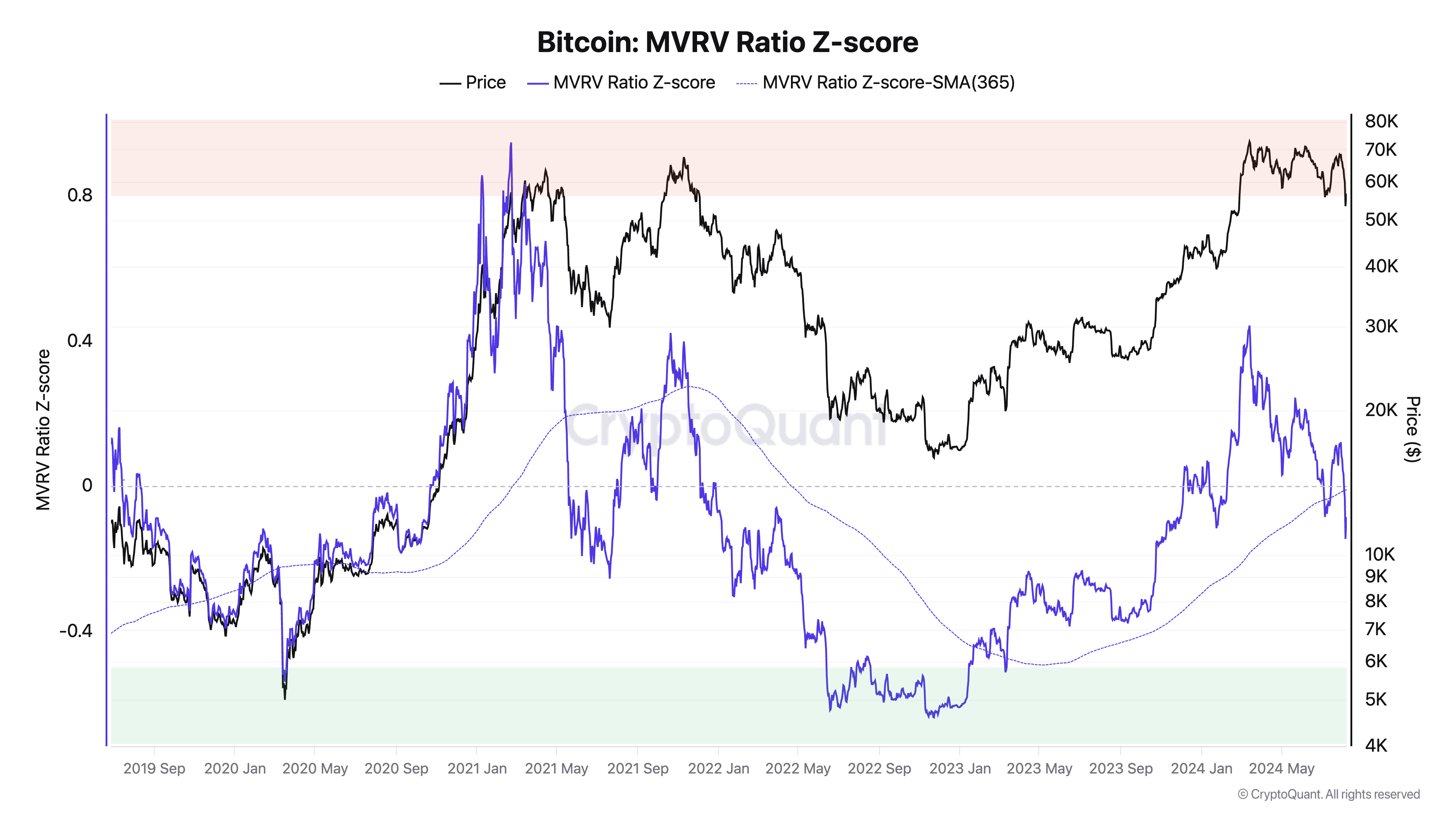
MVRV биткоина. Источник: CryptoQuant

Другой известный аналитик Евгений Нг А Сио указал на структурные недостатки, выявленные во время коррекции рынка. Его стратегия предполагает жесткий контроль над рисками, особенно в периоды высокой волатильности.

«Структура рынка для всех основных валют либо нарушена, либо выглядит крайне мрачно. Я обычно не хочу оставаться агрессивно настроенным на покупку, когда на рынке столько неопределенности и слабости», — написал он.

В отличие от распространенного страха, охватившего рынок, гендиректор компании Real Vision Рауль Пал остается оптимистичным.

«Дальше — период высокой волатильности и неопределенности, так называемая банановая зона. Я не хочу, чтобы вы пропустили это из-за того, что попались на краткосрочные временные рамки трейдеров в X», — объяснил он.

По мнению Пала, за просадкой всегда следует взлет. На это указывают исторические данные, когда серьезные падения сменялись мощными подъемами.

Читайте также: Прогноз биткоина на август 2024 — мнения экспертов
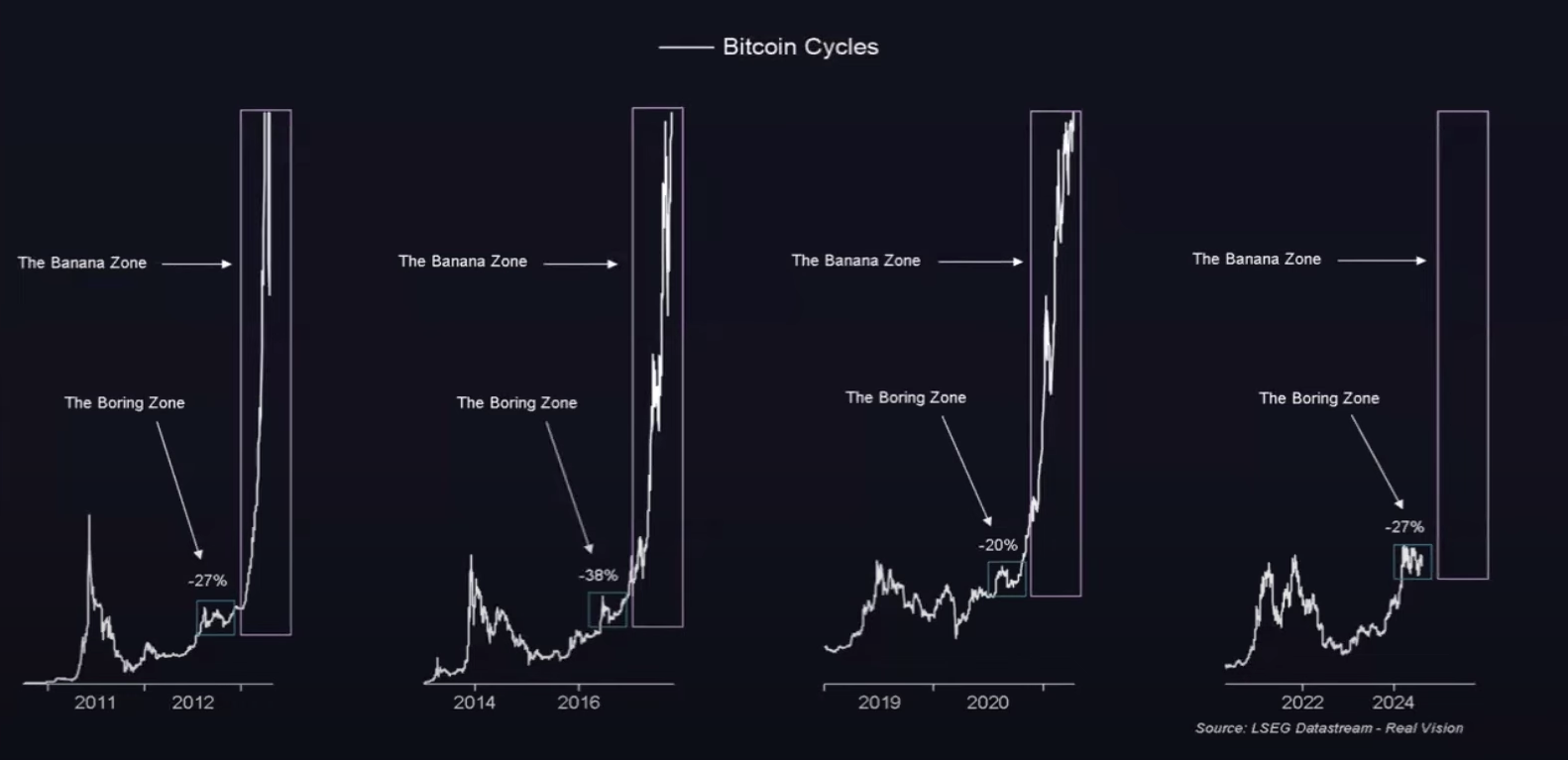
Циклы BTC и банановая зона. Источник: Raoul Pal

Между тем генеральный директор аналитической площадки CryptoQuant указал на тихое, но значительное накопление биткоина долгосрочными инвесторами. По словам Ки Янг Ю, за последний месяц киты накопили 404 448 BTC на сумму в $23 млрд.

«В течение года различные субъекты — будь то традиционные финансовые институты, компании, правительства или другие — объявят о покупке биткоина в третьем квартале 2024 года. И розничные инвесторы будут жалеть, что не купили его раньше, беспокоясь о продаже немецким правительством, Mt. Gox или других макроэкономических проблемах», — спрогнозировал Ю.


Trending Cryptos

Related Reads

DRAM ETF Issuer: Samsung, SK Hynix, Micron All Surpass $1 Trillion, the AI Era of Memory Chips Has Only Just Begun

Authors: Dave Mazza, Thomas DiFazio | Source: Deep Tide TechFlow The article, written by Roundhill Investments (issuer of the DRAM ETF), responds to Morningstar's caution about investing in memory chip stocks. Morningstar warns of the sector's history of boom-bust cycles, a lack of economic moats, and potential momentum-driven overvaluation. Roundhill argues the current situation is structurally different due to AI. Key points in Roundhill's rebuttal include: * **Changed Demand & Supply Dynamics:** AI infrastructure, not consumer electronics, is now the primary growth driver for memory demand. New, strict long-term supply agreements with hyperscalers reflect the high capital intensity of advanced manufacturing. * **Existence of a Moat:** High-Bandwidth Memory (HBM), essential for AI, has extremely high manufacturing barriers. The market is dominated by Samsung, SK Hynix, and Micron, with new entrants blocked by technological complexity and long lead times for equipment like ASML's EUV machines. * **Strong Fundamental Outlook:** Analyst consensus projects the three companies will rank among the world's most profitable by 2027, with combined profits of $704 billion on over $1 trillion in revenue. Their operating margins have already reached record highs. * **Valuation Re-rating:** Despite significant stock price gains, memory stocks trade at attractive valuations (e.g., a median NTM P/E of 8.37x for the DRAM ETF) relative to projected explosive EPS growth. Roundhill suggests historical valuation frameworks may no longer apply given the new profitability paradigm. Conclusion: Roundhill contends the rally is justified by fundamentals, marking a structural shift for the memory industry into a new era of sustained, AI-driven demand against constrained supply, rather than a repeat of past cycles.

marsbit53m ago

DRAM ETF Issuer: Samsung, SK Hynix, Micron All Surpass $1 Trillion, the AI Era of Memory Chips Has Only Just Begun

marsbit53m ago

EF's Epic Reorganization: 20% Layoffs, Budget Halved, Is Ethereum Gearing Up for a Leaner Future?

The Ethereum Foundation (EF) has announced a major organizational restructuring, involving a 20% staff reduction (approx. 54 employees) and a division into functional clusters like Protocol, Access, User, Community, and Institutional layers. Co-founder Vitalik Buterin further revealed plans to cut the EF's budget by around 40% over the coming years, aiming to reduce its annual spending rate from about 15% to roughly 5% by 2030, transitioning to an endowment-driven model. This overhaul is seen as a long-overdue correction to the EF's ambiguous role. As Ethereum grew, the foundation faced persistent criticism over ETH sales, perceived lack of execution, and unclear strategy, often becoming a focal point for community frustration amid ETH's price stagnation. The reform aims to redefine the EF's boundaries, narrowing its focus to core protocol research, public goods funding, and ecosystem coordination, while offloading more applied development work to the broader market. Concurrently, ecosystem forces like the newly formed Ethlabs (founded by ex-EF researchers) and other independent groups are stepping in to fill the space, signaling a shift from a centralized model to a more distributed, collaborative ecosystem structure. The move was notably praised by Solana co-founder toly, who viewed a "leaner" EF as potentially more decisive and agile.

Odaily星球日报1h ago

EF's Epic Reorganization: 20% Layoffs, Budget Halved, Is Ethereum Gearing Up for a Leaner Future?

Odaily星球日报1h ago

Trading

Spot
Futures

Hot Articles

What is $BITCOIN

DIGITAL GOLD ($BITCOIN): A Comprehensive Analysis Introduction to DIGITAL GOLD ($BITCOIN) DIGITAL GOLD ($BITCOIN) is a blockchain-based project operating on the Solana network, which aims to combine the characteristics of traditional precious metals with the innovation of decentralized technologies. While it shares a name with Bitcoin, often referred to as “digital gold” due to its perception as a store of value, DIGITAL GOLD is a separate token designed to create a unique ecosystem within the Web3 landscape. Its goal is to position itself as a viable alternative digital asset, although specifics regarding its applications and functionalities are still developing. What is DIGITAL GOLD ($BITCOIN)? DIGITAL GOLD ($BITCOIN) is a cryptocurrency token explicitly designed for use on the Solana blockchain. In contrast to Bitcoin, which provides a widely recognized value storage role, this token appears to focus on broader applications and characteristics. Notable aspects include: Blockchain Infrastructure: The token is built on the Solana blockchain, known for its capacity to handle high-speed and low-cost transactions. Supply Dynamics: DIGITAL GOLD has a maximum supply capped at 100 quadrillion tokens (100P $BITCOIN), although details regarding its circulating supply are currently undisclosed. Utility: While precise functionalities are not explicitly outlined, there are indications that the token could be utilized for various applications, potentially involving decentralized applications (dApps) or asset tokenization strategies. Who is the Creator of DIGITAL GOLD ($BITCOIN)? At present, the identity of the creators and development team behind DIGITAL GOLD ($BITCOIN) remains unknown. This situation is typical among many innovative projects within the blockchain space, particularly those aligning with decentralized finance and meme coin phenomena. While such anonymity may foster a community-driven culture, it intensifies concerns about governance and accountability. Who are the Investors of DIGITAL GOLD ($BITCOIN)? The available information indicates that DIGITAL GOLD ($BITCOIN) does not have any known institutional backers or prominent venture capital investments. The project seems to operate on a peer-to-peer model focused on community support and adoption rather than traditional funding routes. Its activity and liquidity are primarily situated on decentralized exchanges (DEXs), such as PumpSwap, rather than established centralized trading platforms, further highlighting its grassroots approach. How DIGITAL GOLD ($BITCOIN) Works The operational mechanics of DIGITAL GOLD ($BITCOIN) can be elaborated on based on its blockchain design and network attributes: Consensus Mechanism: By leveraging Solana’s unique proof-of-history (PoH) combined with a proof-of-stake (PoS) model, the project ensures efficient transaction validation contributing to the network's high performance. Tokenomics: While specific deflationary mechanisms have not been extensively detailed, the vast maximum token supply implies that it may cater to microtransactions or niche use cases that are still to be defined. Interoperability: There exists the potential for integration with Solana’s broader ecosystem, including various decentralized finance (DeFi) platforms. However, the details regarding specific integrations remain unspecified. Timeline of Key Events Here is a timeline that highlights significant milestones concerning DIGITAL GOLD ($BITCOIN): 2023: The initial deployment of the token occurs on the Solana blockchain, marked by its contract address. 2024: DIGITAL GOLD gains visibility as it becomes available for trading on decentralized exchanges like PumpSwap, allowing users to trade it against SOL. 2025: The project witnesses sporadic trading activity and potential interest in community-led engagements, although no noteworthy partnerships or technical advancements have been documented as of yet. Critical Analysis Strengths Scalability: The underlying Solana infrastructure supports high transaction volumes, which could enhance the utility of $BITCOIN in various transaction scenarios. Accessibility: The potential low trading price per token could attract retail investors, facilitating wider participation due to fractional ownership opportunities. Risks Lack of Transparency: The absence of publicly known backers, developers, or an audit process may yield skepticism regarding the project's sustainability and trustworthiness. Market Volatility: The trading activity is heavily reliant on speculative behavior, which can result in significant price volatility and uncertainty for investors. Conclusion DIGITAL GOLD ($BITCOIN) emerges as an intriguing yet ambiguous project within the rapidly evolving Solana ecosystem. While it attempts to leverage the “digital gold” narrative, its departure from Bitcoin's established role as a store of value underscores the need for a clearer differentiation of its intended utility and governance structure. Future acceptance and adoption will likely depend on addressing the current opacity and defining its operational and economic strategies more explicitly. Note: This report encompasses synthesised information available as of October 2023, and developments may have transpired beyond the research period.

440 Total ViewsPublished 2025.05.13Updated 2025.05.13

What is $BITCOIN

Discussions

Welcome to the HTX Community. Here, you can stay informed about the latest platform developments and gain access to professional market insights. Users' opinions on the price of BTC (BTC) are presented below.

活动图片