Solana强劲反弹,在情绪高涨时对比特币上涨15%

币界网Published on 2024-08-07Last updated on 2024-08-07

币界网报道:

根据市场情报资源Santiment的数据,索拉纳(SOL)在过去24小时内大幅上涨,在市场情绪高涨的情况下上涨了7.5%。

按市值计算,SOL是第五大资产,其价格表现尤其受到人群情绪的影响。

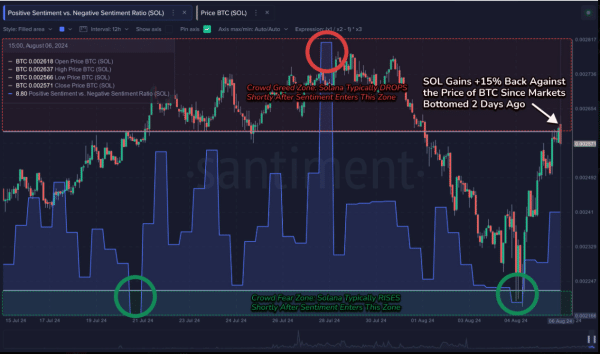
如果市场乐观情绪持续下去,最近的积极情绪可能会推动进一步上涨。Santiment图表对比分析了SOL与比特币(BTC)的价格,并强调了情绪驱动的价格走势。

Screenshot 29

积极情绪与消极情绪之比

情绪比率由Santiment图表上的蓝色阴影区域显示。情绪的显著飙升与SOL的价格走势相关,特别是在已确定的人群贪婪和人群恐惧区域内。

7月28日左右,观察到红色标记的人群贪婪区,SOL通常在情绪高涨后下跌,Solana价格随后暴跌。7月21日和8月4日注意到绿色标记的人群恐惧区,SOL在进入后通常会上升。

例如,在7月21日左右进入恐惧区与随后的价格上涨相对应,反映了市场情绪对SOL表现的影响。从7月份的恐惧水平反弹证实了对索拉纳的强劲支持,并表明了持续看涨势头的潜力。

SOL/BTC价格比率展示了SOL对BTC的表现,突出了情绪影响价格走势的关键事件。自两天前市场触底以来,SOL兑BTC上涨了15%,表明强劲复苏。

技术终点

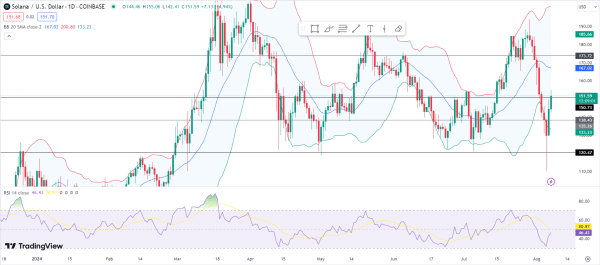
技术分析支持这一说法,SOL价格最近反弹至布林带中段,反映出购买压力增加。

Screenshot 27

RSI为46.43,表明从超卖状态中复苏,进一步支持看涨情绪。值得注意的是,MACD和信号线显示出潜在看涨交叉的迹象,表明价格持续上涨。

根据The Crypto Basic之前的分析,尽管市场崩盘,Solana最近在支撑趋势线上表现出看涨的主导地位,从110美元反弹至150美元的水平。这标志着40%的复苏。

目前交易价格为153美元,Solana在V型复苏中形成了第二支看涨蜡烛,旨在重新挑战头顶的破趋势线。

Trending Cryptos

Related Reads

Citi Research Report Analysis: U.S. Proposed Ban on Chinese Optical Modules Has No Substantial Progress, Short-term Enforcement Faces Supply Constraints

Citi Report Analysis: U.S. Proposed Ban on Chinese Optical Modules Lacks Substantive Progress, Faces Supply Bottlenecks in Short Term. Reuters reported on August 4th that the U.S. government and FCC are considering a ban on Chinese optical modules. Citi's August 9th report clarifies that optical modules are not listed on any effective FCC ban. The FCC's Order 26-50 established two restricted list mechanisms (based on manufacturer and production location), but optical modules were only mentioned once, as an example in a disclosure requirement, not as a restricted product. The reported ban remains at a proposal stage. Citi estimates Chinese suppliers provide 60-70% of high-speed optical modules for U.S. hyperscalers. Non-Chinese suppliers cannot fill this gap in the short term, making the immediate implementation of a genuine ban unlikely. Future regulatory paths could be manufacturer-based (least likely), location-based covering all offshore production (strictest), or location-based covering only China (more feasible but with unresolved definitions). A ban would pressure U.S. AI infrastructure, conflicting with stated policy goals. Citi sees low near-term implementation probability, with the issue potentially becoming a negotiation chip in bilateral talks. U.S. domestic capacity build-out is a key long-term variable. Among Chinese companies, XSENS and Dongshan Precision have the highest U.S. exposure, while Tianfu Communication, as a passive component supplier, is relatively insulated. Citi maintains Buy ratings on all three with respective price targets. The conclusion is that Chinese modules are currently irreplaceable in the U.S. AI supply chain, creating a longer timeline for potential restrictions than the market may expect.

marsbit36m ago

Citi Research Report Analysis: U.S. Proposed Ban on Chinese Optical Modules Has No Substantial Progress, Short-term Enforcement Faces Supply Constraints

marsbit36m ago

Lead Analyst Claims Bitcoin is at a Critical Stage: 'We are at the Bear Market Bottom, What Happens Next…'

Renowned cryptocurrency analyst Benjamin Cowen, in his latest analysis video, examined recent events and historical cycles in the Bitcoin market. Noting Bitcoin's trading range of $64,000 to $65,000, Cowen stated that market dynamics and investor interest show similarities to past cycles, suggesting the upcoming period marks a critical turning point. Cowen observed a significant decline in public interest and investor enthusiasm for the crypto market, with social risk metrics falling to 0.2, far below levels seen four years ago. He added that market volatility has notably decreased, and a sense of distrust prevails among investors, drawing parallels to the ends of bear markets in 2018 and 2022. Historical data indicates Bitcoin markets typically bottom in summer months, followed by a period of stagnation with low volatility, implying a major move could occur in the year's final quarter. However, Cowen noted on-chain indicators like the MVRV Z-Score have not yet signaled a definitive bottom. Cowen believes an event in the coming weeks could shake the market, potentially triggering a final sell-off wave. Such an event, he argues, would bring investors back and pave the way for a new bull cycle. He predicts October as the most likely bottoming period, while acknowledging September or November are also possible, advising crypto users to remain cautious and prepared for a decisive market moment.

cryptonews.ru45m ago

Lead Analyst Claims Bitcoin is at a Critical Stage: 'We are at the Bear Market Bottom, What Happens Next…'

cryptonews.ru45m ago

Bitcoin Community in Uproar: Deciphering the New Scaling War Sparked by BIP-110

On August 10, Luke Dashjr, a long-time Bitcoin Improvement Proposal (BIP) editor and co-founder of Ocean mining pool, was removed from the BIP editing team for bypassing discussion protocols and preemptively assigning a number to BIP-110, a controversial soft fork proposal he helped draft. The conflict stems from Bitcoin Core's version 30 release in October 2025, which removed the default 83-byte limit on OP_RETURN, a field used for embedding non-transaction data. In response, BIP-110 aimed to enforce this limit as a consensus rule. It controversially lowered the activation threshold for miners to 55% and included a mandatory activation clause, causing significant community backlash. Major mining pools like Foundry USA and AntPool did not support it, with public criticism from figures like F2Pool's Wang Chun and Michael Saylor, who argued it compromised Bitcoin's neutrality. On August 8, at block height 961,632, nodes running the BIP-110 patch rejected the main chain block, causing a chain split. The minority chain, supported by only about 2.53% of the network's hash rate, produced just one additional block before stalling. The main chain quickly outpaced it by over 240 blocks. No major exchanges have supported the minority chain. The event highlighted Bitcoin's governance reality: while rules can be proposed by a few, ultimate authority lies with the economic majority—miners willing to expend hash power and users/exchanges recognizing a chain's validity. Following the failed split, BIP-110 proponents, including Luke Dashjr, have begun discussing a change to the proof-of-work algorithm to create a separate coin, though this remains in early discussion stages.

marsbit1h ago

Bitcoin Community in Uproar: Deciphering the New Scaling War Sparked by BIP-110

marsbit1h ago

Trading

Spot

Hot Articles

What is $BITCOIN

DIGITAL GOLD ($BITCOIN): A Comprehensive Analysis Introduction to DIGITAL GOLD ($BITCOIN) DIGITAL GOLD ($BITCOIN) is a blockchain-based project operating on the Solana network, which aims to combine the characteristics of traditional precious metals with the innovation of decentralized technologies. While it shares a name with Bitcoin, often referred to as “digital gold” due to its perception as a store of value, DIGITAL GOLD is a separate token designed to create a unique ecosystem within the Web3 landscape. Its goal is to position itself as a viable alternative digital asset, although specifics regarding its applications and functionalities are still developing. What is DIGITAL GOLD ($BITCOIN)? DIGITAL GOLD ($BITCOIN) is a cryptocurrency token explicitly designed for use on the Solana blockchain. In contrast to Bitcoin, which provides a widely recognized value storage role, this token appears to focus on broader applications and characteristics. Notable aspects include: Blockchain Infrastructure: The token is built on the Solana blockchain, known for its capacity to handle high-speed and low-cost transactions. Supply Dynamics: DIGITAL GOLD has a maximum supply capped at 100 quadrillion tokens (100P $BITCOIN), although details regarding its circulating supply are currently undisclosed. Utility: While precise functionalities are not explicitly outlined, there are indications that the token could be utilized for various applications, potentially involving decentralized applications (dApps) or asset tokenization strategies. Who is the Creator of DIGITAL GOLD ($BITCOIN)? At present, the identity of the creators and development team behind DIGITAL GOLD ($BITCOIN) remains unknown. This situation is typical among many innovative projects within the blockchain space, particularly those aligning with decentralized finance and meme coin phenomena. While such anonymity may foster a community-driven culture, it intensifies concerns about governance and accountability. Who are the Investors of DIGITAL GOLD ($BITCOIN)? The available information indicates that DIGITAL GOLD ($BITCOIN) does not have any known institutional backers or prominent venture capital investments. The project seems to operate on a peer-to-peer model focused on community support and adoption rather than traditional funding routes. Its activity and liquidity are primarily situated on decentralized exchanges (DEXs), such as PumpSwap, rather than established centralized trading platforms, further highlighting its grassroots approach. How DIGITAL GOLD ($BITCOIN) Works The operational mechanics of DIGITAL GOLD ($BITCOIN) can be elaborated on based on its blockchain design and network attributes: Consensus Mechanism: By leveraging Solana’s unique proof-of-history (PoH) combined with a proof-of-stake (PoS) model, the project ensures efficient transaction validation contributing to the network's high performance. Tokenomics: While specific deflationary mechanisms have not been extensively detailed, the vast maximum token supply implies that it may cater to microtransactions or niche use cases that are still to be defined. Interoperability: There exists the potential for integration with Solana’s broader ecosystem, including various decentralized finance (DeFi) platforms. However, the details regarding specific integrations remain unspecified. Timeline of Key Events Here is a timeline that highlights significant milestones concerning DIGITAL GOLD ($BITCOIN): 2023: The initial deployment of the token occurs on the Solana blockchain, marked by its contract address. 2024: DIGITAL GOLD gains visibility as it becomes available for trading on decentralized exchanges like PumpSwap, allowing users to trade it against SOL. 2025: The project witnesses sporadic trading activity and potential interest in community-led engagements, although no noteworthy partnerships or technical advancements have been documented as of yet. Critical Analysis Strengths Scalability: The underlying Solana infrastructure supports high transaction volumes, which could enhance the utility of $BITCOIN in various transaction scenarios. Accessibility: The potential low trading price per token could attract retail investors, facilitating wider participation due to fractional ownership opportunities. Risks Lack of Transparency: The absence of publicly known backers, developers, or an audit process may yield skepticism regarding the project's sustainability and trustworthiness. Market Volatility: The trading activity is heavily reliant on speculative behavior, which can result in significant price volatility and uncertainty for investors. Conclusion DIGITAL GOLD ($BITCOIN) emerges as an intriguing yet ambiguous project within the rapidly evolving Solana ecosystem. While it attempts to leverage the “digital gold” narrative, its departure from Bitcoin's established role as a store of value underscores the need for a clearer differentiation of its intended utility and governance structure. Future acceptance and adoption will likely depend on addressing the current opacity and defining its operational and economic strategies more explicitly. Note: This report encompasses synthesised information available as of October 2023, and developments may have transpired beyond the research period.

1.7k Total ViewsPublished 2025.05.13Updated 2025.05.13
What is $BITCOIN

Discussions

Welcome to the HTX Community. Here, you can stay informed about the latest platform developments and gain access to professional market insights. Users' opinions on the price of BTC (BTC) are presented below.

活动图片