ICP与BTC的相关性、或将引发ICP进一步上涨

金色财经Published on 2024-08-06Last updated on 2024-08-06

  • 从 90 天相关性来看,互联网计算机的发展方向与比特币类似。

  • 这种关联性推动了ICP近期的价格上涨,而关键的整合则可以增强其价格。

  • ICP 的价格在 20 EMA 之上交易,超级趋势支持该代币的看涨前景。

HxqxJ4EuGh8HNecrwXaJF6KdfkTuph3clNItC04a.jpeg

并非所有加密货币都会相互影响。然而,互联网计算机(ICP)已经与比特币(BTC)挂钩一段时间了。

山寨币最终会走出自己的道路吗?这一链上分析证明,投资者短期内可能不想押注于此。

ICP与BTC步调一致

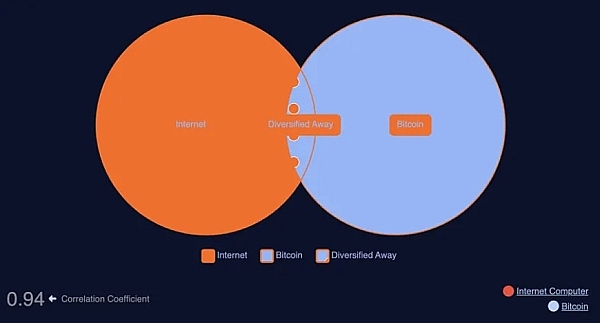
根据 Macroaxis 的数据,ICP 和 BTC 之间的 90 天相关性为 0.94。相关系数为 1 或接近 1 意味着两种加密货币的价格大多数时候都朝着相似的方向变动。

然而,当系数接近 -1 时,表明分歧很大。在 90 天的时间范围内,Internet Computer 的表现不及 BTC,尤其是因为它产生了负收益。 

在同一时间段内,比特币的价格回报并不令人印象深刻。但是,它并不像 ICP 那样令人失望。

kYUEA6gFewatbz4nUJNw8PBi9L7LpEsIckGyziej.jpeg

然而,这种强烈的相关性可能与ICP在过去 30 天内的复苏有关,当时 ICP 的价格与 BTC 同步上涨,上涨了 23.55%。

此外,链上环境之外的发展表明,有可能看到更强的相关性。 

这是因为数字资产抵押品管理公司 Copper.co 已经建立了支持互联网计算机网络上 BTC 交互的跨链基础设施。 

通过这样的跨链交互,流动性可以轻松地在网络之间移动,有时,所涉及网络的本机加密货币会相互受益,同时朝着相似的方向发展。 

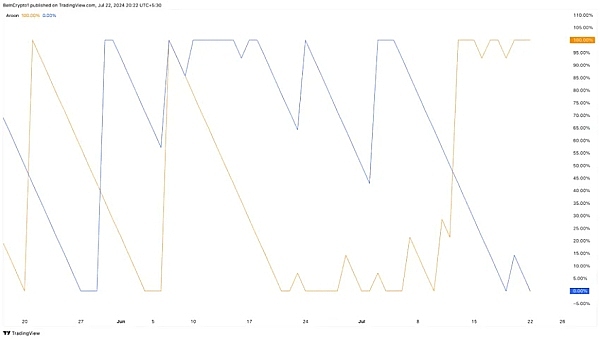
BTC的价格可能会走高。如果这一预测得到证实,ICP 可能会效仿。Aroon 指标也证实了这一预测。

该指标有两条线:Aroon Up(橙色)和 Aroon Down(蓝色)。总之,它显示加密货币的价格是开始新的趋势、改变趋势还是继续朝特定方向发展。

73fvyC4eZ71JUa9HQ0Vv9373EF23elJoxbctCTWo.jpeg

从上图中我们观察到 Aroon Up 要高得多,这表明 ICP 的价格可能保持看涨势头。

ICP 价格预测:能否飙升至 12 美元以上?

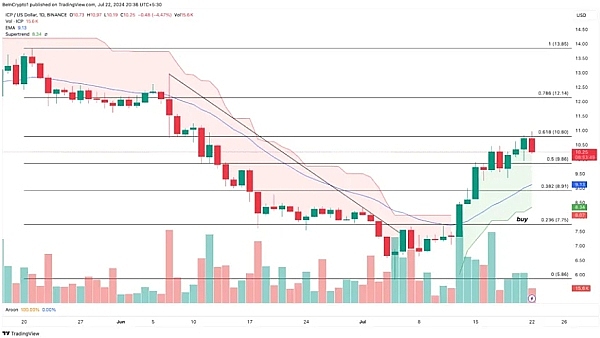
ICP于7月6日突破了下行趋势,这对其近期的上涨至关重要。虽然该代币的交易价格为 10.25 美元,但仍高于 20 EMA(蓝色),该价格为 9.13 美元。

EMA 代表指数移动平均线。当价格高于该值时,趋势为看涨,但如果低于该值,趋势为看跌。因此,当前的 ICP 条件意味着代币上涨的可能性高于下跌的可能性。

此外,Supertrend 在 8.34 美元发出了买入信号。此技术分析工具显示了加密货币遵循的趋势。如果红色区域出现在价格上方,则为卖出信号,价格可能会下降。

超级趋势的绿色部分徘徊在 ICP 价格以下,表明代币的价值可能更高。

QD36S9Wdbsa9Shw9SNz2oogaNYykGOQcUtvTWi1M.jpeg

如果购买压力增加,斐波那契回撤指标显示 ICP 可能达到 10.80 美元。

如果多头维持上涨趋势,价格可能会在未来几天达到 12.14 美元。但是,如果代币价格跌破 20 EMA,这一预测可能不会实现。如果是这样的话,ICP 的价格可能会降至 9.86 美元。

Trending Cryptos

Related Reads

From Polymarket to U.S. Stock Trading: How Events Map to Asset Prices

From Polymarket to Stock Trading: How Events Map to Asset Prices Polymarket, a prediction market platform, lists numerous contracts tied to financial events like CPI reports, nonfarm payrolls, FOMC decisions, regulatory policies, and major corporate earnings—all of which influence US stock prices. Instead of relying solely on static analyst forecasts, Polymarket converts expectations of different event outcomes into real-time prices, allowing traders to observe what the market is currently pricing in. The core mechanism can be summarized as: Event Probability → Market Expectations → Changes in Interest Rates, Earnings, or Risk Appetite → Repricing of US Stocks. The primary use of Polymarket is to identify the market's current "anchor" of expectations and the direction in which those expectations are shifting. For traders, the key isn't trading the event itself, but the deviation of the actual outcome from these pre-event expectations. Polymarket helps pinpoint which outcomes are already heavily priced in and which low-probability results could cause significant market shocks if they occur. Furthermore, traders can use Polymarket for cross-market validation. A divergence—for instance, rising inflation probabilities on Polymarket without a corresponding move in Treasury yields or the US dollar—may signal a mispricing or that other markets are discounting the risk. Conversely, if asset prices move sharply while Polymarket probabilities remain stable, it suggests the market is trading on risks not yet reflected in the prediction markets. To utilize this tool, traders should: 1) Understand the event and its settlement rules, 2) Monitor Polymarket's probability levels, momentum, and market depth, 3) Determine if the event primarily impacts interest rates, corporate earnings, or risk sentiment, 4) Identify the most sensitive assets (e.g., indices, sectors, stocks), 5) Validate signals with moves in Treasury yields, the dollar, the VIX, and options markets, and 6) Act on any identified pricing discrepancies. In conclusion, Polymarket serves best as an event expectation monitor, a cross-market verification tool, and a reference for tail risks. Its value lies not in triggering trades based on probability shifts alone, but in integrating those shifts into the broader asset pricing framework—considering interest rates, earnings, and risk premiums—and then validating them against actual market prices. The key lesson is to watch what the market does, not just what analysts say.

marsbit18m ago

From Polymarket to U.S. Stock Trading: How Events Map to Asset Prices

marsbit18m ago

Hyperliquid's Open Interest Hits Record High, Yet Revenue Declines for Four Consecutive Quarters: Where's the Money Going?

Hyperliquid, a derivatives trading platform, has seen its open interest (OI) for perpetual contracts surge to a record high of over $11 billion, capturing about 9% of the global perpetual OI. However, the protocol's revenue has declined for four consecutive quarters, falling 43% from its Q3 2025 peak to approximately $202 million in Q2 2026. This revenue drop is largely attributed to Hyperliquid Improvement Proposal (HIP)-3, implemented in October 2025. This mechanism allows external developers who stake 500,000 HYPE (~$28 million) to deploy their own perpetual markets on Hyperliquid and keep up to half of the trading fees. Markets created by these third parties, primarily offering real-world asset (RWA) perps like stocks and commodities, now account for nearly 50% of the platform's volume, up from just 2% earlier in 2026. Consequently, the share of fees distributed to developers, market makers, and the liquidity treasury has risen from 6% to 18% of total revenue year-over-year. The RWA perpetual boom, dominated by a single entity (Trade.xyz with over 90% of HIP-3 OI), carries concentration and operational risks, as evidenced by a recent incident causing a 19% price crash in a SK Hynix contract. Lower platform revenue directly reduces the buyback and burn of the HYPE token, with repurchases nearly halving from $290 million in Q3 2025 to $149 million in Q2 2026. HYPE's price has fallen 28% from its June all-time high. Additional pressures include significant monthly token unlocks for core contributors beginning in August, regulatory warnings from authorities in Singapore and the UK, potential CFTC scrutiny in the US, and emerging competition. While Hyperliquid remains a major revenue generator in crypto, its model of sharing fees with external builders is currently diminishing the earnings that support the HYPE token's value.

marsbit24m ago

Hyperliquid's Open Interest Hits Record High, Yet Revenue Declines for Four Consecutive Quarters: Where's the Money Going?

marsbit24m ago

Trading

Spot

Hot Articles

What is $BITCOIN

DIGITAL GOLD ($BITCOIN): A Comprehensive Analysis Introduction to DIGITAL GOLD ($BITCOIN) DIGITAL GOLD ($BITCOIN) is a blockchain-based project operating on the Solana network, which aims to combine the characteristics of traditional precious metals with the innovation of decentralized technologies. While it shares a name with Bitcoin, often referred to as “digital gold” due to its perception as a store of value, DIGITAL GOLD is a separate token designed to create a unique ecosystem within the Web3 landscape. Its goal is to position itself as a viable alternative digital asset, although specifics regarding its applications and functionalities are still developing. What is DIGITAL GOLD ($BITCOIN)? DIGITAL GOLD ($BITCOIN) is a cryptocurrency token explicitly designed for use on the Solana blockchain. In contrast to Bitcoin, which provides a widely recognized value storage role, this token appears to focus on broader applications and characteristics. Notable aspects include: Blockchain Infrastructure: The token is built on the Solana blockchain, known for its capacity to handle high-speed and low-cost transactions. Supply Dynamics: DIGITAL GOLD has a maximum supply capped at 100 quadrillion tokens (100P $BITCOIN), although details regarding its circulating supply are currently undisclosed. Utility: While precise functionalities are not explicitly outlined, there are indications that the token could be utilized for various applications, potentially involving decentralized applications (dApps) or asset tokenization strategies. Who is the Creator of DIGITAL GOLD ($BITCOIN)? At present, the identity of the creators and development team behind DIGITAL GOLD ($BITCOIN) remains unknown. This situation is typical among many innovative projects within the blockchain space, particularly those aligning with decentralized finance and meme coin phenomena. While such anonymity may foster a community-driven culture, it intensifies concerns about governance and accountability. Who are the Investors of DIGITAL GOLD ($BITCOIN)? The available information indicates that DIGITAL GOLD ($BITCOIN) does not have any known institutional backers or prominent venture capital investments. The project seems to operate on a peer-to-peer model focused on community support and adoption rather than traditional funding routes. Its activity and liquidity are primarily situated on decentralized exchanges (DEXs), such as PumpSwap, rather than established centralized trading platforms, further highlighting its grassroots approach. How DIGITAL GOLD ($BITCOIN) Works The operational mechanics of DIGITAL GOLD ($BITCOIN) can be elaborated on based on its blockchain design and network attributes: Consensus Mechanism: By leveraging Solana’s unique proof-of-history (PoH) combined with a proof-of-stake (PoS) model, the project ensures efficient transaction validation contributing to the network's high performance. Tokenomics: While specific deflationary mechanisms have not been extensively detailed, the vast maximum token supply implies that it may cater to microtransactions or niche use cases that are still to be defined. Interoperability: There exists the potential for integration with Solana’s broader ecosystem, including various decentralized finance (DeFi) platforms. However, the details regarding specific integrations remain unspecified. Timeline of Key Events Here is a timeline that highlights significant milestones concerning DIGITAL GOLD ($BITCOIN): 2023: The initial deployment of the token occurs on the Solana blockchain, marked by its contract address. 2024: DIGITAL GOLD gains visibility as it becomes available for trading on decentralized exchanges like PumpSwap, allowing users to trade it against SOL. 2025: The project witnesses sporadic trading activity and potential interest in community-led engagements, although no noteworthy partnerships or technical advancements have been documented as of yet. Critical Analysis Strengths Scalability: The underlying Solana infrastructure supports high transaction volumes, which could enhance the utility of $BITCOIN in various transaction scenarios. Accessibility: The potential low trading price per token could attract retail investors, facilitating wider participation due to fractional ownership opportunities. Risks Lack of Transparency: The absence of publicly known backers, developers, or an audit process may yield skepticism regarding the project's sustainability and trustworthiness. Market Volatility: The trading activity is heavily reliant on speculative behavior, which can result in significant price volatility and uncertainty for investors. Conclusion DIGITAL GOLD ($BITCOIN) emerges as an intriguing yet ambiguous project within the rapidly evolving Solana ecosystem. While it attempts to leverage the “digital gold” narrative, its departure from Bitcoin's established role as a store of value underscores the need for a clearer differentiation of its intended utility and governance structure. Future acceptance and adoption will likely depend on addressing the current opacity and defining its operational and economic strategies more explicitly. Note: This report encompasses synthesised information available as of October 2023, and developments may have transpired beyond the research period.

1.8k Total ViewsPublished 2025.05.13Updated 2025.05.13

What is $BITCOIN

Discussions

Welcome to the HTX Community. Here, you can stay informed about the latest platform developments and gain access to professional market insights. Users' opinions on the price of BTC (BTC) are presented below.

活动图片