Jump一周抛售上亿美元ETH,解析数额细节与潜在抛压

深潮Published on 2024-08-05Last updated on 2024-08-05

Jump Trading仍有少则1亿、多则数十亿美元的ETH。

作者:南枳,Odaily星球日报

今日,加密市场伴随全球经济衰退预期陷入恐慌式螺旋下跌,BTC 从 60000 万美元上方两天跌破 50000 万美元,ETH 自 3000 美元上方跌至最低 2100 美元附近。尽管宏观消息面上存在诸多利空,今日暴跌的主要场内诱因则被认为是知名加密机构 Jump Trading 的大举抛售。

一周之内,Jump Trading 迅猛地抛售了上亿美元的 ETH,结合此前其被美国商品期货交易委员会(CFTC)调查之事,本就恐慌的加密市场正在传言其加密相关业务或将被关停。

那么 Jump Trading 抛售了多少代币,还有多少持仓?Odaily 将于本文进行解析。

Jump 抛售细节

Jump Trading 相关地址的第一笔异动发生于 7 月 26 日,彼时某地址向 Jump Trading转入 7000 枚 ETH,价值约 2260 万美元。此时 ETH 刚刚经历了从 3500 USDT 到 3100 USDT 的暴跌。

两日后,Jump Trading开始了首次抛售,相关地址 将 4737 枚 ETH 存入币安,价值约 1540 万美元。

此后数日,Jump Trading 进行了一系列的资金归集操作,包括从 Lido 中解除质押 ETH、多次从其他钱包中转移 ETH,然后陆续将这些 ETH 存入了交易所。

Jump Trading 所持有的 ETH 代币中占比最高的形式是 12 万枚 wstETH,这些代币 Jump Trading 自 7 月 25 日以来就开始持续赎回。

截止发文时,Jump Trading 仍有约 3.7 万枚 wstETH,价值 1 亿美元,此外还有 800 万美元的 RETH,而赎回部分均已转移或销售完毕。

(Odaily 注:wstETH 持仓地址为0x48d62ED012E327FaaCb9c8d2A56330E215DA0575)
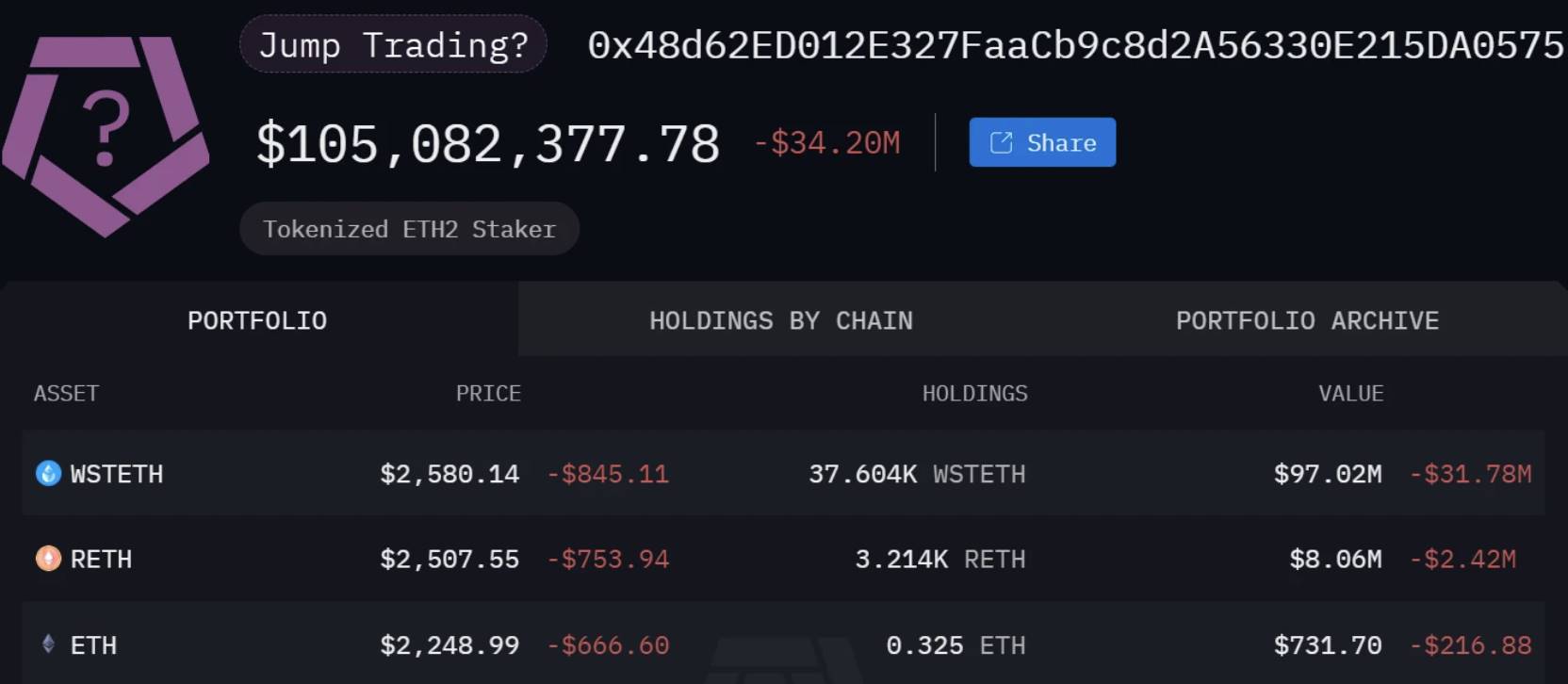
剩余持仓情况

今日上午,多个链上分析团队报道 Jump Trading 持仓中 96% 的代币为稳定币,实际上未纳入以上持有 1 亿美元 wstETH 的地址。

目前 Arkham 标记的 Jump Trading 地址持仓价值为 5.9 亿美元,其中 5.69 亿美元为稳定币,因此明面上的抛压为以上的 1 亿美元 ETH。
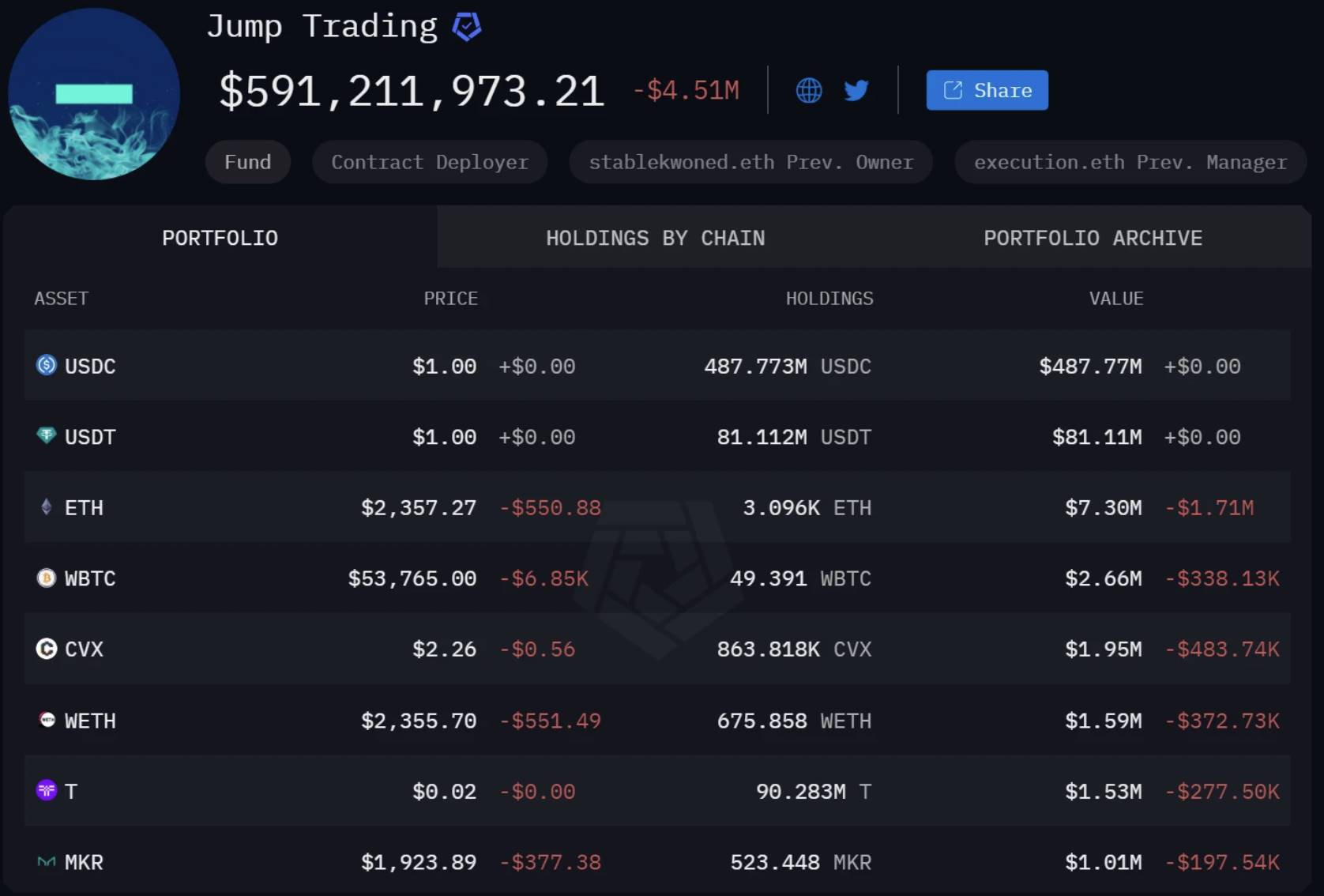
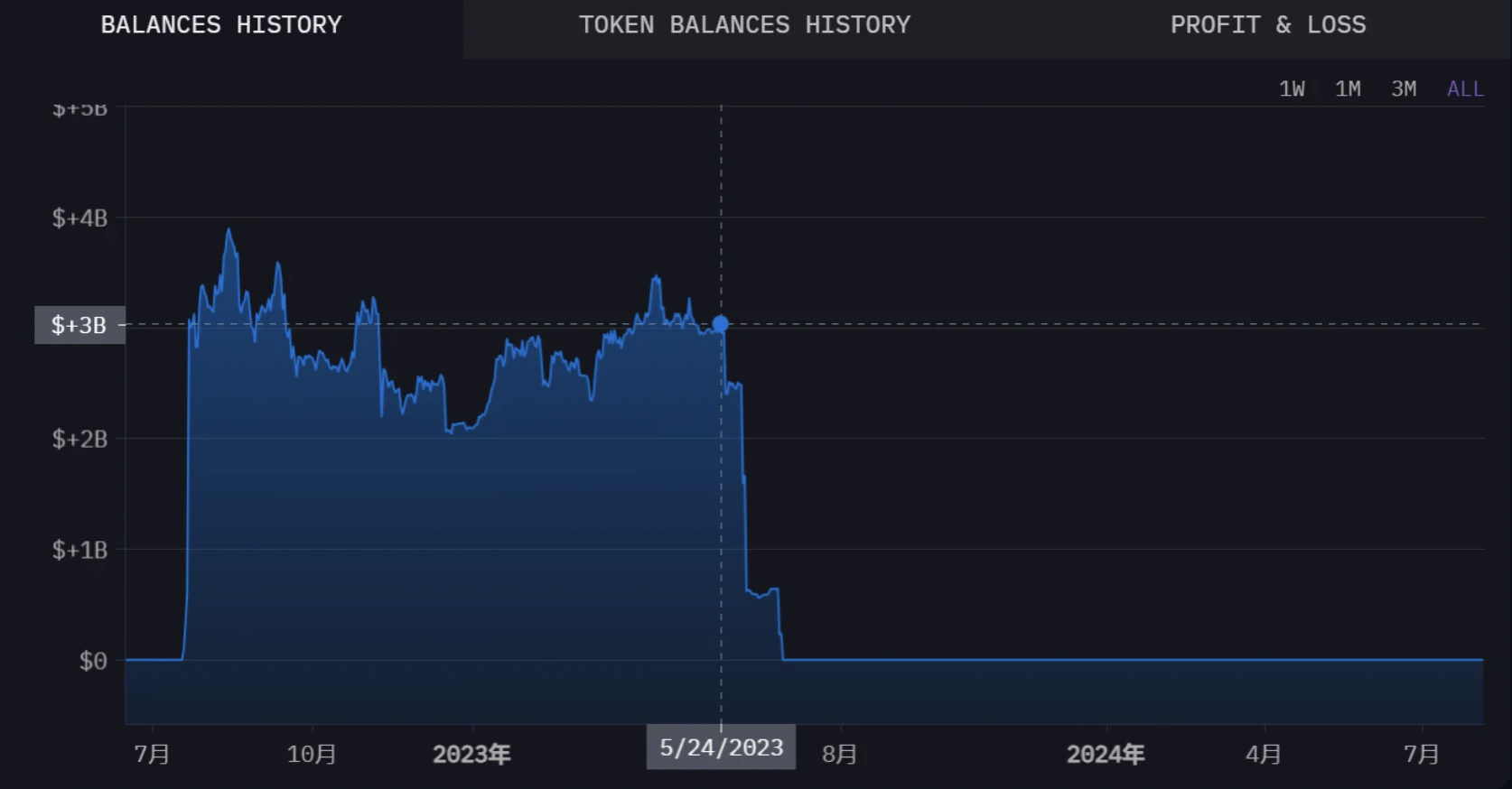
然而 Jump Trading 作为行业龙头,理论上的持仓量应远不止于这 6 亿美元。经 Odaily 调查发现,Jump Trading 的一个老地址在巅峰时期持有 164 万枚 ETH,按照 2300 USDT 的价格价值高达 37.7 亿美元。

不过由于 Jump Trading 在 2023 年 5 月和 6 月将以上百万枚 ETH 转入了 Robinhood,是否出售、转移暂时无法追踪,潜在的抛压量级无法估算,但值得关注。

(Odaily 注:Jump 的老地址为0x0716a17FBAeE714f1E6aB0f9d59edbC5f09815C0)
Jump 将退出加密领域?

为何 Jump 开始快速地抛售 ETH?现还没有公开的定论,但市场猜测此举与此前的 CFTC 调查有关。6 月 20 日,据一则市场消息,美国商品期货交易委员会(CFTC)正在调查 Jump Crypto,但尚不清楚 CFTC 是否考虑对该公司提出任何指控。4 天后,Jump Crypto 总裁 Kanav Kariya 在 X 平台宣布辞职

(Odaily 注:Jump Crypto 是 Jump Trading 的加密部门,于 2021 年 9 月成立。)

在 Jump 抛售 ETH 的过程中,加密货币做市商 Keyrock 亚太区业务发展主管 Justin d'Anethan 表示:“有传言称,由于 CFTC 的调查,他们(Jump Trading)可能被迫退出加密业务。”

今晨暴跌后,BitMEX 联创 Arthur Hayes 于 X 发文表示,其通过传统金融领域的消息渠道得知,某个“大人物”被处置并出售所有加密资产,其补充称不确定消息是否属实,但不会披露具体名称。根据种种迹象,社区猜测其所指为 Jump Crypto。

Jump 领投项目

倘若 Jump Trading 真的因为某些原因,被迫退出加密领域,Jump Crypto 领投的项目可能也将受到影响,我们将近两年 Jump Crypto 领投+已发币的项目整理如下,分别列出了项目名称、代币名称、投资轮次、代币当前的流通市值,轮次越早或持有的代币份额越多:

ZTX-ZTX-种子轮-1850 万美元;

Port3-PORT3-种子轮-489 万美元;

Sui-SUI-B 轮-12.9 亿美元;

Injective-INJ-上市后融资-14 亿美元;

Aptos-APT-A 轮-2.14 亿美元;

AltLayer-ALT-种子轮-1.64 亿美元;

Push Protocol-PUSH-A 轮-372 万美元;

Thetanuts Finance-NUTS-种子轮-500 万美元。

Trending Cryptos

Related Reads

Farewell to Speculation: The Graham Moment of the Crypto Industry

"Farewell to Speculation: The Graham Moment for the Crypto Industry" The article draws a parallel between today's cryptocurrency market and the speculative, unregulated US stock market of the 1920s. That era lacked mandatory corporate disclosure, enabling rampant manipulation and turning stocks into gambling tools. The 1929 crash led to foundational reforms: the Securities Acts of 1933/34 mandated transparent, audited financial reporting, and Benjamin Graham's "Security Analysis" provided a framework for fundamental valuation. Together, they created modern investing, requiring both reliable data and a methodology to value assets. Similarly, the crypto market is currently driven by narratives and speculation. However, it possesses a key advantage: unlike 1920s corporations, blockchain protocols have inherently transparent, on-chain data for revenue, treasury, and activity. The core obstacle is not transparency, but the lack of legal claim to that value. Due to regulatory uncertainty (primarily the Howey Test), most tokens are deliberately stripped of economic rights like profit-sharing to avoid being classified as securities. This creates a paradox where protocols generate revenue, but token holders have no right to it. The turning point, argues the author, is imminent US legislation. The already-passed GENIUS Act provides a framework for stablecoins. The crucial CLARITY Act, currently in advanced legislative stages, aims to clearly categorize digital assets and define their regulatory treatment (SEC vs. CFTC). This would allow developers to legally design tokens with enforceable economic rights, such as profit distribution. If passed, this would enable a shift from speculation to fundamental investment. Analysis would focus on protocol revenue sustainability, network effects, valuation multiples, and the specific rights encoded in a token's contract—mirroring traditional equity analysis. The article notes significant legislative hurdles and timelines (1-3 years for rulemaking post-passage), but emphasizes the direction is set. A deeper challenge remains: building decentralized, legally enforceable governance and ownership structures to protect token holder rights, akin to corporate law. This will be a core development focus. The transformation applies mainly to revenue-generating protocol tokens, not to assets like Bitcoin (digital gold). The article concludes that the industry's question has evolved from "can tokens create value?" to "who gets to allocate that value?". Solving the latter, as in the 1920s, will mark crypto's transition to a legitimate asset class for fundamental investment.

Foresight News10m ago

Farewell to Speculation: The Graham Moment of the Crypto Industry

Foresight News10m ago

Quantum Computing "Manhattan Project" Unveiled: Is the Encryption Industry at a Critical Turning Point?

"Quantum Computing 'Manhattan Project' Launched: Is the Crypto Industry at a Critical Juncture?" On June 22, former U.S. President Donald Trump signed two executive orders. The first mandates all federal agencies upgrade their cryptographic systems to new, quantum-resistant standards by 2030. The second orders the Department of Energy to lead the development of a national quantum computer, signaling a shift from laboratory research to a state-enforced national agenda. This creates a hard deadline. A powerful quantum computer could break current encryption. The threat is compounded by "harvest now, decrypt later" attacks, where encrypted data is stored today for future decryption. Federal agencies must appoint migration officers and complete post-quantum cryptography (PQC) upgrades for key establishment by 2030 and digital signatures by 2031. Procurement rules will also be changed, forcing government contractors to comply. The crypto industry faces a direct threat. Bitcoin's ECDSA signatures are theoretically vulnerable. Research indicates millions of Bitcoin with exposed public keys are at risk if quantum computers advance. While projects like Bitcoin Quantum testnets and efforts by Ethereum, Solana, NEAR, and Zcash are exploring quantum-resistant solutions, achieving consensus in decentralized networks remains a major challenge. The centralized U.S. government has started a 5-year countdown. For decentralized crypto networks, the real test is whether they can complete this anti-quantum upgrade before the theoretical threat becomes a practical reality.

Foresight News32m ago

Quantum Computing "Manhattan Project" Unveiled: Is the Encryption Industry at a Critical Turning Point?

Foresight News32m ago

Coin Stock Barometer丨BitMine's Total Assets and Investment Reach $10.7 Billion, Exceeding ~$9.3 Billion Floating Loss; Strategy Buys Only 520 BTC, Strive Adds Positions Against the Trend (June 23)

This article provides a weekly market update on "coin-equity" trends, focusing on listed companies holding major cryptocurrencies. Key highlights include: **General Market Trends:** Global equities, particularly in the US, Japan, and South Korea, faced significant sell-offs, led by large tech and AI-related stocks. Analysts cite profit-taking and a shift from hype-driven to performance-driven valuation for AI companies. Market focus is on upcoming Micron Technology's earnings. **Cryptocurrency Treasury Updates:** * **Bitcoin (BTC):** Net weekly BTC purchases by listed companies (excluding miners) totaled approximately $86 million, down 13.97% from the prior week. Strategy (formerly MicroStrategy) purchased only 520 BTC for ~$34.9 million, while Strive Asset Management increased its holdings by 759 BTC for ~$50 million. Other notable actions include Mara Holdings adding 1,000 BTC and Capital B shareholders approving a massive financing plan (up to ~$1.2 trillion) to potentially expand its Bitcoin reserves. * **Ethereum (ETH):** BitMine emerged as the largest corporate ETH treasury, holding 5.67 million ETH (4.7% of supply). It purchased an additional 52,203 ETH ($92 million) in the past week. Sharplink completed a $75 million private placement to fund further ETH accumulation and stock buybacks. * **Solana (SOL):** The top five listed companies hold over 15.7 million SOL combined. However, Solmate Infrastructure, a SOL treasury firm, faces a lawsuit from its largest external shareholder alleging board misconduct and self-dealing. * **Other:** Updates include Canton Strategic's $50 million stock buyback plan and Lite Strategy's $1 million strategic investment in LitVM, a Layer-2 network for Litecoin. The article notes that while crypto treasury firms continue fundraising and accumulation, their stocks may struggle to rise against the broader market downturn until Q4.

marsbit46m ago

Coin Stock Barometer丨BitMine's Total Assets and Investment Reach $10.7 Billion, Exceeding ~$9.3 Billion Floating Loss; Strategy Buys Only 520 BTC, Strive Adds Positions Against the Trend (June 23)

marsbit46m ago

Trading

Spot
Futures

Hot Articles

Discussions

Welcome to the HTX Community. Here, you can stay informed about the latest platform developments and gain access to professional market insights. Users' opinions on the price of ETH (ETH) are presented below.

活动图片