XRP價格暴跌:XRP Ledger交易量下降65.6% 它会否跌至$0.01?

cryptonewsPublished on 2024-08-04Last updated on 2024-08-05

Trending Cryptos

Related Reads
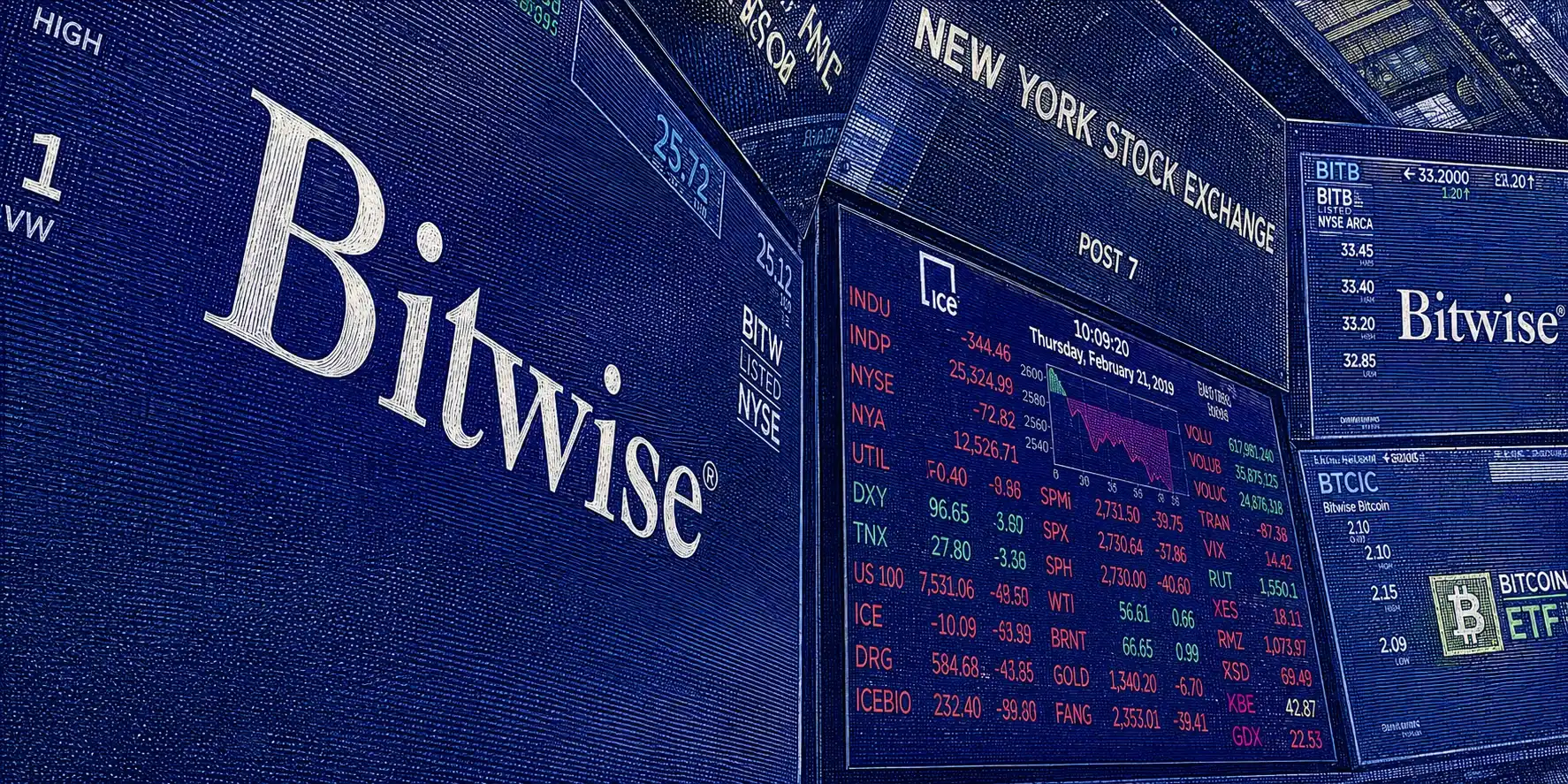
Bitwise Closes 8 ETFs and Cuts Staff by 14%, but Continues to Launch New Products

Bloomberg reported on August 12 that cryptocurrency asset management firm Bitwise has laid off approximately 14% of its staff, reducing headcount from around 180 to about 155 employees. CEO Hunter Horsley stated the adjusted team remains the largest in the company's eight-year history and expressed confidence in long-term growth, though current personnel and product configurations are tightening. Prior to the layoffs, Bitwise disclosed a significant drop in client assets from over $15 billion in early February to $11 billion by April 1st, a decrease of at least $4 billion. The company did not specify the contributions of price changes, fund flows, or changes in reporting scope to this decline. In a related product restructuring, Bitwise decided to liquidate eight ETFs between April and June. This included the Web3 ETF, a BTC/ETH/Treasuries rotation strategy ETF, and six options income ETFs tied to assets like Coinbase and Ethereum. These moves reduce the number of products requiring ongoing operational support. Despite these cuts, Bitwise continues to launch new products. Recent offerings include an Avalanche ETP with staking in Europe, the Hyperliquid ETF, and the takeover of Superstate's $267+ million Crypto Carry Fund, entering the tokenized fund management space. The company now manages 70 investment products for over 5,500 advisory teams and works with more than 20 banks and broker-dealers. The simultaneous staff reduction and product portfolio shift—away from thematic Web3 and single-asset options strategies towards direct crypto exposure, staking, and tokenized funds—indicates a strategic realignment. The operational burden on the smaller remaining team will depend heavily on the complexity of the revised product lineup. Bitwise has not disclosed the specific reasons for the layoffs, the affected departments, severance details, or any one-time costs associated with the job cuts.

marsbit17m ago

Bitwise Closes 8 ETFs and Cuts Staff by 14%, but Continues to Launch New Products

marsbit17m ago

CoreWeave: The Inflection Point Has Arrived. Has the 'Hard-Working Underdog' Finally Turned Profitable?

CoreWeave, an AI cloud unicorn, released its Q2 2026 earnings on August 12, with shares rising about 15% post-announcement. While overall performance did not significantly exceed expectations, key positive trends emerged. Revenue reached approximately $2.58 billion, up 112% year-over-year, though slightly below the high end of prior guidance. A major highlight was the acceleration in computing power deployment, with Active Power increasing by a record 500 Mw to 1,500 Mw, far surpassing market forecasts and signaling faster future revenue growth. Capital expenditures also hit a new high of $9.4 billion. Importantly, profitability showed signs of inflection. "True" gross margin (after deducting cost of revenue and Tech & Infrastructure expenses) rose to 7.3%, up 3 percentage points from the previous quarter. As revenue scales, depreciation and operating expenses are being diluted. Adjusted operating profit margin improved significantly to 5% from 1% last quarter. The company's guidance points to continued acceleration, with Q3 revenue growth expected at 158% and margins continuing to climb. Management raised full-year 2026 guidance, projecting Q4 revenue growth of around 194% and an adjusted operating margin of approximately 14.6%, suggesting a rapid path toward its 25%-30% long-term target. Recent developments, including a 25% price increase for its services and the launch of higher-margin Managed Inference offerings, support the improving profitability narrative. While long-term competitive challenges remain for new cloud providers, CoreWeave's near-term trajectory of accelerating growth and expanding margins presents a high-risk, high-reward opportunity, especially amid renewed market optimism for cloud stocks.

marsbit55m ago

CoreWeave: The Inflection Point Has Arrived. Has the 'Hard-Working Underdog' Finally Turned Profitable?

marsbit55m ago

Uncovering the Secret Reasoning Chains of Claude Opus for $720: A Leak via Haiku, with GPT and Gemini Also Affected

Researchers discovered a method to extract hidden reasoning traces, or "Chain of Thought" (CoT), from major proprietary large language models (LLMs) like Anthropic's Claude Opus 4.8, OpenAI's GPT-5.6 Sol, and Google's Gemini 3.1 Pro. The attack exploits a design flaw in how these models handle encrypted reasoning "blobs." These blobs, which contain a model's internal reasoning steps, are encrypted and sent to the client for storage between conversation turns to save server costs. The researchers found these blobs were encrypted with a global key, allowing them to be reused across different sessions, users, and, crucially, different models from the same company. By taking an encrypted reasoning blob generated by a powerful "flagship" model and feeding it to a smaller, less capable model from the same family (e.g., feeding Claude Opus's blob to Claude Haiku), the researchers could prompt the smaller model to divulge the hidden CoT. This bypassed the need to crack the encryption directly. The implications are significant: 1) Competitors could potentially distill high-value reasoning data at low cost (estimated at ~$720 for 10,000 traces). 2) Sensitive information like API keys, passwords, and personal emails, which models might process internally but not output, could be leaked. The team found such leaks in 4.9% of analyzed public agent logs. 3) Models might internally analyze dangerous queries (e.g., car theft methods) before refusing to answer, but this dangerous analysis could be extracted from the CoT. 4) Malicious instructions could potentially be hidden within a reasoning blob to influence a model's future behavior. While the vulnerability was responsibly disclosed and patched by the affected companies, the research highlights a fundamental tension between the convenience of portable reasoning states and security. The paper also notes preliminary tests found no clear evidence that open-source models like DeepSeek had been distilled from the extracted CoTs.

marsbit1h ago

Uncovering the Secret Reasoning Chains of Claude Opus for $720: A Leak via Haiku, with GPT and Gemini Also Affected

marsbit1h ago

1confirmation: Reverse Entrepreneurship, the Next Web3 Blockbuster Might Come from a Once-Failed Track

**Title: Reverse Entrepreneurship: The Next Web3 Blockbuster May Come from Previously Failed Tracks** This article argues that the next major consumer crypto application is likely to emerge from a concept that failed five years ago, now benefiting from matured infrastructure and better timing. It examines several such "failed" tracks that hold renewed potential: 1. **Internet-Native Assets:** Beyond simply tokenizing tweets or creating digital collectibles, there's an opportunity to create a genuinely new, crypto-native asset class that captures cultural moments and online phenomena, as opposed to merely tokenizing real-world assets (RWA). 2. **X-to-Earn:** While unsustainable token emission models doomed early projects like STEPN, the core premise that most people will first *earn* crypto, not buy it, remains valid. The future challenge is designing what is earned and why users would hold it long-term. 3. **The Metaverse:** Past failures like Decentraland stemmed from trying to replicate the physical world online. The opportunity lies not in abandoning shared online social spaces, but in reimagining their form beyond real-world analogs. 4. **DAOs:** DAOs have underdelivered by overcomplicating governance. The fundamental, unmet user need is simpler: enabling groups of internet strangers to pool funds and collectively achieve goals (e.g., buying assets, funding projects) that are impossible individually. 5. **Personal Value Tokenization:** Numerous attempts (Friend.tech, BitClout) to create markets around individuals have failed. The enduring demand for "person-as-asset" trading (seen in meme coins, prediction markets) suggests the direction isn't wrong, but the execution has been flawed, often lacking creator consent or a less commodified model. The conclusion is that true innovation will come from revisiting these past ideas with new insights, rather than crowding into currently popular trends.

marsbit1h ago

1confirmation: Reverse Entrepreneurship, the Next Web3 Blockbuster Might Come from a Once-Failed Track

marsbit1h ago

Trading

Spot

Hot Articles

What is XRP 2.0

XRP 2.0: A New Frontier in the Cryptocurrency Landscape Introduction to XRP 2.0 In the ever-evolving realm of cryptocurrency, new projects continuously emerge, vying for attention and adoption. One such promising initiative is XRP 2.0, a novel cryptocurrency project designed to leverage advanced blockchain technology and robust encryption methodologies. While the name draws parallels with Ripple’s XRP, it’s crucial to note that XRP 2.0 operates independently, focusing on enhancing transaction security, privacy, and scalability. As the digital financial landscape increasingly embraces decentralized solutions, XRP 2.0 aims to contribute meaningfully to web3 and the overall expansion of crypto projects. What is XRP 2.0? At its core, XRP 2.0 is a cryptocurrency project that aims to create a secure and decentralized digital currency ecosystem. Its foundational technology integrates sophisticated blockchain principles with cutting-edge encryption techniques. The overarching goal of XRP 2.0 is to establish itself as a reliable and efficient platform enabling swift transaction execution while prioritizing enhanced privacy protections for its users. The project is promoted as a solution to many limitations faced by existing cryptocurrencies, proposing a system that can handle a higher volume of transactions with improved speed and privacy. This versatility positions XRP 2.0 as a significant contender in a marketplace riddled with various digital currencies. Who is the Creator of XRP 2.0? The identity of the creator behind XRP 2.0 has been flagged as ‘Wilbur.’ However, comprehensive details regarding Wilbur or their associated entity remain elusive. The anonymity of many cryptocurrency creators is not an uncommon phenomenon in the industry, often designed to maintain a degree of privacy and security. Who are the Investors of XRP 2.0? As of now, specific information related to the investment foundations or organizations supporting XRP 2.0 is not publicly available. In the cryptocurrency sector, the backing by reputed investors can significantly influence a project's credibility and success, yet the transparency regarding the financial supporters of XRP 2.0 has not been established. How Does XRP 2.0 Work? XRP 2.0 stands out by employing a combination of blockchain technology and advanced encryption algorithms that ensures secure and decentralized transactions. Its innovative structure includes unique features designed to foster user engagement and broaden functionalities beyond conventional cryptocurrency transactions. Among these features, XRP 2.0 incorporates AI-powered capabilities, such as text-to-image and text-to-speech functionalities. These additions are designed to enhance the interactive experience for users, promoting broader applicability across various sectors. By bridging technological advancements with user-centered design, XRP 2.0 aims to capture the attention of a diverse range of individuals and enterprises looking to integrate cryptocurrency solutions into their operational frameworks. Timeline of XRP 2.0 Understanding XRP 2.0 requires examining the milestones that have defined its journey thus far: July 23, 2023: XRP 2.0 is introduced as a novel cryptocurrency project, aiming to revolutionize secure and decentralized transaction capabilities in the blockchain domain. September 8, 2023: The launching of another project, XRP20, occurs, marking the emergence of an ERC-20 token on the Ethereum blockchain that remains unrelated to XRP 2.0. November 13, 2023: The XRP Ledger undergoes a significant update with the release of rippled server software version 2.0.0. It is essential to note that this development is disconnected from the XRP 2.0 cryptocurrency project. Key Points About XRP 2.0 To distill the essence of XRP 2.0, several critical factors emerge: Unique Features: The inclusion of features like AI-powered text-to-image and text-to-speech further diversifies the potential applications of XRP 2.0. Blockchain Technology: The framework utilizes advanced blockchain mechanisms and encryption protocols, ensuring a secure and decentralized environment for transactions. Scalability and Privacy: XRP 2.0 prioritizes enhanced privacy protections in transaction processes and the scalability necessary to accommodate a growing user base. No Affiliation with Ripple: Importantly, despite its name, XRP 2.0 does not have any allegiance or collaboration with Ripple’s XRP, distinguishing its operational framework and objectives within the cryptocurrency ecosystem. Conclusion XRP 2.0 represents an ambitious venture into the cryptocurrency sphere, aiming to offer a combination of security, privacy, and efficiency in digital transactions. By integrating sophisticated technologies and user-friendly features, the project sets out to broaden the horizons of what cryptocurrency can achieve in today's digital economy. While the anonymity of its creator and lack of disclosed investors might raise questions for some, XRP 2.0's focus on advanced functionalities and decentralisation enhances its appeal amidst an increasingly crowded crypto market. As the cryptocurrency landscape continues to evolve, XRP 2.0 may yet emerge as a pivotal player in the expansion of secure and scalable blockchain solutions.

1.5k Total ViewsPublished 2024.04.01Updated 2024.12.03

What is XRP 2.0

Discussions

Welcome to the HTX Community. Here, you can stay informed about the latest platform developments and gain access to professional market insights. Users' opinions on the price of XRP (XRP) are presented below.

活动图片