避险情绪上升,BTC盘中砸向6.2万美元

Odaily星球日报Published on 2024-08-02Last updated on 2024-08-02

Abstract

投资者担心美国经济正在陷入衰退,避险情绪上升。

原文作者:比推 BitpushNews Mary Liu

周四金融市场惨遭抛售,加密货币、美股均大幅下跌。

美国首次申请失业救济人数升至一年高位,表明劳动力市场继续降温。美国劳工部数据显示,截至 7 月 27 日当周,首次申请失业救济人数为 24.9 万人,高于前一周的 23.5 万人,创 2023 年 8 月以来的最高水平。

此外,美国制造业萎缩幅度创八个月最大, 7 月份 ISM 制造业 PMI 为 46.8 ,低于 6 月份的 48.5 ,为 2023 年 11 月以来的最低水平。

弱于预期的经济数据,加上英伟达等芯片股的抛售,抵消了鲍威尔昨天暗示 9 月份降息后市场的乐观情绪。截至当天收盘时,标普、道指、纳指均收跌,分别下跌 1.37% 、 1.21% 和 2.30% 。美国 10 年期国债收益率下跌 12 个基点至 3.98% ,为 2 月份以来 10 年期国债收益率首次跌破 4% 。美元指数上涨 0.38% ,报 104.351 点。

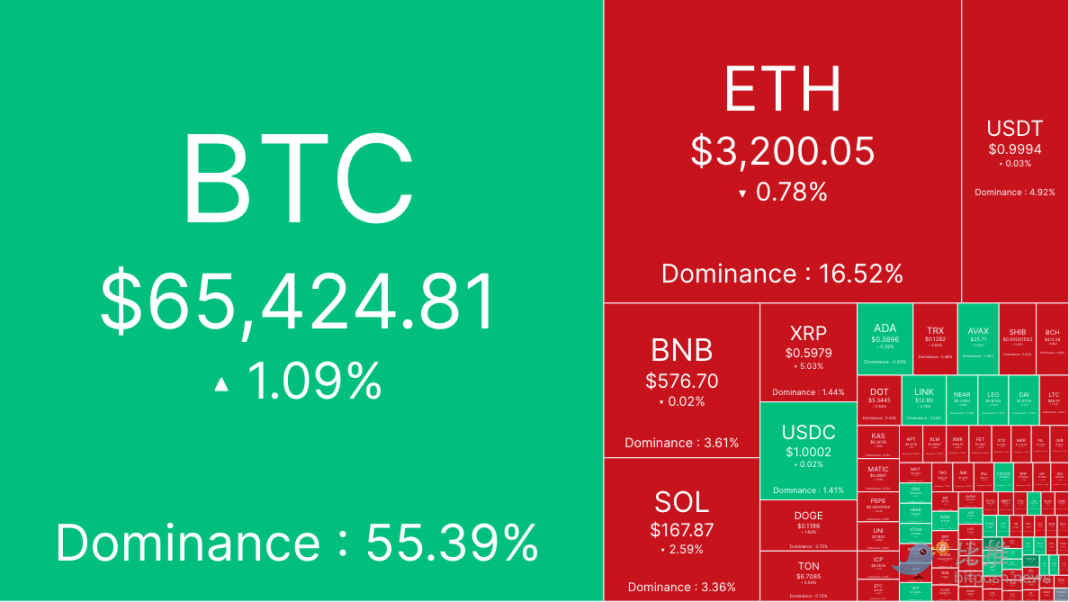
比推数据显示,比特币(BTC)午盘附近在 64, 500 美元附近失去支撑,迅速跌至 62, 227 美元的低点,盘中跌幅达 4.17 %,此后多头逢低买入,截至发稿时,比特币交易价格为 64, 720 美元, 24 小时下跌 0.25% 。
避险情绪上升,BTC盘中砸向6.2万美元

山寨币损失惨重,市值排名前 200 位的山寨代币中,只有 12 个币种实现了正收益。

Convex Finance (CVX) 涨幅最大,上涨 9.3% ,Curve DAO Token (CRV) 上涨 6.7% ,Helium (HNT) 上涨 5.7% 。Mog Coin (MOG) 跌幅最大,下跌 19.7% ,其次是 cat in a dogs world (MEW) 下跌 16.3% ,io.net (IO) 下跌 15.13% 。

目前加密货币整体市值为 2.27 万亿美元,比特币的市场占有率为 55.2% 。

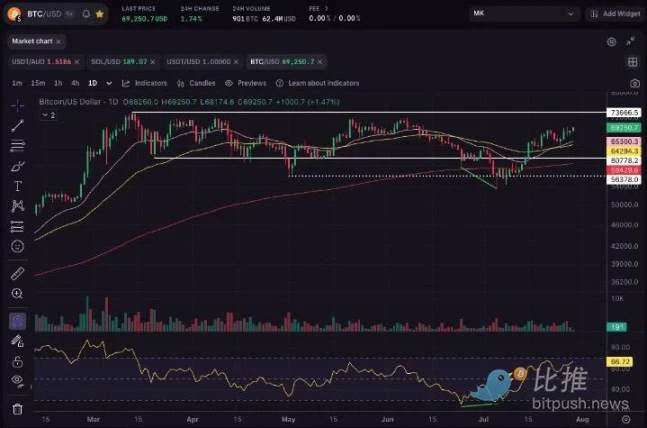
在周四的下跌之前,Kraken 的分析师注意到比特币图表上出现了看涨背离,暗示 BTC 可能很快就会挑战其历史高点。

Kraken 分析师表示:「BTC 似乎有望测试之前的历史高点 (ATH) 73, 666 美元。尽管它在 7 月初短暂跌破 200 天指数移动平均线 (EMA) 和 56, 378 美元的低点,但并没有后续走势。BTC 成功收复 200 日均线,在相对强弱指数 (RSI) 上形成看涨背离。从那时起,BTC 已经收复了 21 日和 50 日均线,表明看涨态势明显。」
避险情绪上升,BTC盘中砸向6.2万美元

这种分析是否长期成立还有待观察,因为周四的抛售导致比特币价格回落至 50 天和 200 天 EMA 以下(如上图所示)。

避险情绪上升

据雅虎财经报道,投资者担心美国经济正在陷入衰退,尤其是失业救济申请数量升至 11 个月以来的最高水平,制造业建筑支出连续两个月下降。

投资者加大了对美国国债的押注,导致五年期国债收益率跌至六个月以来的最低水平。还有一部分原因在于中东紧张局势升级,导致交易员寻求较安全的资产进行避险,例如,黄金价格上涨至 2, 450 美元,仅比历史最高价低 1.5% 。

尽管遭遇抛售,前景仍然看好

尽管周四出现抛售,但业内分析师一致认为,在要求将比特币列为类似黄金的战略储备资产的呼声中,加密货币市场的前景正在改善。

Swan Bitcoin 董事总经理 John Haar 表示:「黄金和比特币都是供应量有限的货币资产。因此,它们对更广泛的宏观经济事件和趋势的反应往往相似。黄金目前的总市值估计约为 13 万亿美元,而比特币目前的市值约为 1.3 万亿美元(约为黄金的 10% ),比特币可以充当黄金的价值存储,还有一个额外的好处,那就是比特币非常适合支付(也称为交换媒介)。」

Haar 表示:「我们认为,黄金在未来几年可能会逐渐升值,因为我们将继续经历这样的环境:法定货币随着时间的推移贬值 / 购买力下降,而外国实体希望尽可能摆脱对美元的依赖,我们认为,未来几年,比特币的价格升值潜力大于黄金。我们预计,未来 5-10 年,黄金和比特币的市值将持平。」

Haar 指出,短期内「可能存在一些影响黄金或比特币价格的因素,导致它们的表现不同。」

他总结道:「如果你相信货币贬值、通货膨胀、债务累积、金融审查或资本管制将不断加剧,那么比特币就是你应该拥有的首要资产。」

Synteq Digital 联合创始人兼首席执行官 Taras Kulyk 认为,「美联储维持现有利率,这可能是比特币未能突破 70, 000 大关的原因,未来几个月,随着全球越来越多的金融机构开始采用比特币作为金融储备资产,我们应该能够看到比特币价格的额外升值。」

Taras Kulyk 表示:「全球持续的政治紧张局势肯定会随着时间的推移提高两者的价值,然而,随着越来越多的投资者开始意识到比特币真正硬通货的数字货币和财富保值地位,我们应该会看到更大的机构加入进来,增加其资产负债表中对比特币的敞口。」


Trending Cryptos

Related Reads

IOSG Founder: Ethereum Doesn't Need Another Leap of Technical Faith, It Needs a Musk-style Compromise

Jocy, founder of IOSG Ventures, argues that Ethereum does not need renewed technological faith but a "Musk-like compromise." The recent formation of ETHLabs—funded by major ETH holders like BitMine and Lubin—highlights a market-driven move to fill a gap left by the Ethereum Foundation (EF), signaling a loss of confidence in its decentralized, hands-off approach. The core critique contrasts Vitalik Buterin's (V) idealistic, technology-first vision with Elon Musk's pragmatic, business-driven execution. The author asserts Ethereum's current shortage is not another technical roadmap but a clear, real-world application narrative and a leader willing to engage directly with commercial realities—like Musk. Internal issues are emphasized, citing EF's management problems and talent drain. While the new decentralized model with independent nodes like ETHLabs addresses the single foundation's limitations, it risks fragmentation without cohesive direction. True cohesion, the author suggests, must come from a shared, compelling narrative around ETH's value, not just from aligned financial interests. Independence claims for new entities are seen as aspirational, needing years of transparency to build trust. The ultimate threat is not competitors like Solana, but the broader shift of attention and talent toward AI. Ethereum has a limited window—12 to 18 months—to recapture focus by delivering tangible, real-world applications. The conclusion urges V to shift from abstract ideals to grounded, pragmatic leadership. The time for this crucial pivot is running out.

marsbit53m ago

IOSG Founder: Ethereum Doesn't Need Another Leap of Technical Faith, It Needs a Musk-style Compromise

marsbit53m ago

Google Starts Selling TPUs, Big Tech Aims to Produce "Low-Cost Tokens" with AI Chips

Google has begun selling its proprietary TPU chips and AI computing hardware directly to third-party data centers and clients, marking a strategic shift. Previously only accessible via cloud rentals, TPUs are specialized processors designed for the matrix and tensor operations central to AI models. By combining thousands into supercomputing clusters managed by CPUs, Google achieves high-efficiency AI processing. This move enables Google’s Gemini AI to offer competitive token pricing, challenging rivals like OpenAI. It also signals a broader industry trend where AI compute is becoming a commoditized resource like electricity. While NVIDIA remains dominant with its CUDA ecosystem and high-performance GPUs, the focus is shifting from raw power to cost efficiency and system integration. Google’s approach mirrors NVIDIA’s by selling an entire ecosystem—hardware, software, and data center expertise—rather than just chips. This threatens NVIDIA’s grip on the mid-range inference market, where lower-cost, efficient solutions are increasingly demanded. Similarly, cloud providers like Huawei Cloud and Alibaba Cloud in China are developing their own AI chip ecosystems (e.g., Ascend, Zhenwu), packaging chips, clusters, and tools into full-stack solutions. They aim to reduce token costs and capture market share through integrated systems. In summary, the AI infrastructure race is evolving from a competition for the strongest chips to a contest for the most efficient and cost-effective systems. Google’s TPU sales highlight this transition, emphasizing that future success lies in delivering affordable, scalable AI compute as a foundational service.

marsbit1h ago

Google Starts Selling TPUs, Big Tech Aims to Produce "Low-Cost Tokens" with AI Chips

marsbit1h ago

Trading

Spot
Futures

Hot Articles

What is $BITCOIN

DIGITAL GOLD ($BITCOIN): A Comprehensive Analysis Introduction to DIGITAL GOLD ($BITCOIN) DIGITAL GOLD ($BITCOIN) is a blockchain-based project operating on the Solana network, which aims to combine the characteristics of traditional precious metals with the innovation of decentralized technologies. While it shares a name with Bitcoin, often referred to as “digital gold” due to its perception as a store of value, DIGITAL GOLD is a separate token designed to create a unique ecosystem within the Web3 landscape. Its goal is to position itself as a viable alternative digital asset, although specifics regarding its applications and functionalities are still developing. What is DIGITAL GOLD ($BITCOIN)? DIGITAL GOLD ($BITCOIN) is a cryptocurrency token explicitly designed for use on the Solana blockchain. In contrast to Bitcoin, which provides a widely recognized value storage role, this token appears to focus on broader applications and characteristics. Notable aspects include: Blockchain Infrastructure: The token is built on the Solana blockchain, known for its capacity to handle high-speed and low-cost transactions. Supply Dynamics: DIGITAL GOLD has a maximum supply capped at 100 quadrillion tokens (100P $BITCOIN), although details regarding its circulating supply are currently undisclosed. Utility: While precise functionalities are not explicitly outlined, there are indications that the token could be utilized for various applications, potentially involving decentralized applications (dApps) or asset tokenization strategies. Who is the Creator of DIGITAL GOLD ($BITCOIN)? At present, the identity of the creators and development team behind DIGITAL GOLD ($BITCOIN) remains unknown. This situation is typical among many innovative projects within the blockchain space, particularly those aligning with decentralized finance and meme coin phenomena. While such anonymity may foster a community-driven culture, it intensifies concerns about governance and accountability. Who are the Investors of DIGITAL GOLD ($BITCOIN)? The available information indicates that DIGITAL GOLD ($BITCOIN) does not have any known institutional backers or prominent venture capital investments. The project seems to operate on a peer-to-peer model focused on community support and adoption rather than traditional funding routes. Its activity and liquidity are primarily situated on decentralized exchanges (DEXs), such as PumpSwap, rather than established centralized trading platforms, further highlighting its grassroots approach. How DIGITAL GOLD ($BITCOIN) Works The operational mechanics of DIGITAL GOLD ($BITCOIN) can be elaborated on based on its blockchain design and network attributes: Consensus Mechanism: By leveraging Solana’s unique proof-of-history (PoH) combined with a proof-of-stake (PoS) model, the project ensures efficient transaction validation contributing to the network's high performance. Tokenomics: While specific deflationary mechanisms have not been extensively detailed, the vast maximum token supply implies that it may cater to microtransactions or niche use cases that are still to be defined. Interoperability: There exists the potential for integration with Solana’s broader ecosystem, including various decentralized finance (DeFi) platforms. However, the details regarding specific integrations remain unspecified. Timeline of Key Events Here is a timeline that highlights significant milestones concerning DIGITAL GOLD ($BITCOIN): 2023: The initial deployment of the token occurs on the Solana blockchain, marked by its contract address. 2024: DIGITAL GOLD gains visibility as it becomes available for trading on decentralized exchanges like PumpSwap, allowing users to trade it against SOL. 2025: The project witnesses sporadic trading activity and potential interest in community-led engagements, although no noteworthy partnerships or technical advancements have been documented as of yet. Critical Analysis Strengths Scalability: The underlying Solana infrastructure supports high transaction volumes, which could enhance the utility of $BITCOIN in various transaction scenarios. Accessibility: The potential low trading price per token could attract retail investors, facilitating wider participation due to fractional ownership opportunities. Risks Lack of Transparency: The absence of publicly known backers, developers, or an audit process may yield skepticism regarding the project's sustainability and trustworthiness. Market Volatility: The trading activity is heavily reliant on speculative behavior, which can result in significant price volatility and uncertainty for investors. Conclusion DIGITAL GOLD ($BITCOIN) emerges as an intriguing yet ambiguous project within the rapidly evolving Solana ecosystem. While it attempts to leverage the “digital gold” narrative, its departure from Bitcoin's established role as a store of value underscores the need for a clearer differentiation of its intended utility and governance structure. Future acceptance and adoption will likely depend on addressing the current opacity and defining its operational and economic strategies more explicitly. Note: This report encompasses synthesised information available as of October 2023, and developments may have transpired beyond the research period.

440 Total ViewsPublished 2025.05.13Updated 2025.05.13

What is $BITCOIN

Discussions

Welcome to the HTX Community. Here, you can stay informed about the latest platform developments and gain access to professional market insights. Users' opinions on the price of BTC (BTC) are presented below.

活动图片