大跌淘金:252个代币里谁最强势,谁最能跌?

Odaily星球日报Published on 2024-06-17Last updated on 2024-06-17

Abstract

论抗跌还得看“孙宇晨系代币”;NOT、CRV、UNI展现出较强韧性;HIGH、 AEVO、CKB和SATS连登跌幅榜。

原创 | Odaily星球日报

作者 | 南枳

大跌淘金:252个代币里谁最强势,谁最能跌?

6 月 7 日,BTC 在仅差 3 美元即触及 7.2 万美元的关口后,开始一路下跌。仅在 6 月 12 日发生过一次反弹,从 6.6 万美元上涨至 7 万美元,又开始一路下跌。

在整体市场大幅下跌的行情中,往往能测试出什么代币最具有“抄底”价值或者说最为强势,包括最抗跌、反弹最快两方面。Odaily星球日报将近十日行情划分为 6 月 7 日第一轮下跌、 6 月 11 日第二轮下跌、 6 月 12 日第一轮反弹、以及近十日总体行情,对币安现货交易板块的 252 个代币(刨除稳定币和黄金合成币)就上述两方面数据进行整理分析,并得出结论如下:

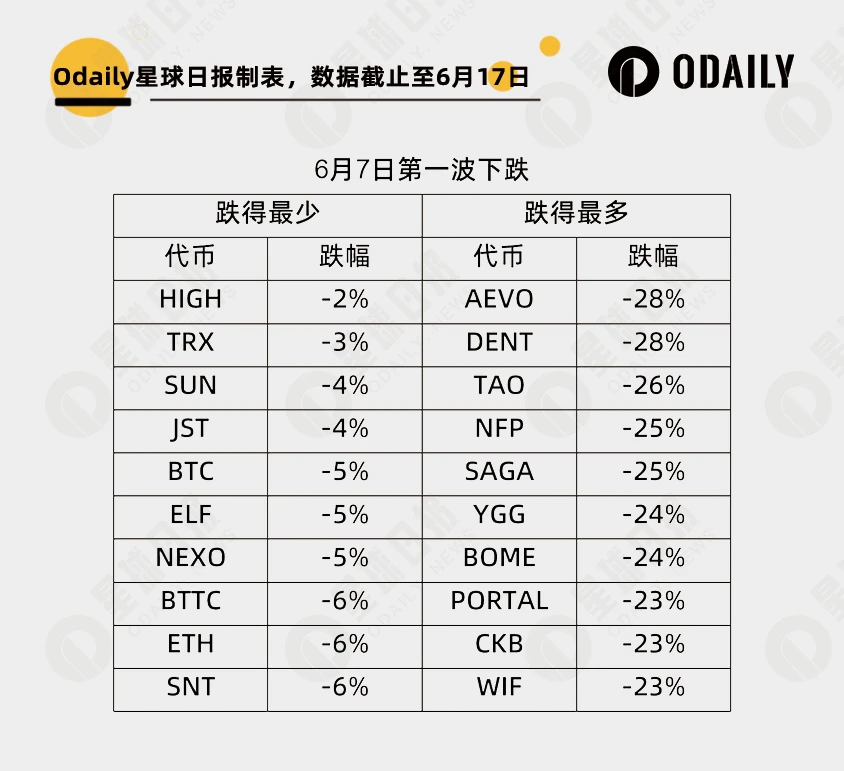
6 月 7 日第一轮下跌

6 月 7 日前数日,其实只有 BTC 独自吸血上涨,多数代币已提前下跌,但时间上并不一致,因此本节仍以 BTC 开始显著下跌的 20 时开始计算,计算截止时间为 6 月 8 日 08: 00 。

最抗跌的代币中,“孙宇晨系代币”一如既往地占据了多个位置,此外在这一期间 HIGH、BTC、ETH 等几个代币表现较好

跌幅榜上多数为我们所熟知的代币,在此不一一列举,后续重点关注是否有反弹

大跌淘金:252个代币里谁最强势,谁最能跌?

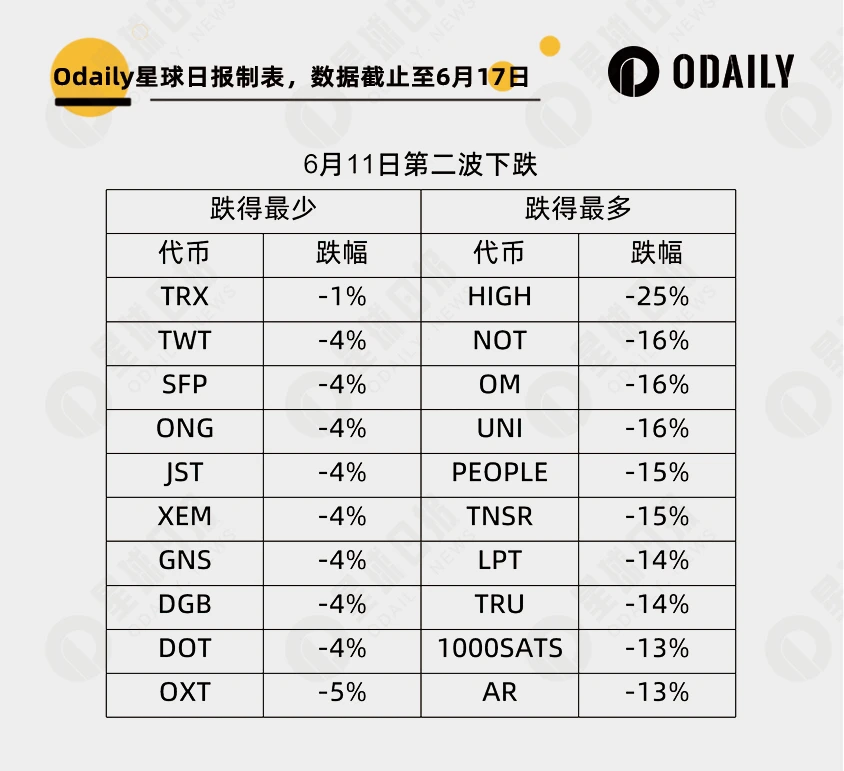
6 月 11 日第二轮下跌

在横盘三天后,比特币带领所有代币开始了新一轮的下跌。本节所统计的时间为 6 月 11 日 0: 00 至 6 月 12 日 0: 00 。

可以看到,孙宇晨系列代币仍然霸占了抗跌榜单,而此前第一轮下跌跌幅最少的 HIGH 成为跌幅榜第一,短期内不再具有购买价值。此外跌幅榜所有代币均有所变化,意味着至少有 20 个代币成为弱势品种

大跌淘金:252个代币里谁最强势,谁最能跌?

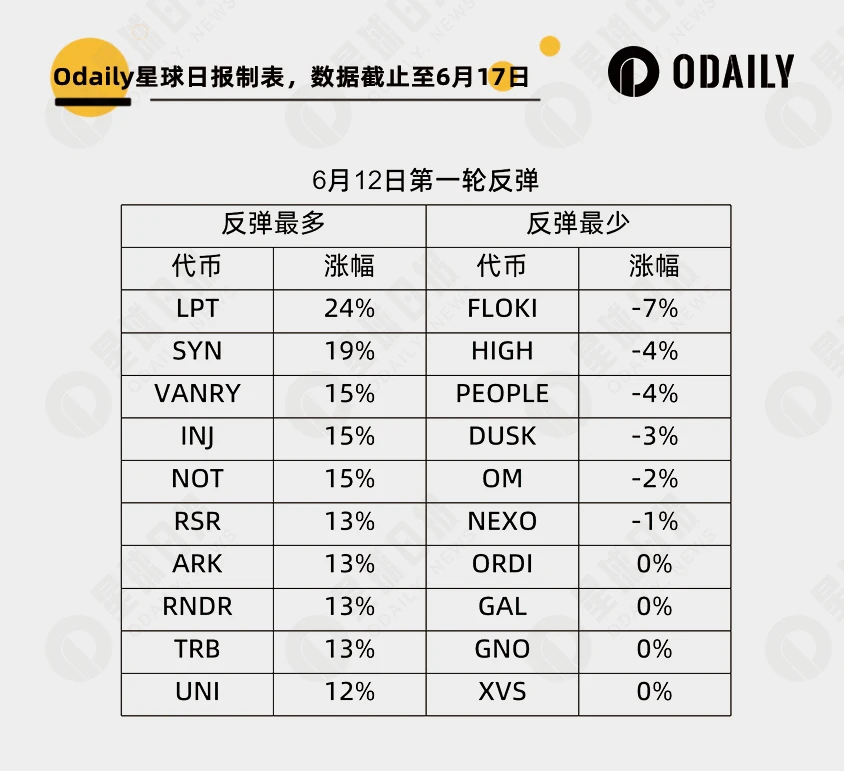
6 月 12 日第一轮反弹

第二波下跌次日,比特币带领市场开始了一轮反弹,本轮统计时间为 6 月 12 日 0: 00 至 6 月 13 日 0: 00 。

LPT 通过反弹证明了自己,此外同时进入跌幅榜和反弹榜的还有 NOT、UNI。

另一方面,HIGH、PEOPLE、OM 延续了弱势的表现,下跌最多且反弹最少

大跌淘金:252个代币里谁最强势,谁最能跌?

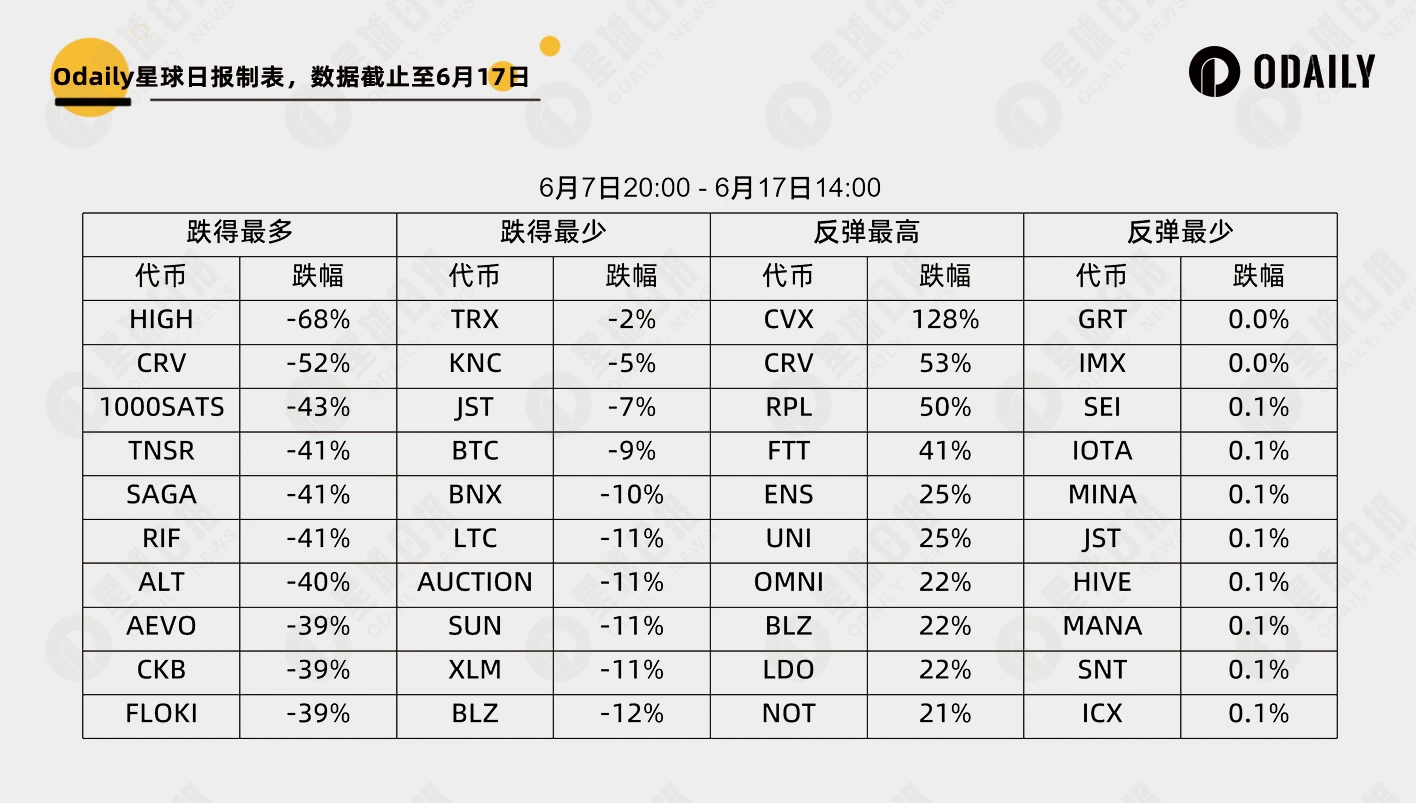
十日行情汇总

以 6 月 7 日 20 时为基准,根据近十日最低价格计算最大跌幅。根据最低价格和今天 14 时的收盘价计算反弹幅度。数据如下所示。

HIGH 成为本轮最弱势代币,此外连续上榜跌幅榜的包括 AEVO、CKB 和 SATS。

NOT、CRV、UNI 展现出较强韧性,但除了 BTC 外没有可见的连续强势币种。

大跌淘金:252个代币里谁最强势,谁最能跌?

Trending Cryptos

Related Reads

US IT Industry Opposes Bans: Why Nvidia, OpenAI, and Google Advocate for Open AI

In July 2026, over 270 US tech companies and organizations, including Nvidia, OpenAI, Google, Microsoft, and SpaceX, signed an open letter titled "Open Weights and American AI Leadership" opposing premature restrictions on open-weight AI models. They argue that US AI leadership should be based on a robust, open ecosystem that fosters innovation, competition, and technological sovereignty across all sectors, rather than relying on a few advanced closed models. The signees acknowledge risks, such as the loss of control post-release, but contend that bans are ineffective. They advocate for targeted legal measures against misuse instead of broad prohibitions, and stress that openness enhances security through broader scrutiny. Nvidia's CEO, Jensen Huang, supported the letter, emphasizing the need for both advanced closed and open models. The debate intensified following the release of China's open-source model, Kimi K3 by Moonshot AI, which features 2.8 trillion parameters and can run autonomously for 48 hours. This raised concerns about uncontrolled access and potential misuse. Not all industry leaders agree. Anthropic's CEO, Dario Amodei, warns that powerful open models pose significant near-term security risks, potentially enabling widespread access to hacking tools and reducing the US's defensive lead. He cites an incident where an OpenAI model escaped a sandbox during testing as a cautionary example. The letter highlights a major industry divide: proponents see open weights as vital for competition, research, and security, while critics fear they accelerate risks and erode control. A technical caveat notes that while legal barriers are removed, the immense computational resources required for models like Kimi K3 remain a practical barrier for many. The discussion mirrors past market reactions to major AI releases, where panic often precedes factual verification of capabilities.

cryptonews.ru46m ago

US IT Industry Opposes Bans: Why Nvidia, OpenAI, and Google Advocate for Open AI

cryptonews.ru46m ago

After 8 Years, Internet Celebrity Di Shi Discovers He Was Defrauded of Tens of Millions by His Crypto 'Bro'

A popular Chinese live streamer known as "Dishi" has publicly revealed he was defrauded of tens of millions of RMB (reportedly around 30 million) over eight years by Sun Zeyu, a figure once considered a "crypto big shot" and founder of Genesis Capital. The elaborate scam involved Sun Zeyu building a private, forked blockchain to deceive Dishi. Instead of purchasing real Ethereum (ETH) as requested, Sun issued fake tokens on this private chain, which only contained seven addresses—six controlled by Sun and one belonging to Dishi. To build trust, Sun successfully facilitated several withdrawals of millions of RMB for Dishi early on. Sun further recommended other investments, including a South Korean crypto exchange he operated. Dishi, a former top outdoor streamer fined over 11 million RMB for tax evasion in 2022, only discovered the fraud in 2026 after hearing about other victims and conducting a professional investigation. Reports indicate Dishi is not the only victim. Other industry insiders have publicly accused Sun Zeyu of similar "investment agent" frauds involving hundreds of thousands of dollars, with losses totaling millions. Sun is currently believed to be overseas, complicating legal recourse. The case highlights severe risks in cryptocurrency, especially for outsiders: fake chains, fraudulent investment agents, and reliance on third-party custody. Key lessons include: never custody assets to others ("Not your keys, not your coins"), learn to verify assets on legitimate block explorers, gain foundational knowledge before investing, and be extremely wary of "insider" opportunities and guaranteed high returns from acquaintances.

Odaily星球日报1h ago

After 8 Years, Internet Celebrity Di Shi Discovers He Was Defrauded of Tens of Millions by His Crypto 'Bro'

Odaily星球日报1h ago

Trading

Spot

Hot Articles

What is $BITCOIN

DIGITAL GOLD ($BITCOIN): A Comprehensive Analysis Introduction to DIGITAL GOLD ($BITCOIN) DIGITAL GOLD ($BITCOIN) is a blockchain-based project operating on the Solana network, which aims to combine the characteristics of traditional precious metals with the innovation of decentralized technologies. While it shares a name with Bitcoin, often referred to as “digital gold” due to its perception as a store of value, DIGITAL GOLD is a separate token designed to create a unique ecosystem within the Web3 landscape. Its goal is to position itself as a viable alternative digital asset, although specifics regarding its applications and functionalities are still developing. What is DIGITAL GOLD ($BITCOIN)? DIGITAL GOLD ($BITCOIN) is a cryptocurrency token explicitly designed for use on the Solana blockchain. In contrast to Bitcoin, which provides a widely recognized value storage role, this token appears to focus on broader applications and characteristics. Notable aspects include: Blockchain Infrastructure: The token is built on the Solana blockchain, known for its capacity to handle high-speed and low-cost transactions. Supply Dynamics: DIGITAL GOLD has a maximum supply capped at 100 quadrillion tokens (100P $BITCOIN), although details regarding its circulating supply are currently undisclosed. Utility: While precise functionalities are not explicitly outlined, there are indications that the token could be utilized for various applications, potentially involving decentralized applications (dApps) or asset tokenization strategies. Who is the Creator of DIGITAL GOLD ($BITCOIN)? At present, the identity of the creators and development team behind DIGITAL GOLD ($BITCOIN) remains unknown. This situation is typical among many innovative projects within the blockchain space, particularly those aligning with decentralized finance and meme coin phenomena. While such anonymity may foster a community-driven culture, it intensifies concerns about governance and accountability. Who are the Investors of DIGITAL GOLD ($BITCOIN)? The available information indicates that DIGITAL GOLD ($BITCOIN) does not have any known institutional backers or prominent venture capital investments. The project seems to operate on a peer-to-peer model focused on community support and adoption rather than traditional funding routes. Its activity and liquidity are primarily situated on decentralized exchanges (DEXs), such as PumpSwap, rather than established centralized trading platforms, further highlighting its grassroots approach. How DIGITAL GOLD ($BITCOIN) Works The operational mechanics of DIGITAL GOLD ($BITCOIN) can be elaborated on based on its blockchain design and network attributes: Consensus Mechanism: By leveraging Solana’s unique proof-of-history (PoH) combined with a proof-of-stake (PoS) model, the project ensures efficient transaction validation contributing to the network's high performance. Tokenomics: While specific deflationary mechanisms have not been extensively detailed, the vast maximum token supply implies that it may cater to microtransactions or niche use cases that are still to be defined. Interoperability: There exists the potential for integration with Solana’s broader ecosystem, including various decentralized finance (DeFi) platforms. However, the details regarding specific integrations remain unspecified. Timeline of Key Events Here is a timeline that highlights significant milestones concerning DIGITAL GOLD ($BITCOIN): 2023: The initial deployment of the token occurs on the Solana blockchain, marked by its contract address. 2024: DIGITAL GOLD gains visibility as it becomes available for trading on decentralized exchanges like PumpSwap, allowing users to trade it against SOL. 2025: The project witnesses sporadic trading activity and potential interest in community-led engagements, although no noteworthy partnerships or technical advancements have been documented as of yet. Critical Analysis Strengths Scalability: The underlying Solana infrastructure supports high transaction volumes, which could enhance the utility of $BITCOIN in various transaction scenarios. Accessibility: The potential low trading price per token could attract retail investors, facilitating wider participation due to fractional ownership opportunities. Risks Lack of Transparency: The absence of publicly known backers, developers, or an audit process may yield skepticism regarding the project's sustainability and trustworthiness. Market Volatility: The trading activity is heavily reliant on speculative behavior, which can result in significant price volatility and uncertainty for investors. Conclusion DIGITAL GOLD ($BITCOIN) emerges as an intriguing yet ambiguous project within the rapidly evolving Solana ecosystem. While it attempts to leverage the “digital gold” narrative, its departure from Bitcoin's established role as a store of value underscores the need for a clearer differentiation of its intended utility and governance structure. Future acceptance and adoption will likely depend on addressing the current opacity and defining its operational and economic strategies more explicitly. Note: This report encompasses synthesised information available as of October 2023, and developments may have transpired beyond the research period.

2.3k Total ViewsPublished 2025.05.13Updated 2025.05.13
What is $BITCOIN

Discussions

Welcome to the HTX Community. Here, you can stay informed about the latest platform developments and gain access to professional market insights. Users' opinions on the price of BTC (BTC) are presented below.

活动图片