9月降息有戏了?比特币站上6.6万美元

Odaily星球日报Published on 2024-05-16Last updated on 2024-05-16

Abstract

CPI 的下降并不能保证美联储会降低利率。

原文作者:Mary Liu,比推 BitpushNews

周三下午,疲软的美国消费者价格指数 (CPI) 数据提振了投资者对降息的预期,金融市场走高。

美国劳工统计局提供的数据显示,扣除食品和能源价格后,「核心」CPI 同比上涨 3.6% 。该数据与市场预测一致,较 3 月份 3.8% 的增幅略有降温, 4 月份 CPI 环比为 0.3% ,低于预期 0.1% 。

这是四个多月以来首次达到或低于市场预期,交易员认为这是利率和年底前降息可能性的积极信号。

CME FedWatch 工具提供的数据显示,在 CPI 发布后,市场目前预计美联储将在 9 月会议上开始降息的可能性约为 70% ,高于上个月的 45% 。

受低 CPI 带来的利好影响,周三标普、道琼斯指数和纳斯达克指数均创出或接近历史高位,收盘时分别上涨 1.17% 、 0.88% 和 1.40% 。

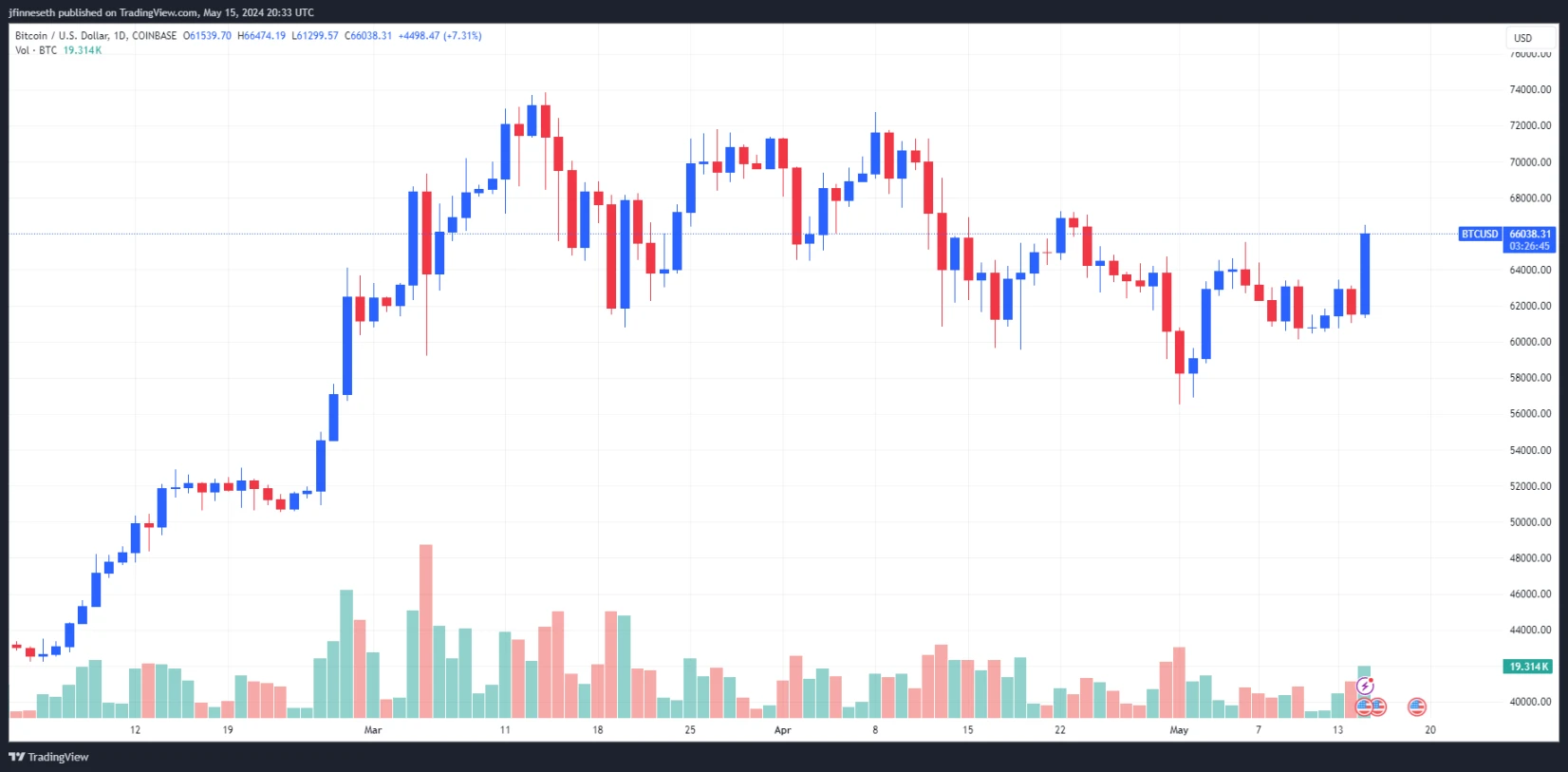
比推数据显示,比特币周三处于上涨趋势,下午从 61, 315 美元的低点飙升至 66, 420 美元的高点,截至撰写本文时,BTC 交易价格为 66, 035 美元, 24 小时上涨 7.21% 。
9月降息有戏了?比特币站上6.6万美元

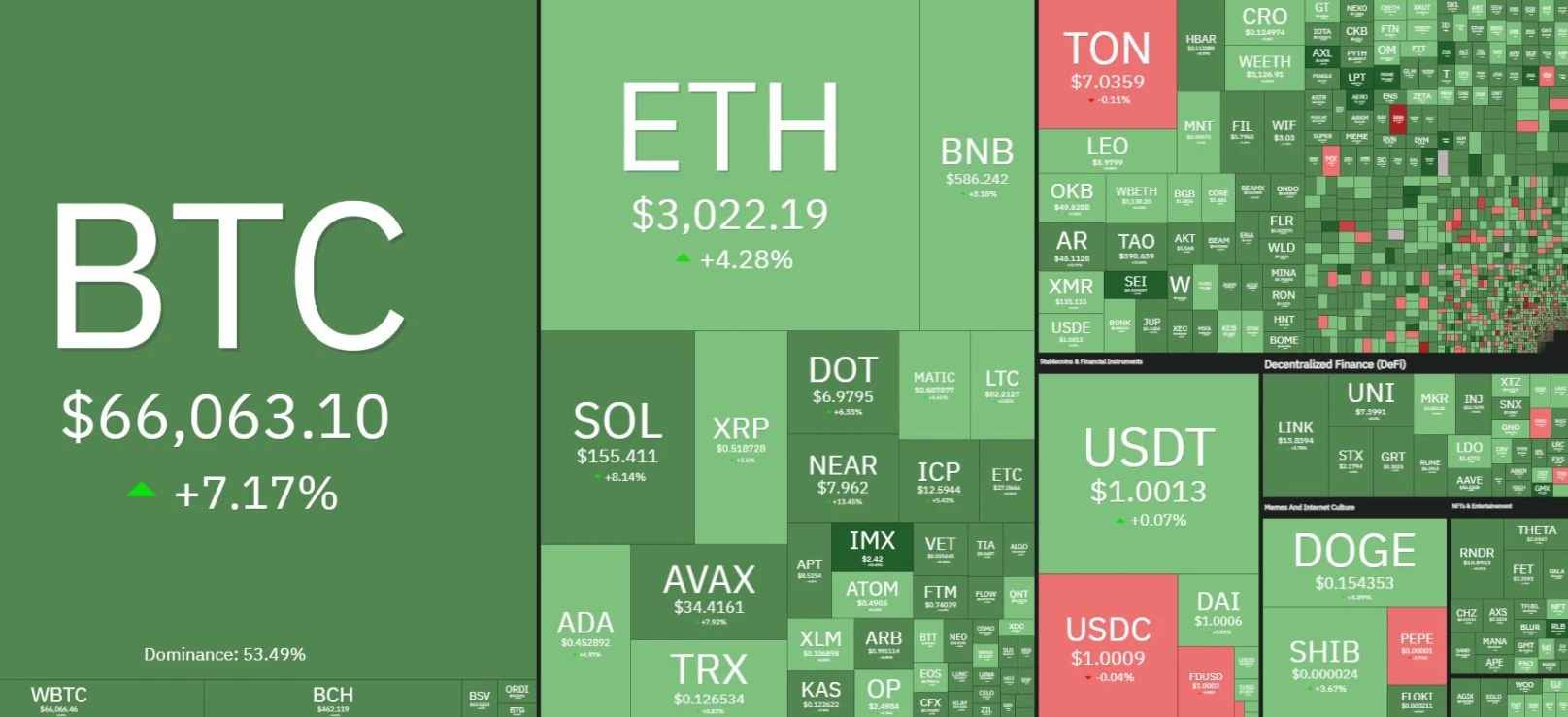
山寨币在比特币势头的推动下上涨,周三,市值前 200 大代币中几乎所有代币上涨。Livepeer (LPT) 表现最好,上涨 20.8% ,其次是 Axelar (AXL) 和 GMX (GMX),涨幅为 18% 。Ribbon Finance (RBN) 跌幅最大,下跌 21.5% ,Pepe (PEPE) 下跌 2.6% ,Starknet (STRK) 下跌 1.9% 。
9月降息有戏了?比特币站上6.6万美元

目前加密货币整体市值为 2.38 万亿美元,比特币的主导率为 54.7% 。

CPI 降温不等于美联储通胀进展取得胜利

尽管市场可能对 CPI 数据做出了积极反应,但 BIT Mining 首席经济学家兼副总裁 Youwei Yang 警告说,现在宣布通胀进展取得胜利还为时过早。

她在一份报告中表示:「尽管出台了宽松政策,并且消费者价格指数 (CPI) 通胀率如预期达到 3.4% ,但当前的全球经济格局仍然接近危险的温和滞胀情景。今天的政策制定者似乎低估了滞胀风险,这与 20 世纪 70 年代的情景相呼应,尽管没有出现那个时代的极端通胀率。」

她补充道:「尽管存在这些风险,许多投资者和政策制定者仍然过于乐观,许多主要市场领域的市盈率处于历史高位就证明了这一点。当市场面临潜在风险时,加密货币总是第一个做出反应,因此在过去几个月里一直在下跌,尽管人工智能驱动的股票增长似乎给金融市场带来了令人担忧的虚假繁荣。」

Bitfinex 分析师也表达了担忧,他们警告称,CPI 的下降并不能保证美联储会降低利率。

他们表示:「投资者认为这是看涨的转变,因为这标志着消费者物价指数 (CPI) 通胀在过去三个月内首次下降,而且是在美联储宣布打算逐步缩减量化紧缩政策之后。过去两个月,CPI 已经形成局部顶部,因此这被视为有利于风险资产,但却产生了相反的效果。然而,我们的通胀率仍高于 3% ,昨天 PPI 通胀数据显示连续第三个月上涨,尽管通胀数据下降是个好消息,但投资者将不得不等待,看看美联储是否认为这是足够积极的消息来降息。」

21 Shares 研究助理 Leena ElDeeb 表示,「仅 CPI 不足以说服美联储降息,特别是考虑到该数据仍远高于 2% 的目标,正如两周前的 FOMC 会议所表达的那样,短期内降息的希望变得渺茫」。

ElDeeb 警告说,「由于降息仍然存在疑问,复苏可能会很缓慢。通常情况下,较高的利率会降低科技股和比特币等风险资产的吸引力,因为投资者可以从美国国债等更安全的选择中获得可观的收益。这促使短期投资者转向传统市场。」

ElDeeb 补充道:「然而,尽管比特币对市场产生短期影响,但许多投资者对比特币持长期看法,比特币是一种可以防止货币贬值和经济不稳定的全球资产。虽然美联储的政策可能会引发短期波动,但它们不会从根本上改变比特币的长期轨迹。」

她总结道:「因此,比特币目前作为一种风险承受和规避风险的资产,拥有独特的地位,引领着独特的市场动态。」
9月降息有戏了?比特币站上6.6万美元

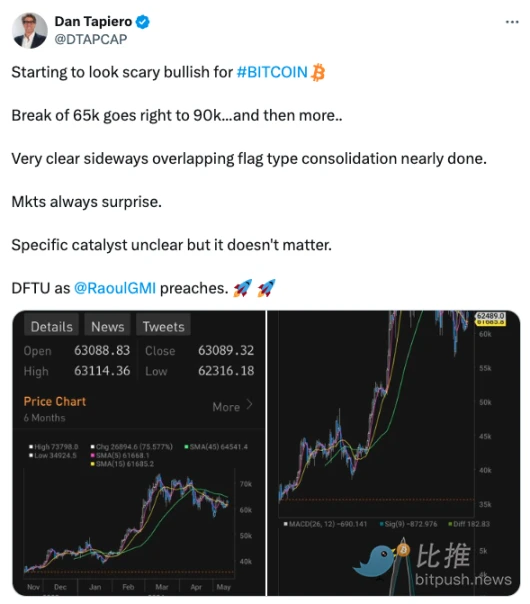
投资公司 10 T Holdings 首席执行官 Dan Tapiero 认为,如果比特币能够重新获得 65, 000 美元的支撑,其价格可能会继续飙升超过 45% 。他在 X 平台表示:「突破 65, 000 后将直接升至 90, 000 美元…然后更多,非常清晰的横向重叠旗形整合即将完成」。

市场分析师 Mustache 同意 Tapiero 的推测,并在周三指出,「比特币的每周 Stoch RSI 刚刚交叉看涨」,这表明「最大的走势即将到来」。

Trending Cryptos

Related Reads

Interview with Strategy CEO: Can STRC Recover After Selling Bitcoin?

Interview with Strategy CEO Phong Le on the recent sale of 32 Bitcoin and its impact. He clarifies the move was a small, strategic action to demonstrate liquidity to debt holders, test internal processes, and prove operational discipline—not a response to fears of a "death spiral" from DeFi protocols leveraging STRC (Strategy's preferred stock product), which he notes holds less than 10% of STRC. Le emphasizes Strategy’s long-term focus as the largest corporate Bitcoin holder, using the adage that markets are a "voting machine" short-term but a "weighing machine" long-term. Decision-making is data-driven, involving the board, complex modeling, and multiple stakeholder considerations, moving beyond a founder-centric model. He outlines various capital options but stresses the strategic importance of "doing nothing" as a valid choice, citing resilience built during the 2022 bear market. Le expresses unwavering belief in Bitcoin's foundational value for global sovereignty and its future role in an AI-driven economy with trillions of autonomous agents. Addressing STRC's current price below its $100 face value, Le explains recent pressure was due to using dollar reserves for bond buybacks. He expects STRC to return to par as reserves are replenished and its semi-monthly dividend payments begin, noting the product is heavily over-collateralized. Finally, Le confirms the company sold Bitcoin the week prior to May 31st, as disclosed in an 8-K filing, leaving prediction market interpretations to others. The overarching philosophy remains "Spread Bitcoin with love," embracing all methods of gaining Bitcoin exposure.

marsbit9m ago

Interview with Strategy CEO: Can STRC Recover After Selling Bitcoin?

marsbit9m ago

IOSG Founder: Ethereum Doesn't Need Another Leap of Technical Faith, It Needs a Musk-style Compromise

Jocy, founder of IOSG Ventures, argues that Ethereum does not need renewed technological faith but a "Musk-like compromise." The recent formation of ETHLabs—funded by major ETH holders like BitMine and Lubin—highlights a market-driven move to fill a gap left by the Ethereum Foundation (EF), signaling a loss of confidence in its decentralized, hands-off approach. The core critique contrasts Vitalik Buterin's (V) idealistic, technology-first vision with Elon Musk's pragmatic, business-driven execution. The author asserts Ethereum's current shortage is not another technical roadmap but a clear, real-world application narrative and a leader willing to engage directly with commercial realities—like Musk. Internal issues are emphasized, citing EF's management problems and talent drain. While the new decentralized model with independent nodes like ETHLabs addresses the single foundation's limitations, it risks fragmentation without cohesive direction. True cohesion, the author suggests, must come from a shared, compelling narrative around ETH's value, not just from aligned financial interests. Independence claims for new entities are seen as aspirational, needing years of transparency to build trust. The ultimate threat is not competitors like Solana, but the broader shift of attention and talent toward AI. Ethereum has a limited window—12 to 18 months—to recapture focus by delivering tangible, real-world applications. The conclusion urges V to shift from abstract ideals to grounded, pragmatic leadership. The time for this crucial pivot is running out.

marsbit1h ago

IOSG Founder: Ethereum Doesn't Need Another Leap of Technical Faith, It Needs a Musk-style Compromise

marsbit1h ago

Google Starts Selling TPUs, Big Tech Aims to Produce "Low-Cost Tokens" with AI Chips

Google has begun selling its proprietary TPU chips and AI computing hardware directly to third-party data centers and clients, marking a strategic shift. Previously only accessible via cloud rentals, TPUs are specialized processors designed for the matrix and tensor operations central to AI models. By combining thousands into supercomputing clusters managed by CPUs, Google achieves high-efficiency AI processing. This move enables Google’s Gemini AI to offer competitive token pricing, challenging rivals like OpenAI. It also signals a broader industry trend where AI compute is becoming a commoditized resource like electricity. While NVIDIA remains dominant with its CUDA ecosystem and high-performance GPUs, the focus is shifting from raw power to cost efficiency and system integration. Google’s approach mirrors NVIDIA’s by selling an entire ecosystem—hardware, software, and data center expertise—rather than just chips. This threatens NVIDIA’s grip on the mid-range inference market, where lower-cost, efficient solutions are increasingly demanded. Similarly, cloud providers like Huawei Cloud and Alibaba Cloud in China are developing their own AI chip ecosystems (e.g., Ascend, Zhenwu), packaging chips, clusters, and tools into full-stack solutions. They aim to reduce token costs and capture market share through integrated systems. In summary, the AI infrastructure race is evolving from a competition for the strongest chips to a contest for the most efficient and cost-effective systems. Google’s TPU sales highlight this transition, emphasizing that future success lies in delivering affordable, scalable AI compute as a foundational service.

marsbit1h ago

Google Starts Selling TPUs, Big Tech Aims to Produce "Low-Cost Tokens" with AI Chips

marsbit1h ago

Trading

Spot
Futures

Hot Articles

What is $BITCOIN

DIGITAL GOLD ($BITCOIN): A Comprehensive Analysis Introduction to DIGITAL GOLD ($BITCOIN) DIGITAL GOLD ($BITCOIN) is a blockchain-based project operating on the Solana network, which aims to combine the characteristics of traditional precious metals with the innovation of decentralized technologies. While it shares a name with Bitcoin, often referred to as “digital gold” due to its perception as a store of value, DIGITAL GOLD is a separate token designed to create a unique ecosystem within the Web3 landscape. Its goal is to position itself as a viable alternative digital asset, although specifics regarding its applications and functionalities are still developing. What is DIGITAL GOLD ($BITCOIN)? DIGITAL GOLD ($BITCOIN) is a cryptocurrency token explicitly designed for use on the Solana blockchain. In contrast to Bitcoin, which provides a widely recognized value storage role, this token appears to focus on broader applications and characteristics. Notable aspects include: Blockchain Infrastructure: The token is built on the Solana blockchain, known for its capacity to handle high-speed and low-cost transactions. Supply Dynamics: DIGITAL GOLD has a maximum supply capped at 100 quadrillion tokens (100P $BITCOIN), although details regarding its circulating supply are currently undisclosed. Utility: While precise functionalities are not explicitly outlined, there are indications that the token could be utilized for various applications, potentially involving decentralized applications (dApps) or asset tokenization strategies. Who is the Creator of DIGITAL GOLD ($BITCOIN)? At present, the identity of the creators and development team behind DIGITAL GOLD ($BITCOIN) remains unknown. This situation is typical among many innovative projects within the blockchain space, particularly those aligning with decentralized finance and meme coin phenomena. While such anonymity may foster a community-driven culture, it intensifies concerns about governance and accountability. Who are the Investors of DIGITAL GOLD ($BITCOIN)? The available information indicates that DIGITAL GOLD ($BITCOIN) does not have any known institutional backers or prominent venture capital investments. The project seems to operate on a peer-to-peer model focused on community support and adoption rather than traditional funding routes. Its activity and liquidity are primarily situated on decentralized exchanges (DEXs), such as PumpSwap, rather than established centralized trading platforms, further highlighting its grassroots approach. How DIGITAL GOLD ($BITCOIN) Works The operational mechanics of DIGITAL GOLD ($BITCOIN) can be elaborated on based on its blockchain design and network attributes: Consensus Mechanism: By leveraging Solana’s unique proof-of-history (PoH) combined with a proof-of-stake (PoS) model, the project ensures efficient transaction validation contributing to the network's high performance. Tokenomics: While specific deflationary mechanisms have not been extensively detailed, the vast maximum token supply implies that it may cater to microtransactions or niche use cases that are still to be defined. Interoperability: There exists the potential for integration with Solana’s broader ecosystem, including various decentralized finance (DeFi) platforms. However, the details regarding specific integrations remain unspecified. Timeline of Key Events Here is a timeline that highlights significant milestones concerning DIGITAL GOLD ($BITCOIN): 2023: The initial deployment of the token occurs on the Solana blockchain, marked by its contract address. 2024: DIGITAL GOLD gains visibility as it becomes available for trading on decentralized exchanges like PumpSwap, allowing users to trade it against SOL. 2025: The project witnesses sporadic trading activity and potential interest in community-led engagements, although no noteworthy partnerships or technical advancements have been documented as of yet. Critical Analysis Strengths Scalability: The underlying Solana infrastructure supports high transaction volumes, which could enhance the utility of $BITCOIN in various transaction scenarios. Accessibility: The potential low trading price per token could attract retail investors, facilitating wider participation due to fractional ownership opportunities. Risks Lack of Transparency: The absence of publicly known backers, developers, or an audit process may yield skepticism regarding the project's sustainability and trustworthiness. Market Volatility: The trading activity is heavily reliant on speculative behavior, which can result in significant price volatility and uncertainty for investors. Conclusion DIGITAL GOLD ($BITCOIN) emerges as an intriguing yet ambiguous project within the rapidly evolving Solana ecosystem. While it attempts to leverage the “digital gold” narrative, its departure from Bitcoin's established role as a store of value underscores the need for a clearer differentiation of its intended utility and governance structure. Future acceptance and adoption will likely depend on addressing the current opacity and defining its operational and economic strategies more explicitly. Note: This report encompasses synthesised information available as of October 2023, and developments may have transpired beyond the research period.

440 Total ViewsPublished 2025.05.13Updated 2025.05.13

What is $BITCOIN

Discussions

Welcome to the HTX Community. Here, you can stay informed about the latest platform developments and gain access to professional market insights. Users' opinions on the price of BTC (BTC) are presented below.

活动图片