Mon Protocol Announces Strategic Partnership with Pixelverse to Enhance Web 3 Gaming Adoption | CoinCodex

cryptodailyPublished on 2024-04-09Last updated on 2024-05-30

Abstract

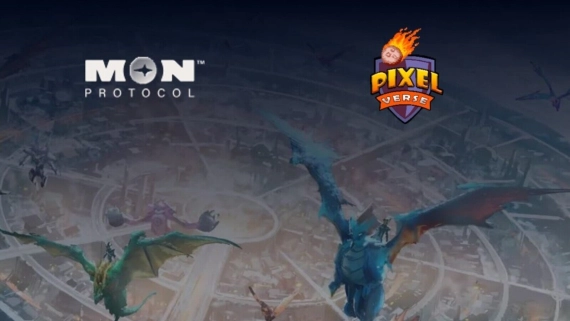
Web 3 publishing protocol for decentralized intellectual property (IP) and gaming Mon Protocol announced its partnership with play-to-earn gaming protocol Pixelverse. The collaboration aims to leverage the expertise of both companies to enhance Web 3 gaming adoption and grow their communities.


Web 3 publishing protocol for decentralized intellectual property (IP) and gaming Mon Protocol announced its partnership with play-to-earn gaming protocol Pixelverse. The collaboration aims to leverage the expertise of both companies to enhance Web 3 gaming adoption and grow their communities.
The 14 Best Play-to-Earn Crypto Games in 2024
According to the team statement, Mon Protocol will add Pixelverse’s gameplay universe to its portfolio, creating a collection that becomes one of the key building blocks of the growing metaverse. On the other hand, Pixelverse will gain more exposure to Mon Protocol’s large audience – with over 1.1 million users – to strengthen its Web 3 gaming community.
Introducing MON Protocol Partner - Pixelverse

Pixelverse (@pixelverse_xyz) is a quest based battler where users can explore and collect resources to craft their bots for arena battles. It features PvE battles, a "Risk to Earn" system, and customizable bots (NFT).

Find out more… pic.twitter.com/56eH7Eluld
— MON Protocol ? $MON (@monprotocol) April 16, 2024
Pixelverse becomes the latest gaming universe to join Mon Protocol’s extensive partnerships with recent additions of Kokodi, Moby, Aether Games Inc., and Playground Games.
The partnership presents clear goals to grow the communities of both platforms in future. The collaboration aims to grow the fan base of Pixelmon, one of the games published under Mon Protocol with over 1.1 million players. On the flip side, Pixelverse will be able to grow its community and extend its global reach via Mon Protocol’s existing user base.
On the cooperation, Giulio Xiloyannis, CEO of Pixelmon and co-founder of Mon Protocol praised the novelty of Pixelverse, stating the gaming protocol is “bringing a new feeling to the [gaming] market” given its unique games and quests. Talking about its success in emerging countries, Xiloyannis compared the gaming universe to the successes of Axie Infinity and Pixels.xyz stating:
“The fact that it [Pixelverse] is being used successfully in emerging countries is a good analogue, as it affirms the truth that mobile games like Axie's Infinity and Pixels.xyz are winning quite many hearts and [Web 3] gaming shows no sign of decreasing."

With blockchain gaming becoming more popular, Xiloyannis believes the collaboration with Pixelverse will inspire more mainstream gamers to join the crypto sphere – especially across emerging countries. 
“The gaming narrative has the potential to yield results in these regions, serving as a gateway for retail and mainstream users to enter the crypto space through play-to-earn mechanics."

To celebrate their partnership, Pixelverse and Mon Protocol are planning a Pixelverse token airdrop for select MON holders. The airdrop aims to offer $TPZ tokens to $MON token holders, enhancing the engagement and rewards of players on the platform. The airdrop will also allow the community to participate more within the gaming universe and collect more $MON tokens.
“Our focus is on rewarding questers and early adopters with their first foray into cryptocurrency through engaging gameplay. This partnership aligns with our goal to provide an educational yet enjoyable introduction to the crypto world,” Kirill Volgin, CEO of Pixelverse, said.

The symbiotic relationship between the two “gaming” companies is expected to also help advance blockchain gaming across the globe while showcasing the ability for communities to grow through exploring shared synergies. Players will also be able to enjoy enhanced qualities across the gaming universe and a better user experience on Pixelverse’s quest-based battler experience, encouraging more exploration, better resource collection, and enhanced combat.
Disclaimer: This article is provided for informational purposes only. It is not offered or intended to be used as legal, tax, investment, financial, or other advice.
Read on CoinCodex Investment Disclaimer

Trending Cryptos

Related Reads

Why Does 'AGI Godfather' Ben Goertzel Believe the Future of AI Relies on Blockchain?

Ben Goertzel, known as the "AGI Godfather," argues that the future of Artificial General Intelligence (AGI) must be built on blockchain to prevent its control by a few corporations or venture capital firms. He believes the core AGI code should be free and open-source, but that this alone is insufficient without a decentralized infrastructure to run it affordably. His blockchain project, SingularityNET, and the broader Artificial Superintelligence Alliance aim to create a user-owned, decentralized network for hosting and deploying AGI, contrasting with the closed models of companies like OpenAI and Anthropic. Goertzel criticizes the shift of other labs from open to closed development. He argues that while a closed path is simpler, an open, decentralized model—akin to Linux and the internet—is both possible and ultimately better for humanity. He envisions an "Agent economy" where individuals orchestrate teams of AI agents to perform tasks, including transactions, on an open network rather than corporate clouds. While his current model relies on cryptocurrency, plans include offering paid AI services to businesses with the decentralized blockchain as the backend. Goertzel predicts human-level AGI could arrive by 2029 and warns that a gap in understanding and access to AGI could drastically worsen inequality. The first test of his decentralized approach will be the upcoming release of the Agent Omega Claw.

Foresight News7m ago

Why Does 'AGI Godfather' Ben Goertzel Believe the Future of AI Relies on Blockchain?

Foresight News7m ago

A Company Once on the Brink of Bankruptcy Just Surpassed Bitcoin in Market Cap

On June 22nd, driven by rising stock prices, SK Hynix’s market capitalization reached $1.35 trillion, surpassing Bitcoin's total market cap of approximately $1.29 trillion. This temporarily made it South Korea's highest-valued company. The core driver of this surge is HBM (High Bandwidth Memory), for which SK Hynix is the primary supplier to NVIDIA, holding over 60% market share. AI's demand for high memory bandwidth has translated into immense profitability, with SK Hynix reporting a 72% operating profit margin in Q1. The company's success follows a 13-year bet on HBM technology, beginning in 2009. It nearly failed after the 2001 dot-com bubble, was acquired by SK Group in 2012, and was subsequently recapitalized to continue its long-term HBM development. The article contrasts this with the Crypto AI narrative. Capital currently favors AI infrastructure players like SK Hynix due to "real orders, physical barriers, and quantifiable profit margins." In comparison, Crypto AI projects, promising decentralized compute and data markets, remain largely conceptual with limited tangible progress. Examples include Bittensor, whose core mechanisms are still under development, and Bitcoin miners transitioning to AI, who face significant funding gaps and execution challenges. The piece cites analysis suggesting the AI sector has absorbed nearly all new market liquidity since 2022, leaving little for crypto. It concludes that the current AI infrastructure红利 is captured by entities with proven technical barriers and supply capabilities, while crypto networks still need to define their concrete role in the value chain.

链捕手47m ago

A Company Once on the Brink of Bankruptcy Just Surpassed Bitcoin in Market Cap

链捕手47m ago

Bittensor Moves Towards Ultimate Decentralization: The Critical 18 Months for the TAO Ecosystem is Here?

Bittensor, a decentralized AI protocol, is accelerating its transition to full decentralization over the next 18 months, as outlined in a recent post by co-founder Const. The project currently operates in a "semi-decentralized" state: ownership and network participation are open and permissionless, with TAO distribution based on competitive contribution. However, protocol upgrades and governance have remained under core team control to enable rapid iteration in the fast-evolving AI sector. This strategic shift comes as the ecosystem matures, boasting 128 subnets and a large community. Const argues that continued centralization now poses risks, including single points of failure and regulatory scrutiny. The upcoming decentralization roadmap includes optimizing validator competition, opening liquidity pools, introducing governance rights for Alpha holders, and refining economic models. The move could fundamentally reshape TAO's value proposition, adding governance premiums to its existing valuation based on AI narrative and scarcity. It also signals a potential maturation of the AI crypto sector, where competition may shift from hype to sustainable protocol design and real economic activity. Bittensor positions itself not just as another AI token, but as foundational infrastructure aiming to decentralize intelligence production—analogous to Bitcoin's role in decentralizing money—with the goal of creating a resilient "Millennium Intelligence Federation."

marsbit59m ago

Bittensor Moves Towards Ultimate Decentralization: The Critical 18 Months for the TAO Ecosystem is Here?

marsbit59m ago

Japan's AI Dark Horse Emerges: How a 7B Small Model Challenges Fable and Mythos?

In June 2026, Sakana AI's new model Fugu caused a stir in the AI community. Its Fugu Ultra variant achieved scores of 73.7 on SWE-Bench Pro and 82.1 on TerminalBench 2.1, surpassing GPT-5.5 and Claude Opus 4.8, and was claimed to be comparable to export-restricted models like Fable 5 and Mythos Preview. Remarkably, the core of this high-performance system is not a massive model, but a small 7B-parameter RL Conductor model. Fugu operates as a multi-agent orchestrator: the 7B model acts as a "foreman," dynamically analyzing user tasks and delegating subtasks to a pool of top-tier global models (e.g., GPT-5, Gemini 3.1 Pro). It then synthesizes and verifies their outputs. This architecture represents a paradigm shift from monolithic models to an expert-team approach. It enhances performance in complex, multi-step engineering tasks like code review and security testing by enabling cross-validation from specialized models, improving long-session stability and token efficiency. However, Fugu's strengths come with trade-offs: it faces inherent latency due to multiple API calls, relies heavily on underlying US model APIs (creating dependency risks), and its benchmark comparisons with Fable/Mythos are based on reported scores, not head-to-head testing. For Japan's AI ecosystem, which lacks the massive compute and data resources of the US or China, Fugu exemplifies an "asymmetric breakthrough" strategy. Instead of competing directly in parameter scale, it focuses on intelligent orchestration of existing global models, offering a degree of AI sovereignty and resilience. While a significant system-level innovation, its ultimate capability is still bounded by the underlying models it coordinates.

marsbit1h ago

Japan's AI Dark Horse Emerges: How a 7B Small Model Challenges Fable and Mythos?

marsbit1h ago

Trading

Spot
Futures

Hot Articles

Discussions

Welcome to the HTX Community. Here, you can stay informed about the latest platform developments and gain access to professional market insights. Users' opinions on the price of ETH (ETH) are presented below.

活动图片