说他俩是比特币最强销售,没人有意见吧?

Odaily星球日报Published on 2024-04-02Last updated on 2024-04-02

Abstract

年轻人更爱Michael Saylor,专业投资者青睐Larry Fink。

本文来自:Blockworks,原文作者:BEN STRACK

Odaily 星球日报译者 | Moni

说他俩是比特币最强销售,没人有意见吧?

1000 个人眼里有 1000 个哈姆雷特,比特币也是如此。

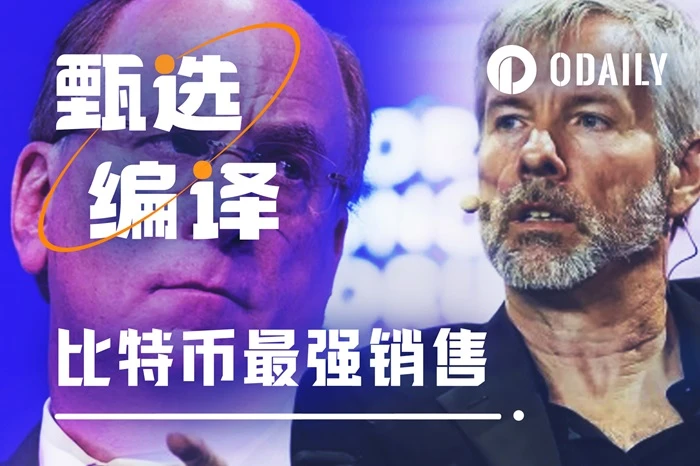
有人认为比特币是骗局,比如摩根大通首席执行官 Jamie Dimon 称比特币是“宠物石头”,股神 Warren Buffett 觉得比特币是“老鼠药”;但同时,也有人笃信比特币精神——这种有限供应量的资产可以在没有金融中介的情况下进行点对点交易——其中就不得不提 MicroStrategy 创始人 Michael Saylor 和贝莱德 CEO Larry Fink 两人了。

Michael Saylor 和 Larry Fink 的“奶言奶语”

Michael Saylor 毕业于麻省理工学院,拥有航空航天学位,他创立的 MicroStrategy 已经购入超 20 万枚比特币,而且似乎仍在继续增持。Michael Saylor 认为,比特币代表资本保值,更是“人类的顶级资产”,他甚至将数字代入方程式来描述比特币的含义:

“我希望你把比特币想象成网络空间中的一座城市,宽 276 个区块,高 276 个区块,深 276 个区块,大约有 2100 万个区块,现在想象一下,世界上 80 亿人有一天都住在那里,每个人都把资本投入进去会是怎样?全世界财富规模大约有 900 万亿美元,当人们从所有其他形式的财产迁移到网络空间时,您将看到比特币网络从 1 万亿美元的网络增长到 10 倍到 100 倍。”

Larry Fink,作为当前全球规模最大资产管理公司之一贝莱德的首席执行官,一开始并不看好比特币,他曾在 2017 年将比特币称为“洗钱指数”,但现在,情况完全不同了。2023 年 10 月,Larry Fink 在一次采访中认为加密货币是一种“正在逐步转向优质的资产”并称比特币就是数字黄金:

“比特币是一个国际分类账,是跨境的,如果你对未来感到恐惧,或者对因赤字过多而导致货币贬值感到恐惧,那么可以使用比特币,它具有巨大潜力。”

说他俩是比特币最强销售,没人有意见吧?

不同角度的影响力

加密货币对冲基金 ZX Squared Capital 联合创始人 CK Zheng 表示,Michael Saylor 和 Larry Fink 在推动比特币采用方面都极具影响力,但他补充说,两人对比特币的影响来自截然不同的角度:Michael Saylor 是一个比特币最大化主义者,而 Larry Fink 则是在加密市场中寻求投资“民主化”的基金经理高管——

“Michael Saylor 对比特币的承诺是毫无疑问的,他的行动胜于雄辩,纯粹且简单:无论市场高峰还是低谷,永远买入并持有。”

与此同时,贝莱德近期也在不断加码比特币,根据 BitMex Research 的数据,这家资产管理巨头的现货比特币 ETF iShares Bitcoin Trust (IBIT) 自 1 月 11 日推出以来几乎每个交易日都有净流入,截至 3 月 28 日规模已达到近 140 亿美元,比特币持仓量超过 25 万枚 BTC,超过了 MicroStrategy 的持仓量。RW 3 Ventures 执行合伙人 Peter Najarian 认为,随着现货比特币 ETF 获得监管机构的批准,Larry Fink 对加密行业的支持可能产生了更大的影响,“有些人会认为,在当前环境下,Larry Fink 比美联储主席更有权力。”

谁是更好的比特币推销员?

不同人看待 Michael Saylor 和 Larry Fink,解读自然不同,也会引起不同投资者的共鸣。

Bitwise Investments 高级加密货币研究分析师 Ryan Rusmussen 表示,Michael Saylor 对比特币的看法很容易引起加密货币社区的共鸣,但对于传统投资者来说可能会有些两极分化。 举个例子,Michael Saylor 不认可资产多元化,这种观点与传统投资者的信念背道而驰,因此他们很难与之保持一致。

此外,Michael Saylor 有时言辞也过于偏激,他在最近接受雅虎财经采访时称:“使用法定货币作为价值储存手段的人——我们给了他们一个名字:穷人。”所以,除了加密行业,Michael Saylor 可能不会受到该领域之外的投资者欢迎。

说他俩是比特币最强销售,没人有意见吧?

另一方面,Larry Fink 有时显得过于“老派”,比如他解释比特币时将其称为是“一种可以保护你免受经济不确定性和地缘政治风险影响的资产类别”,这种教条式的风格很难吸引年轻散户投资者,他们甚至可能不知道贝莱德是什么。相反,Larry Fink 的观点对年长的专业投资者尤其重要。

CK Zheng 认为,对于一位成熟的传统金融高管来说,在比特币的早期采用阶段对比特币采取这样的观点是罕见的,许多华尔街首席执行官仍未完全适应加密货币,而贝莱德一夜之间从根本上加速了比特币在(传统金融)世界的采用,确立了自己在比特币 ETF 领域的领导者地位。

跟随需求

整体来看,Michael Saylor 对比特币的信念较为坚定且稳定,而 Larry Fink 对比特币的信念似乎更多地基于客户需求,他通过熟悉的 ETF 形式,巧妙地为机构投资者和个人投资者设计了一条成功之路。

值得一提的是,贝莱德于 3 月 20 日在以太坊网络上推出了第一只代币化基金,该公司数字资产主管 Robert Mitchnick)称这些产品是其数字资产战略的最新进展。毫无疑问,金融行业里许多公司已经意识到,加密货币已经大到不容忽视,贝莱德、富达和其他公司的情况就是如此,这也是他们近期选择入场的原因之一。

Larry Fink 之所以能够自信地将比特币、黄金、以及美国国债放在同一位置,是因为他已经看到客户开始使用比特币了,这既是一次巨大的商业机遇,也反映了世界各地投资者对加密货币的看法已发生了根本性改变。

Trending Cryptos

Related Reads

Quantum Computing "Manhattan Project" Unveiled: Is the Encryption Industry at a Critical Turning Point?

"Quantum Computing 'Manhattan Project' Launched: Is the Crypto Industry at a Critical Juncture?" On June 22, former U.S. President Donald Trump signed two executive orders. The first mandates all federal agencies upgrade their cryptographic systems to new, quantum-resistant standards by 2030. The second orders the Department of Energy to lead the development of a national quantum computer, signaling a shift from laboratory research to a state-enforced national agenda. This creates a hard deadline. A powerful quantum computer could break current encryption. The threat is compounded by "harvest now, decrypt later" attacks, where encrypted data is stored today for future decryption. Federal agencies must appoint migration officers and complete post-quantum cryptography (PQC) upgrades for key establishment by 2030 and digital signatures by 2031. Procurement rules will also be changed, forcing government contractors to comply. The crypto industry faces a direct threat. Bitcoin's ECDSA signatures are theoretically vulnerable. Research indicates millions of Bitcoin with exposed public keys are at risk if quantum computers advance. While projects like Bitcoin Quantum testnets and efforts by Ethereum, Solana, NEAR, and Zcash are exploring quantum-resistant solutions, achieving consensus in decentralized networks remains a major challenge. The centralized U.S. government has started a 5-year countdown. For decentralized crypto networks, the real test is whether they can complete this anti-quantum upgrade before the theoretical threat becomes a practical reality.

Foresight News7m ago

Quantum Computing "Manhattan Project" Unveiled: Is the Encryption Industry at a Critical Turning Point?

Foresight News7m ago

Coin Stock Barometer丨BitMine's Total Assets and Investment Reach $10.7 Billion, Exceeding ~$9.3 Billion Floating Loss; Strategy Buys Only 520 BTC, Strive Adds Positions Against the Trend (June 23)

This article provides a weekly market update on "coin-equity" trends, focusing on listed companies holding major cryptocurrencies. Key highlights include: **General Market Trends:** Global equities, particularly in the US, Japan, and South Korea, faced significant sell-offs, led by large tech and AI-related stocks. Analysts cite profit-taking and a shift from hype-driven to performance-driven valuation for AI companies. Market focus is on upcoming Micron Technology's earnings. **Cryptocurrency Treasury Updates:** * **Bitcoin (BTC):** Net weekly BTC purchases by listed companies (excluding miners) totaled approximately $86 million, down 13.97% from the prior week. Strategy (formerly MicroStrategy) purchased only 520 BTC for ~$34.9 million, while Strive Asset Management increased its holdings by 759 BTC for ~$50 million. Other notable actions include Mara Holdings adding 1,000 BTC and Capital B shareholders approving a massive financing plan (up to ~$1.2 trillion) to potentially expand its Bitcoin reserves. * **Ethereum (ETH):** BitMine emerged as the largest corporate ETH treasury, holding 5.67 million ETH (4.7% of supply). It purchased an additional 52,203 ETH ($92 million) in the past week. Sharplink completed a $75 million private placement to fund further ETH accumulation and stock buybacks. * **Solana (SOL):** The top five listed companies hold over 15.7 million SOL combined. However, Solmate Infrastructure, a SOL treasury firm, faces a lawsuit from its largest external shareholder alleging board misconduct and self-dealing. * **Other:** Updates include Canton Strategic's $50 million stock buyback plan and Lite Strategy's $1 million strategic investment in LitVM, a Layer-2 network for Litecoin. The article notes that while crypto treasury firms continue fundraising and accumulation, their stocks may struggle to rise against the broader market downturn until Q4.

marsbit21m ago

Coin Stock Barometer丨BitMine's Total Assets and Investment Reach $10.7 Billion, Exceeding ~$9.3 Billion Floating Loss; Strategy Buys Only 520 BTC, Strive Adds Positions Against the Trend (June 23)

marsbit21m ago

OpenAI Partners with PE Firms, Investing $4 Billion. Let's Talk About Silicon Valley's Hottest New Role: FDE.

The hottest new role in Silicon Valley is the Forward Deployment Engineer (FDE), a hybrid of engineer and business consultant whose core mission is to transform AI demos into native, practical workflows within client organizations. The recent surge in demand is driven by a strategic shift from leading AI companies. OpenAI, partnering with 19 private equity firms in a $4 billion investment, formed a Deployment Company and acquired Tomoro along with its 150 FDEs. Anthropic also announced a $1.5 billion joint venture with financial institutions like Blackstone. The article, based on interviews with industry experts Jove (FDE lead at Cresta) and Oliver (VP at Invisible Technologies, ex-McKinsey), explores the FDE role and the rise of deployment-focused companies. Key insights include: **The FDE Role:** Jove describes an FDE as a "Forward Deployed CTO"—a technically strong engineer who works intimately with clients to implement AI solutions, learn from the process, and feed those insights back to improve the core product. They require expertise in AI agents, client-facing experience, resilience, and the ability to handle complex, imperfect systems. While AI tools enhance their efficiency, the role's complexity makes full automation a distant prospect. **Industry Shift:** Model companies are moving beyond selling tools to ensuring real-world adoption. This blurs the line between model and application companies. Collaborations with private equity (PE) firms are key, providing access to large portfolios of traditional businesses needing AI transformation. For PE firms, these partnerships offer signal value to LPs, create tangible value in portfolio companies, and provide exposure to high-growth AI assets. **Consulting & Transformation:** AI deployment involves deep, customized workflow redesign, moving beyond simple tool augmentation. Companies like Invisible Technologies build modular platforms to create bespoke, AI-native workflows for clients. While traditional consulting will see growth in helping businesses rethink their models for AI, the real value is captured by firms that leave behind transformed, operational systems. Critical success factors include building robust data foundations and strategically deciding which workflow steps should be deterministic versus AI-driven. The ultimate goal shifts from pure cost-cutting to unlocking new revenue opportunities previously impossible without AI-scale capabilities.

marsbit34m ago

OpenAI Partners with PE Firms, Investing $4 Billion. Let's Talk About Silicon Valley's Hottest New Role: FDE.

marsbit34m ago

Trading

Spot
Futures

Hot Articles

What is $BITCOIN

DIGITAL GOLD ($BITCOIN): A Comprehensive Analysis Introduction to DIGITAL GOLD ($BITCOIN) DIGITAL GOLD ($BITCOIN) is a blockchain-based project operating on the Solana network, which aims to combine the characteristics of traditional precious metals with the innovation of decentralized technologies. While it shares a name with Bitcoin, often referred to as “digital gold” due to its perception as a store of value, DIGITAL GOLD is a separate token designed to create a unique ecosystem within the Web3 landscape. Its goal is to position itself as a viable alternative digital asset, although specifics regarding its applications and functionalities are still developing. What is DIGITAL GOLD ($BITCOIN)? DIGITAL GOLD ($BITCOIN) is a cryptocurrency token explicitly designed for use on the Solana blockchain. In contrast to Bitcoin, which provides a widely recognized value storage role, this token appears to focus on broader applications and characteristics. Notable aspects include: Blockchain Infrastructure: The token is built on the Solana blockchain, known for its capacity to handle high-speed and low-cost transactions. Supply Dynamics: DIGITAL GOLD has a maximum supply capped at 100 quadrillion tokens (100P $BITCOIN), although details regarding its circulating supply are currently undisclosed. Utility: While precise functionalities are not explicitly outlined, there are indications that the token could be utilized for various applications, potentially involving decentralized applications (dApps) or asset tokenization strategies. Who is the Creator of DIGITAL GOLD ($BITCOIN)? At present, the identity of the creators and development team behind DIGITAL GOLD ($BITCOIN) remains unknown. This situation is typical among many innovative projects within the blockchain space, particularly those aligning with decentralized finance and meme coin phenomena. While such anonymity may foster a community-driven culture, it intensifies concerns about governance and accountability. Who are the Investors of DIGITAL GOLD ($BITCOIN)? The available information indicates that DIGITAL GOLD ($BITCOIN) does not have any known institutional backers or prominent venture capital investments. The project seems to operate on a peer-to-peer model focused on community support and adoption rather than traditional funding routes. Its activity and liquidity are primarily situated on decentralized exchanges (DEXs), such as PumpSwap, rather than established centralized trading platforms, further highlighting its grassroots approach. How DIGITAL GOLD ($BITCOIN) Works The operational mechanics of DIGITAL GOLD ($BITCOIN) can be elaborated on based on its blockchain design and network attributes: Consensus Mechanism: By leveraging Solana’s unique proof-of-history (PoH) combined with a proof-of-stake (PoS) model, the project ensures efficient transaction validation contributing to the network's high performance. Tokenomics: While specific deflationary mechanisms have not been extensively detailed, the vast maximum token supply implies that it may cater to microtransactions or niche use cases that are still to be defined. Interoperability: There exists the potential for integration with Solana’s broader ecosystem, including various decentralized finance (DeFi) platforms. However, the details regarding specific integrations remain unspecified. Timeline of Key Events Here is a timeline that highlights significant milestones concerning DIGITAL GOLD ($BITCOIN): 2023: The initial deployment of the token occurs on the Solana blockchain, marked by its contract address. 2024: DIGITAL GOLD gains visibility as it becomes available for trading on decentralized exchanges like PumpSwap, allowing users to trade it against SOL. 2025: The project witnesses sporadic trading activity and potential interest in community-led engagements, although no noteworthy partnerships or technical advancements have been documented as of yet. Critical Analysis Strengths Scalability: The underlying Solana infrastructure supports high transaction volumes, which could enhance the utility of $BITCOIN in various transaction scenarios. Accessibility: The potential low trading price per token could attract retail investors, facilitating wider participation due to fractional ownership opportunities. Risks Lack of Transparency: The absence of publicly known backers, developers, or an audit process may yield skepticism regarding the project's sustainability and trustworthiness. Market Volatility: The trading activity is heavily reliant on speculative behavior, which can result in significant price volatility and uncertainty for investors. Conclusion DIGITAL GOLD ($BITCOIN) emerges as an intriguing yet ambiguous project within the rapidly evolving Solana ecosystem. While it attempts to leverage the “digital gold” narrative, its departure from Bitcoin's established role as a store of value underscores the need for a clearer differentiation of its intended utility and governance structure. Future acceptance and adoption will likely depend on addressing the current opacity and defining its operational and economic strategies more explicitly. Note: This report encompasses synthesised information available as of October 2023, and developments may have transpired beyond the research period.

431 Total ViewsPublished 2025.05.13Updated 2025.05.13
What is $BITCOIN

Discussions

Welcome to the HTX Community. Here, you can stay informed about the latest platform developments and gain access to professional market insights. Users' opinions on the price of BTC (BTC) are presented below.

活动图片