2026 Neo Bank Outlook: Superform, Veera, Tria - The Three Titans Compete, Who Will Become the Alipay of the Crypto World?

marsbitPublished on 2026-01-08Last updated on 2026-01-08

Abstract

By 2026, the onchain neobanking sector is rapidly evolving, with Superform, Veera, and Tria emerging as key players. These platforms combine DeFi functionality with traditional banking UX, enabling users to spend crypto seamlessly without CEXs while retaining self-custody. Superform focuses on yield optimization, automating cross-chain deposits to vaults across 7+ chains, boasting $144M TVL and 300% growth in six months. Veera, with 4M users across 108 countries, targets emerging markets with a browser-to-bank model, offering staking, rewards, and upcoming debit cards. Tria excels in chain abstraction, enabling frictionless spending with $1M daily transaction volume and $20M ARR, abstracting gas fees and cross-chain complexities. Risks include unsustainable yield subsidies, regulatory uncertainty (e.g., KYC requirements), and competition from MetaMask. Tria is poised for mainstream adoption due to its UX, Veera for emerging market dominance, and Superform for sustainable institutional growth. Together, they represent a new category of non-custodial financial super apps, driving crypto toward everyday usability.

Author:Mesh

Compiled by: Deep Tide TechFlow

January 6, 2026

I've been tracking the "wallet to bank" development trend for several months now, and honestly, the pace of progress is astonishing.

By the end of 2025, three projects reached significant transaction volume milestones, achieving what Metamask could not: converting your cryptocurrency into real spending power without touching a centralized exchange (CEX). Superform, Veera, and Tria are no longer just crypto wallets; they are building actual banks.

The data speaks for itself. By last November, Tria's daily transaction volume had reached $1 million, with over 150,000 users and an Annualized Run Rate (ARR) of approximately $20 million. Veera expanded to 108 countries, reaching 4 million users. And Superform's Total Value Locked (TVL) surged 300% in just six months, reaching $144 million.

This isn't the so-called DeFi 2.0 hype. This is an infrastructure shift that everyone saw coming, but no one expected it to arrive this quickly.

Let's dive into an analysis of these three projects, along with other potential challengers worth watching.

What is an Onchain Neobank?

Let me break it down for you, as this term is often used loosely.

An Onchain Neobank combines three elements that have traditionally been difficult to merge:

  1. The Power of DeFi: Includes yield optimization, staking, and cross-chain swaps.
  2. The User Experience of Traditional Banking: Such as a card you can use at Starbucks, instant payments, and cashback rewards.
  3. Blockchain Abstraction: Users don't need to deal with Gas fees, cross-chain bridge interfaces, or network switching complexities.

How is it different from Revolut or Coinbase? You control your private keys! How is it different from Metamask? You can spend crypto as easily as fiat, without worrying about which chain your USDC is on.

Simply put, this is the change that comes when DeFi protocols realize that average users don't want to manually bridge assets across chains or calculate Gas fees. They just want a card they can swipe.

One of the Three Titans

@superformxyz caught my attention around mid-2025, when their primary target users were still institutional investors. Now, they position themselves as the "savings account" for onchain finance.

What are they doing?

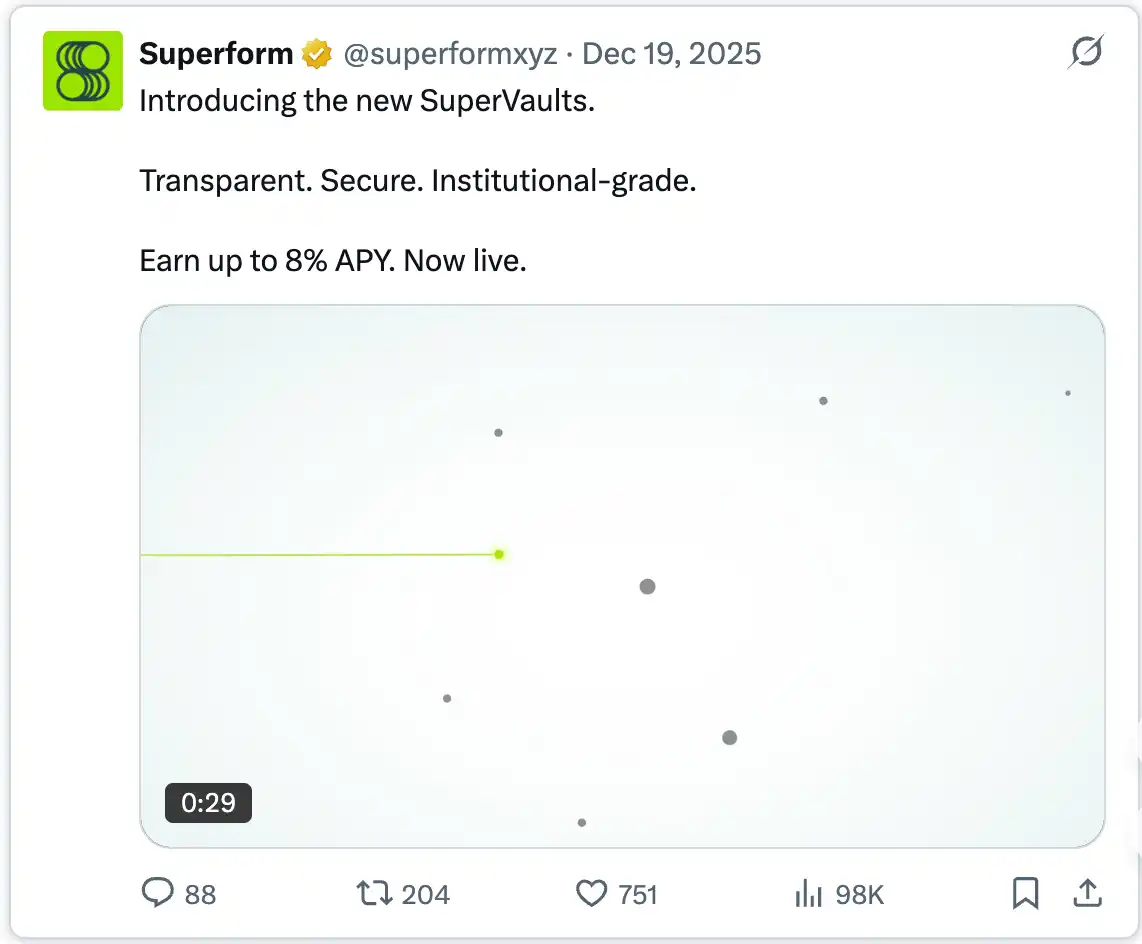
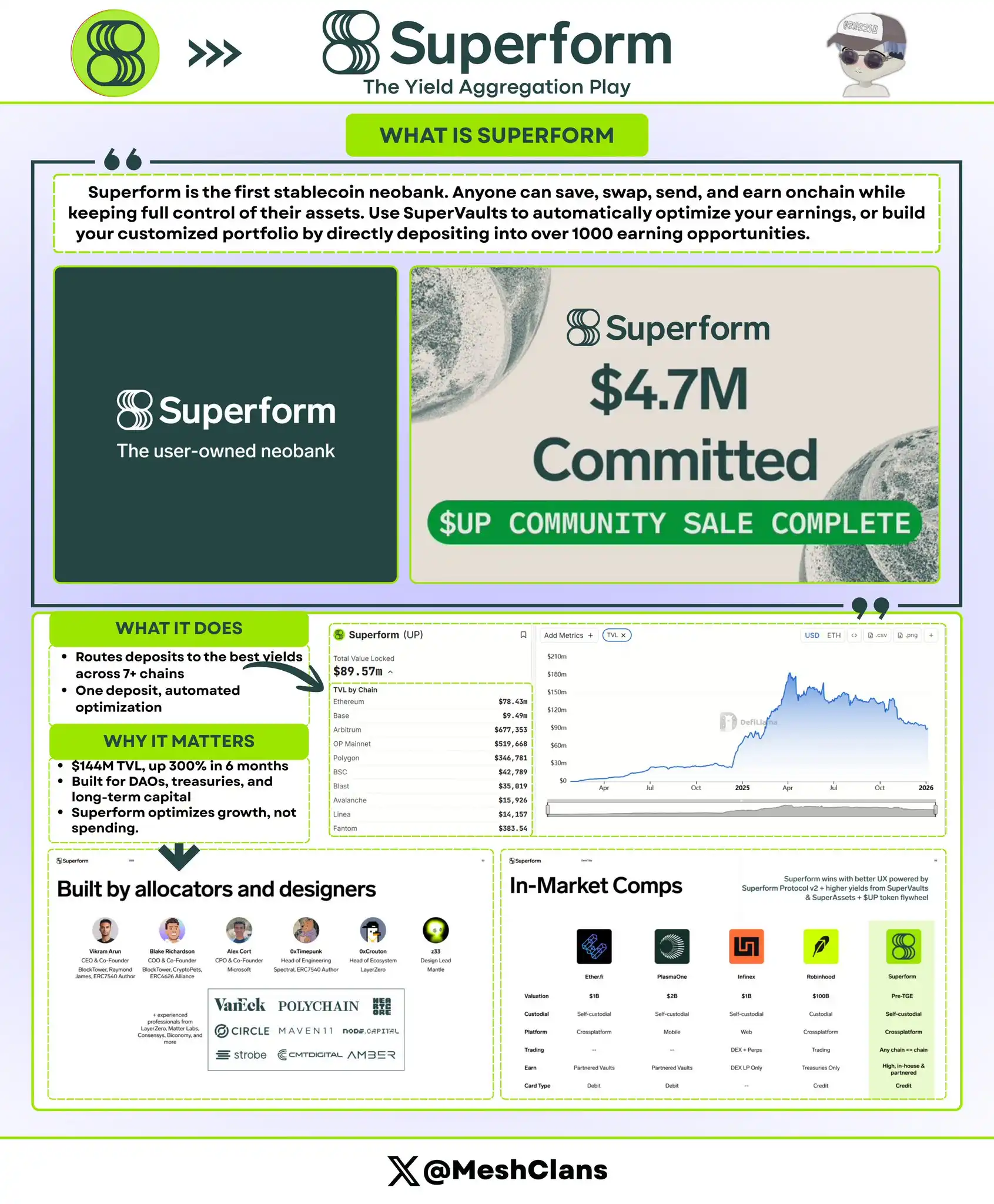
Superform's core function is to automatically route your funds to high-yield vaults across 7+ chains. You simply deposit USDC, and Superform finds the best Annual Percentage Yield (APY) for you, whether it's from Aave, Curve, or some protocol-specific yield farm you've never even heard of.

Data Performance (as of end-2025):

  • Total Value Locked (TVL): $144 million (300% growth in 6 months)
  • Funding: $12.9 million total across Seed, Strategic, and Public rounds
  • Fully Diluted Valuation (FDV): ~$90 million

Why is it important?

Superform's SuperVaults v2 launch in Q4 2025 was a game-changer. The "Cross-Chain Instant Deposit" feature allows users to deposit funds on Base, and Superform deploys them to a vault on Arbitrum in the background. No manual bridging, no waiting for confirmations, everything happens automatically.

Previously, yield optimization required significant expertise—tracking APYs, calculating Gas fees, timing bridges. Superform simplifies this to a "one-click" operation.
What makes it different?

Superform isn't trying to be your spending app; it's positioned as the savings backend layer for onchain finance. Unlike Tria's focus on capital flow efficiency, Superform is more concerned with efficient capital growth.

Additionally, Superform offers institutional-grade security (audited by Zellic and Omniscia), making it a "safe money" option. Many DAOs and protocol treasuries park capital here, which speaks volumes about the market's trust.
Veera's Trajectory is Fascinating

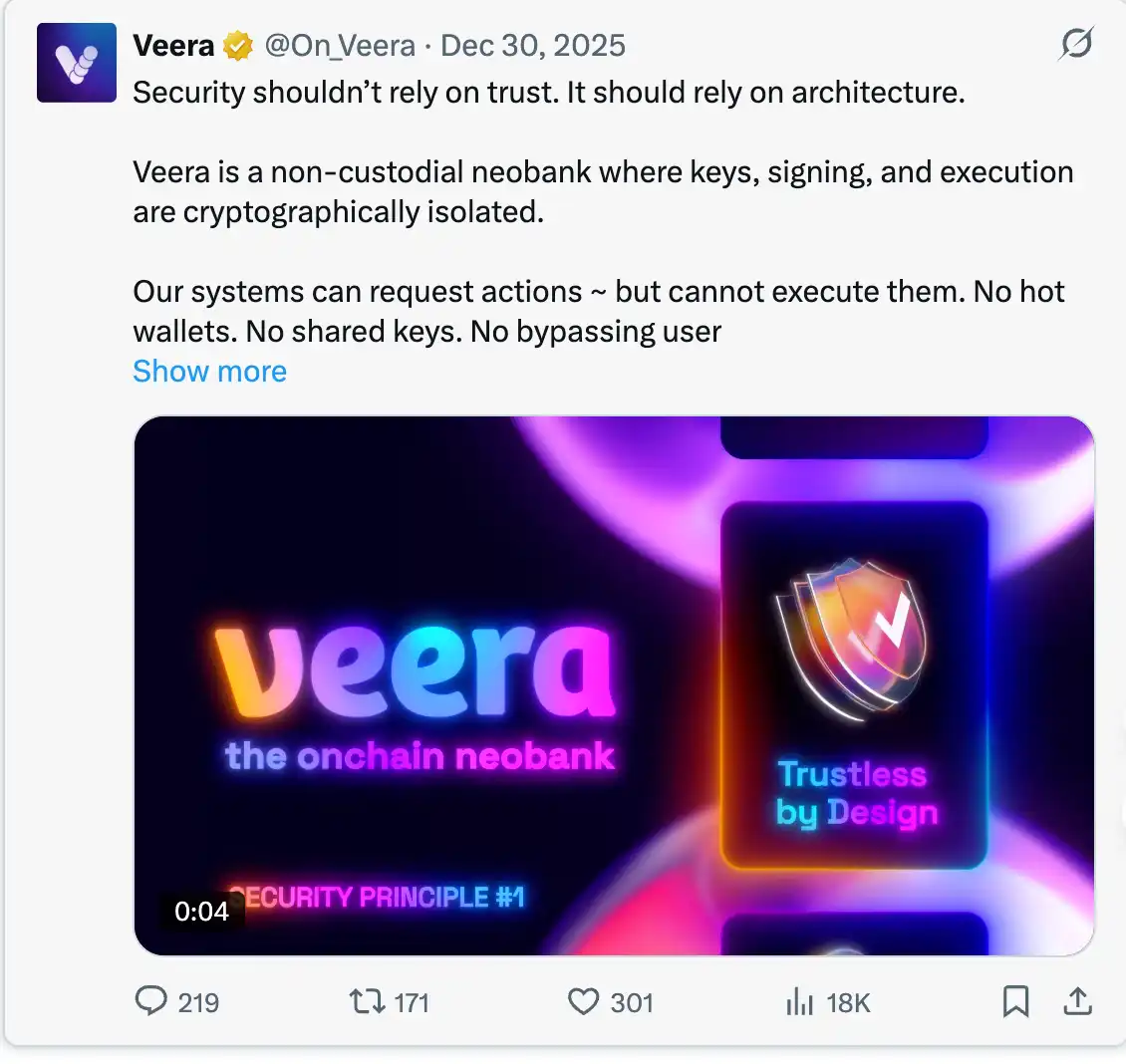
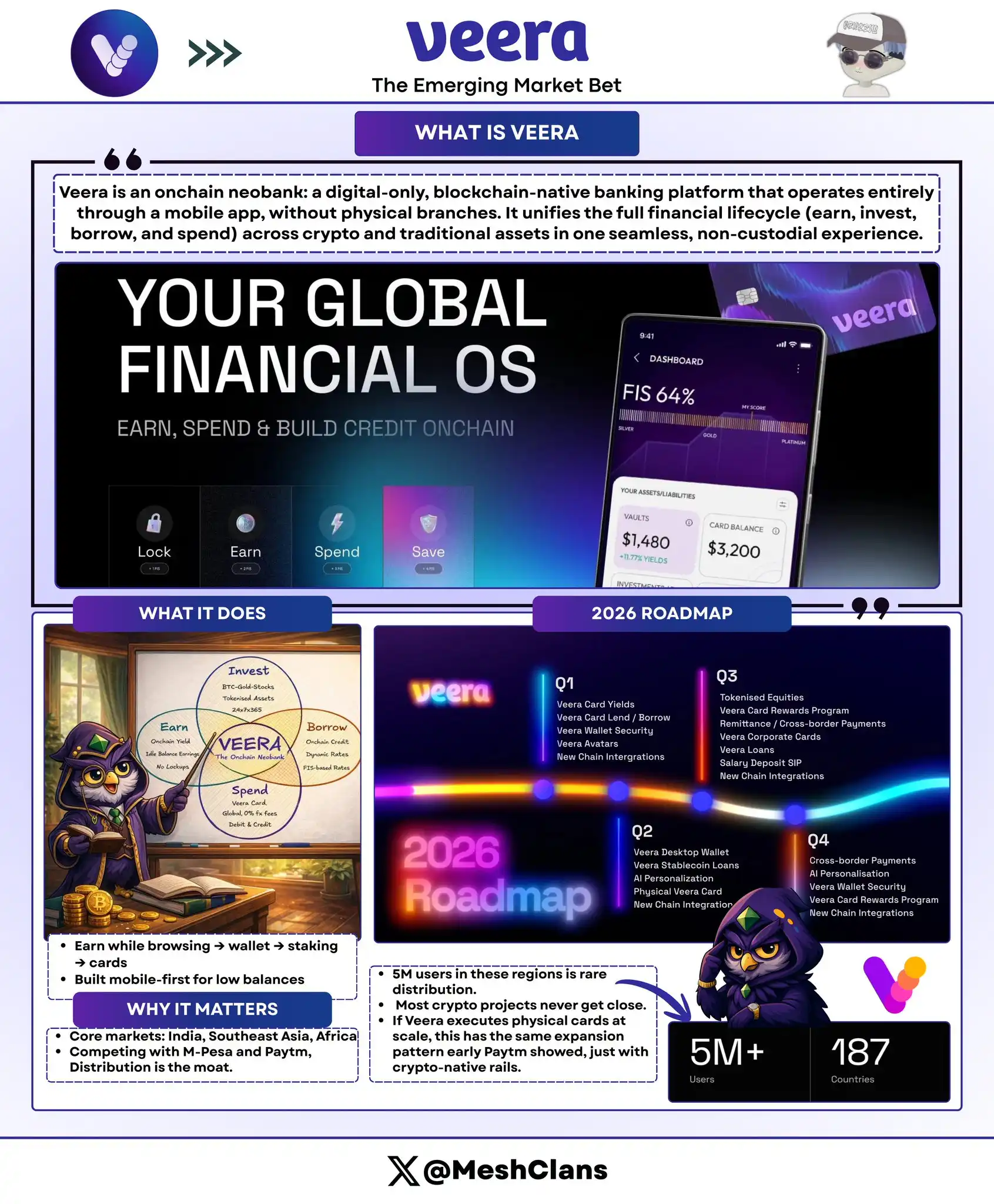
@On_Veera's growth path is very interesting. Starting as a rewards browser (similar to the Brave model), it evolved into a full financial operating system. It now boasts over 4 million users, active in emerging markets largely overlooked by Western VCs.

Basic Info:

  • User Base: Over 4 million users across 108 countries
  • Funding: $6 million Seed round from Ayon Capital in February 2024
  • Core Markets: India, Southeast Asia, Africa

Product Evolution:

The initial Veera was just a "browse-to-earn crypto" rewards browser. It has now developed into:

  • Browser RewardsWalletStaking/YieldPayment Card (Q1 2026)Credit Features (Q1 2026)

Their Q2 2026 roadmap also includes a physical debit card and desktop wallet. Their product iteration speed is rapid.

Why does Veera have the makings of a giant?

Traditional banks won't serve users in remote India with only $50 in savings, and companies like Revolut rarely enter most of Africa. Veera solves the distribution problem by meeting user needs: mobile-first, low-balance friendly, and deeply integrated into the daily browsing experience.

Their growth logic is clever: users earn small crypto rewards for normal browsing, then discover they can earn yield through staking or spend via a payment card. The onboarding has almost no friction because users immediately perceive value.

Competitive Angle:

Veera isn't competing with Coinbase; it's competing with local fintechs like Paytm, MTN Mobile Money, and M-Pesa in markets where crypto adoption is rapidly growing but infrastructure is weak.
4 million users in these markets is what most crypto projects dream of. If they execute the physical card launch in Q2, they could scale like Paytm did.
Tria: The Winner in Chain Abstraction

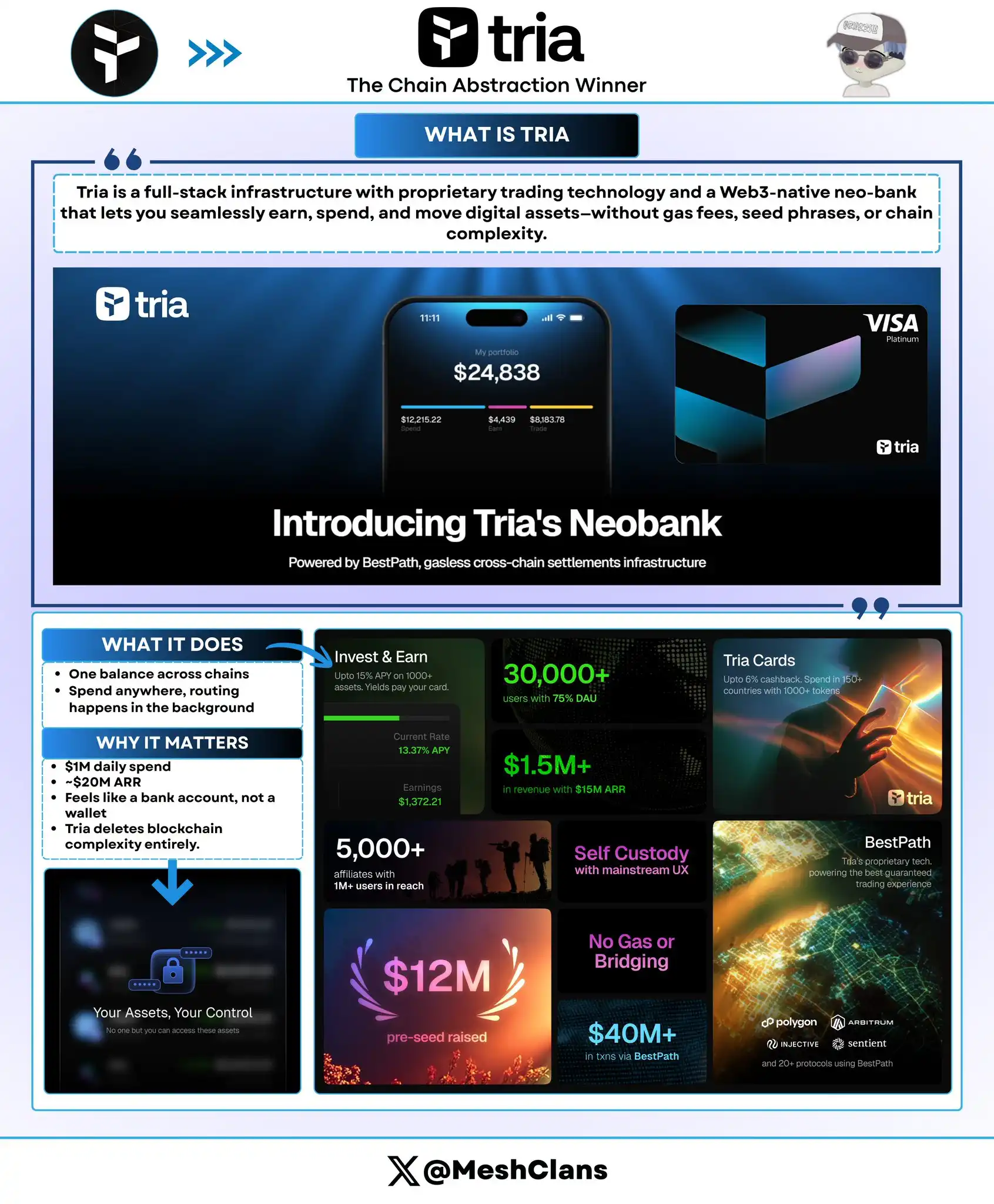
@useTria is one project I actually downloaded and tested in Beta. Its user experience is different and refreshing.

Current Data (Early 2026):

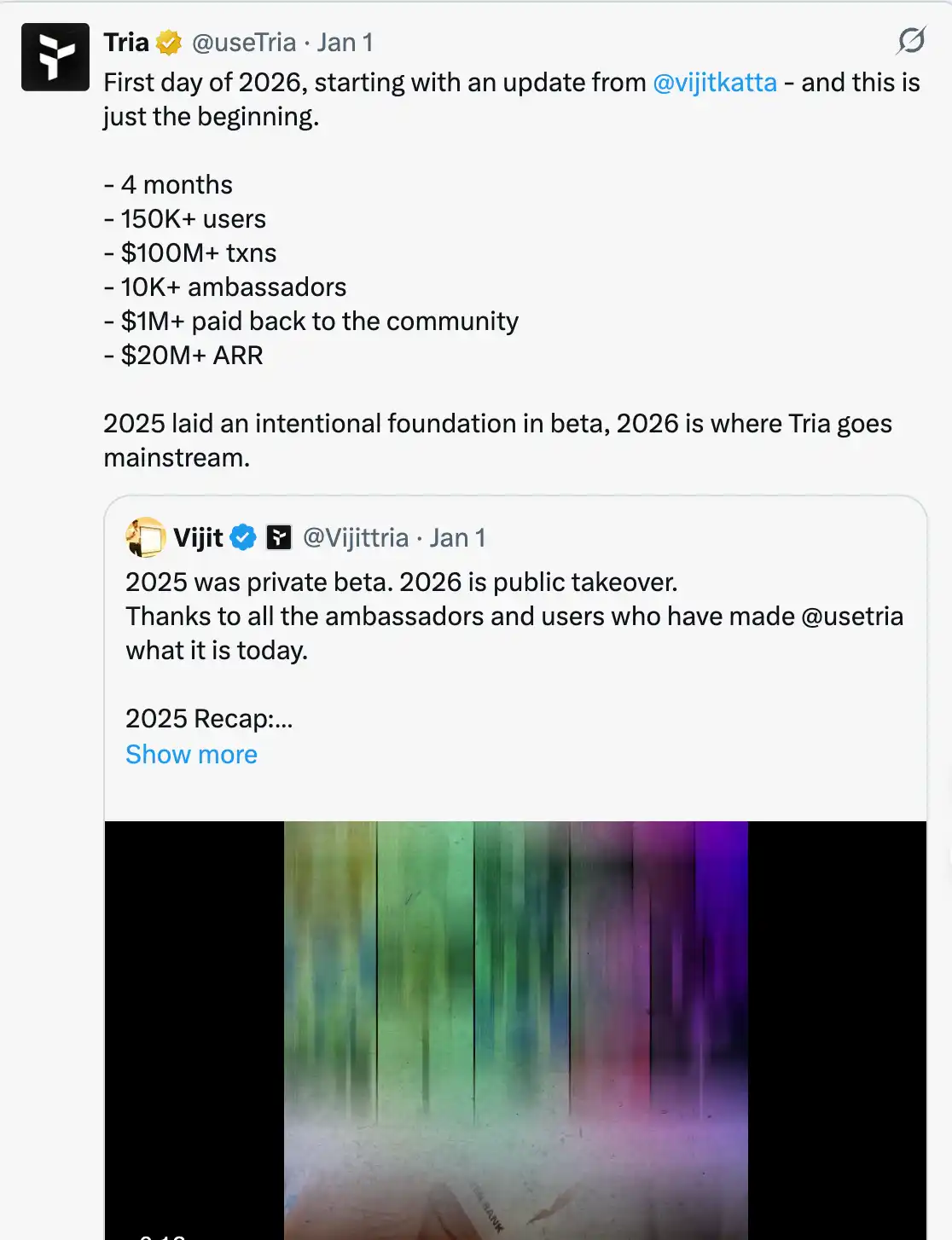
  • Active Users: Over 150,000
  • Beta Transaction Volume: Over $20 million
  • Daily Spending: Broke $1 million in November 2025
  • Annualized Run Rate (ARR): ~$20 million
  • Funding: $12 million raised in October 2025
  • Fully Diluted Valuation (FDV): Valuation between $100M - $200M

How does it work?

Tria's "Unchained" infrastructure makes blockchain complexity completely invisible. Users maintain one unified balance across multiple chains. When you spend, Tria's "BestPath" engine:

  1. Checks your assets on various chains;
  2. Finds the best liquidity path;
  3. Executes the swap or cross-chain operation in the background;
  4. Completes the payment in seconds.

The user experience is seamless: open the app, tap to pay, done. All blockchain complexity is automated away.

Tria's Christmas campaign, Triasmas (their holiday loyalty program), proved that native crypto rewards can rival traditional credit card points. People actually used it for daily spending and got cashback. This shows Tria has found product-market fit.

Why is it important?

Chain abstraction is key to making crypto usable for normal people. Other solutions always make users think about networks, Gas fees, bridges. Tria removes that friction entirely.

$1 million in daily spending validates real consumer demand. This isn't yield farming or speculation; it's real spending—coffee, groceries, bills. Over 150k users and $20M ARR suggest this is more than just beta hype.
Positioning:

In the current crypto landscape, Tria is the closest thing to a traditional bank account. It wins on speed and simplicity, not by flaunting blockchain complexity. This makes it the best candidate for mainstream users, though power users might want more control.
Comparison with Argent and Gnosis:

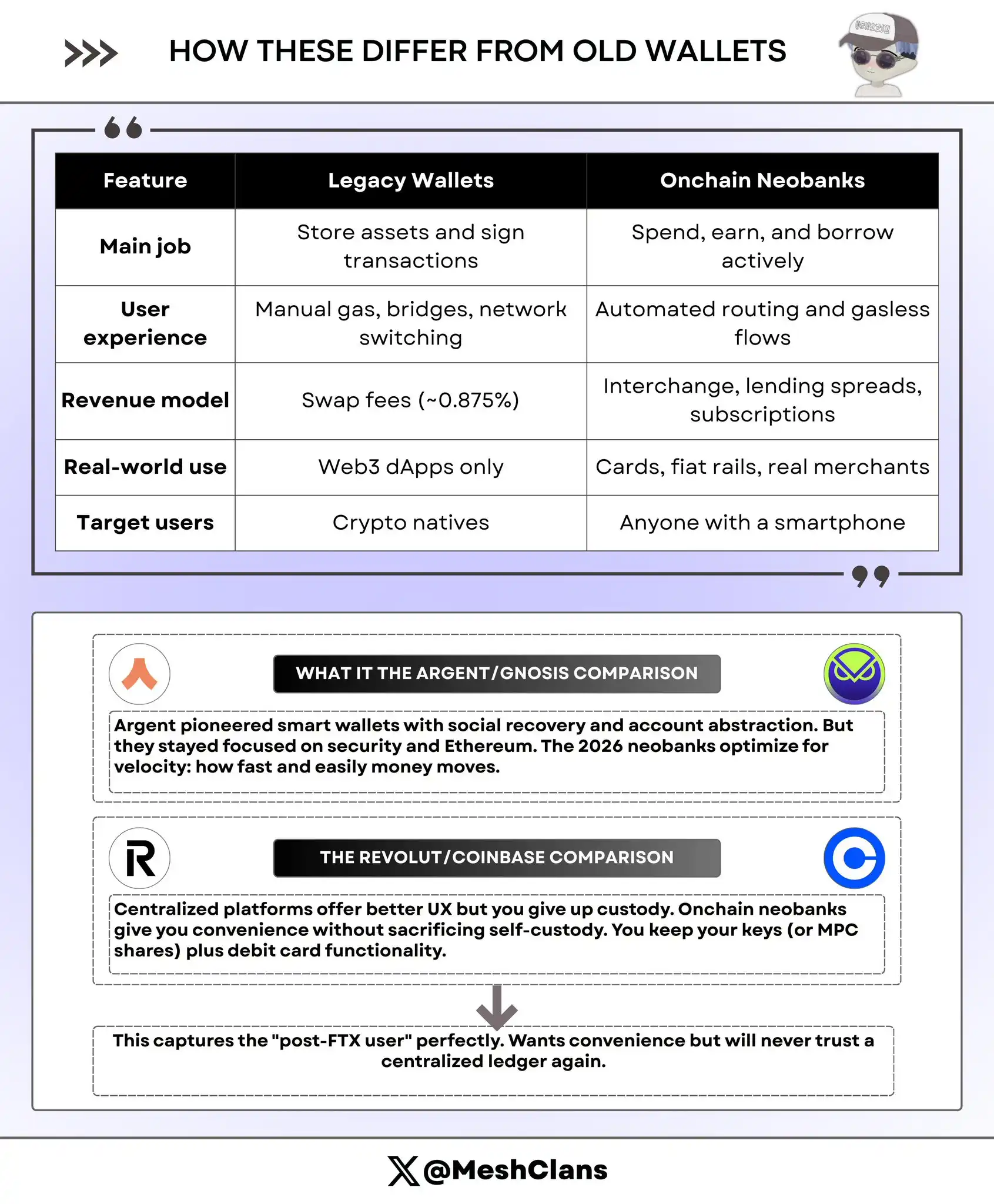
Argent pioneered smart wallets with social recovery and account abstraction. However, Argent has remained security-focused and Ethereum-centric. The 2026 onchain neobanks focus on the speed and ease of moving money—how to make capital flow faster and easier.

Comparison with Revolut and Coinbase:

Centralized platforms (like Revolut, Coinbase) offer better UX but require sacrificing custody. Onchain neobanks offer the same convenience without sacrificing self-custody. Users keep their keys (or MPC shares) while having debit card functionality.
Beyond the Three Titans

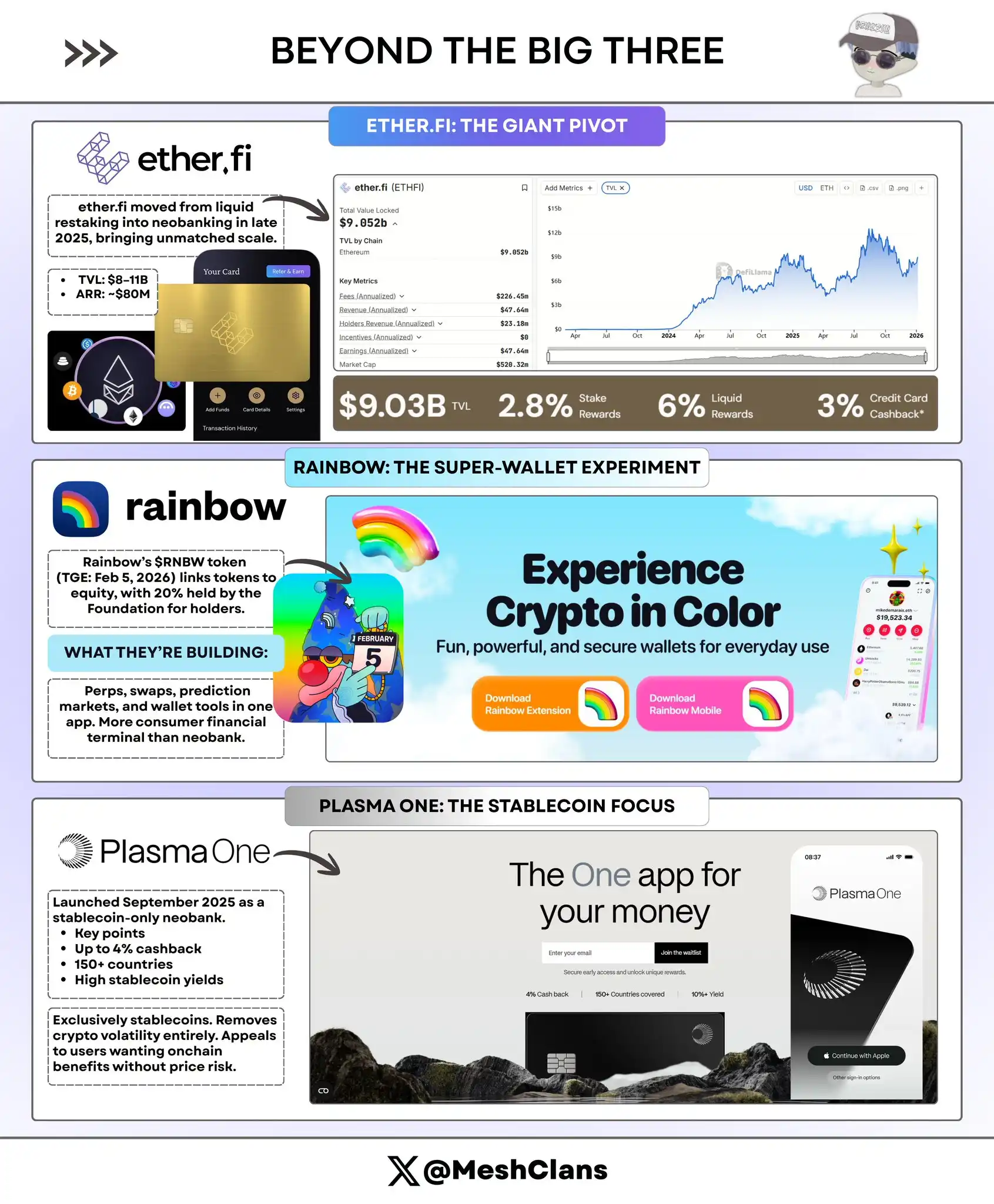
ether.fi: The Titan's Pivot

@ether_fi started as a liquid restaking protocol, but by late 2025, it pivoted heavily into the onchain banking space, on a completely different scale.

Data Performance (Late 2025 / Early 2026):

  • Total Value Locked (TVL): $8B - $11B
  • Annualized Run Rate (ARR): $80 million
  • Product: Cash Card, 3% crypto cashback

Innovation Highlight:

ether.fi's Cash Card lets users borrow against their restaked ETH (eETH) at ~4% APR without unlocking staked assets. This means users continue earning restaking rewards while accessing liquidity for spending.

This model cleanly solves the liquidity problem for yield farmers.

With $8B-$11B TVL, ether.fi is the "Chase Bank" of onchain neobanks. Its scale and liquidity can support serious consumer lending, making it a force in the industry.

Challenge:

Pivoting from DeFi infra to consumer banking isn't easy. ether.fi has capital but lacks Tria's UX polish or Veera's distribution. Execution matters more than TVL here.

Rainbow: The Super-App Experiment

Rainbow is launching its $RNBW token (TGE) on February 5, 2026, with an interesting structure: the Rainbow Foundation will hold 20% of the company's equity to reward token holders.

What are they building?

Rainbow is developing an all-in-one mobile interface including Perps, Swaps, Prediction Markets, and wallet functions. It's more of a consumer "Bloomberg Terminal" than a traditional neobank.

Equity-Token Link:

This equity-linked token structure is an experiment. If successful, other projects may rush to copy it. If it fails, it could be a classic case of over-promising.

Risk:

The risk of feature bloat is high. Trying to do everything might make the product unfocused, struggling to compete with best-in-class single-function apps. The upcoming February TGE will reveal if the market values the equity-link model or sees it as a marketing gimmick.

Plasma One: The Stablecoin-First Contender

Plasma One launched in September 2025, positioning itself as the "first stablecoin-native neobank".

Product Features:

  • 4% cashback
  • Available in 150+ countries
  • High yield on stablecoin balances

Unique Positioning:

Plasma One focuses solely on stablecoins, removing crypto price volatility entirely. This appeals to users who want onchain benefits without price risk.

Core Issue:

The "first stablecoin-native" positioning is more of a marketing angle than a real moat. Any competitor can easily add a stablecoin-only mode. Success will come down to execution, not positioning.
Risks Worth Watching

Sustainability of Yields

Let's be real. High returns like Veera's browser rewards and 15% APYs are mostly subsidized by VC funding and token emissions.

Remember the 20% UST rates from Anchor? We all know how that ended—with the collapse of the entire Terra ecosystem.

The 2026 onchain neobank space faces a core question: what happens when the subsidies run out?

Sustainable onchain banks need real revenue sources: card transaction fees, lending spreads, subscription models. Projects inflating APY by burning token reserves might not survive until the next funding round.

Tria's $20M ARR provides a template: real revenue from real transactions, not token incentives.

Watch for: Projects being transparent about revenue sources, clearly distinguishing organic income from token subsidies. If they aren't transparent, that says something.

Regulatory Uncertainty

2025 discussions around the Stablecoin Act created much uncertainty. If US regulations require self-custody "banks" to implement KYC, the industry could see a major split:

  • Compliant Hybrids (with institutional backing and regulatory infrastructure) will thrive in the US market.
  • Pure Self-Custody Apps (like Tria, Superform) might be forced to geo-block US users or add compliance layers, potentially breaking their core value proposition.

Europe's MiCA regulations in 2024-2025 provided some clarity. Clear rules help legitimate projects but raise the barrier to entry.

Key Question: Can these protocols adapt to regulation while keeping their decentralized core intact?

The Metamask Threat

Metamask has 30 million MAUs and immense brand recognition. For Veera or Tria to reach 10 million users, they need to be significantly better than Metamask, not just marginally.

Chain abstraction is a feature, not a moat. Metamask could launch gasless transactions and unified balances within six months. If that happens, the competitive edge of onchain banks shrinks to payment cards and yield optimization.

Defenses:

  • Tria's Play: Payment networks (hard to copy quickly).
  • Superform's Play: Yield optimization algorithms (more sustainable).
  • Veera's Play: Focus on markets Metamask ignores (geographic moat).

Time will tell who wins.

2026 Outlook

Most Likely to Hit 1M DAU First: Tria

Tria's UX is already polished. $1M daily spending and 150k+ users show strong consumer demand. If the rumored Q1 Mastercard payment network integration happens, Tria could run away with it.

Chain abstraction matters most to mainstream users who don't care about blockchain. They just want to buy coffee with crypto, not understand the tech.

$20M ARR suggests Tria has found real product-market fit, not just beta hype.

Safest for Sustained Growth: Superform

Yield optimization survives every market cycle. Even if consumer-facing neobanks struggle, institutional users (DAOs, protocols, treasuries) will still park capital in optimized vaults.

Superform's focus on "safe money" means lower volatility and more stable growth. Less "sexy," but highly sustainable.

Most Likely Dark Horse: Veera

4 million users in India and Southeast Asia is a distribution most crypto projects can't touch. If Veera executes the physical card launch in Q2, it could become the "Paytm" of crypto.

It achieved massive scale in markets Western VCs largely ignore. The upside is huge.

Most Likely Acquisition Target: ether.fi

$8B-$11B TVL and $80M ARR make ether.fi a prime acquisition target for Coinbase, Kraken, or TradFi banks looking to enter crypto. Expect consolidation by end-2026, as giants choose to buy proven infrastructure rather than build from scratch.

What These Onchain Banks Share

These three projects are essentially building a new kind of financial super-app: combining DeFi's power with everyday banking UX, all self-custodied and onchain.

Common DNA:

  1. Non-Custodial Core: Users control keys and assets, avoiding freeze/confiscation risks of centralized platforms.
  2. Unified Operating System: Yield, spend, trade across chains in one app, vs. traditional wallets requiring constant dApp switching.
  3. Focus on Mass Adoption: Replaced "read 47 docs on liquidity pools" with "earn more, do less".
  4. Timing is Right: These projects emerged in late 2025, marking the next phase post-"DeFi 2.0". Better L2s, account abstraction, and real-world spending needs converged.

Different Paths, Same Goal

  • Superform: Yield optimization & institutional-grade infra
  • Veera: Global credit & yield OS
  • Tria: Consumer payments & spending

Together, these projects are building a new category. People are starting to see "onchain neobanks" as an industry, not just individual projects. This narrative momentum matters for funding, partnerships, and market mindshare.

Final Take

Self-custody is becoming convenient. These three projects represent different paths to solving the same problem: making crypto as easy as traditional banking, while keeping self-custody at the core.

Who will dominate?

Likely, all three will thrive, serving different user segments. The crypto economy is vast enough for multiple financial operating systems.

The real challenge: can they cross the chasm from crypto-natives to mainstream adoption?

Late 2025 data suggests yes:

  • Tria: $20M ARR
  • Veera: 4M users
  • Superform: $1.44B TVL

These numbers suggest sustainable growth, not just speculative hype.

2026 will be the year this space proves its potential.

Trending Cryptos

Related Questions

QWhat are the three leading on-chain neobanks mentioned in the article, and what are their core focuses?

AThe three leading on-chain neobanks are Superform, Veera, and Tria. Superform focuses on yield optimization and institutional-grade infrastructure, acting as a 'savings account' for on-chain finance. Veera is building a global credit and yield operating system, targeting emerging markets. Tria is a consumer-facing platform for payments and spending, prioritizing chain abstraction for a seamless user experience.

QAccording to the article, what key metric suggests Tria has found genuine product-market fit?

AThe key metric is Tria's Annual Recurring Revenue (ARR) of approximately $20 million. This revenue, derived from real transactions rather than token incentives, indicates strong consumer demand and validates that the platform has moved beyond beta hype to achieve sustainable product-market fit.

QWhat major risk do on-chain neobanks face regarding the sustainability of their high yields, as highlighted in the article?

AThe major risk is that high yields, like Veera's 15% APY, are often subsidized by venture capital funding and token emissions. The article compares this to the unsustainable 20% UST yield offered by Anchor Protocol before the Terra collapse. Sustainable neobanks need real revenue sources like card transaction fees, lending spreads, and subscription models instead of relying on burning token reserves.

QHow does the article differentiate the target market and growth strategy of Veera from its competitors?

AVeera's strategy focuses on growth in emerging markets (India, Southeast Asia, Africa) that are often overlooked by Western VCs and underserved by traditional banks and fintechs like Revolut. It acquired over 4 million users through a low-friction, mobile-first onboarding process that starts with a 'browse-to-earn' rewards model, gradually introducing users to staking, yield, and eventually payment cards.

QWhat is the core technological innovation that Tria's 'Unchained' infrastructure provides, and why is it important for mainstream adoption?

ATria's core innovation is chain abstraction, which makes blockchain complexity completely invisible to the user. Its 'BestPath' engine automatically checks assets across multiple chains, finds the best liquidity path, and executes swaps or cross-chain operations in the background within seconds for a payment. This is crucial for mainstream adoption because it allows users to spend crypto as easily as fiat without needing to understand gas fees, bridges, or network switching.

Related Reads

Optical Chips: Collective Capacity Expansion

The global optical chip industry is experiencing a massive wave of expansion driven by surging AI data center demand. Major players across the US, Japan, Europe, and China are aggressively investing to ramp up production capacity. In the US, Coherent is expanding its 6-inch Indium Phosphide (InP) semiconductor fab in Texas, supported by CHIPS Act funding and a $2 billion strategic investment from NVIDIA. Lumentum is building a new factory for InP optical devices, and Nokia is scaling its advanced photonic chip packaging and testing capabilities. NVIDIA's investments aim to secure future supply of critical lasers and optical interconnect products for AI infrastructure. Japan's JX Advanced Metals, a leading InP substrate supplier, plans a multi-billion yen investment to increase its capacity 7-10 times, strengthening its grip on the crucial upstream materials market. In Europe, IQE and Tower Semiconductor settled a patent dispute and signed a multi-year InP epitaxial wafer supply agreement, highlighting that next-generation silicon photonics platforms will integrate high-performance InP components. STMicroelectronics and Sivers Semiconductors are also expanding silicon photonics production and partnerships. China is rapidly building out its domestic supply chain. Dongshan Precision's subsidiary, Source Photonics, announced a $12 billion project to expand optical chip and module production. Companies like Sanan Optoelectronics and Yunnan Germanium are scaling up InP chip manufacturing and substrate production, moving towards vertical integration from materials to modules. While debate continues around the exact future architecture—whether CPO (Co-Packaged Optics), NPO, or pluggables will dominate—analysts like Morgan Stanley argue the underlying driver is unchangeable: the explosive growth in bandwidth demand. This will inevitably increase the volume of optical engines, lasers, and related content per GPU, regardless of the final technical path. The competition for "more light" in the AI era has intensified into a global, full-chain capacity race.

marsbit42m ago

Optical Chips: Collective Capacity Expansion

marsbit42m ago

Stablecoins Finally Find Real Yield: An In-Depth Look at On-Chain Reinsurance Re | A Conversation with Re Founder Karan Saroya

Stablecoin Real Yield Found: A Deep Dive into On-Chain Reinsurance with Re's Karan Saroya As stablecoin supply exceeds $170 billion, the search for sustainable, non-speculative yield intensifies. Re, an on-chain reinsurance platform, provides an answer: connecting stablecoin capital to the trillion-dollar traditional reinsurance market. Re operates as a regulated reinsurer, accepting stablecoin deposits as collateral to back US insurance companies. These insurers pay premiums, generating yield that flows back to on-chain depositors. Currently supporting 35 insurers and underwriting $500 million, Re projects scaling to over $1 billion soon. Key insights from a Bankless podcast with founder Karan Saroya and investor Avichal of Electric Capital: 1. **Uncorrelated, Real-World Yield:** Re offers stablecoin holders access to reinsurance returns (targeting 12-14%+), an asset class entirely separate from crypto or equity markets. 2. **Operational Efficiency via Smart Contracts:** Re replaces traditional, labor-intensive capital fundraising with smart contracts, allowing a ~12-person team to compete with industry giants. 3. **Regulatory Leverage:** For every $1 of collateral, regulations allow backing $5-7 in written premiums. This leverage amplifies returns from the underlying risk-free rate. 4. **DeFi Integration:** Depositors receive receipt tokens, which can be used in protocols like Morpho for "looping," potentially pushing yields to 18-20%+. 5. **The "DeFi Mullet" Model:** A compliant front-end (regulated reinsurer) paired with a decentralized back-end (smart contracts, DeFi capital markets). 6. **RE Governance Token:** Modeled on Lloyd's of London, the token governs the central capital pool's allocation, counterparty acceptance, and parameters. 7. **Real Economic Impact:** Capital funds real-world productivity (factories, clinics, businesses) via insurance, moving beyond crypto's internal loops. The discussion highlights a pivotal moment: DeFi's supply-side infrastructure is now met by real demand for productive yield, potentially kickstarting a flywheel where vast on-chain stablecoin capital seeks these real-world returns.

链捕手2h ago

Stablecoins Finally Find Real Yield: An In-Depth Look at On-Chain Reinsurance Re | A Conversation with Re Founder Karan Saroya

链捕手2h ago

1996 or 1999? Walsh's First Test is 'How to View AI'

"1996 or 1999? Wall's First Big Test Is 'How to View AI'" Federal Reserve Chairman Wall's initial challenge is not whether to raise or cut rates, but a more fundamental judgment: what kind of boom is the current AI boom? This will determine the Fed's policy path and define his legacy. Economics is split between two opposing views, according to reporter Nick Timiraos. One sees imminent productivity gains that will increase supply and cool inflation, allowing the Fed to hold steady. The other argues that while productivity benefits are distant, demand shocks are here now, and waiting for data confirmation risks missing the intervention window, forcing sharper rate hikes later. Wall has signaled a leaning toward the first view, echoing 1996-era Alan Greenspan, who embraced strong, productivity-driven growth without fear of inflation. However, Wall faces a different macro environment than Greenspan did, with tariff pressures, expanding fiscal deficits, and diminishing globalization benefits, which could force more significant inflation pressures even if AI benefits materialize. Wall's logic, expressed before taking office, is that AI-driven productivity gains won't show in official data for years. If the Fed waits for confirmation, it might mistakenly tighten policy and choke off the very growth that could suppress inflation. This argues for using forward-looking narratives over lagging data. Chicago Fed President Austan Goolsbee presents a key counter-argument. He distinguishes between expected and unexpected productivity booms. A widely anticipated boom, like the current AI wave, can cause people to spend future wealth gains in advance, overheating the economy before productivity actually rises, thus requiring preemptive rate hikes. He cites rising costs for AI data centers as evidence of such overheating. Fed Governor Christopher Waller offers a rebuttal to Goolsbee, noting the "expected spending" mechanism only works if people can borrow against future income, which many households cannot do due to borrowing constraints. Wall also faces a paradox related to his desire to reduce the Fed's use of "forward guidance" (pre-announcing policy moves). This practice was established in 1999 when Greenspan began signaling hikes to avoid market shocks. If the economy follows a less optimistic path, Wall may be forced to choose between using the guidance he wants to abolish or risking market volatility by staying silent. The ultimate question defining Wall's first major test remains: Is this 1996 or 1999?

marsbit3h ago

1996 or 1999? Walsh's First Test is 'How to View AI'

marsbit3h ago

Ethereum Q1 2026 Report: Fees Decline, Users and Transaction Volume Hit New Highs

Ethereum Q1 2026 Report: Fees Down, Users & Transactions Hit New Highs Token Terminal's Q1 2026 report on Ethereum presents a pivotal development: the network achieved record highs in monthly active users (13.2M, +85.9% YoY), total transactions (200.4M, +81.5% YoY), and throughput (25.78 TPS), while transaction fees on the mainnet plummeted by 47.9% quarter-over-quarter. This shift is attributed to the network's strategic move into a "low fees for scale" phase, exemplified by the Fusaka upgrade which increased data capacity and lowered block space costs, releasing pent-up demand (a manifestation of Jevons's Paradox). The report highlights a core narrative shift for Ethereum: from a DeFi-centric blockchain to a global financial settlement layer. It maintains a dominant position in tokenized assets, holding majority market shares among top chains in stablecoins (61.8%), tokenized funds (73.0%), and tokenized commodities (84.0%). Growth in tokenized funds (+73.1% YoY) and commodities (+325.9% YoY) was particularly strong, driven by institutions like BlackRock and JPMorgan entering the space. Contrasting these usage gains, several USD-denominated value metrics declined in Q1: fully diluted market cap fell 30.3% QoQ, total value locked (TVL) dropped 11.0%, and ecosystem transaction volume decreased 24.0%. The report interprets this as Ethereum prioritizing long-term network expansion and cementing its role as the default settlement layer for finance over short-term fee capture. The commentary from Etherealize argues that, much like the early internet, Ethereum's open, permissionless model is poised to win over closed alternatives as institutional tokenization accelerates.

marsbit4h ago

Ethereum Q1 2026 Report: Fees Decline, Users and Transaction Volume Hit New Highs

marsbit4h ago

Trading

Spot
Futures

Hot Articles

What is $BANK

Bank AI: A Revolutionary Step in the Future of Banking Introduction In an era marked by rapid advancements in technology, Bank AI stands at the intersection of artificial intelligence (AI) and banking services. This innovative project seeks to redefine the financial landscape, enhancing operational efficiency, security measures, and customer experiences through the power of AI. As we embark on this exploration of Bank AI, we will delve into what the project entails, its operational dynamics, its historical context, and significant milestones. What is Bank AI? At its core, Bank AI represents a transformative initiative aimed at integrating artificial intelligence into various banking operations. This project harnesses the capabilities of AI to automate processes, improve risk management protocols, and enhance customer interaction through personalised services. The primary objectives of Bank AI include: Automation of Banking Functions: By leveraging AI technologies, Bank AI aims to automate routine tasks, reducing the burden on human resources and enhancing efficiency. Enhanced Risk Management: The project utilises AI algorithms to predict and identify risks, thereby fortifying security measures against fraud and other threats. Personalisation of Banking Services: Bank AI focuses on offering tailored financial products and services by analysing customer data and behaviours. Improving Customer Experience: The implementation of AI-driven solutions, such as chatbots and virtual assistants, aims to provide users with more human-like interactions, revolutionising the way customers engage with banks. With these goals, Bank AI positions itself as a crucial player in rendering banking more efficient, secure, and user-centric. Who is the Creator of Bank AI? Details regarding the creator of Bank AI remain unknown. As such, no specific individual or organisation has been identified in the available information. The anonymity surrounding the project's inception raises questions but does not detract from its ambitious vision and objectives. Who are the Investors of Bank AI? Similar to the project's creator, specific information regarding the investors or supporting organisations of Bank AI has not been disclosed. Without this information, it is challenging to outline the financial backing and institutional support that might be propelling the project forward. Nevertheless, the importance of having a robust investment foundation is pivotal for sustaining development in such an innovative field. How Does Bank AI Work? Bank AI operates on several innovative fronts, focusing on unique factors that differentiate it from traditional banking frameworks. Below are key operational features: Automation: By applying machine learning algorithms, Bank AI automates various manual processes within banks. This results in reduced operational costs and allows human workers to redirect their efforts towards more strategic activities. Advanced Risk Management: The integration of AI into risk management practices equips banks with tools to accurately predict potential threats such as fraud, ensuring that customer information and assets remain secure. Tailored Financial Recommendations: Through continuous learning from customer interactions, the AI systems develop a nuanced understanding of user needs, enabling them to offer tailored advice on financial decisions. Enhanced Customer Interactions: Utilizing chatbots and virtual assistants powered by AI, Bank AI enables a more engaging customer experience, allowing users to have their queries resolved quickly, thus reducing wait times and improving satisfaction levels. Together, these operational features position Bank AI as a pioneer in the banking sector, establishing new benchmarks for service delivery and operational excellence. Timeline of Bank AI Understanding the trajectory of Bank AI requires a look at its historical context. Below is a timeline highlighting important milestones and developments: Early 2010s: The conceptualisation of AI integration into banking services began to gain attention as banking institutions recognised the potential benefits. 2018: A marked increase in the implementation of AI technologies occurred when banks started using AI tools like chatbots for basic customer service and risk management systems for improved security handling. 2023: The sophistication of AI continued to advance, with generative AI being introduced for more complex tasks such as document processing and real-time investment analysis. This year marked a significant leap in the capabilities afforded to banks by AI technology. 2024-Current Status: As of this year, Bank AI is on an upward trajectory, with ongoing research and developments poised to further enhance capabilities in banking operations. Continued exploration of AI applications hints at exciting developments yet to come. Key Points About Bank AI Integration of AI in Banking: Bank AI focuses on adopting artificial intelligence to streamline banking processes and improve user experiences. Automation and Risk Management Focus: The project strongly emphasises these areas, aiming to shift the burden of routine tasks while enhancing security frameworks through predictive analytics. Personalised Banking Solutions: By harnessing customer data, Bank AI enables tailored banking services that cater to individual user needs. Commitment to Development: Bank AI remains committed to ongoing research and development efforts, ensuring its adaptability and ongoing relevance as technology continues to evolve. Conclusion In summary, Bank AI exemplifies a crucial step forward in the banking industry, leveraging artificial intelligence to reshape operational paradigms, enhance security, and promote customer satisfaction. Despite gaps in information surrounding the creator and investors, the clear objectives and functional mechanisms of Bank AI provide a strong foundation for its ongoing evolution. As AI technology continues to advance and merge with the banking sector, Bank AI is well-positioned to significantly impact the future of financial services, enhancing the way we understand and interact with banking.

160 Total ViewsPublished 2024.04.06Updated 2024.12.03

What is $BANK

Discussions

Welcome to the HTX Community. Here, you can stay informed about the latest platform developments and gain access to professional market insights. Users' opinions on the price of BANK (BANK) are presented below.

活动图片