If Bitcoin Breaks Well Below $30,000, Crash Under $10,000 May Follow: Peter Schiff

u.todayPublished on 2022-05-09Last updated on 2022-05-09

Abstract

Prominent Bitcoin hater Peter Schiff has taken to Twitter to repeat his earlier statement about Bitcoin's likely crash below $10,000.

Contents

Peter Schiff running a Bitcoin-related poll, 54% plan to HODL

Bitcoin drops 7%

Schiff predicted massive crypto selloff
Prominent Bitcoin hater Peter Schiff has taken to Twitter to repeat his earlier statement about Bitcoin's likely crash below $10,000.
In January this year, he tweeted that should BTC go under the $30,000 level, it would soon crash under $10,000 too. At that time, the leading crypto was trading at roughly $35,000.
Peter Schiff running a Bitcoin-related poll, 54% plan to HODL
The CEO and chief global strategist of Euro Pacific Capital, and chairman of SchiffGold, has named a condition on which the global flagship cryptocurrency may collapse below the $10,000 level.
In his tweet, Schiff stated that in order for that to happen, Bitcoin needs to break significantly below the $30,000 price line.
He has launched a Twitter poll to find out how Bitcoin holders among his followers plan to act should BTC keep dropping and fall below $30,000.
A total of 33,425 voters have taken part in the survey, and slightly over 54% have chosen the "I'll HODL" option.
Ten point five percent plan to sell without repurchasing BTC later, and 15% intend to rebuy their Bitcoin cheaper after selling it now.
Nearly 20% believe that Bitcoin will not go below the $30,000 zone.
If #Bitcoin breaks decisively below $30K it seems highly likely that it will crash below $10K. That means anyone who owns Bitcoin now has a very important decision to make. What will you do? You had better decide now so you don't panic and make a rash spur-of-the-moment decision.
— Peter Schiff (@PeterSchiff) May 8, 2022
Bitcoin drops 7%
Over the weekend, the leading digital currency dropped 7.13% from $35,734 on May 7 and is trading at $33,185 at the time of this writing.
In another tweet, Schiff stated that the fact of this BTC drop demonstrates the weakness of other risk assets too and, due to this, he says, stock market futures are now trading 1% lower than before.
Schiff claims that in the near future, his favorite asset, gold, is likely to surge since investors will soon realize that interest rate hikes made by the Federal Reserve will provoke a recession rather than reduce inflation.
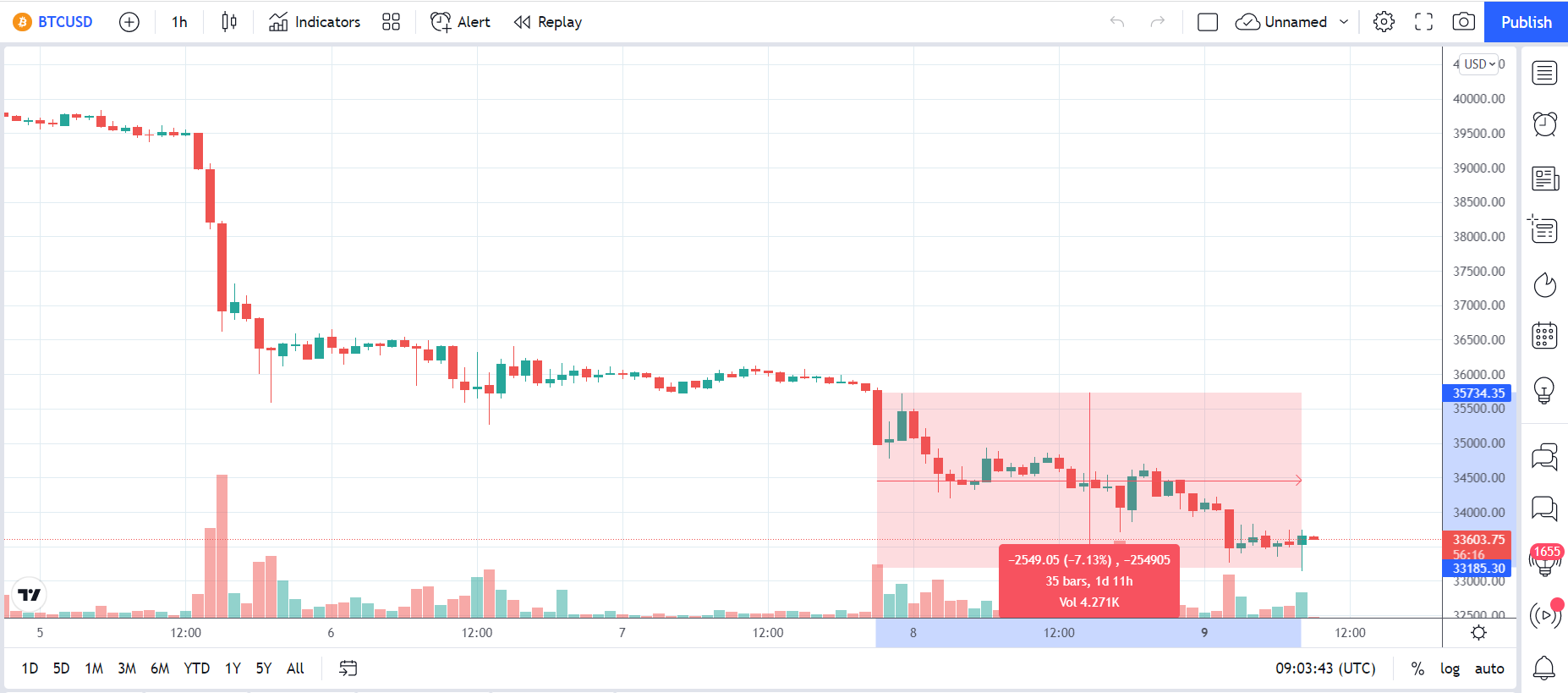
BTCdrop_00weekend_9efs

Image via TradingView
Schiff predicted massive crypto selloff
On Friday, Bitcoin critic Schiff tweeted that he expected a massive crypto selloff to begin after BTC broke below $37,000. He stated that the crypto market overall was plunging along with shares of blockchain-related companies and, in his view, the whole space would soon be exposed as a "malinvestment."
Schiff wrote that as people begin to lose their jobs, a lot of them would start selling their crypto assets in order to pay for rising household bills.


Trending Cryptos

Related Reads

From Issuance to Yield: Decoding the Hidden Gold Mine in the Trillion-Dollar Stablecoin Race

From Issuance to Yield: Decoding the Hidden Goldmine in the Trillion-Dollar Stablecoin Arena This report shifts focus from the stablecoin issuance duopoly (Tether and Circle) to explore the broader value chain, identifying greater opportunities downstream. It systematically outlines five key stages: Issuance, On-Ramp, Transfer, Payment, and Yield Generation. While issuance is dominated by scale and trust, other layers offer diverse business models. The prevailing strategy isn't rebuilding systems from scratch but integrating stablecoin efficiencies—like instant settlement and low-cost transfers—with existing traditional finance (TradFi) infrastructure, as seen in acquisitions like Stripe's purchase of Bridge. The Yield layer, however, requires specialized, independent capabilities. **Key Stages & Insights:** * **Issuance:** An oligopoly with high barriers; newcomers should focus on specialized functions like licensing or distribution rather than direct competition. * **On-Ramp:** A competitive, commoditized space where providers are expanding into issuance and infrastructure or being acquired to secure recurring revenue. * **Transfer:** Showcases stablecoin's cost advantage for cross-border payments. Winners control end-point exchanges, licenses, and customer relationships (e.g., payroll platforms like Rise). * **Payment:** Core revenue lies not in consumer-facing cards but in underlying issuance infrastructure and the capital efficiency gained from T+0 on-chain settlement. * **Yield:** Evolving into a full-scale on-chain asset management industry. Risk curators design vaults on lending protocols, charging management and performance fees. Demand is shifting toward predictable, treasury-backed yields over high-risk synthetic products. The future lies in controlling specific customer segments and integrating stablecoin technology with TradFi rails. Trends like regional currency adoption and deeper regulatory integration will further expand opportunities in infrastructure layers like card issuance, custody, and asset management. The market is converging, with major players seeking to dominate this fusion of efficiency and established systems.

Foresight NewsJust now

From Issuance to Yield: Decoding the Hidden Gold Mine in the Trillion-Dollar Stablecoin Race

Foresight NewsJust now

Crossing Boundaries Is Hard: Neither Prediction Market Nor Perp DEX Leader Has Replicated Their Own Success

Over the past six months, two of the hottest trading sectors—prediction markets and Perpetual DEXs (Perp DEXs)—have been attempting to cross into each other's territories. In April, prediction market platform Polymarket announced plans to launch perpetual contracts (Perps) for crypto, stocks, and commodities. In late May, the regulated platform Kalshi launched CFTC-regulated crypto Perps. Meanwhile, leading Perp DEX Hyperliquid moved in the opposite direction, launching its HIP-4 outcome markets for event-based trading in May. Initial results from these crossovers have been mixed, showing that established user habits and liquidity do not easily transfer to new product categories. Hyperliquid's HIP-4 platform saw strong initial demand, with daily volume reaching nearly $30 million during the World Cup, but active markets have since collapsed from over 120 to under 20, with daily volume often falling below $1 million. This highlights the inherent challenge: perpetual contracts maintain liquidity around core assets, while event contracts expire and require constant renewal of interest and liquidity. Similarly, Polymarket's Perps, still in an invite-only phase, saw daily volume drop from an initial ~$48 million to around $18 million by late July, with open interest (OI) at only ~$26.4 million—a fraction of Hyperliquid's ~$7.7 billion OI. Kalshi's Perps had a faster start, accumulating $16.1 billion in volume over six weeks, but recent daily volume has plummeted over 80% to around $80 million, with OI remaining in the millions, far below major Perp DEXs. The article concludes that replicating the deep liquidity and entrenched user behavior of a core market is exceptionally difficult. For these platforms, deepening their dominance in their original "home" sectors—whether Perp DEXs or prediction markets—may be a more viable strategy than pursuing a broad "everything exchange" model through跨界 expansion. Success ultimately depends on sustained accumulation of users, liquidity, and market depth in a core niche.

Odaily星球日报11m ago

Crossing Boundaries Is Hard: Neither Prediction Market Nor Perp DEX Leader Has Replicated Their Own Success

Odaily星球日报11m ago

Trading

Spot

Hot Articles

What is $BITCOIN

DIGITAL GOLD ($BITCOIN): A Comprehensive Analysis Introduction to DIGITAL GOLD ($BITCOIN) DIGITAL GOLD ($BITCOIN) is a blockchain-based project operating on the Solana network, which aims to combine the characteristics of traditional precious metals with the innovation of decentralized technologies. While it shares a name with Bitcoin, often referred to as “digital gold” due to its perception as a store of value, DIGITAL GOLD is a separate token designed to create a unique ecosystem within the Web3 landscape. Its goal is to position itself as a viable alternative digital asset, although specifics regarding its applications and functionalities are still developing. What is DIGITAL GOLD ($BITCOIN)? DIGITAL GOLD ($BITCOIN) is a cryptocurrency token explicitly designed for use on the Solana blockchain. In contrast to Bitcoin, which provides a widely recognized value storage role, this token appears to focus on broader applications and characteristics. Notable aspects include: Blockchain Infrastructure: The token is built on the Solana blockchain, known for its capacity to handle high-speed and low-cost transactions. Supply Dynamics: DIGITAL GOLD has a maximum supply capped at 100 quadrillion tokens (100P $BITCOIN), although details regarding its circulating supply are currently undisclosed. Utility: While precise functionalities are not explicitly outlined, there are indications that the token could be utilized for various applications, potentially involving decentralized applications (dApps) or asset tokenization strategies. Who is the Creator of DIGITAL GOLD ($BITCOIN)? At present, the identity of the creators and development team behind DIGITAL GOLD ($BITCOIN) remains unknown. This situation is typical among many innovative projects within the blockchain space, particularly those aligning with decentralized finance and meme coin phenomena. While such anonymity may foster a community-driven culture, it intensifies concerns about governance and accountability. Who are the Investors of DIGITAL GOLD ($BITCOIN)? The available information indicates that DIGITAL GOLD ($BITCOIN) does not have any known institutional backers or prominent venture capital investments. The project seems to operate on a peer-to-peer model focused on community support and adoption rather than traditional funding routes. Its activity and liquidity are primarily situated on decentralized exchanges (DEXs), such as PumpSwap, rather than established centralized trading platforms, further highlighting its grassroots approach. How DIGITAL GOLD ($BITCOIN) Works The operational mechanics of DIGITAL GOLD ($BITCOIN) can be elaborated on based on its blockchain design and network attributes: Consensus Mechanism: By leveraging Solana’s unique proof-of-history (PoH) combined with a proof-of-stake (PoS) model, the project ensures efficient transaction validation contributing to the network's high performance. Tokenomics: While specific deflationary mechanisms have not been extensively detailed, the vast maximum token supply implies that it may cater to microtransactions or niche use cases that are still to be defined. Interoperability: There exists the potential for integration with Solana’s broader ecosystem, including various decentralized finance (DeFi) platforms. However, the details regarding specific integrations remain unspecified. Timeline of Key Events Here is a timeline that highlights significant milestones concerning DIGITAL GOLD ($BITCOIN): 2023: The initial deployment of the token occurs on the Solana blockchain, marked by its contract address. 2024: DIGITAL GOLD gains visibility as it becomes available for trading on decentralized exchanges like PumpSwap, allowing users to trade it against SOL. 2025: The project witnesses sporadic trading activity and potential interest in community-led engagements, although no noteworthy partnerships or technical advancements have been documented as of yet. Critical Analysis Strengths Scalability: The underlying Solana infrastructure supports high transaction volumes, which could enhance the utility of $BITCOIN in various transaction scenarios. Accessibility: The potential low trading price per token could attract retail investors, facilitating wider participation due to fractional ownership opportunities. Risks Lack of Transparency: The absence of publicly known backers, developers, or an audit process may yield skepticism regarding the project's sustainability and trustworthiness. Market Volatility: The trading activity is heavily reliant on speculative behavior, which can result in significant price volatility and uncertainty for investors. Conclusion DIGITAL GOLD ($BITCOIN) emerges as an intriguing yet ambiguous project within the rapidly evolving Solana ecosystem. While it attempts to leverage the “digital gold” narrative, its departure from Bitcoin's established role as a store of value underscores the need for a clearer differentiation of its intended utility and governance structure. Future acceptance and adoption will likely depend on addressing the current opacity and defining its operational and economic strategies more explicitly. Note: This report encompasses synthesised information available as of October 2023, and developments may have transpired beyond the research period.

1.1k Total ViewsPublished 2025.05.13Updated 2025.05.13

What is $BITCOIN

Discussions

Welcome to the HTX Community. Here, you can stay informed about the latest platform developments and gain access to professional market insights. Users' opinions on the price of BTC (BTC) are presented below.

活动图片