Bitcoin Fees Soar Above Ethereum’s As Investors Flock To Ordinals-Backed Assets

newsbtcPublished on 2023-11-27Last updated on 2023-11-27

Abstract

CryptoFees data shows that Bitcoin daily fees averaged $10.65 million from November 16 to November 18, surpassing Ethereum’s average fee of nearly $7 million for the same period. Until 2024,...

CryptoFees data shows that Bitcoin daily fees averaged $10.65 million from November 16 to November 18, surpassing Ethereum’s average fee of nearly $7 million for the same period.
Until 2024, the US Securities and Exchange Commission (SEC) is deferring decisions on several Bitcoin ETF applications, despite the market’s increasing optimism about the approval of a spot Bitcoin exchange-traded fund (ETF) in the US.
This hesitation has coincided with a remarkable surge in the top crypto’s average transaction fees, soaring over 1,000% to reach a peak of $18.67 on November 16, according to BitInfoCharts data.
The average daily transaction fees for BTC, totaling $37,370, have seen a reversal with Ethereum. This change comes in the wake of heightened activi Bitcoin Fees Hit Highest Point In 6 Months
During the observed trend, it became evident that Bitcoin’s average daily trading fee experienced a noteworthy surge, reaching its highest point in the past six months on November 16, where it peaked at $18.67.
This spike in transaction fees within the Bitcoin network indicated a moment of heightened activity and demand. In contrast, over the same period, Ethereum’s transaction fees registered at $7.90, showcasing a relatively lower level compared to Bitcoin.
The divergence in fee dynamics between the two prominent cryptocurrencies underscores the distinct market forces and user behaviors influencing their respective blockchain networks.
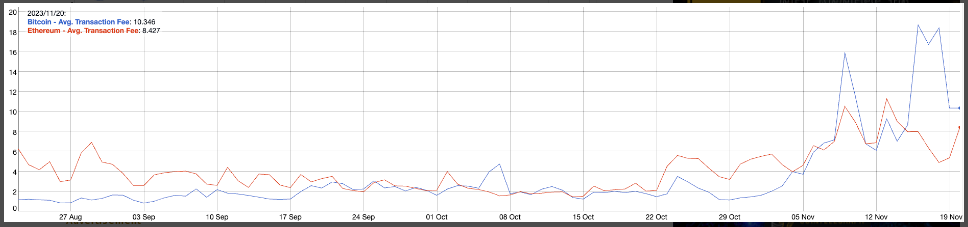
Bitcoin has outpaced Ethereum in daily fees in the last five days. Source: BitInfoCharts
This fluctuation underscores the dynamic nature of transaction fees in the cryptocurrency space, with Bitcoin experiencing notable shifts in its fee landscape.
Contrary to worries about the potential deterrent effect of elevated transaction fees on Bitcoin users, on-chain data suggests a contrasting trend.
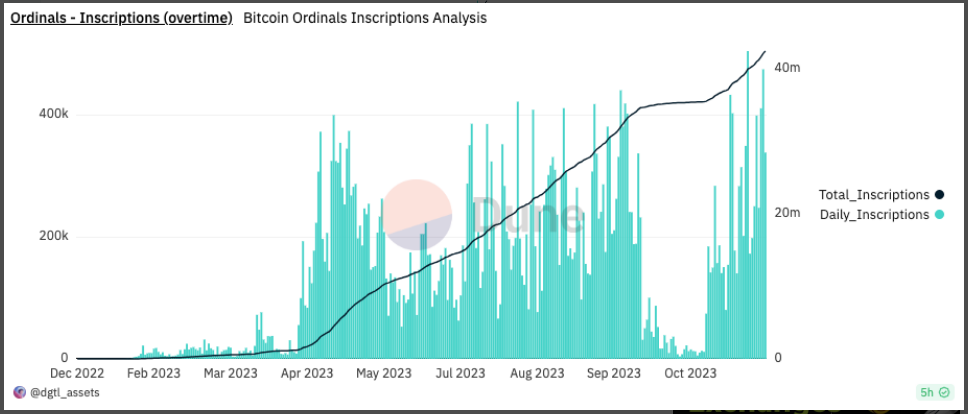
From late October, Ordinals inscriptions increased by almost 6 million. Source: Dune Analytics
Widespread Adoption And Growing Addresses
Recent data from IntoTheBlock reveals a notable surge in Bitcoin adoption, hitting a new yearly high at 67.62% this week.
This increase in adoption is reflected in the uptick of newly created active addresses, signaling a substantial influx of new participants into the market.


Bitcoin retakes the $37K territory. Chart: TradingView.com
Ordinals Gathering Momentum
Additionally, the volume of Bitcoin held by long-term investors has reached an unprecedented high, with over 1 million addresses now possessing more than 1 unit of Bitcoin.
This data indicates a growing and robust interest in Bitcoin, despite concerns about transaction fees, as evidenced by both increased user participation and a rise in long-term holdings.
Since October 24, the network has redistributed approximately 800 BTC in fees, equivalent to $30 million, as a result of the production of nearly 6 million Ordinal assets.
Following ORDI’s (the second-largest BRC-20 token by market capitalization) debut on Binance on November 7, the increase in Ordinals inscription activities gathered momentum.

Trending Cryptos

Related Reads

Just now, DeepSeek V4 updates with DSpark, improving inference speed by 80%

DeepSeek has updated its DeepSeek V4 model with the DSpark speculative decoding framework, achieving a significant 60-85% speedup in generation for Flash models and 57-78% for Pro models while maintaining the same overall throughput. This engineering-focused update, rather than a core architectural change, introduces DSpark to address latency and throughput bottlenecks in high-concurrency production environments. DSpark combines high-throughput parallel generation with adaptive load-aware verification. Its key innovations include a semi-autoregressive generation architecture to model dependencies within token blocks and a hardware-aware confidence-scheduled verification system. This system uses a confidence head to predict token acceptance probabilities, allowing it to dynamically optimize verification length per request and allocate compute only to tokens with the highest expected payoff. The asynchronous scheduler is designed for real-world deployment, ensuring zero-overhead scheduling and continuous CUDA graph replay while preserving the target model's output distribution. In tests across mathematical reasoning, code generation, and daily dialogue, DSpark outperformed state-of-the-art models like Eagle3 and DFlash, increasing average acceptance length by 26.7%-30.9% and 16.3%-18.4% respectively on Qwen3 target models. DeepSeek also open-sourced DeepSpec, a full-stack codebase for training and evaluating speculative decoding draft models, providing a standardized toolkit that includes data preparation tools, model implementations, training code, and evaluation scripts.

marsbit6h ago

Just now, DeepSeek V4 updates with DSpark, improving inference speed by 80%

marsbit6h ago

Trading

Spot

Hot Articles

What is $BITCOIN

DIGITAL GOLD ($BITCOIN): A Comprehensive Analysis Introduction to DIGITAL GOLD ($BITCOIN) DIGITAL GOLD ($BITCOIN) is a blockchain-based project operating on the Solana network, which aims to combine the characteristics of traditional precious metals with the innovation of decentralized technologies. While it shares a name with Bitcoin, often referred to as “digital gold” due to its perception as a store of value, DIGITAL GOLD is a separate token designed to create a unique ecosystem within the Web3 landscape. Its goal is to position itself as a viable alternative digital asset, although specifics regarding its applications and functionalities are still developing. What is DIGITAL GOLD ($BITCOIN)? DIGITAL GOLD ($BITCOIN) is a cryptocurrency token explicitly designed for use on the Solana blockchain. In contrast to Bitcoin, which provides a widely recognized value storage role, this token appears to focus on broader applications and characteristics. Notable aspects include: Blockchain Infrastructure: The token is built on the Solana blockchain, known for its capacity to handle high-speed and low-cost transactions. Supply Dynamics: DIGITAL GOLD has a maximum supply capped at 100 quadrillion tokens (100P $BITCOIN), although details regarding its circulating supply are currently undisclosed. Utility: While precise functionalities are not explicitly outlined, there are indications that the token could be utilized for various applications, potentially involving decentralized applications (dApps) or asset tokenization strategies. Who is the Creator of DIGITAL GOLD ($BITCOIN)? At present, the identity of the creators and development team behind DIGITAL GOLD ($BITCOIN) remains unknown. This situation is typical among many innovative projects within the blockchain space, particularly those aligning with decentralized finance and meme coin phenomena. While such anonymity may foster a community-driven culture, it intensifies concerns about governance and accountability. Who are the Investors of DIGITAL GOLD ($BITCOIN)? The available information indicates that DIGITAL GOLD ($BITCOIN) does not have any known institutional backers or prominent venture capital investments. The project seems to operate on a peer-to-peer model focused on community support and adoption rather than traditional funding routes. Its activity and liquidity are primarily situated on decentralized exchanges (DEXs), such as PumpSwap, rather than established centralized trading platforms, further highlighting its grassroots approach. How DIGITAL GOLD ($BITCOIN) Works The operational mechanics of DIGITAL GOLD ($BITCOIN) can be elaborated on based on its blockchain design and network attributes: Consensus Mechanism: By leveraging Solana’s unique proof-of-history (PoH) combined with a proof-of-stake (PoS) model, the project ensures efficient transaction validation contributing to the network's high performance. Tokenomics: While specific deflationary mechanisms have not been extensively detailed, the vast maximum token supply implies that it may cater to microtransactions or niche use cases that are still to be defined. Interoperability: There exists the potential for integration with Solana’s broader ecosystem, including various decentralized finance (DeFi) platforms. However, the details regarding specific integrations remain unspecified. Timeline of Key Events Here is a timeline that highlights significant milestones concerning DIGITAL GOLD ($BITCOIN): 2023: The initial deployment of the token occurs on the Solana blockchain, marked by its contract address. 2024: DIGITAL GOLD gains visibility as it becomes available for trading on decentralized exchanges like PumpSwap, allowing users to trade it against SOL. 2025: The project witnesses sporadic trading activity and potential interest in community-led engagements, although no noteworthy partnerships or technical advancements have been documented as of yet. Critical Analysis Strengths Scalability: The underlying Solana infrastructure supports high transaction volumes, which could enhance the utility of $BITCOIN in various transaction scenarios. Accessibility: The potential low trading price per token could attract retail investors, facilitating wider participation due to fractional ownership opportunities. Risks Lack of Transparency: The absence of publicly known backers, developers, or an audit process may yield skepticism regarding the project's sustainability and trustworthiness. Market Volatility: The trading activity is heavily reliant on speculative behavior, which can result in significant price volatility and uncertainty for investors. Conclusion DIGITAL GOLD ($BITCOIN) emerges as an intriguing yet ambiguous project within the rapidly evolving Solana ecosystem. While it attempts to leverage the “digital gold” narrative, its departure from Bitcoin's established role as a store of value underscores the need for a clearer differentiation of its intended utility and governance structure. Future acceptance and adoption will likely depend on addressing the current opacity and defining its operational and economic strategies more explicitly. Note: This report encompasses synthesised information available as of October 2023, and developments may have transpired beyond the research period.

473 Total ViewsPublished 2025.05.13Updated 2025.05.13

What is $BITCOIN

Discussions

Welcome to the HTX Community. Here, you can stay informed about the latest platform developments and gain access to professional market insights. Users' opinions on the price of BTC (BTC) are presented below.

活动图片