“死亡潮”来临,盘点Web3项目的七种死法。

PanewsPublished on 2023-11-09Last updated on 2023-11-09

Abstract

在最近的几个月, Web3 行业迎来一阵“死亡”小高峰, Stelo 、 Yield Protocol 等诸多具有显赫机构背景的项目相继宣布停止运营。

作者:谷昱, ChainCatcher
10月31日,加密货币钱包 Linen Wallet 宣布将关闭其应用程序,“人们对我们产品的兴趣有所下降,寻求先进自我托管解决方案的个人加密货币投资者整体活动也在下降。”此前在2019年9月,该项目曾获得 Polychian、Coinbase Venture 等机构的投资。
10月17日,Web3 安全解决方案 Stelo 宣布停止开发旗下所有产品。今年2月,该项目曾宣布获得 a16z 领投的 600 万美元种子轮融资。
10月23日,Web3 创作者平台 Async Art 宣布将停止运营。此前在 2021 年 2月,该项目曾获得200万美元融资,Lemniscap、Galaxy Interactive、Collab+Currency 等参投。
10月3日,固定利率借贷协议 Yield Protocol 宣布将停止运营。此前在 2021年6月,Yield Protocol 完成 1000 万美元A轮融资,Paradigm、Framework Ventures 等参投。
9 月 20 日,稳定币收益率聚合器 GRO Protocol 宣布将停止运营。此前在 2021年3月, GRO Protocol 宣布完成 710 万美元种子轮融资, Galaxy Digital 、 Framework Ventures 、 Nascent 、 Variant Fund 等参投。
9 月 13 日,DeFi 流动性管理协议xToken 宣布停止运营。此前在 2021 年 11 月,该项目曾完成 200 万美元融资, Lattice Capital 等参投。

“死亡潮”来临,盘点Web3项目的七种死法


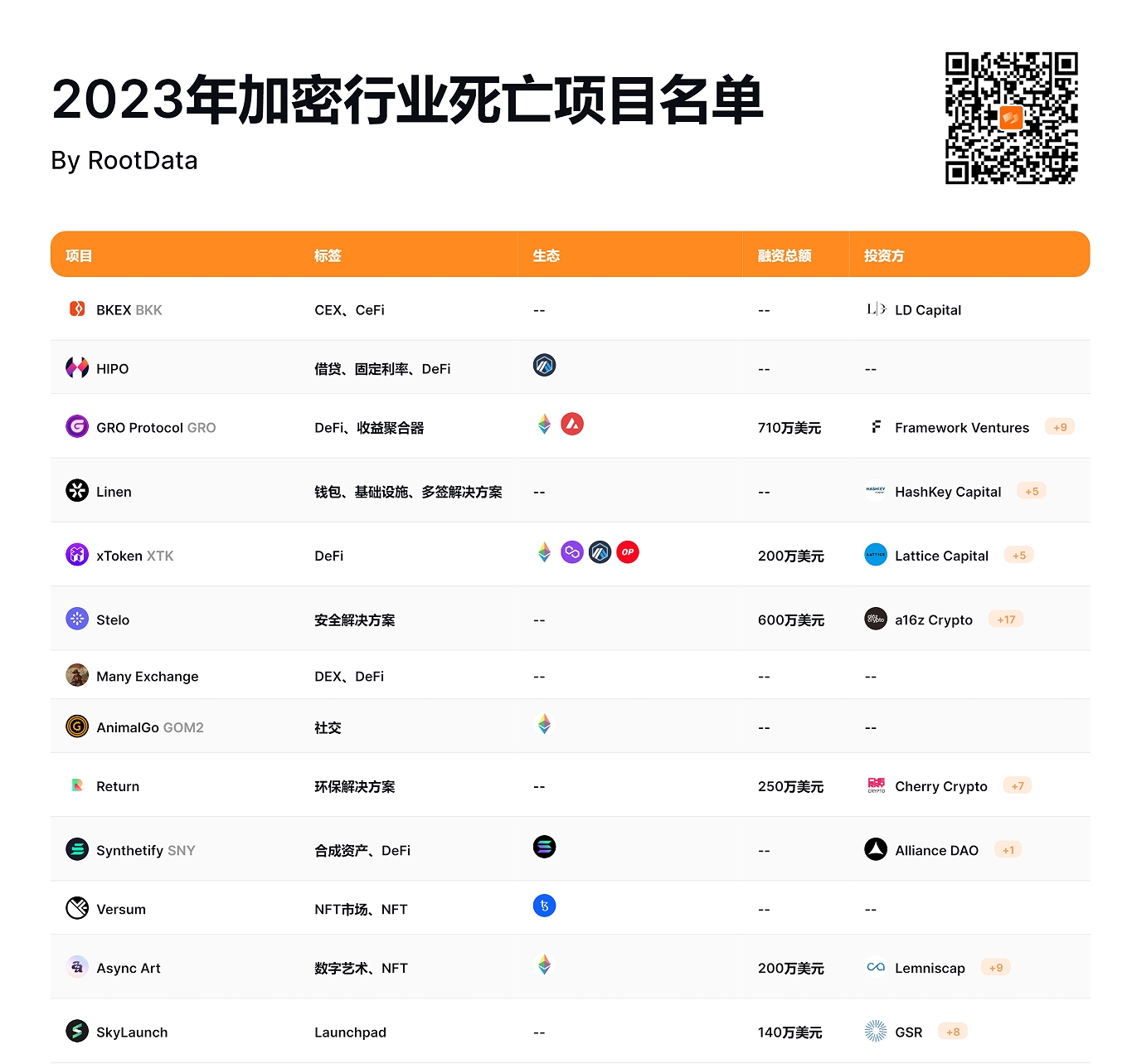
来源:《2023年加密行业死亡项目名单》
在最近的几个月, Web3 行业迎来一阵“死亡”小高峰, Stelo 、 Yield Protocol 等诸多具有显赫机构背景的项目相继宣布停止运营。据链捕手统计,近三个月主动宣布停止运营的 Web3 项目至少有 16 个,而悄无声息“慢性死亡”的项目只会更多。
优胜劣汰与高死亡率是创业公司的常态,对于牛熊周期特别明显的加密行业而言更是如此。综合这些死亡项目的“临终遗言”,链捕手总结了致使它们的五大原因。对于多数宣告死亡的项目,资金不足是最主要、也是最直接的原因,其它原因还包括产品缺乏市场契合度、监管政策趋严等。
以下是详细信息:
资金不足
在这些宣布停止运营的项目中,大多数项目的上一次融资时间发生在 2 0 2 1 年上半年,距今超过 2 年之久,加之区块链产品往往需要很高的开发与运营成本,融资款至今年基本消耗殆尽。同时,加密一级融资市场近两年持续下滑,老项目很难重新获得资本的青睐并获得新融资,因此被迫走向关闭。
绝大多数项目都是因为缺乏资金而走向倒闭,尤其是在无法完成新一轮融资的情况下。当然,也有多个项目表示仍具有一定资金,并计划将剩余资金分发给投资者,包括 Superdao 、 Linen Wallet 。
产品缺乏市场契合度
很多项目制定了野心勃勃的产品计划,并认为可以获得可观的市场采用率,但最终市场并未如同他们预期那般大规模采用其产品。这意味着产品定位存在严重误区,即便长期运营下去也难以获得相应的回报,这也使得部分项目选择主动关停。这类项目的涉及领域包括 DAO 解决方案、 NFT (租赁 NFT 、视频 NFT 等)等。
例如 DAO 一体化平台 Superdao 表示,2022 年其开始为已经启动并运营的 Web3 项目构建增长和分析工具,其清晰地看到,加密行业本身变得比最初的抱负(“新互联网”)要小得多,为加密公司提供专门的工具不太可能产生风险投资规模的回报。
a16 z 投资的安全解决方案 Steolo 则表示,产品开发之初,团队认为最紧迫的问题是防止用户受骗或陷入钓鱼陷阱,但最后发现用户最关心的问题是参与赌博和投机活动。该团队还指出三个错误的假设包括“交易安全具有数据网络效应”、“每位加密货币用户都使用独立钱包”、“消费者采用加密货币指日可待”。
“ AAA 级加密游戏或去中心化社交可能很快就会带来爆炸性增长,但 Stelo 产品组合并不能为这些用户带来太多好处,也不能从这种增长中获益。重要的是,我们不相信我们目前的用户能够代表我们预期的随着更广泛采用到来的新用户浪潮。” Steolo 反思道。
黑客攻击
近两年黑客攻击频次始终居高不下,致使许多项目的国库资金或者用户资产遭受巨大损失,从数十万美元到数千万美元不等,这既降低了项目的自我维持能力,也消耗了用户对项目的信任度,致使项目难以为继。
Hotbit 就表示,其停运的三大原因之一就是, Hotbit 曾多次遭遇网络攻击、项目缺陷被恶意用户利用等问题,造成重大损失。去中心化借贷协议 Hundred Finance 停止运营的主要原因也是黑客攻击,该项目在今年 4 月遭黑客盗取超 700 万美元。宣告解散的去中心化交易协议 Saddle Finance 亦在黑客攻击中损失数百万美元。
被母公司放弃
部分项目的死亡则身不由己,因为他们的母公司处于各种原因的考虑,决定不再支持该项目的发展,因此宣告停止运营。
今年 5 月, DCG 宣布将关闭旗下机构级交易平台 TradeBlock,其原因是宏观经济状况和长期的加密寒冬,以及充满挑战的美国数字资产监管环境。
今年 9 月, IoT 区块链 IOTA 宣布停止对旗下公链 Assembly 的开发,因为这是在该协议中增加进一步的复杂性,创建一个潜在的竞争解决方案,从而夺走 IOTA 和 $ IOTA 代币的价值并稀释市场注意力。此前 Assembly 曾获得 1800 万美元融资。
经营不善
经营水平是影响项目长期发展最重要的因素之一,有些项目即便有着充实的资金支持、市场空间巨大,但在糟糕的运营水平、一系列错误决策的影响下,也会最终导致死亡。
典型案例是加密货币托管公司 Prime Trust ,曾获得数亿美元的融资,但今年被曝从 2021 年起就一直在私自挪用客户资金,并与 FTX 等暴雷项目存在较大规模业务往来,最终陷入资不抵债、宣告破产的境地。
监管政策趋严
随着 FTX 等加密项目的暴雷以及洗钱风险的扩大,各国监管部门近一年显著增加了的加密行业的监管力度, SEC 甚至对 Ripple 等项目提出涉及证券发行的指控,这使得在美国地区的加密项目合规压力倍增,
Yield Protocol 发言人表示,需求不足和监管环境不确定是停止运营决定背后的关键驱动因素。 Web3 直播平台 Xeenon 在其社交平台表示,美国的监管环境使其难以进行创新,为此团队决定于关闭平台运营。
核心团队失联
不同于政策环境的问题,今年以来多个加密项目因为涉及洗钱风险,其核心团队被警方直接带走,致使项目被迫停止运营。典型案例是 Multichain 、 BKEX 与 CNHC Group ,这些项目今年年中均传出核心团队成员被警方控制的消息,其中 Multichain 上亿美元的用户资产也去向成谜。

Trending Cryptos

Related Reads

After Three Consecutive Quarters of Decline, Can the Crypto Market Find a Window for Stabilization in Q3?

The cryptocurrency market has just concluded its worst-performing quarter since 2022, with total capitalization dropping 12.6% to $2.1 trillion. All core metrics indicate capital is leaving the sector, not just rotating within it. Bitcoin fell 14.2% and Ethereum dropped 25.4% in Q2, breaking their previous correlation with US tech stocks. A key driver is the reversal in US spot Bitcoin ETF flows, which saw a net outflow of approximately $4.67 billion in Q2, including a record monthly outflow near $4.5 billion in June. While recent data suggests long-term holders are accumulating again, sustained ETF outflows mean continued selling pressure. Market focus is now singularly on the Federal Reserve. The upcoming July FOMC meeting is seen as the most critical event for Q3. A dovish signal could support Bitcoin reclaiming a $68,000-$84,000 range, while a hawkish stance might establish a new trading band around $50,000-$56,000. Additionally, regulatory uncertainty persists, with the progress of the crucial *CLARITY Act* stalling in the Senate, reducing its perceived 2026 passage probability to 40-45%. Despite the broad downturn, a few sectors showed growth. Prediction markets saw nominal volume surge 48.7% year-over-year to $113.8 billion, and tokenized collectibles transaction volume rose 143% quarterly to $1.4 billion. The Real-World Asset (RWA) tokenization sector also continued steady growth, now representing ~$28.1 billion in on-chain value. The market's foundation for an extreme crash appears limited, with Bitcoin price hovering near its 200-week moving average. However, the trading paradigm has shifted from narrative-driven speculation to decisions based on price action, policy developments, and interest rate expectations, making a broad sentiment-driven rally unlikely in the near term.

marsbit19m ago

After Three Consecutive Quarters of Decline, Can the Crypto Market Find a Window for Stabilization in Q3?

marsbit19m ago

BIT Trading Moment: BTC Still Suppressed by Weekly 200 EMA, Rejection May Restart Decline; Storage and Semiconductors that Surged Last Night Begin Falling in Evening Trading

**Crypto & Stock Market Wrap: Bitcoin Tests Resistance, Stocks Retreat After AI Surge** Bitcoin consolidates around $66,000, facing key resistance near $68,000—an area seen as a major psychological and technical hurdle where previous rallies have failed. Analysts note the cryptocurrency is caught between its 200-week moving average (~$63,333) and 200-week EMA (~$68,328). A clear break above $68k is needed to signal a stronger bullish trend, while a rejection could lead to a retest of $63k support. Market sentiment remains cautious, with low futures open interest pointing to a low-liquidity rebound rather than a full bull market. Bitcoin spot ETFs saw another $203 million inflow. US stock futures pointed lower after a strong Tuesday session led by a massive rebound in semiconductors and memory stocks. The rally was fueled by renewed optimism about AI-driven hardware demand, with Micron, SanDisk, and SK Hynix surging. However, those gains reversed in pre-market trading. Super Micro Computer (SMCI) soared over 20% after hours on strong guidance and a record backlog. Other standouts included Rocket Lab and nuclear energy plays Oklo and X-Energy. Rising oil prices (Brent above $91) and climbing Treasury yields (10-year near 4.64%), however, are reigniting inflation concerns and acting as a headwind for equities. In Asia, markets were mixed. South Korea's KOSPI pared early gains to close slightly higher as semiconductor stocks like SK Hynix gave back initial surges. Japan's Nikkei edged lower as the yen hit a fresh 38-year low against the dollar, raising fears of potential market intervention. Key events to watch include the Samsung Galaxy launch, AMD's AI event, and a slew of major tech earnings from Alphabet, Tesla, and IBM after the close on Wednesday, followed by the ECB meeting and Intel's earnings on Thursday.

marsbit27m ago

BIT Trading Moment: BTC Still Suppressed by Weekly 200 EMA, Rejection May Restart Decline; Storage and Semiconductors that Surged Last Night Begin Falling in Evening Trading

marsbit27m ago

Former CFTC Chairman, Circle President Tarbert: Preaching Long-Termism While Cashing Out $30 Million Himself

Former CFTC Chairman and Circle President Heath Tarbert has consistently advocated for a long-term vision in public, urging patience from investors as Circle’s stock price has fallen significantly from its peak. However, it has been revealed that since Circle’s IPO, Tarbert has continuously sold his CRCL shares through pre-arranged trading plans, cashing out approximately $30 million, without making any public market purchases. This contrast between his public messaging and personal actions has drawn criticism. Tarbert joined Circle in July 2023 as Chief Legal Officer, leveraging his regulatory experience to help guide the company through its IPO and expansion. Despite promoting stablecoins as long-term infrastructure, he established a 10b5-1 trading plan just before Circle went public, leading to substantial stock sales over the following year. In March 2026, he initiated another plan to sell more shares. His career trajectory highlights a pattern of moving between high-level regulatory roles and influential positions in the financial sector. After resigning as CFTC Chairman in early 2021, he joined Citadel Securities as Chief Legal Officer just 27 days later, during a period of intense regulatory scrutiny for the firm. He later joined Circle, aiding its efforts to navigate regulatory challenges for its public listing. While Tarbert's expertise in policy and compliance is valuable to companies like Circle, his actions—advocating long-term confidence while personally divesting—raise questions about the alignment between his public statements and his private financial decisions, leaving investors who followed his advice to bear the market risks.

marsbit50m ago

Former CFTC Chairman, Circle President Tarbert: Preaching Long-Termism While Cashing Out $30 Million Himself

marsbit50m ago

Gate Research Institute: The 'Wall Street-ization' Wave of Crypto Financial Products – Competition or Integration?

The article titled "Gate Research Institute: Are Crypto Financial Products Sparking a 'Wall Street' Wave—Competition or Convergence?" explores the evolving relationship between the crypto ecosystem and traditional finance (TradFi). The piece begins by reflecting on Bitcoin's original 2009 vision of decentralization, disintermediation, and moving away from banks. It then contrasts this with the 2024 landscape, where key crypto assets like Bitcoin are increasingly held through Wall Street products like ETFs issued by giants like BlackRock. The article questions whether this signifies that TradFi is systematically taking over the rights to issue, price, custody, and distribute crypto financial assets. The core argument is that this is not a zero-sum takeover but rather a bidirectional convergence where each side addresses the other's weaknesses. Crypto offers 24/7 global markets, programmable settlement, and open access but lacks compliant channels, institutional-grade custody, deep fiat liquidity, and mainstream distribution. TradFi possesses these but is constrained by legacy systems, limited operating hours, and slow settlement. Two primary convergence paths are highlighted: * **Path A (CEX to TradFi):** Exemplified by Gate, which has progressed from offering tokenized stocks and CFDs to providing direct, real stock trading (US, Hong Kong, South Korea) within its platform, using USDT. * **Path B (TradFi to Crypto):** Exemplified by Robinhood, which has integrated crypto trading, acquired exchanges like Bitstamp, and is moving traditional assets like stocks onto the blockchain via tokenization and its own Layer 2. Both paths are ultimately competing to become the next-generation, unified financial account—a "super account" where users can seamlessly trade cryptocurrencies, stocks, ETFs, RWA (Real World Assets), and tokenized treasury products in one interface. The growth of RWA and tokenized treasuries (e.g., BlackRock's BUIDL) is presented as the asset-layer fusion, providing stable, yield-bearing assets on-chain and acting as a bridge between the two worlds. In conclusion, the "Wall Street-ization" of crypto is framed as a mutual transformation. Decentralized ideals persist in the protocol layer, while at the application layer, a more efficient, global, and accessible unified capital market is emerging from this convergence. The future competition lies not between crypto exchanges and stockbrokers, but between platforms vying to offer the most comprehensive asset coverage, liquidity, and user experience within a single account.

marsbit54m ago

Gate Research Institute: The 'Wall Street-ization' Wave of Crypto Financial Products – Competition or Integration?

marsbit54m ago

Trading

Spot

Hot Articles

How to Buy NFT

Welcome to HTX.com! We've made purchasing AINFT (NFT) simple and convenient. Follow our step-by-step guide to embark on your crypto journey.Step 1: Create Your HTX AccountUse your email or phone number to sign up for a free account on HTX. Experience a hassle-free registration journey and unlock all features.Get My AccountStep 2: Go to Buy Crypto and Choose Your Payment MethodCredit/Debit Card: Use your Visa or Mastercard to buy AINFT (NFT) instantly.Balance: Use funds from your HTX account balance to trade seamlessly.Third Parties: We've added popular payment methods such as Google Pay and Apple Pay to enhance convenience.P2P: Trade directly with other users on HTX.Over-the-Counter (OTC): We offer tailor-made services and competitive exchange rates for traders.Step 3: Store Your AINFT (NFT)After purchasing your AINFT (NFT), store it in your HTX account. Alternatively, you can send it elsewhere via blockchain transfer or use it to trade other cryptocurrencies.Step 4: Trade AINFT (NFT)Easily trade AINFT (NFT) on HTX's spot market. Simply access your account, select your trading pair, execute your trades, and monitor in real-time. We offer a user-friendly experience for both beginners and seasoned traders.

7.6k Total ViewsPublished 2024.03.29Updated 2026.06.02

How to Buy NFT

What is Altura NFT?

Altura: Providing One-Stop NFT Solutions for Game Developers

56.2k Total ViewsPublished 2024.06.12Updated 2024.06.12

What is Altura NFT?

What is AINFT

EternaFi Agents and $AINFT: A Comprehensive Analysis of AI-Powered NFT Infrastructure in the Web3 Ecosystem The intersection of artificial intelligence (AI) and blockchain technology is rapidly evolving, establishing innovative platforms that redefine ownership models and economic participation. EternaFi Agents, along with its native token $AINFT, exemplifies a groundbreaking approach to the tokenization of AI infrastructures through the means of non-fungible tokens (NFTs). Launched in July 2025 by the development team at Nova Club, EternaFi merges the advancements of AI with the decentralized financial mechanisms of blockchain, presenting a unique investment opportunity for participants within the web3 ecosystem. This article aims to provide an in-depth assessment of EternaFi Agents, covering its core components, functionality, and significance within the crypto landscape. Introduction and Project Overview EternaFi Agents stands as a salient example of how blockchain technology can democratize access to advanced AI capabilities. The project endeavors to reshape the paradigm of AI ownership by diversifying economic participation, making sophisticated AI systems accessible to a larger pool of stakeholders. At its core, the project tokenizes a proprietary large language model (LLM) developed by Nova Club, allowing NFT holders to gain fractional exposure to the model's economic performance. By utilizing NFTs representing stakes in the LLM, EternaFi Agents fosters a model wherein stakeholders not only participate in AI service consumption but also enjoy sharing in the economic rewards generated by the platform. This transformative approach enables the development of sustainable revenue models for AI services, all the while promoting broad community engagement and facilitating transparent governance. What is EternaFi Agents? EternaFi Agents represents an AI-NFT infrastructure project that aims to blend the capabilities of AI with blockchain technology in a coherent ecosystem. The essential feature of this project is the creation of NFTs that serve as financial instruments, representing fractions of ownership in Nova Club's proprietary AI infrastructure. Each NFT symbolizes direct exposure to the economic performance of the underlying AI system, providing a lucrative opportunity for investors. The project operates on the Base blockchain, known for its scalability and efficiency, thus ensuring manageable transaction costs while facilitating a seamless operational experience. One of the notable features includes a revenue-sharing mechanism, wherein NFT holders can receive portions of subscription income generated by the AI services provided on the platform. This innovative approach establishes a connection between the success of the AI services and the economic dividends distributed among the holders, thus ensuring an alignment of interests across the community. Who is the Creator of EternaFi Agents? The creative force behind EternaFi Agents is Nova Club, a development team based in Singapore proficient in the amalgamation of AI and blockchain technology. Their prior experience in AI development and cryptocurrency analysis gives credence to the project, contributing a breadth of expertise to the creation of EternaFi Agents. Nova Club’s mission centers on democratizing access to cutting-edge AI technologies while building sustainable economic models that benefit users alongside developers. Their commitment to transparency, community governance, and innovation is reflected in the design and implementation of the EternaFi platform, aiming to establish a unique ecosystem that fosters positive engagement and long-term value creation. Who are the Investors of EternaFi Agents? The specific details concerning investors or investment organizations backing EternaFi Agents are not publicly available. However, EternaFi has adopted an inclusive approach to funding its development through the sale of NFTs to the public, allowing a wide array of participants to invest in the ecosystem. The project’s architecture ensures that core infrastructure is funded responsibly while allowing community members to partake in the ownership and economic returns generated from the AI services. This model emphasizes community engagement by aligning the interests of investors and project developers, creating a collaborative environment where long-term participation is incentivized. How Does EternaFi Agents Work? EternaFi Agents operates through a multifaceted ecosystem where NFTs serve as a primary means of ownership representation within the project. Each NFT holder is entitled to a share of the monthly subscription income produced by the underlying AI-powered platform, thereby positioning NFT ownership as a lucrative investment vehicle. Revenue Generation Mechanism The primary source of revenue generation for the EternaFi platform stems from subscription fees related to the AI services provided. Users can access various tiered services, ranging from basic market analysis tools to comprehensive AI-assisted trading solutions. These services are monetized and form the basis for the revenue-sharing framework, which distributes profits to NFT holders through automated smart contracts. An innovative feature of the EternaFi ecosystem is the revenue-sharing mechanism that operates transparently, ensuring that rewards are allocated based on verifiable metrics from the AI platform's operations. This creates a direct link between the performance of AI services and the returns available to community investors, establishing a sustainable economic model. Staking and Vesting Mechanisms Participants within EternaFi can engage in staking their NFTs to unlock additional economic benefits. The vesting schedule is designed to promote long-term commitment among participants, rewarding those who exhibit ongoing support for the project. This ensures a robust alignment of interests and fosters a sense of community engagement essential for achieving the project's long-term goals. Transparent Governance EternaFi Agents embraces decentralized governance, allowing NFT holders to play an active role in decision-making regarding the platform's development and future directions. The governing structure includes community voting mechanisms, providing NFT holders with the opportunity to influence significant decisions and contributing to a collaborative approach to project growth. Timeline of EternaFi Agents The development trajectory of EternaFi Agents showcases a systematic approach toward building a sustainable AI infrastructure while meeting the needs of community participants. Below is a timeline of important milestones in the project’s history: July 2025: Launch of EternaFi Agents, including the public sale of NFTs and deployment of the $AINFT token on the Base blockchain. Q4 2025: Establishment of market infrastructure including liquidity pools and launch of staking dashboards for NFT holders. 2026: Initiation of community engagement programs, expanding AI capabilities, and integration with cross-chain technologies. Q4 2026: Implementation of the dividend distribution system, allowing NFT holders to reap economic benefits from their investments. These milestones signify the focus on establishing a functional and participative ecosystem while ensuring continuous evolution to meet market demands. Technological Infrastructure and Blockchain Integration EternaFi Agents is anchored in an advanced technological framework combining AI systems with blockchain capabilities. Operating on the Base blockchain, the project leverages the advantages of scalability and low transaction costs. The underlying smart contract architecture governs the NFT ownership, revenue sharing, and community management features, ensuring efficiency and transparency. AI System Development The proprietary large language model underpinning EternaFi Agents has been independently developed and designed to cater to revenue-generating applications without reliance on proprietary external frameworks. This endeavor reflects a commitment to creating a versatile and adaptable AI infrastructure capable of delivering meaningful services to users, thus generating economic value for investors. Security Measures The robustness of EternaFi’s security infrastructure is paramount. Regular audits and stringent security measures ensure the integrity of the AI systems and blockchain mechanisms, safeguarding against potential vulnerabilities while fostering confidence among participants. Conclusion EternaFi Agents signifies a landmark innovation within the realm of artificial intelligence and blockchain technology, opening avenues for community ownership and economic participation in advanced AI capabilities. The project’s comprehensive strategy to tokenize AI infrastructure via NFTs establishes a precedent for future decentralized ecosystems. By harmonizing technical sophistication with user-centric economic models, EternaFi not only fosters engagement but also generates a sustainable revenue-sharing framework for community participants. The significance of EternaFi extends well beyond its operational success as it exemplifies how blockchain can democratize cutting-edge AI technologies, paving the way for future ventures in this intersectional space. The evolution of EternaFi Agents may herald a new era of AI development characterized by participant-driven governance, sustainable economic models, and transparent verification, ultimately contributing to the broader democratization of AI and technology accessibility across industries.

4.8k Total ViewsPublished 2025.08.14Updated 2025.08.14
What is AINFT

Discussions

Welcome to the HTX Community. Here, you can stay informed about the latest platform developments and gain access to professional market insights. Users' opinions on the price of NFT (NFT) are presented below.

活动图片