背靠 8 亿月活社交巨头,TON 生态将昙花一现还是高歌猛进?

白话区块链Published on 2023-10-08Last updated on 2023-10-08

Abstract

今年 Telegram Bot 赛道的火热,使得其依附的平台 Telegram 相关概念也被带动起来,TON 在短时间冲到市值 No.9(目前回落至 No.11)突然从不知名蹿入大家视野。

今年 Telegram Bot 赛道的火热,使得其依附的平台 Telegram 相关概念也被带动起来,TON 在短时间冲到市值 No.9(目前回落至 No.11)突然从不知名蹿入大家视野。

再加上近期 TOKEN2049 峰会上,Telegram 官方表示通过 TON 将 Telegram 转为 Web3 的入口,使得 Telegram 相关概念得到广泛关注,为TON的热度再添一把火,当然,目前对于 Telegram 将来的发展褒贬不一,有看好的,认为生态会出现泼天的财富效应;也有人认为雷声大雨点小。

今天,我们来简单了解下 Telegram 和TON在区块链行业的发展历程。

Telegram 折戟区块链

Telegram 拥有全球范围内庞大的用户基础,注册用户量 13 亿,其中许多用户来自俄罗斯、伊朗、印度和其他亚洲和欧洲国家。据 Telegram 创始人 7 月 18 在其个人频道中表示,Telegram 每天都有超过 250 万新用户注册,月活已超过 8 亿。

2023 年 1 月 statista 整理数据显示,这一数据是 X (原 Twitter) 的 1.4 倍(5.56 亿)、微信的 0.61 倍(13.09 亿)、Facebook 的 0.86 倍(9.31 亿),超过抖音(7.15 亿)。目前作为 Crypto 必备 app 之一,拥有庞大的 Crypto 用户基础。

Telegram 早早就看好区块链赛道,早在 2017 年,Telegram 就发布了名为 Telegram Open Network(TON)的白皮书。TON 被设计为一个去中心化的区块链平台,旨在提供安全、高性能的区块链解决方案,以支持 Telegram 的通信和服务。

为了支持 TON 的开发和推出,2018 年 Telegram 进行了 2 轮筹款。从 175 位投资人手中筹得 17 亿美元,这使得 TON 成为当时最大规模的融资之一,Token Gram 预估总市值 295 亿美元,大概是当时以太坊市值两倍,仅次于比特币,可见当时热度之高。

Telegram 原计划 2019 年 3 月进行 Gram Token 发行,然而,区块链计划受到了美国证券交易委员会(SEC)的起诉,SEC 声称 Telegram 的Token销售违反了美国的证券法规。

最终,法院支持了 SEC 的观点,禁止 Telegram 在美国境内发行其加密货币 Gram,并要求退还投资者的款项。迫于法院的判决,2020 年 5 月 13 日,Telegram 创始人 Pavel Durov 宣布终止 TON 的研究与开发。并开始退还投资者的部分款项,这对 Telegram 的区块链野心构成了重大打击。

尽管终止了 TON,Telegram 仍然在区块链领域寻找机会。他们推出了 Telegram Passport 和 Telegram Payments 功能。Telegram Passport 允许用户在不同的区块链身份验证服务之间共享身份信息,而 Telegram Payments 则提供了一种在 Telegram 平台上进行支付的方式。表明了他们对区块链技术在用户身份验证和金融领域的潜力的关注。

根据一些报道,Telegram 正在考虑为其聊天应用程序添加加密货币适配器。这意味着用户可以在 Telegram 平台上直接进行加密货币交易,而无需离开应用程序。还有报道称,Telegram 考虑将加密货币钱包整合到其聊天应用程序中。这将使用户能够在 Telegram 内部存储和发送加密货币,进一步促进加密货币的采用和使用。这一系列操作为后续 Telegram 与 The Open Network 的合作埋下了伏笔。

TON 接力 Telegram?

在 2020 年 5 月,TON 技术研发团队 TON Labs 宣布了 TON 项目的代码开源并终止项目的开发,随后,由软件开发者、13 位验证者和用户组成的去中心化社区 Free TON 发布分叉版本「Free TON Blockchain」的区块链,Token名称为「Ton Crystals」。

根据 TON Labs 的公告,该社区还将向用户免费提供 85%的 TON Token。Free TON 社区表示,任何人都可以加入该网络。目前 Ton Crystals 官方长时间停止更新,价格也查不到,差不多处于凉凉的状态。

2021 年 5 月,Telegram 社区自发成立的 Newton 开发者社群开始继续研究 TON 并推进 TON 项目的发展。

2021 年,Newton 更名为 TON Foundation,TON 也由原来的 Telegram Open Network 更改为 The Open Network,链上的加密Token也变成了 TON,其目标是成为最易使用的支付方式。从 2020 年 6 月开始,TON 总供应量 98.55%开放挖矿,两年后,所有TON全部被产出。

在 2022 年 4 月 12 日,TON Foundation 启动其生态系基金,并获得一些机构的 2.5 亿美元投资,该基金主要用于资助 TON 生态项目的发展。在 TON Foundation 的推动下,TON陆续上线一些平台。

TON最初是为了服务 Telegram 而创建的,尽管在过程中遇到了一些阻碍,但 Telegram 用户迟早都会接触到TON生态系统。其他区块链项目在获取新用户方面面临的主要困难是使用难度高以及进入门槛高。但 TON 与 Telegram 应用基本无缝地连接在一起,难度大大降低。2022 年 4 月,TON 基金会宣布为 Telegram 提供钱包机器人,意味着 Telegram 用户可以直接在 Telegram 中收发TON 和兑换其它加密资产。

随着这几年的发展,社区持续为TON增加更多使用场景,如 DeFi、定期补贴计划等,扩大用户群体。TON逐渐成为生态的基础货币,在 DeFi、NFT 等领域不断扩大应用场景。

总体来说,Telegram 打造 TON 失败被 SEC 阻断,但 TON 技术开源得到社区支持,成功独立发展壮大。然而,Telegram 创始人在宣布不再参与 TON 的开发时,明确表示不会对基于 TON 构建的技术网络有任何联系或支持,正因为 Telegram 创始人的表态,使得该项目被大家所忽视,没有官方支持,大家的普遍观点便是,师出无名,做起来的可能性极低。

现状

Telegram 创始人的态度在这几年间逐渐发生转变,从早期的排斥不认可,官方不会有任何支持,到 2022 年 8 月开始公开赞赏 TON 的域名拍卖。他提出 Telegram 也可以考虑为用户名、群组和频道建立拍卖市场,同时试着采用TON作为这些未来市场的底层区块链支持。

Token 2049 活动中,Telegram 官方与 TON 基金会官宣合作关系,Telegram 整合 TON 所推出的自托管加密钱包「TON Space」,允许直接在 Telegram 菜单中访问 Wallet,完成 Crypto 自循环。

TON Space 用户可以通过 Telegram 账户与 TON 生态应用无缝连接,用户可以直接从基于 TON 的去中心化应用(dApp)中连接到 TON Space,并享受其提供的功能和服务。TON Space 充当区块链账户,支持生态系统中的TON等资产。有人将 TON Space 之于 Telegram,跟微信支付之于腾讯对比,来说明这次合作的重要性。

虽然,目前媒体对于 Telegram 的生态讨论热度很高,但在双方宣布合作之后,生态发展其实并没有带来多少增长,据 defillima 的数据显示,目前 Ton 的 TVL 仅为 1686 万,并没有明显的资金流入。
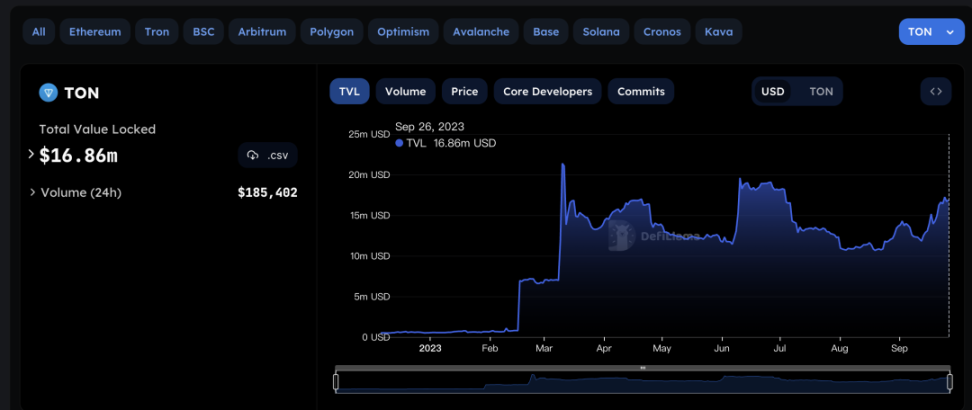
Ton 的 TVL 变化 来源:hellobtc.pro

有人认为TON短期亮眼的表现完全是因为 Telegram Bot 的原因,官方的合作并没有起到多大作用。而且目前TON生态表现一般,大多项目属于复刻以太坊生态,并没有任何亮眼之处,但也有人持相反观点,认为将来生态会有爆款出现,毕竟月活 8 亿,是个很恐怖的数字,和推特微信处于同一个量级,而且是 Crypto 用户聚集地,TON生态值得关注。

小结

以上,便是目前 Telegram 与TON 生态的发展,目前,TON市值排在 12 位,一些人认为这是项目方强控的结果,大多筹码集中在项目方手中,至于是否值得关注,则见仁见智。

Related Reads

How Much Debt Does Strategy Really Have? Is There a Risk of Implosion?

MicroStrategy's Debt Risk: A Turning Point in the "Never Sell" Strategy As of June 3, 2026, MicroStrategy holds 843,706 bitcoins (valued at ~$53.1B) but faces significant financial obligations. Its capital structure includes $6.75B in convertible notes and $15.48B in perpetual preferred stock (led by the $8.5B STRC series), creating an annual payout burden of ~$1.71B. With software revenue at only ~$500M, interest and dividend obligations far exceed operating income. A critical shift occurred in late May 2026 when the company sold 32 bitcoins for ~$2.5M to cover dividends, breaking CEO Michael Saylor's long-standing "never sell" pledge. This symbolic move triggered a sharp decline in both Bitcoin's price and MSTR stock, reflecting market fears about cash flow sustainability. The core of the strain is the STRC perpetual preferred stock, designed as a "permanent loan" with no maturity date but requiring high monthly dividends (currently 11.5%). Its business model relies on a three-part cycle: issuing new STRC shares, using proceeds to buy more Bitcoin and fund a USD reserve, and using that reserve to pay dividends. This cycle depends on continuous investor demand for STRC and Bitcoin's price appreciation. Analysis shows Bitcoin needs to appreciate at least 2.3% annually to cover the $1.71B in yearly obligations at current holdings. With Bitcoin price down ~22% from March 2026 highs, this pressure has intensified. The company's $900M USD reserve can only cover about 7 months of payments if STRC issuance stalls. Key risks are not immediate bankruptcy or forced Bitcoin liquidation (as BTC is not collateral), but rather: 1) The erosion of MSTR's premium to its Bitcoin holdings (mNAV), which would cripple its ability to raise cheap capital; 2) A vicious cycle where stagnant Bitcoin prices reduce STRC demand, draining the USD reserve and forcing BTC sales, further depressing prices. The period from February 2027 to September 2028 is a crucial test, with over $5.9B in convertible notes facing put options or maturity. In essence, MicroStrategy has evolved from a simple Bitcoin holder into a complex financial entity acting like a "private Bitcoin bank," leveraging its BTC holdings to create layered financial products. Its survival depends on maintaining Bitcoin's price trend, its stock premium, and market appetite for its preferred shares. The recent token sale marks not a betrayal of its Bitcoin thesis, but an admission that the leveraged strategy must eventually be paid for.

marsbit6m ago

How Much Debt Does Strategy Really Have? Is There a Risk of Implosion?

marsbit6m ago

Anthropic Cries Wolf: Is the AGI Threat Real, or Just an IPO Story?

Anthropic has published an article titled "When AI builds itself," discussing the emerging concept of "recursive self-improvement," where AI begins to actively participate in designing, training, testing, and optimizing its own subsequent versions. The company presents internal data showing that by May 2026, over 80% of code merged into its codebase was written by Claude, its AI model. Claude's capabilities have expanded to handling complex, open-ended engineering tasks, achieving a 76% success rate in such areas, and even contributing to research processes, such as optimizing code performance and conducting AI safety experiments. Anthropic outlines an evolution from human-driven development to AI-assisted workflows, culminating in the current stage where AI agents can autonomously write, run, and delegate code. The company cautions that the path toward a "closed loop," where AI continuously improves itself, is becoming visible. It calls for coordinated global mechanisms to potentially slow or pause frontier AI development to allow safety research and societal structures to catch up. However, the timing of this warning coincides with Anthropic's preparations for an IPO, framing the narrative not just as a safety concern but also as a demonstration of Claude's advanced capabilities and its integral role in accelerating Anthropic's own R&D—creating a potential "flywheel" effect for competitive advantage. This contrasts with OpenAI's recent, more policy-oriented discussion of the same risks, highlighting the competitive dynamics in the AI industry as companies position themselves in both the technological and regulatory landscape.

marsbit1h ago

Anthropic Cries Wolf: Is the AGI Threat Real, or Just an IPO Story?

marsbit1h ago

BIT Research: ETF Purchases Have Slowed, Strategy (MicroStrategy) Has Slowed, What Else Can Drive Bitcoin's Rise?

Market Refocus on Inflation and Rate Expectations Weighs on Bitcoin Currently, the market is in a phase of macro-repricing dominated by inflation and interest rate expectations. Bitcoin, which previously benefited from easy liquidity and low inflation, is seeing its core bullish drivers weaken. These drivers were market expectations for interest rate cuts and strong inflows from Bitcoin ETFs and institutions like MicroStrategy (referred to as "Strategy" in the text). The logic has shifted. Recent high inflation data (e.g., CPI hitting 3.8% in a May 2026 report) has caused the market to sharply reduce its rate cut expectations for 2025 and even price in potential hikes. This is a key constraint for Bitcoin, as it lacks cash flows and is highly sensitive to rate expectations. Concurrently, institutional capital flows have slowed significantly. Following the hot CPI data, Bitcoin ETFs saw accelerated outflows, with around $4.3 billion leaving over a period. MicroStrategy's ability to keep adding substantial Bitcoin to its balance sheet is also diminishing. Together, ETF and MicroStrategy holdings total roughly $110 billion, but their momentum as growth engines is cooling. In summary, Bitcoin's current pressure stems not from its own fundamentals but from a changing macro environment. As long as inflation stays elevated, Bitcoin is likely to remain in a consolidating phase. However, historically, inflation eventually peaks. Once it recedes and rate cut expectations rebuild, institutional capital could return, potentially fueling a new and more robust recovery phase for Bitcoin.

marsbit1h ago

BIT Research: ETF Purchases Have Slowed, Strategy (MicroStrategy) Has Slowed, What Else Can Drive Bitcoin's Rise?

marsbit1h ago

Trading

Spot
Futures

Hot Articles

How to Buy TON

Welcome to HTX.com! We've made purchasing TONCOIN (TON) simple and convenient. Follow our step-by-step guide to embark on your crypto journey.Step 1: Create Your HTX AccountUse your email or phone number to sign up for a free account on HTX. Experience a hassle-free registration journey and unlock all features.Get My AccountStep 2: Go to Buy Crypto and Choose Your Payment MethodCredit/Debit Card: Use your Visa or Mastercard to buy TONCOIN (TON) instantly.Balance: Use funds from your HTX account balance to trade seamlessly.Third Parties: We've added popular payment methods such as Google Pay and Apple Pay to enhance convenience.P2P: Trade directly with other users on HTX.Over-the-Counter (OTC): We offer tailor-made services and competitive exchange rates for traders.Step 3: Store Your TONCOIN (TON)After purchasing your TONCOIN (TON), store it in your HTX account. Alternatively, you can send it elsewhere via blockchain transfer or use it to trade other cryptocurrencies.Step 4: Trade TONCOIN (TON)Easily trade TONCOIN (TON) on HTX's spot market. Simply access your account, select your trading pair, execute your trades, and monitor in real-time. We offer a user-friendly experience for both beginners and seasoned traders.

14.4k Total ViewsPublished 2024.03.29Updated 2026.06.02

How to Buy TON

Discussions

Welcome to the HTX Community. Here, you can stay informed about the latest platform developments and gain access to professional market insights. Users' opinions on the price of TON (TON) are presented below.

活动图片