BRC-20投机盛行,Ordinals创始人发布的新FT协议Rune将吹起新风?

PanewsPublished on 2023-09-27Last updated on 2023-09-28

Abstract

Rune协议与 BRC-20 以及 Taro/RGB 等闪电网络上的 FT 协议有什么不同?Casey 为什么突然提出了「符文」协议的构想?在该构想出现后短短不到 1 天的时间里,已经有了哪些进展?

作者:Cookie
今天,比特币 NFT 协议 Ordinals 的创始人 Casey Rodarmor 提出了一个新的比特币 FT 协议设计构想,名为「Rune」,也被称为「符文」协议。
这个协议与 BRC-20 以及 Taro/RGB 等闪电网络上的 FT 协议有什么不同?Casey 为什么突然提出了「符文」协议的构想?在该构想出现后短短不到 1 天的时间里,已经有了哪些进展?
律动 BlockBeats 将为您详细梳理「符文」协议至今的各方面消息。
「符文」协议的设计出发点
Casey Rodarmor 用一句话对「符文」协议最大的特点进行了概括——一个简单的、基于 UTXO 的、能使比特币用户具有使用良好体验的 FT 协议。
Casey 认为,如果该协议的链上「足迹」较小,并促进可信任的 UTXO 管理,那么与现有的比特币 FT 协议相比,它可能会减少「危害」。至少,目前 BRC-20 的流行已经创造了大量的「垃圾」UTXO。
Casey 在以下 4 方面将「符文」协议与其它现有的比特币 FT 协议进行了比较:

  • 复杂性:协议有多复杂?实施起来容易吗?容易被大范围采用吗?
  • 用户体验:是否有任何实施细节会对用户体验产生负面影响?特别是,依赖链下数据的协议具有较轻的链上「足迹」,但引入了很大的复杂性。并且,用户要么运行自己的服务器,要么发现现有服务器并与其交互。
  • 状态模型:基于 UTXO 的协议更自然地适合比特币,并通过避免创建「垃圾」UTXO 来促进 UTXO 集最小化。
  • 原生 Token:具有协议操作所需的原生 Token 的是繁琐的、需要挖的(extractive),自然不太会受到广泛采用。

比较的结果是:

  • BRC-20:不是基于 UTXO 并且相当复杂,因为它需要使用 Ordinals 协议来进行某些操作。
  • RGB:非常复杂,依赖链下数据,已经开发了很长时间而没有被广泛采用。
  • Counterparty:某些操作需要使用原生 Token,而不是基于 UTXO。
  • Omni Layer:某些操作需要使用原生 Token,而不是基于 UTXO。
  • Taproot Assets(Taro):有点复杂,依赖链下数据。

那么「符文」协议具体将要怎么实现来解决上述的痛点呢?
「符文」协议的实现
概述
「符文」Token 的余额直接包含在 UTXO 内,UTXO 可以包含任意数量的「符文」Token。
如果一笔交易包含一个输出,而该输出的脚本 pubkey 包含一个 OP_RETURN,后跟一个表示 ASCII 大写字母「R」的数据输出,则该交易包含一个协议消息。协议消息是第一个数据输出之后的所有。
如果将无效的协议消息和「符文」Token 插入到一笔交易中,「符文」Token 将被烧毁。这将使「符文」协议能够在未来进行升级,避免已经被创建 / 分配的「符文」Token 无法纠正在旧版本协议中的分配错误。
将整数编码为前缀变量,该变量开始的部分决定了「符文」Token 的字节长度。
「符文」Token 的转账
协议消息中的第一个数据输出被解码为一个整数序列,这个整数序列将包含「ID」、「OUTPUT」和「AMOUNT」3 种信息。如果解码后的整数数量不是 3 的倍数,协议消息将被视为无效。

  • ID:指定了进行转账的是哪个「符文」Token。每个「符文」Token 在被创建时都会被分配一个 ID,ID 是从 1 开始的,越早创建的「符文」Token ID 值越小。
  • OUTPUT:决定分配给第几个输出。
  • AMOUNT:转账的「符文」Token 数量。如果 AMOUNT 数量为 0,则代表账户剩余的全部「符文」Token 数量。

处理完整数序列所包含的所有操作后,如果还有不需要操作的「符文」Token,都分配到第一个非 OP_RETURN 输出。此外,如果把「符文」Token 分配到包含协议消息的 OP_RETURN 输出中,「符文」Token 可能被烧毁。
「符文」Token 的创建
如果协议消息后还有第二个数据输出,该交易则为一笔「符文」Token 创建交易。这部分的数据输出将被解码为「SYMBOL」和「DECIMALS」两个整数,如果还有更多其它整数则无效。

  • SYMBOL:相当于 BRC-20 的 Ticker(即 Token 名称),最多支持 26 位,可用字符只有 A-Z。
  • DECIMALS:精度,决定「符文」Token 能支持小数点后多少位。

如果「SYMBOL」还未被使用,该「符文」Token 将被分配一个 ID 值,第一个被创建的「符文」Token ID 值为 1,BITCOIN、BTC 和 XBT 这 3 个名称被禁用。如果「SYMBOL」已被使用,那么创建将无效。也就是说,在「符文」协议依然不支持创建同名 Token。
比特币余额在 UTXO 中的显示
在一个 UTXO 中,比特币的余额将显示为 BITCOIN、BTC 或 XBT,又或是以 ID 值为 0 的方式显示。
Casey 为什么突然提出了「符文」协议的构想?
在 Ordinals 协议的官方手册里,我们可以看出 Casey 对 Ordinals 协议的设想就是一个通过比特币创造「数字文物」,或者说「NFT」的协议。但随着 Ordinals 协议的发展,BRC-20 相关的铭文数量已经占到了铭文总数的 85% 以上。
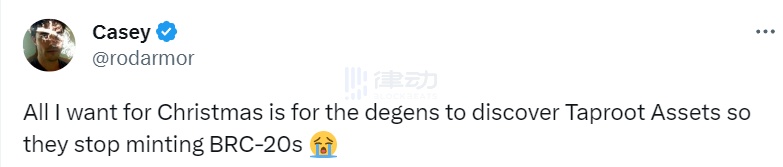
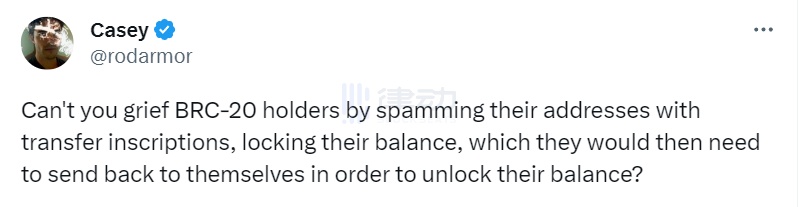
Casey 对 BRC-20 的不满已经很久了,尤其是他最近引起轩然大波的两条推文,更能感受到他对于 BRC-20 的消极态度:
BRC-20投机盛行,Ordinals创始人发布的新FT协议Rune将吹起新风?


我最想要的圣诞礼物是投机者发现 Taproot Assets(Taro),这样他们就可以停止铸造 BRC-20 Token 了
BRC-20投机盛行,Ordinals创始人发布的新FT协议Rune将吹起新风?


难道不能向 BRC-20 Token 的持有者们刻录「转账铭文」把他们的余额给锁定,这样他们就不得不把转账铭文发给他们自己从而解锁余额嘛?
在 Casey 看来,自己创造的「艺术馆」成了投机者的乐园,这让他非常难受。不仅是自己的「艺术馆」变成了「大赌场」,Casey 对于 FT 本身的态度也很消极:

BRC-20投机盛行,Ordinals创始人发布的新FT协议Rune将吹起新风?


在这篇提出 Rune 协议设想的博文中,Casey 在文章的最后表示,「FT 的世界几乎就是一个不可救药的、充满了欺骗与贪婪的深渊」
Rune 协议设想的提出,堪称 Casey 对 Ordinals 协议的「刮骨疗毒」——尽管作为协议的创始人,但在 Web3 的世界中,他没有办法一意孤行封杀掉他所认为的、寄生在 Ordinals 协议上的「毒瘤」BRC-20。于是,他抛出了这个想法——这里是「艺术馆」,你们想继续 Degen 的话,我有一个想法,大家去「大赌场」Degen OK 不 OK?
话虽如此,Casey 也仅仅是提出一个 Rune 这个关于比特币 FT 协议的设想,他本人甚至没有意愿将之实现。不过,Casey 的号召力摆在那里,我们已经可以看到短短 1 天不到的时间里,玩家们有多兴奋。
1 天不到的时间里,Rune 协议有哪些发展?
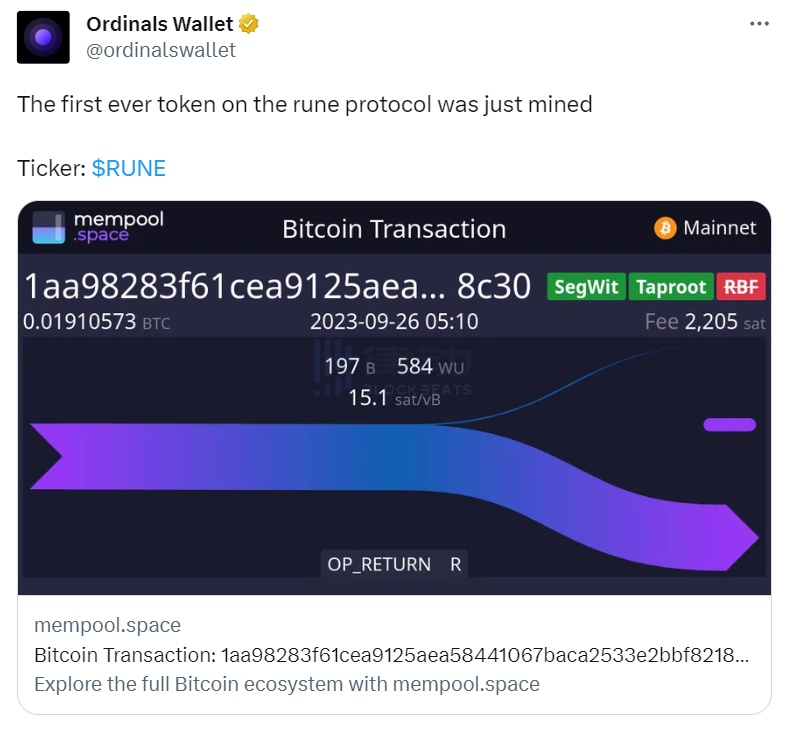
比特币 NFT 交易市场 Ordinals Wallet 在下午 3 点宣布部署了 Rune 协议的第一个 Token $RUNE。
BRC-20投机盛行,Ordinals创始人发布的新FT协议Rune将吹起新风?


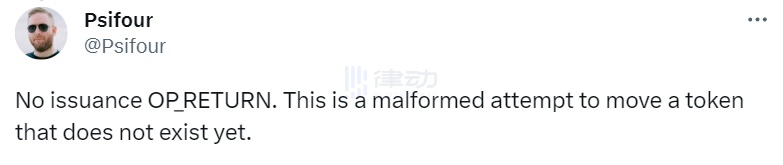
不过,在推文的评论区有人指出,这似乎是一个无效的部署...

BRC-20投机盛行,Ordinals创始人发布的新FT协议Rune将吹起新风?


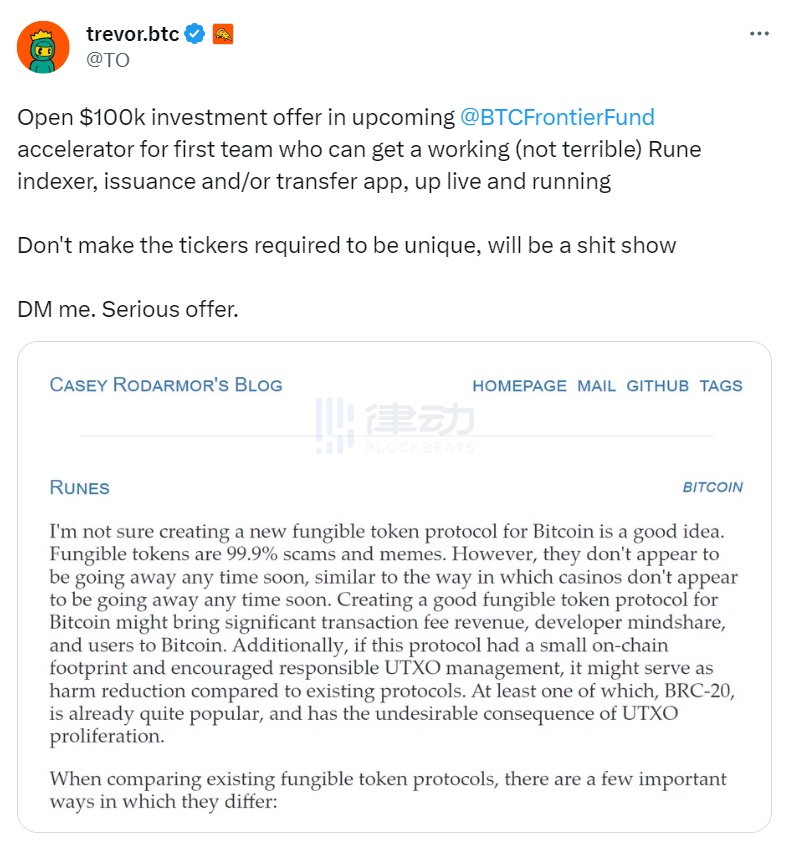
此外,@TO还发起了一个公开悬赏,第一个做出 Rune 协议索引器的团队,可获得 10 万美元赏金。
BRC-20投机盛行,Ordinals创始人发布的新FT协议Rune将吹起新风?


这里需要提醒大家特别注意的是,$RUNE 的部署是否有效现在没有定论,因为该协议目前为止只是 Casey 的一个设想,并没有任何已经草拟好的相关标准以及代码出产。谨防各类骗局!
结语
Casey 的这个设想,更多是无可奈何地对大家说——我有比 BRC-20 更好的法子,大家是不是考虑一下,让 Ordinals 回归最开始的发展方向?
那么 BRC-20 会「死」吗?我觉得倒也无需太过悲观。几个月来,BRC-20 已经吸引了大量的团队进行建设,这些团队并不会仅仅因为 Casey 的一个设想就放弃。并且,BRC-20 也是动态发展的,是不是可以结合闪电网络解决掉现在的一些痛点?这些都是可以期待的。
最后的最后,来自 Casey 的灵魂拷问——
99.9% 的 FT 都是 meme 与骗局,我不确定,为比特币创建一个新的 FT 协议真的是一个好主意吗?


Related Reads

Bitcoin Trading Strategy Breakdown: Celebrity Predictions and Classic Models All Fail, Only These Four Indicators Remain

Analysis of Bitcoin Trading Strategies: Why Celebrity Forecasts and Classic Models Fail, Leaving Only These Four Reliable Indicators This analysis examines the failure of common Bitcoin prediction methods and identifies four reliable indicators for constructing a trading strategy. The author reviewed all major BTC prediction approaches from 2017-2025, categorizing them into three groups: celebrity price targets (consistently over-optimistic), analytical models like Stock-to-Flow (broken post-2022), and on-chain signals. The key finding is that more data often creates confusion, not clarity. The strategy discards unreliable elements: celebrity predictions (incentivized to be extreme), pure models (invalidated by post-ETF market changes), and the Fear & Greed Index used alone (too many false signals). Four reliable indicators were selected: 1. **MVRV Z-Score:** Accurately identifies cycle bottoms when entering its green zone (e.g., 2018, 2020, 2022). Note: Its ability to call tops is now ineffective post-2024. 2. **SOPR (28-day MA):** Consistently signals bottoms when below 1.0, indicating holders are selling at a loss. 3. **ETF Net Flow:** A crucial post-2024 metric showing institutional momentum (e.g., sustained inflows = buying). 4. **Macro Liquidity (Fed policy & M2):** Sets the overall directional bias (e.g., bullish during easing cycles). The core strategy involves waiting for a multi-signal共振 (resonance). For example, a bottom signal requires MVRV in the green zone + SOPR < 1.0. A top signal requires overheated on-chain data + sustained ETF outflows. Macro policy sets the overall direction. The Fear & Greed Index is only used as a weighted confirmatory signal, never alone. Action is only taken when three or more indicators align. The author automated this into a monitoring system that sends Telegram alerts only when signals trigger. As of the article's date (April 15, 2026), the system showed a strong bottom signal: extreme fear (F&G=12), MVRV in the buy zone, and SOPR < 1.0. The only contrary signal was weak ETF flows. Historically, such triple on-chain共振 has preceded 100%+ returns. The conclusion emphasizes building a personal framework over relying on external predictions, allowing for iterative improvement and customization based on individual risk tolerance.

marsbit15m ago

Bitcoin Trading Strategy Breakdown: Celebrity Predictions and Classic Models All Fail, Only These Four Indicators Remain

marsbit15m ago

Trading

Spot
Futures

Hot Articles

What is $BITCOIN

DIGITAL GOLD ($BITCOIN): A Comprehensive Analysis Introduction to DIGITAL GOLD ($BITCOIN) DIGITAL GOLD ($BITCOIN) is a blockchain-based project operating on the Solana network, which aims to combine the characteristics of traditional precious metals with the innovation of decentralized technologies. While it shares a name with Bitcoin, often referred to as “digital gold” due to its perception as a store of value, DIGITAL GOLD is a separate token designed to create a unique ecosystem within the Web3 landscape. Its goal is to position itself as a viable alternative digital asset, although specifics regarding its applications and functionalities are still developing. What is DIGITAL GOLD ($BITCOIN)? DIGITAL GOLD ($BITCOIN) is a cryptocurrency token explicitly designed for use on the Solana blockchain. In contrast to Bitcoin, which provides a widely recognized value storage role, this token appears to focus on broader applications and characteristics. Notable aspects include: Blockchain Infrastructure: The token is built on the Solana blockchain, known for its capacity to handle high-speed and low-cost transactions. Supply Dynamics: DIGITAL GOLD has a maximum supply capped at 100 quadrillion tokens (100P $BITCOIN), although details regarding its circulating supply are currently undisclosed. Utility: While precise functionalities are not explicitly outlined, there are indications that the token could be utilized for various applications, potentially involving decentralized applications (dApps) or asset tokenization strategies. Who is the Creator of DIGITAL GOLD ($BITCOIN)? At present, the identity of the creators and development team behind DIGITAL GOLD ($BITCOIN) remains unknown. This situation is typical among many innovative projects within the blockchain space, particularly those aligning with decentralized finance and meme coin phenomena. While such anonymity may foster a community-driven culture, it intensifies concerns about governance and accountability. Who are the Investors of DIGITAL GOLD ($BITCOIN)? The available information indicates that DIGITAL GOLD ($BITCOIN) does not have any known institutional backers or prominent venture capital investments. The project seems to operate on a peer-to-peer model focused on community support and adoption rather than traditional funding routes. Its activity and liquidity are primarily situated on decentralized exchanges (DEXs), such as PumpSwap, rather than established centralized trading platforms, further highlighting its grassroots approach. How DIGITAL GOLD ($BITCOIN) Works The operational mechanics of DIGITAL GOLD ($BITCOIN) can be elaborated on based on its blockchain design and network attributes: Consensus Mechanism: By leveraging Solana’s unique proof-of-history (PoH) combined with a proof-of-stake (PoS) model, the project ensures efficient transaction validation contributing to the network's high performance. Tokenomics: While specific deflationary mechanisms have not been extensively detailed, the vast maximum token supply implies that it may cater to microtransactions or niche use cases that are still to be defined. Interoperability: There exists the potential for integration with Solana’s broader ecosystem, including various decentralized finance (DeFi) platforms. However, the details regarding specific integrations remain unspecified. Timeline of Key Events Here is a timeline that highlights significant milestones concerning DIGITAL GOLD ($BITCOIN): 2023: The initial deployment of the token occurs on the Solana blockchain, marked by its contract address. 2024: DIGITAL GOLD gains visibility as it becomes available for trading on decentralized exchanges like PumpSwap, allowing users to trade it against SOL. 2025: The project witnesses sporadic trading activity and potential interest in community-led engagements, although no noteworthy partnerships or technical advancements have been documented as of yet. Critical Analysis Strengths Scalability: The underlying Solana infrastructure supports high transaction volumes, which could enhance the utility of $BITCOIN in various transaction scenarios. Accessibility: The potential low trading price per token could attract retail investors, facilitating wider participation due to fractional ownership opportunities. Risks Lack of Transparency: The absence of publicly known backers, developers, or an audit process may yield skepticism regarding the project's sustainability and trustworthiness. Market Volatility: The trading activity is heavily reliant on speculative behavior, which can result in significant price volatility and uncertainty for investors. Conclusion DIGITAL GOLD ($BITCOIN) emerges as an intriguing yet ambiguous project within the rapidly evolving Solana ecosystem. While it attempts to leverage the “digital gold” narrative, its departure from Bitcoin's established role as a store of value underscores the need for a clearer differentiation of its intended utility and governance structure. Future acceptance and adoption will likely depend on addressing the current opacity and defining its operational and economic strategies more explicitly. Note: This report encompasses synthesised information available as of October 2023, and developments may have transpired beyond the research period.

363 Total ViewsPublished 2025.05.13Updated 2025.05.13

What is $BITCOIN

Discussions

Welcome to the HTX Community. Here, you can stay informed about the latest platform developments and gain access to professional market insights. Users' opinions on the price of BTC (BTC) are presented below.

活动图片