[dragon and tiger list] BTC's short-term volatility will increase, ETH's capital rate will remain low

Huobi ResearchPublished on 2022-04-21Last updated on 2022-04-21

Abstract

The volatility of BTC decreased and the demand for short-term change was strong.

1. Market trend: BTC is lower than the main moving average, and there is great rebound pressure

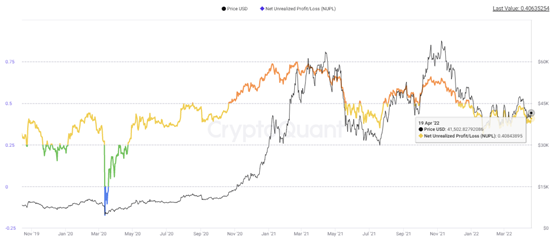
From the change of the ratio of unrealized gain to loss of BTC, this value reached 0.408 on April 19 and the lowest point of the year reached 0.314 on January 22. Historically, the ratio of realized gains to unrealized losses can be as low as less than 0.25. At present, the nupl index of BTC has been running in the low range within 2 years. If in a bull market, this value has increased to a low buying point. The expectation of BTC shrinkage adjustment remains unchanged. The long-term adjustment means that the nupl index is likely to continue to retreat, and the price decline is also expected.
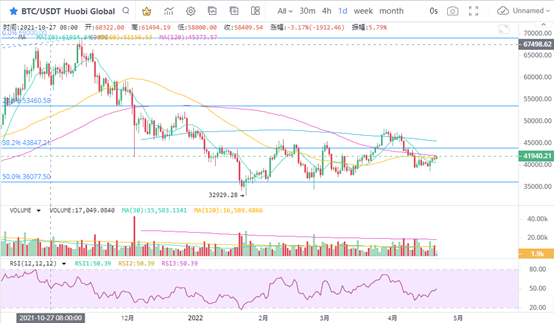
In terms of price, BTC in the daily K-line chart is already below the bonding areas of different moving averages, and the demand for further changes is very strong. In short, if BTC cannot maintain the upward breakthrough trend, it will choose to break down in the short term. Recently, the US dollar index has continued to strengthen, and the point has reached more than 100, which also puts great pressure on the rebound of BTC. In addition, the Fed's expectation of raising interest rates is very strong, and BTC is more likely to remain weak.
2. Interpretation of eth average capital rate:

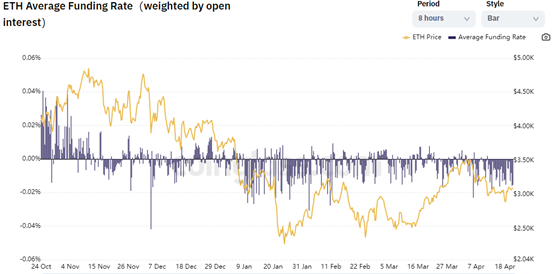
The average daily operating rate of eth is below - 0.02%, indicating that investors frequently buy eth funds. The decrease of financing cost means that the selling pressure of eth is large. Considering that the ETH point operates around us $3100, there are many opportunities for further downward change.

In terms of daily K-line, the bonding effect of eth moving average is more obvious, and the risk of short-term change is greater. In particular, the strong earthquake expectation is very strong, so we should pay attention to the high change expectation.
3. Dragon and tiger list:

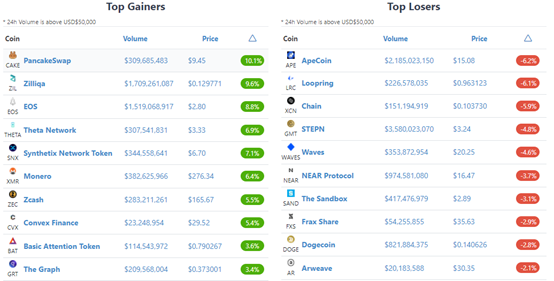
During the short-term rise of mainstream currencies, the overall market began to differentiate continuously. Among the currencies with the highest growth, the platform currency cake has a large short-term increase, while the old public chain ZIL, EOS and theta have the highest growth. At the same time, XmR and Zec rank relatively high, the market hot spots are relatively scattered, and it is more likely to grasp short-term opportunities.
CAKE

Pancakeswap (also known as pancake) is the top five decentralized exchange and the largest exchange on BSC (coin security intelligent chain), with the highest number of users. Pancakeswap has the following characteristics: the transaction cost is much lower than that on ERC chain (the cost of each transaction of BSC is about US $0.01 ~ 0.3), and the transaction cost of ERC chain is about US $200. Most emerging currencies on the currency security chain can be traded in pancakeswap.

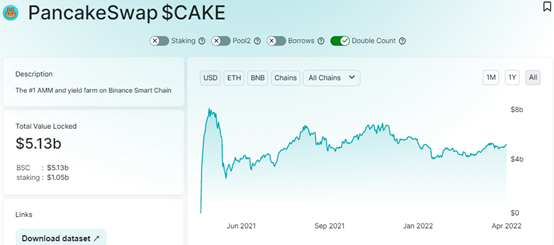
In terms of position locking, the amount of cake position locking remained stable, reaching US $5.13 billion on April 21. Although it is lower than the highest peak of $7.79 billion on March 3, 2021, the TVL value of cake is very stable during the year, which supports the expectation of cake rebound.

In terms of 24-hour increase, cake rose to 10.1%, continuing the recovery trend since mid March. The daily trading volume is not high, and the rhythm of price recovery is relatively mild.
EOS

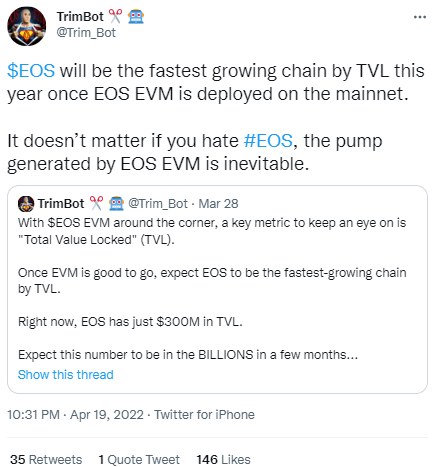
As an old public chain, EOS's TVL ranks 27th in the public chain. On April 21, 2022, the value showed that it was $280 million. Although the lock up volume is not high, the recent action of EOS foundation is expected to change this situation.

On April 19, 2022, EOS network foundation held eosevm press conference and AMA activity in twitterspaces. Yves LaRose, founder and CEO of EOS network foundation, Matias Romeo, technical director of EVM working group and Dr. yarkin, core member of EVM product team, attended the event and delivered a keynote speech around this major event.

At the press conference, Yves LaRose described in detail the original intention of EOS network foundation, its main t contribution after taking over EOS and the changes brought to eosio by Mandel upgrade, and announced the official brand of eosevm - trust. According to its description, trust will operate as an independent project, and then the developer preview version of trust will be officially opened. At the same time, a token named EVM will be issued in the future as part of EVM value products. The release of trust (token: EVM) will help EOS further complete the ecological diversification, make EVM's defi project benefit from yield, and further stimulate the TVL improvement of EOS.

Therefore, although the recent price trend of EOS is relatively mild, it is expected to continue to rise, which is worthy of attention.
XMR and ZEC

Private currency XmR and Zec led the short-term increase, indicating that the hot plates are relatively scattered under the current market. The short-term performance of private currency is good. In contrast, the short-term increase of BTC is limited. We can continue to pay attention to the adjustment expectation in the near future.

Decline list

Among the currencies with the highest decline, ape, GMT, waves and near led the decline, indicating that the performance of hot currencies is poor and the market is on the eve of change. The overall market sectors rose and fell with each other. While paying attention to BTC's changing direction, we need to pay more attention to the risk of currency holding.


Trending Cryptos

Related Reads

Is Bitcoin Price Lagging? Record Global M2 Money Supply Could Be a Springboard for BTC's Rise

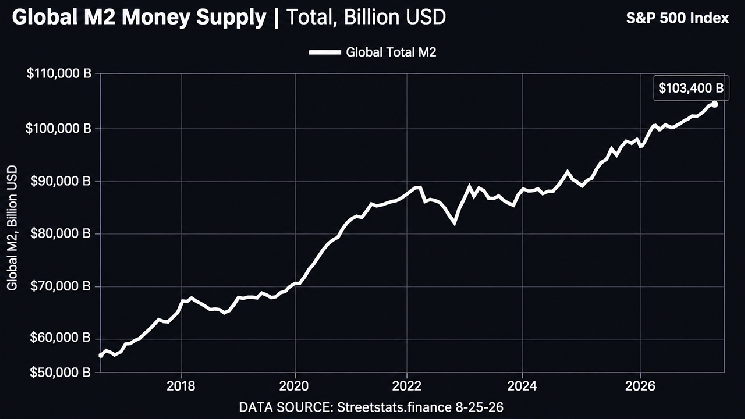
Bitcoin Price Lagging? Record Global Money Supply M2 Could Springboard BTC Growth The global money supply (M2) is expanding rapidly, similar to global debt. The US M2, representing all money circulating in its economy, has reached a record $23.16 trillion. Combined with figures from major economies like the Eurozone, China, and Japan, the global M2 is approximately $103 trillion. Some estimates, however, place it closer to $195 trillion. This surge in liquidity is significant because excess capital often seeks higher returns in assets like precious metals, stocks, and cryptocurrencies. Bitcoin's recent price surge above $81,000 has brought the global M2 metric back into focus. Following a sharp rise in early August after a US Treasury bond buyback announcement, BTC still trades about 37% below its October 2025 all-time high exceeding $126,000. This gap presents a potential "catch-up" trade thesis. Bitcoin's fixed supply of 21 million contrasts with governments' ability to print fiat currency, making scarce assets like BTC attractive if monetary expansion continues. Historically, Bitcoin's bull cycles in 2017-2018 and 2020-2021 coincided with M2 expansion and increased liquidity. Over the past year, the correlation seemed broken as M2 grew while Bitcoin's price fell sharply from its peak. Observers believe fresh dollars may have remained locked in cash-favorable investments. Some, like Ash Crypto, now suggest a long-awaited alignment between Bitcoin and M2 may be starting, especially as a weakening US Dollar Index this month has seen assets like gold and Bitcoin surge. A softer dollar pressures cash havens and prompts holders to act. While record M2 doesn't guarantee higher Bitcoin prices, a sustained influx of liquidity, a weak dollar, and capital flowing into alternative assets could trigger a catch-up rally sooner than expected. However, changes in these conditions could lead to the opposite outcome.

cryptonews.ru26m ago

Is Bitcoin Price Lagging? Record Global M2 Money Supply Could Be a Springboard for BTC's Rise

cryptonews.ru26m ago

Blockchain Capital Partner: Tokenization Will Reshape the Underlying Structure of Capital Markets

"Blockchain Capital partner Aleks Larsen argues that tokenization will fundamentally restructure capital markets by solving a costly 'packaging' problem in finance. Currently, assets like mortgages, private equity, and stocks exist in fragmented, incompatible systems, creating huge friction and slowing capital flow. Tokenization introduces a standardized, machine-readable interface for assets—akin to shipping containers for finance. Just as containerization standardized global trade, enabling massive efficiency gains and economic growth, tokens standardize financial rights. This allows platforms, lenders, and custodians to interact with assets directly on a shared network without rebuilding infrastructure for each one. Stablecoins demonstrate this potential, processing volumes rivaling Visa with far lower cost and faster settlement. Beyond payments, tokenization is expanding to assets like U.S. Treasuries, commodities, and private credit, now totaling nearly $400 billion on-chain. This shift changes financial service access: instead of depending on relationships with institutions, services become accessible based on the asset's tokenized properties themselves. DeFi protocols like Aave exemplify this, where assets meeting criteria can be used as collateral programmatically. Ultimately, tokenization will reorganize capital markets around open networks of specialized services, lowering barriers to entry and reducing costs. This could unlock global capital for currently underserved assets—small receivables, regional infrastructure, emerging market credit—integrating them into a seamless, programmable financial system. Combined with AI, tokenization promises to make capital allocation more efficient, transparent, and globally accessible, reshaping how economic value is created and distributed."

marsbit30m ago

Blockchain Capital Partner: Tokenization Will Reshape the Underlying Structure of Capital Markets

marsbit30m ago

Trading

Spot

Hot Articles

What is $BITCOIN

DIGITAL GOLD ($BITCOIN): A Comprehensive Analysis Introduction to DIGITAL GOLD ($BITCOIN) DIGITAL GOLD ($BITCOIN) is a blockchain-based project operating on the Solana network, which aims to combine the characteristics of traditional precious metals with the innovation of decentralized technologies. While it shares a name with Bitcoin, often referred to as “digital gold” due to its perception as a store of value, DIGITAL GOLD is a separate token designed to create a unique ecosystem within the Web3 landscape. Its goal is to position itself as a viable alternative digital asset, although specifics regarding its applications and functionalities are still developing. What is DIGITAL GOLD ($BITCOIN)? DIGITAL GOLD ($BITCOIN) is a cryptocurrency token explicitly designed for use on the Solana blockchain. In contrast to Bitcoin, which provides a widely recognized value storage role, this token appears to focus on broader applications and characteristics. Notable aspects include: Blockchain Infrastructure: The token is built on the Solana blockchain, known for its capacity to handle high-speed and low-cost transactions. Supply Dynamics: DIGITAL GOLD has a maximum supply capped at 100 quadrillion tokens (100P $BITCOIN), although details regarding its circulating supply are currently undisclosed. Utility: While precise functionalities are not explicitly outlined, there are indications that the token could be utilized for various applications, potentially involving decentralized applications (dApps) or asset tokenization strategies. Who is the Creator of DIGITAL GOLD ($BITCOIN)? At present, the identity of the creators and development team behind DIGITAL GOLD ($BITCOIN) remains unknown. This situation is typical among many innovative projects within the blockchain space, particularly those aligning with decentralized finance and meme coin phenomena. While such anonymity may foster a community-driven culture, it intensifies concerns about governance and accountability. Who are the Investors of DIGITAL GOLD ($BITCOIN)? The available information indicates that DIGITAL GOLD ($BITCOIN) does not have any known institutional backers or prominent venture capital investments. The project seems to operate on a peer-to-peer model focused on community support and adoption rather than traditional funding routes. Its activity and liquidity are primarily situated on decentralized exchanges (DEXs), such as PumpSwap, rather than established centralized trading platforms, further highlighting its grassroots approach. How DIGITAL GOLD ($BITCOIN) Works The operational mechanics of DIGITAL GOLD ($BITCOIN) can be elaborated on based on its blockchain design and network attributes: Consensus Mechanism: By leveraging Solana’s unique proof-of-history (PoH) combined with a proof-of-stake (PoS) model, the project ensures efficient transaction validation contributing to the network's high performance. Tokenomics: While specific deflationary mechanisms have not been extensively detailed, the vast maximum token supply implies that it may cater to microtransactions or niche use cases that are still to be defined. Interoperability: There exists the potential for integration with Solana’s broader ecosystem, including various decentralized finance (DeFi) platforms. However, the details regarding specific integrations remain unspecified. Timeline of Key Events Here is a timeline that highlights significant milestones concerning DIGITAL GOLD ($BITCOIN): 2023: The initial deployment of the token occurs on the Solana blockchain, marked by its contract address. 2024: DIGITAL GOLD gains visibility as it becomes available for trading on decentralized exchanges like PumpSwap, allowing users to trade it against SOL. 2025: The project witnesses sporadic trading activity and potential interest in community-led engagements, although no noteworthy partnerships or technical advancements have been documented as of yet. Critical Analysis Strengths Scalability: The underlying Solana infrastructure supports high transaction volumes, which could enhance the utility of $BITCOIN in various transaction scenarios. Accessibility: The potential low trading price per token could attract retail investors, facilitating wider participation due to fractional ownership opportunities. Risks Lack of Transparency: The absence of publicly known backers, developers, or an audit process may yield skepticism regarding the project's sustainability and trustworthiness. Market Volatility: The trading activity is heavily reliant on speculative behavior, which can result in significant price volatility and uncertainty for investors. Conclusion DIGITAL GOLD ($BITCOIN) emerges as an intriguing yet ambiguous project within the rapidly evolving Solana ecosystem. While it attempts to leverage the “digital gold” narrative, its departure from Bitcoin's established role as a store of value underscores the need for a clearer differentiation of its intended utility and governance structure. Future acceptance and adoption will likely depend on addressing the current opacity and defining its operational and economic strategies more explicitly. Note: This report encompasses synthesised information available as of October 2023, and developments may have transpired beyond the research period.

2.1k Total ViewsPublished 2025.05.13Updated 2025.05.13

What is $BITCOIN

Discussions

Welcome to the HTX Community. Here, you can stay informed about the latest platform developments and gain access to professional market insights. Users' opinions on the price of BTC (BTC) are presented below.

活动图片