Shibarium By Numbers: How The Shiba Inu L2 Fares Up So Far

BitcoinistPublished on 2023-09-19Last updated on 2023-09-20

Abstract

Since its anticipated launch on August 16, the Shiba Inu Layer 2 solution, Shibarium, has been under the spotlight, facing...

Since its anticipated launch on August 16, the Shiba Inu Layer 2 solution, Shibarium, has been under the spotlight, facing a mix of challenges and milestones. The platform, shortly after its launch, encountered an unexpected halt in block production owing to an immense surge in traffic.
The lead developer, Shytoshi Kusama, elucidated on this setback, mentioning a “massive influx of transactions and users” that immediately ensued upon the network going live, pushing it offline. Highlighting the extent of the traffic deluge, Kusama referred to data from the Web3 development platform Alchemy.
The data revealed that while Shibarium had a monthly allocation of 400 million compute units, a whopping 160+ million units were used up in just under half an hour. Nevertheless, the technical glitches were addressed, and Shibarium was successfully revived by August 23. But how does Shibarium fare up almost one month after the launch?
Shibarium By The Numbers
Based on the most recent data from Shibariumscan, the network’s average block time stands at 195.48 seconds with 2.64 million completed transactions. On the contract side, 11 have been deployed today, with 5 of those verified. The overall account number has reached 25.706, with a total of 1.247 million addresses registered.
In terms of blocks, there have been 710.485 processed, with 9.896 contracts in total. Native coin transfers have reached 127.086K, and there are 7.509K tokens with a cumulative transaction count of 2.84 million. Furthermore, 416 contracts have been verified in total.
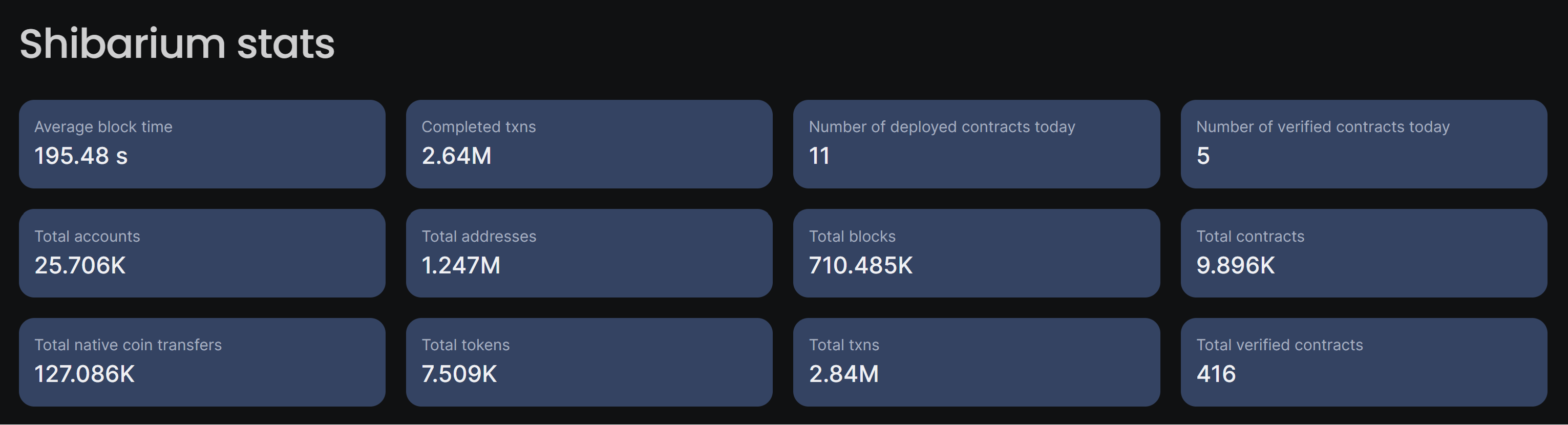
Shibarium stats

Shibarium stats | Source: https://www.shibariumscan Activity on Shibarium has been subject to wide fluctuations over the past month, with generally declining usage. Active accounts per day reached their zenith on August 26 with a count of 7,729. However, in the past week, this figure has declined to below 1,000, recording its lowest figure at 520 on Monday.
The surge in new account creation was at its pinnacle on August 24 with 5,552 accounts. Afterwards, the growth of new accounts slowed massively. This number then dropped significantly to 33 on Sunday, with 65 new accounts created yesterday.
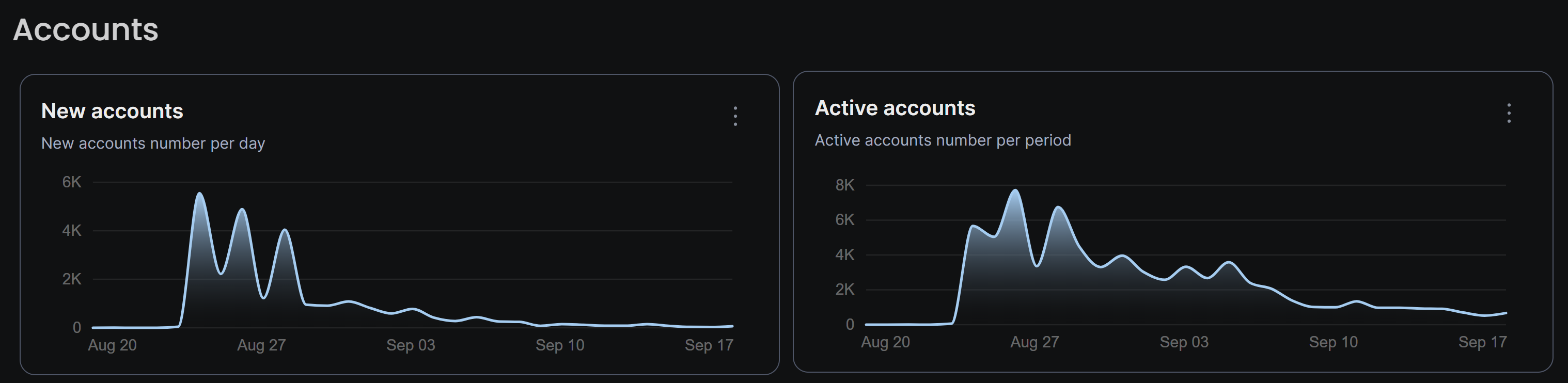
Shibarium accounts

Shibarium accounts | Source: https://www.shibariumscan Transaction numbers soared to their highest on September 11 with 202,906 but took a plunge in recent days, ranging between 40,000 and 42,000 in the past two days. The average block size in bytes reached its peak on September 14 with 75,611 bytes, which dropped to below 16,500 bytes in recent days.
Moreover, the peak of new contract creations was on August 24 with 2,766 contracts. This momentum seems to have slowed down, with the number last exceeding 100 on September 6, registering 174. Yesterday, only 51 new contracts were generated.
Most Popular Shiba Inu Based Tokens
Delving into the most popular tokens on Shibarium, Wrapped BONES (WBONES) leads with 2,360 holders, followed by Ryoshi’s Coin (RYOSHI) with 1,407 holders. Brick by Brick (BRICK) comes in third place with 625 holders, followed by Shibarium Wrapped BONE (WBONE) with 369. Shiboshi (SHIBOSHI) rounds up the top five with 318 holders.
Adding to the discourse, renowned Shiba Inu influencer @LucieSHIB recently posed a compelling question to the community, urging them to transition from exchanges and embrace Shibarium. In her tweet, she emphasized the community’s role in driving SHIB adoption, pointing out that the community needs to become more active on Shibarium. Addressing the topic of SHIB burns, she stated:
It’s adorable to see people hyping burns and never use Shibarium , but the fact remains that $SHIB burns are a community effort, not a call to the devs saying, “Do something.” To initiate burns, you need to actively use Shibarium. The more you utilize it, the more you contribute to the burns. This is fact.
At press time, Shiba Inu traded at $0.00000739.
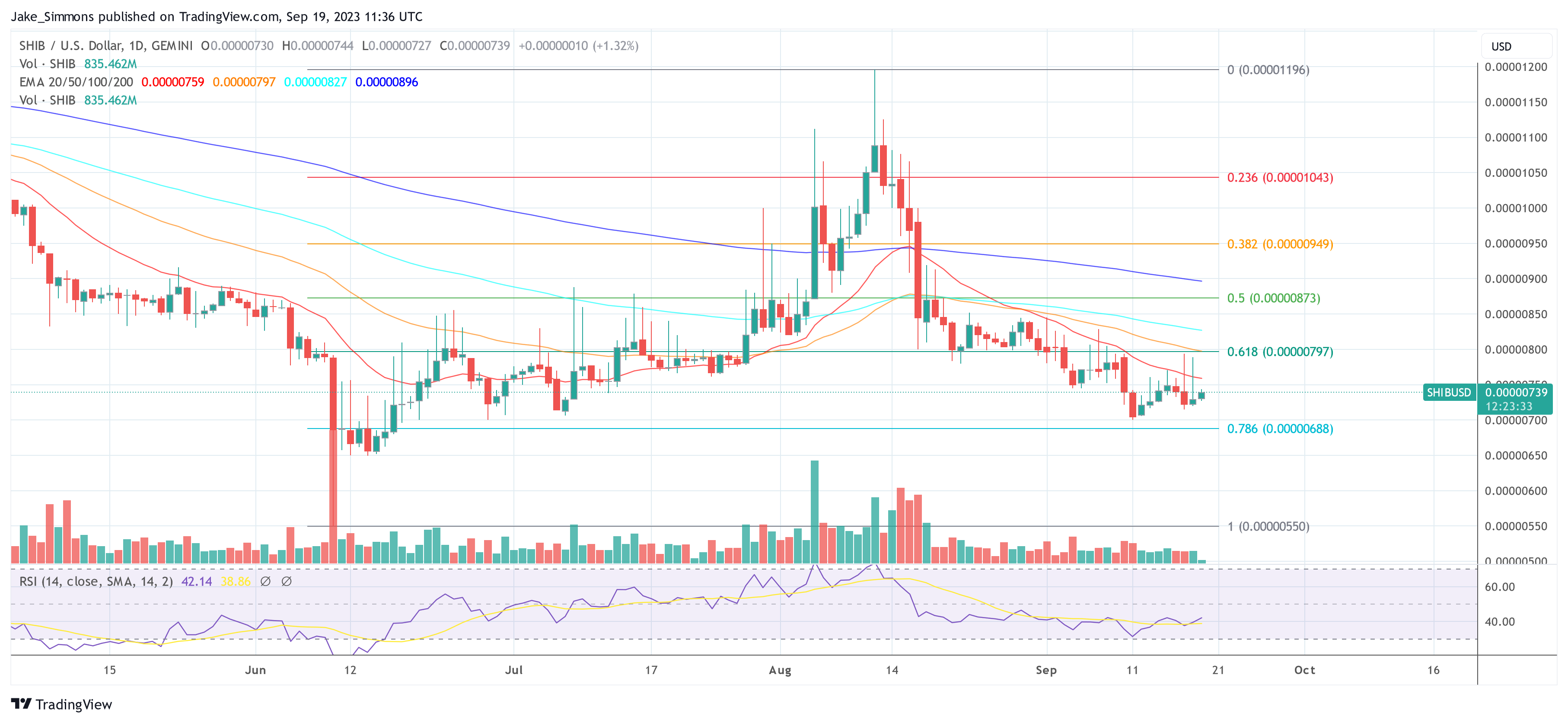
Shiba Inu price

Shiba Inu price, 1-day chart | Source: SHIBUSD on TradingView.com Featured image from Metaverse Post, chart from TradingView.com


Related Reads

Three Years Later: Looking Back on My 2023 Predictions for ChatGPT

Looking Back After Three Years: Revisiting My 2023 Predictions on ChatGPT In March 2023, shortly after ChatGPT's debut and before GPT-4's release, I made over twenty predictions about AI's future based on limited information and intuition. Now, in May 2026, I revisited those forecasts using an AI-driven analysis with 41 Opus 4.8 agents to cross-reference them with the latest data. The assessment used symbols: ✅ Correct, 🟢 Mostly Correct, 🟡 Partially Correct, ❌ Incorrect. Overall, the directional judgments held up well, with only one major factual error regarding GPT-4's rumored parameter size (incorrectly cited as 100T). However, nuances and degrees of accuracy revealed more. **What Was Largely Correct:** Predictions about mechanisms and directions proved accurate. The rise of RAG (Retrieval-Augmented Generation) as the standard architecture for combating AI hallucination was confirmed, as was the transformative potential of LUI (Language User Interface) in creating a new industry layer atop GUIs. The emergence of "robot networks" (agent-to-agent communication protocols) and China's rapid catch-up in developing capable large models (closing the performance gap with top models to ~2.7%) were also on point. The analysis affirmed that LLMs lack consciousness and that the Turing Test merely measures perceived intelligence. **What Was Off Target:** Errors often involved specific numbers, over-optimistic timelines, or misjudged distributions. The prediction that value would primarily accrue to the application layer was half-right but missed NVIDIA's dominance as the profitable infrastructure layer. Forecasts about AI circumventing copyright issues and fostering a "global common ground" by averaging human viewpoints were incorrect; instead, major copyright settlements occurred and AI personalization is increasing. Estimates for model training costs ("$5-10 billion cap") were significantly off, underestimating frontier costs and overestimating replication costs. The notion that LLMs could never do complex math without tools was disproven by later models winning IMO gold. **Key Patterns from the Review:** 1. **Direction over precision:** Judgments about mechanisms and trends were more reliable than specific numbers or definitive statements. 2. **Timing bias:** There was a tendency to overestimate short-term speed but underestimate long-term magnitude and transformation. 3. **The distribution blind spot:** Aggregate-level correctness often masked uneven impacts (e.g., on young professionals' employment). 4. **The value of qualifiers:** Predictions framed with caution (e.g., "reportedly," "for now," "prototype in 2-3 years") aged better. 5. **Some debates continue:** Issues like the nature of "emergent abilities" or machine consciousness remain unresolved. This three-year review highlights that while seeing the big picture is crucial, humility regarding specifics, timelines, and disparate impacts is essential for future forecasting.

链捕手1h ago

Three Years Later: Looking Back on My 2023 Predictions for ChatGPT

链捕手1h ago

AI Bubble Warning: AI Investments Are Negative Returns for Most Tech Giants

The article issues a stark warning about a potential AI investment bubble. It notes that while the AI boom shares similarities with the TMT bubble of the late 1990s, its scale is vastly larger, currently driving 93% of U.S. GDP growth. Major hyperscale cloud providers like Microsoft, Alphabet, Amazon, Meta, and Oracle are planning to invest trillions in AI data centers over the coming years. However, calculations based on analyst projections for 2025-2030 reveal a concerning math problem: expected capital expenditure growth far outpaces projected revenue growth. Even under an extremely optimistic scenario of zero costs, the implied return on investment for most of these tech giants (except Amazon) is deeply negative. This suggests that the current trajectory could lead to one of history's largest shareholder value destruction events. The piece outlines two potential escapes: AI generating vastly more revenue than currently anticipated—a near-impossible task—or a significant cutback in the planned investment splurge. The latter scenario could trigger a domino effect, severely impacting the entire tech supply chain (from Nvidia to TSMC), potentially pushing the U.S. economy into recession, and causing a major stock market downturn. The author suggests upcoming high-profile IPOs by companies like OpenAI and Anthropic might represent a transfer of risk from early investors to public market participants. While the peak of the hype cycle might sustain investment through 2026, the fundamental financial dilemma remains unresolved, setting the stage for a potential market correction in 2027 or 2028, similar to the years following Alan Greenspan's "irrational exuberance" warning.

marsbit2h ago

AI Bubble Warning: AI Investments Are Negative Returns for Most Tech Giants

marsbit2h ago

From Tokens to Machine Labor: AI is Shifting from Tool to "Worker"

The article "From Token to Machine Labor: AI is Evolving from Tool to 'Worker'" argues that the business model for AI is shifting beyond simply selling computational resources (tokens, GPU hours) or model access. Instead, a new "machine labor market" is emerging, where the core economic transaction is the purchase of economically useful work directly performed by software. The central thesis is that AI pricing will evolve through four stages: 1) raw tokens, 2) standardized LLM capabilities (e.g., text generation), 3) industry-specific labor markets (e.g., legal review, radiology), and finally 4) a programmable results market where tasks like resolving a support ticket are bid on and priced based on outcome. In this future, buyers will care less about *which* model or GPU completes a task and more about whether the work meets specified standards for accuracy, latency, and cost. This transition reframes the impact of AI on human labor. Rather than simple replacement, it suggests a re-coordination where machines handle standardized, verifiable work, freeing humans for roles involving oversight, context management, responsibility, and final judgment. In some cases, this "last 1%" of human input becomes more valuable as it enables the other 99% to be automated. Furthermore, as AI reduces the cost of work, demand may expand, creating larger markets (e.g., 24/7 customer service) rather than just cheaper versions of existing ones. The article concludes that while infrastructure (GPUs, models, tokens) remains crucial upstream, the market is converging on a simpler, tradeable unit: machine labor that can be defined, measured, priced, and procured based on contractible specifications.

marsbit2h ago

From Tokens to Machine Labor: AI is Shifting from Tool to "Worker"

marsbit2h ago

Xiaomi MiMo's 99% Price Cut is Not Marketing! Luo Fuli Posts on X to Refute Critics

The price of Xiaomi's MiMo-V2.5 series API has been permanently reduced by up to 99%, specifically for the "Input (Cache Hit)" cost, which covers users re-reading historical context in long conversations. MiMo's head, Luo Fuli, published a detailed technical blog to clarify that this drastic price cut stems from genuine engineering breakthroughs, not a marketing stunt or a simple price war. The core of the achievement lies in six key engineering optimizations. First, the model architecture adopts a Hybrid Sliding Window Attention (SWA), reducing the memory footprint (KVCache) to 1/7th of a traditional model. Second, a dual-pool memory management system actually utilizes these savings, allowing a single GPU to handle over 5 times more concurrent users. Third, an upgraded prefix caching mechanism achieves a cache hit rate of 93-95% for repeated reads, meaning most such requests bypass GPU computation entirely. Fourth, a self-developed distributed cache (GCache) utilizes idle SSD space on existing GPU servers, eliminating additional storage costs. Fifth, an intelligent scheduling system (LLM-Router) efficiently routes requests to maximize cache reuse and performance. Sixth, Multi-Token Prediction (MTP) accelerates the model's text generation ("output") side. Together, these systemic optimizations dramatically lower the real computational cost per request, enabling the 99% price reduction for cached inputs while reportedly maintaining positive gross margins. Luo Fuli's disclosure aims to shift the narrative from "price war" to a demonstration of substantive AI engineering progress.

marsbit4h ago

Xiaomi MiMo's 99% Price Cut is Not Marketing! Luo Fuli Posts on X to Refute Critics

marsbit4h ago

$26 Billion: An 'All-Chinese Team' Backs the World's Highest-Valued AI Programming Company

Cognition AI, the company behind the AI programmer "Devin," has raised over $1 billion in new funding at a valuation of $26 billion, just eight months after reaching a $10.2 billion valuation. The round was led by Lux Capital, General Catalyst, and 8VC. Founded by three young Chinese entrepreneurs with strong competitive programming backgrounds, Cognition initially gained fame with Devin, marketed as the world's first AI software engineer capable of handling tasks from start to finish. While its early demos were impressive, real-world usage revealed reliability and cost-effectiveness issues, leading to a significant price cut for Devin in 2025. A pivotal moment came when Cognition acquired the assets of AI IDE company Windsurf after a failed acquisition by OpenAI. This move gave Cognition a crucial developer-facing tool, allowing it to pursue a two-pronged strategy: Devin for autonomous task execution and Windsurf for integrated, collaborative coding within an IDE. This shift helped the company move away from the controversial "AI replacement" narrative towards a model of augmenting human engineers, particularly for repetitive or maintenance tasks. This strategic pivot is backed by strong commercial metrics. The company reports a 10x increase in enterprise usage this year, with an annual revenue run-rate of $492 million and a 50% month-over-month growth in enterprise Devin usage over the past six months. Its client list now includes major corporations like Goldman Sachs and Mercedes-Benz, as well as government agencies like NASA and the U.S. Army. Investors are betting on Cognition becoming a foundational piece of next-generation software engineering infrastructure, positioning it at the center of a hybrid future where AI agents and human developers work in tandem.

marsbit4h ago

$26 Billion: An 'All-Chinese Team' Backs the World's Highest-Valued AI Programming Company

marsbit4h ago

Trading

Spot
Futures

Hot Articles

How to Buy KSM

Welcome to HTX.com! We've made purchasing Kusama (KSM) simple and convenient. Follow our step-by-step guide to embark on your crypto journey.Step 1: Create Your HTX AccountUse your email or phone number to sign up for a free account on HTX. Experience a hassle-free registration journey and unlock all features.Get My AccountStep 2: Go to Buy Crypto and Choose Your Payment MethodCredit/Debit Card: Use your Visa or Mastercard to buy Kusama (KSM) instantly.Balance: Use funds from your HTX account balance to trade seamlessly.Third Parties: We've added popular payment methods such as Google Pay and Apple Pay to enhance convenience.P2P: Trade directly with other users on HTX.Over-the-Counter (OTC): We offer tailor-made services and competitive exchange rates for traders.Step 3: Store Your Kusama (KSM)After purchasing your Kusama (KSM), store it in your HTX account. Alternatively, you can send it elsewhere via blockchain transfer or use it to trade other cryptocurrencies.Step 4: Trade Kusama (KSM)Easily trade Kusama (KSM) on HTX's spot market. Simply access your account, select your trading pair, execute your trades, and monitor in real-time. We offer a user-friendly experience for both beginners and seasoned traders.

2.6k Total ViewsPublished 2024.03.29Updated 2026.01.28

How to Buy KSM

Discussions

Welcome to the HTX Community. Here, you can stay informed about the latest platform developments and gain access to professional market insights. Users' opinions on the price of KSM (KSM) are presented below.

活动图片