128 Tokens Under Scrutiny in Defillama's Latest Crypto Rankings

cryptonews.ruPublished on 2026-08-27Last updated on 2026-08-27

Abstract

Defillama, in collaboration with Forgd, has launched a Universal Token Ratings (UTR) system, assessing 128 tokens on a scale from AAA to CCC. According to the announcement, these dynamic ratings are updated in near real-time based on market performance, even if a project's public disclosures remain unchanged. The system aims to provide a standardized, data-driven method for evaluating crypto assets. Currently, Uniswap (UNI) holds the sole AAA rating. Tokens like Meteora (MET), Curve DAO (CRV), and Dogecoin (DOGE) are among those rated AA. Defillama's research lead stated this initiative is an extension of their mission to provide objective data, giving users a tool to identify promising projects. The UTR model draws parallels to traditional credit rating agencies like Moody's and S&P, which have also begun applying their methodologies to digital assets. Forgd's CEO emphasized that these ratings must be "continuously earned" based on real-time market function, unlike static transparency checklists. The launch targets a time of peak institutional awareness, with the partners believing a bond-like rating standard can bolster trust and accountability in the crypto industry.

According to a message relayed by Bitcoin.com News, over 100 tokens have now received ratings ranging from AAA to CCC. The system is called Universal Token Ratings (UTR), and the two companies explain that the ratings are not static. UTR is regularly updated, and Defillama and Forgd note that "a project’s rating can deteriorate almost in real-time if its market structure fails, even if the disclosed information remains the same."

Looking at the UTR dashboard, the DeFi crypto-asset Uniswap (UNI) is the leader with the only AAA rating. Meteora (MET), Curve DAO (CRV), Raydium (RAY), Olexchange (O), jito (JTO), ether.fi (ETHFI), dogecoin (DOGE), zama (ZAMA), and pyth network (PYTH) have an AA rating. The dashboard also displays other performance metrics and market capitalization. As of Wednesday, August 26, 2026, the UTR rating by Defillama includes 128 unique assets.
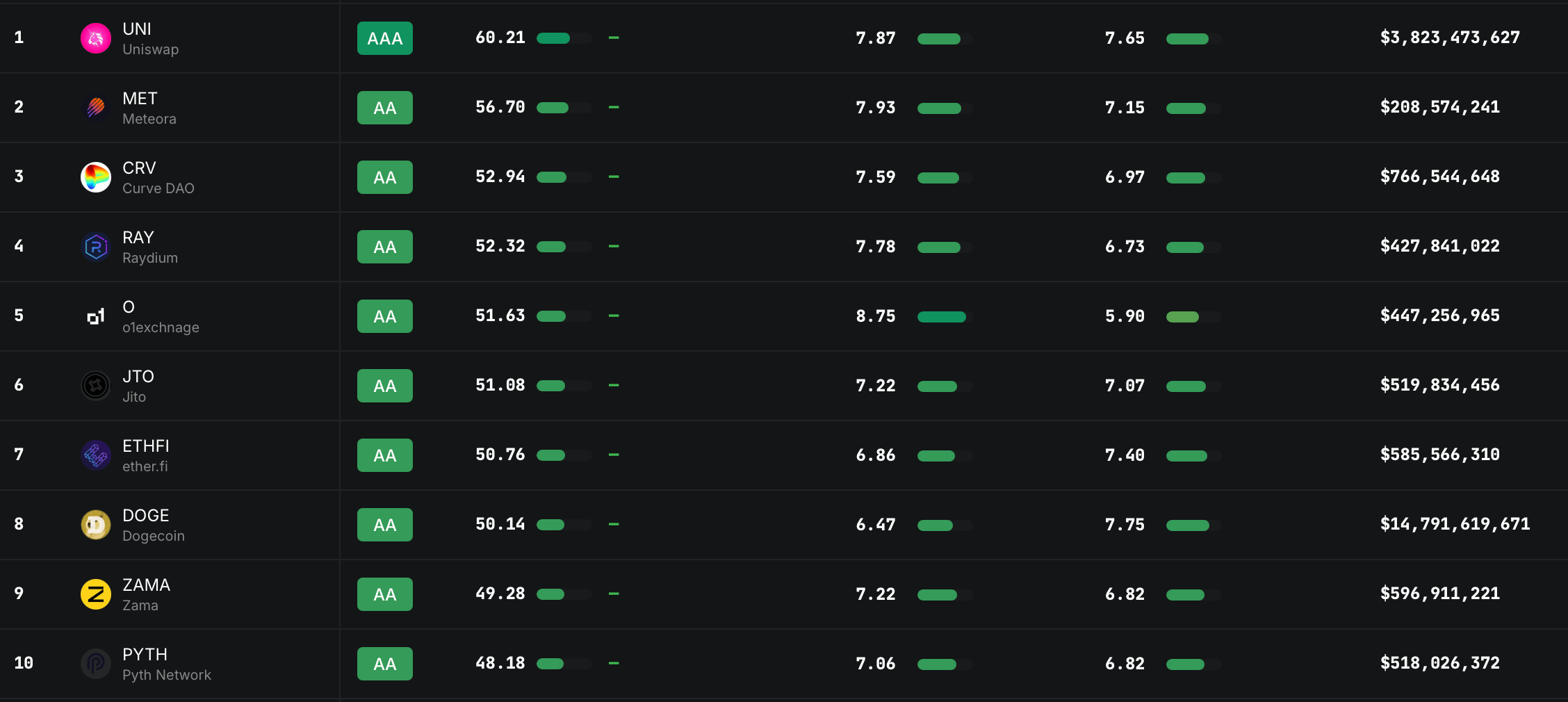
The top ten tokens featured on the Defillama UTR dashboard. Screenshot taken on Wednesday, August 26, 2026. Ratings and rankings are subject to change in the future.

"Defillama’s mission has always been to provide honest and unbiased data," explained Ryan Selai, Head of Research at Defillama. "Ratings, calculated based on real-time market data, are a natural extension of this mission and give our users a quick, standardized way to identify promising projects."

From Moody’s to Crypto: A Century-Old Rating Model Gets a New Life

UTR resembles what rating agencies such as Moody’s Ratings, Standard & Poor’s (S&P), and Fitch Ratings have used for decades to assess default risk. Moody’s began applying this methodology to bonds in 1909, Fitch joined the effort several years later in 1924, and S&P followed in Fitch’s footsteps around the same time. An "AAA" rating is considered the highest credit quality, while ratings of "CCC" and below are often referred to as "junk."

Moody’s and S&P are also participating in the digital asset industry, implementing their own assessment systems. Moody’s has a dedicated stablecoin rating methodology, and S&P uses a 1-to-5 stablecoin stability assessment scale to measure the creditworthiness and risks associated with specific stablecoin assets. The new UTR rating from Forgd and Defillama aims to be "the first rating standard in the digital asset space that continuously verifies whether a token project’s real-market performance matches its public disclosures."

Forgd Says Token Ratings Must Be Earned, Not Just Received

"There have been transparency checklists in crypto, but the industry has never had a continuously updated rating system," stated Shane Molidor, Founder and CEO of Forgd, during the announcement. "Our rating shows whether the market is functioning correctly at a given moment. The Universal Token Ratings system is designed so that the rating must be continuously earned."

Defillama and Forgd Bet That Ratings Can Bolster Institutional Investor Trust

The companies note that the project's launch comes at a time when institutional investor awareness of crypto assets, blockchains, and applications has peaked. Defillama and Forgd believe that an industry standard, similar to bond ratings, should help build trust and increase accountability. The teams also noted that recently launched coins from token generation events (TGEs) are "pre-rated" from the outset.

end-content

Related Questions

QAccording to the article, what is the name of the new token rating system launched by Defillama and Forgd?

AThe new token rating system is called Universal Token Ratings (UTR).

QWhich token currently holds the sole 'AAA' rating on the UTR dashboard, and what is its primary focus?

AUniswap (UNI) currently holds the sole 'AAA' rating on the UTR dashboard. It is a DeFi crypto asset.

QHow many unique assets were included in Defillama's UTR ratings as of Wednesday, August 26, 2026?

AAs of Wednesday, August 26, 2026, Defillama's UTR ratings included 128 unique assets.

QWhat historical financial industry model is the new UTR system compared to, and which agencies pioneered it?

AThe UTR system is compared to the model used by rating agencies like Moody's, Standard & Poor's (S&P), and Fitch Ratings for assessing default risk. Moody's began using this methodology for bonds in 1909.

QAccording to Forgd's founder Shane Moledor, what key feature distinguishes the UTR system from previous transparency checklists in crypto?

AShane Moledor stated that the key distinction is that the UTR system is a continuously updated rating system, whereas the industry previously only had transparency checklists. The rating must be constantly earned based on real-time market performance.

Related Reads

Cryptocurrency Company Doppler Finance Launches New Altcoin, 1% of Which Will Be Distributed in an Airdrop! Details Here

Cryptocurrency company Doppler Finance is announcing the launch of its new altcoin, XDP. Designed as a utility and governance token for protocol coordination, XDP aims to boost user participation, support decentralized governance, and contribute to ecosystem growth. The total supply of XDP is capped at 10 billion tokens. Over half of this supply is allocated to ecosystem development, treasury, partnerships, and community growth. Shares for investors will be subject to lock-up and vesting conditions to prevent market flooding and encourage long-term commitment. During the Token Generation Event (TGE), 1% of the total supply will be unlocked and distributed via a Genesis Airdrop to early users, contributors, and ecosystem supporters. An additional 43% of the supply is dedicated to ecosystem incentives, funding future Doppler Points seasons, XDP staking activities, and local community programs. The tokenomics are structured to reward user participation and ensure the protocol's long-term development, with a significant emphasis on ecosystem funding. The Genesis Airdrop allows early adopters to benefit directly from the token launch. With XDP, Doppler Finance plans to build its governance mechanism and user reward system around its native token. Further details regarding the launch date and specific distribution mechanics are to be announced later. *This is not investment advice.

cryptonews.ru1m ago

Cryptocurrency Company Doppler Finance Launches New Altcoin, 1% of Which Will Be Distributed in an Airdrop! Details Here

cryptonews.ru1m ago

Morgan Stanley Research Report Analysis: Google at a 12% Premium, Meta at a 30% Discount - Internet Giants' Valuations Diverge

In a volatile end to the summer for internet stocks, Morgan Stanley's latest valuation report highlights a significant divergence in how the market is pricing major tech giants. While the sector's average forward EV/EBITDA multiple trades below historical averages, individual company valuations are splitting, largely driven by perceived AI capabilities. Alphabet (Google) is the standout, trading at a 12% premium to its 3-year average on an EV/EBITDA basis. This premium is attributed to upward revisions for its AI hardware (TPU) sales potential, advancements in its Gemini models, and cloud margin expansion. In stark contrast, Meta trades at a deep 30% discount to its 2-year average, as concerns over social media advertising competition outweigh its progress in AI-powered ad tools. Amazon sits in the middle, trading at a moderate discount. The report notes a broader sector trend: EV/Sales multiples are expanding while EV/EBITDA multiples are contracting, indicating the market is placing a higher premium on profitability over pure revenue growth. Sub-sectors like e-commerce and digital media face the most valuation pressure. Furthermore, adjusting earnings for stock-based compensation (SBC) reveals significantly higher "true" valuation multiples across the board. Morgan Stanley concludes that valuation recovery for the internet sector will depend on upward revisions to profit estimates—driven by catalysts like new AI product cycles and cloud growth stabilization—rather than simple mean reversion. The firm maintains an "Attractive" view on the sector.

marsbit21m ago

Morgan Stanley Research Report Analysis: Google at a 12% Premium, Meta at a 30% Discount - Internet Giants' Valuations Diverge

marsbit21m ago

Trading

Spot
活动图片