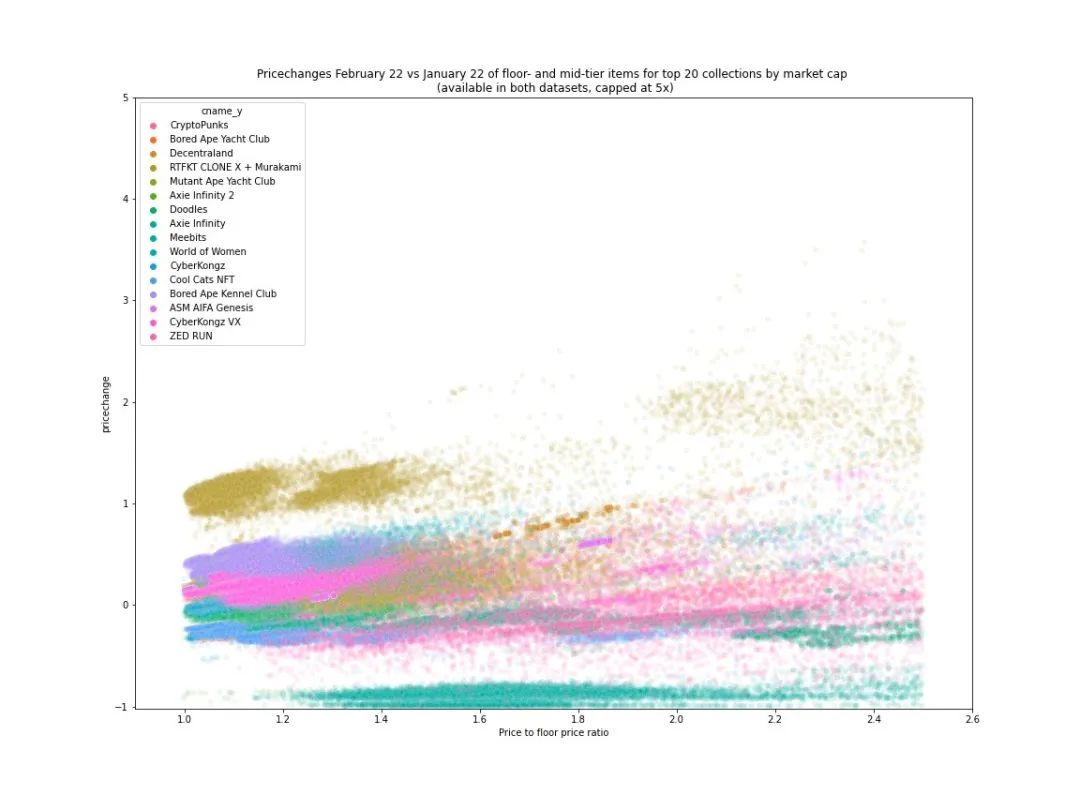
数据分析每种NFT系列的价格层级分布

FastDailyPublished on 2022-04-05Last updated on 2022-04-05

Abstract

NFT类别,如虚拟土地、PFP和游戏资产,是评估项目和收藏品的常见框架。

NFT类别,如虚拟土地、PFP和游戏资产,是评估项目和收藏品的常见框架。然而,很少讨论的是收藏品中的价格"层级",以及同一价格层级的资产在NFT类别中的表现。

GringottsDAO的使命是成为NFT持有人获取流动性的一站式服务。随着新的NFT金融化协议的迅速出现,我们着手评估不同方法在用户寻求流动性的NFT类型方面的功效。我们没有纯粹关注资产类别,而是研究了所有这些资产的共同属性--它们的价格。

更具体地说,我们试图回答3个问题:

在整个市场上,NFT的价格分布是怎样的?

是否有价格分布模式出现,如果有,它们有多普遍?

从这些分布中,我们如何定义价格"层级",使特定的NFT更适合于某些流动性方法而不是其他?

一个主要的发现是,不同藏品和NFT类别的项目可能比同一藏品中的项目表现得更加相似。因此,价格分布分析可以给用户和开发者提供一个更全面的观点,即在哪里可以找到最好的流动性,以及金融化方法的可解决市场。

方法论

NFTBank是一个算法资产评估产品,它使用机器学习来预测NFT价格,基于过去类似资产的定价。我们从NFTBank提取了3个月的数据。首先是2021年12月15日(279个收藏,约240万个NFT,约370万个ETH市值),然后是2022年1月13日(540个收藏,约1420万个NFT,约890万个ETH市值),以及最近的2022年2月27日(538个收藏,约1480万个NFT,约650万个ETH市值)。

这篇文章深入探讨了我们发现的4个观察点:

1.价格分布通常在整个系列和内部都非常集中。

2.价格分布有5种主要的"形状",似乎与NFT的"类别"(PFP、游戏、虚拟土地等)没有关系。

3.价格分布形状通常保持不变。对于75%的收藏品,价格分布在不同时间点保持不变。对于那些发生变化的,则是朝着一个"相关"的形状。

4对于具有指数衰减和对数正态分布的收藏品(60%的收藏品),我们可以定义并研究底层、中层和高层资产的行为。

集中的价格分布

在整个NFT市场中,市场是集中的,前10个收藏品占市值的60%以上,基尼系数约为0.9。

在收藏品中,大多数价格分布遵循一个模式,即大多数物品的价格接近底线。剩下的少数项目构成了价格范围的大部分,因此对收藏品的市值有很大的贡献。

正态分布价格图的例子:
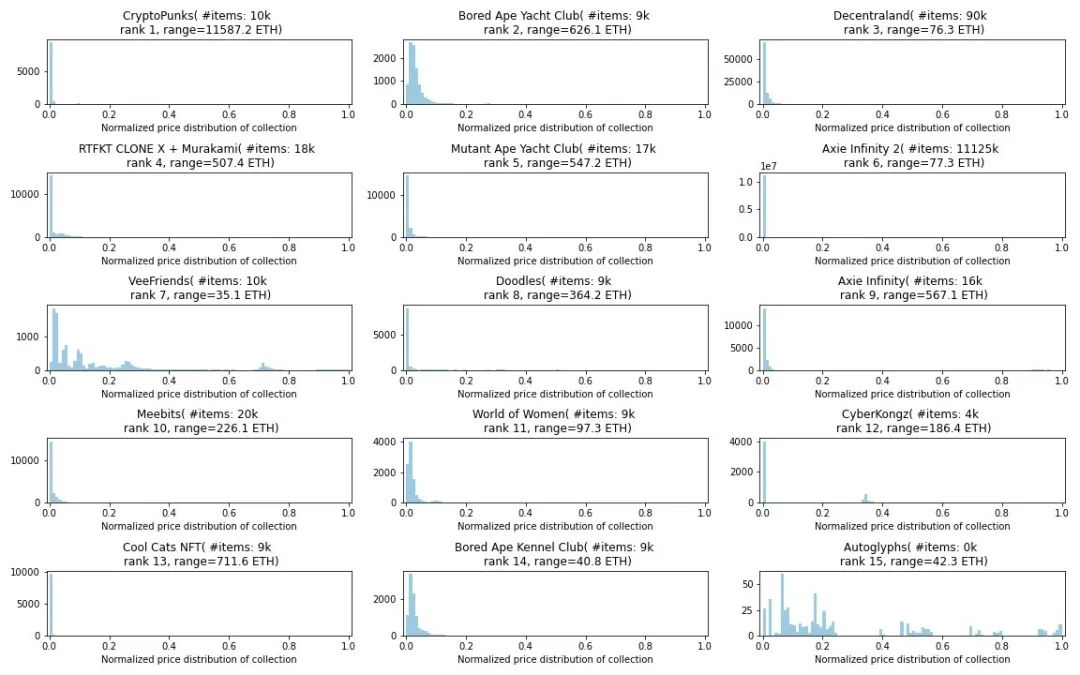
在这些图表中,X轴被分成100个相等的部分,所以第一个图表(CryptoPunks)为例表明,几乎所有Punks的价格都在全部价格范围的前2%内。

这对最适合地板项目的NFT金融化产品来说是有希望的,例如,像NFTX这样的流动性池,可以作为"地板AMM",为NFT所有者提供即时流动性,他们可以针对池子交易他们的地板资产。

拥有大量底层项目和可靠价格反馈的集合(那些经常在大量不同的独特地址之间交易的集合)也是P2Pool贷款产品中作为抵押品的不错选择。这是因为底层资产通常可以被视为"相同的",因此不需要人工评估。一旦插入价格反馈和自动评估风险的手段,贷款条款就可以自动化。

在上面的样本中,注意到一些收藏品(例如VeeFriends和Decentraland)并不符合这种"模式是地板"的模式,然而。事实上,价格分布模式属于5种不同的形状之一,这就带来了我们的下一个观察。

价格分布有五种主要形状:

在整个收藏品中,我们观察到的价格分布形状是:

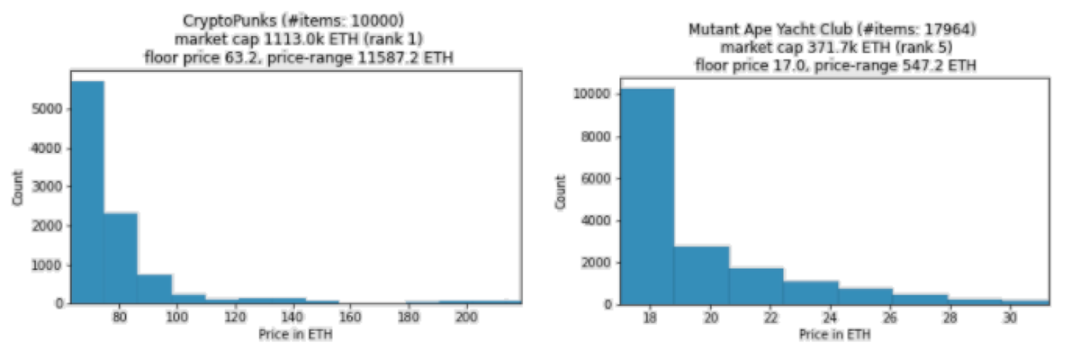
1.指数衰减。这些藏品的大部分价格都在底线附近,有一条长长的高价位藏品的尾巴。~我们抽样调查的收藏品中约有40%表现出这种情况。例子包括Cryptopunks,RTFKTCloneX+Murakami,和MutantApeYachtClub
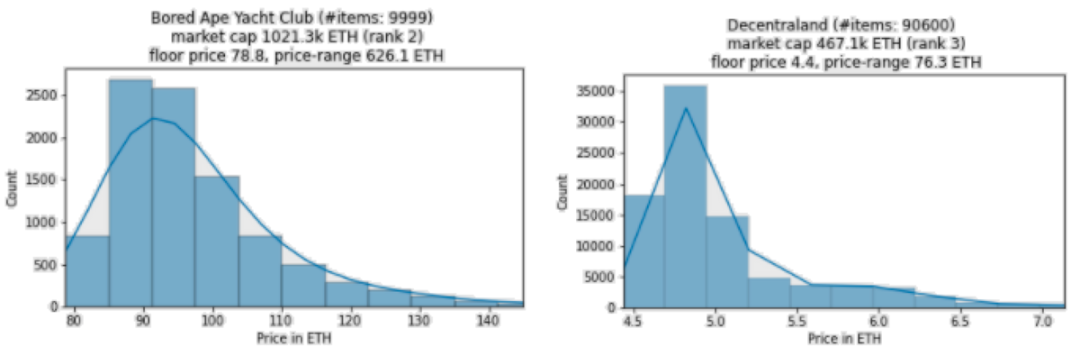
2.类似对数正态分布的形状与指数类似,但模式略高于地板价。我们抽样调查的NFT中,约有20%表现出这种情况。例子包括BoredApeYachtClub,SandboxLAND,和Decentraland。
3.对称(或类似正态)分布是指资产高度集中在平均价格周围,两侧逐渐减少。我们抽样调查的收藏品中约有5%展示了这种情况。例子包括Anonymice,Blitmap,和Rollbots。

图片

4.多模式分布在更大的范围内表现出几个凸起和尖峰。我们取样的集合中约有20%表现出这种情况。例子包括VeeFriends,Autoglyphs,和FLUFworld。
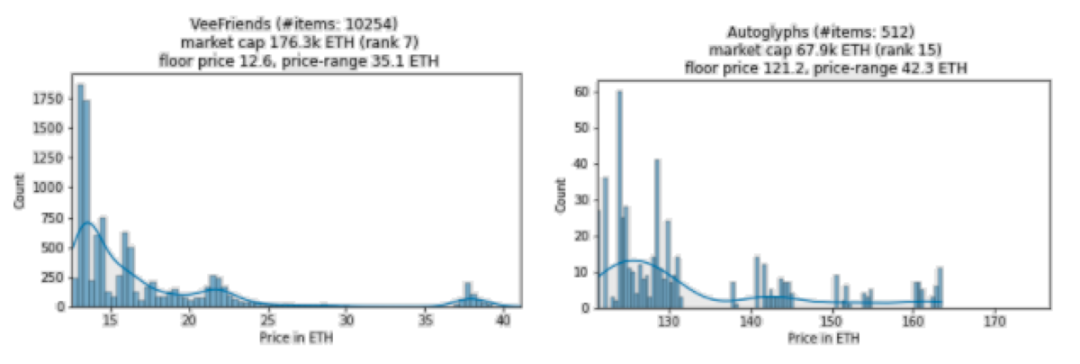
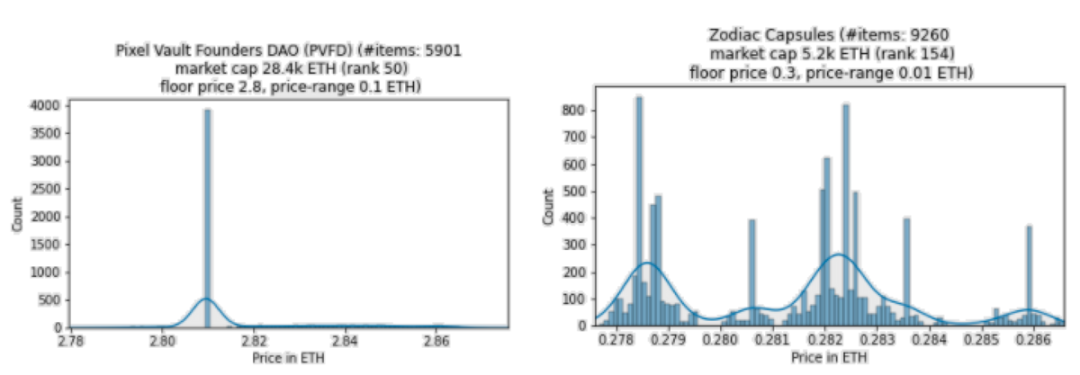
5.点状分布模式有上述形状之一,但价格分布在<0.1ETH。因为我们将其定义为大致相同的价格,所以我们将这些标记为"点状分布"。这种形状是较小市值的集合的共同特征(除了PVFD,前100名的集合都没有表现出这种形状)-因此它们起到了某种过滤器的作用。我们抽样调查的NFT中约有15%表现出这种形状。例如PVFD、ZodiacCapsules或PEGZ。
值得注意的是,NFT类别(PFP、虚拟土地、游戏资产等)与价格分布形状并不相关。例如,Cryptovoxels、Decentraland和SomniumSpace的虚拟土地NFT都有不同的分布(分别是指数型、对数正态型(在1月/12月数据中是对称的)和多模型)。
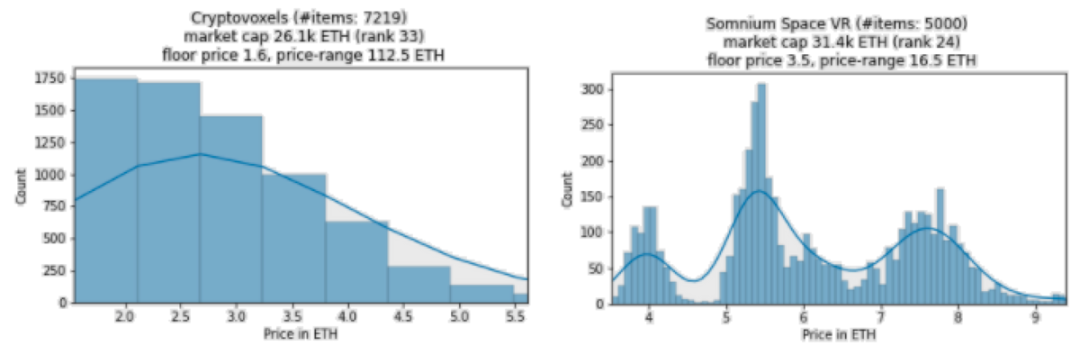
价格分布很可能是一个NFT系列本身固有特征的函数,而不是它所属的NFT类别。对于土地来说,这可能是位置、地块大小、人流量(创收潜力)、已经建成的土地,因此以高价出售,等等。

接下来,我们研究了这些价格分布是否随时间变化:

价格分布(一般)保持不变

由于这里的数据有限(3个数据点),只有时间能证明这里的分析是否能继续保持到未来。再看一下正态分布的价格,我们可以看到,12月(灰色)和1月(红色)的价格分布往往是一致的,但并不总是,或者至少与2月(蓝色)的价格分布形状相似。
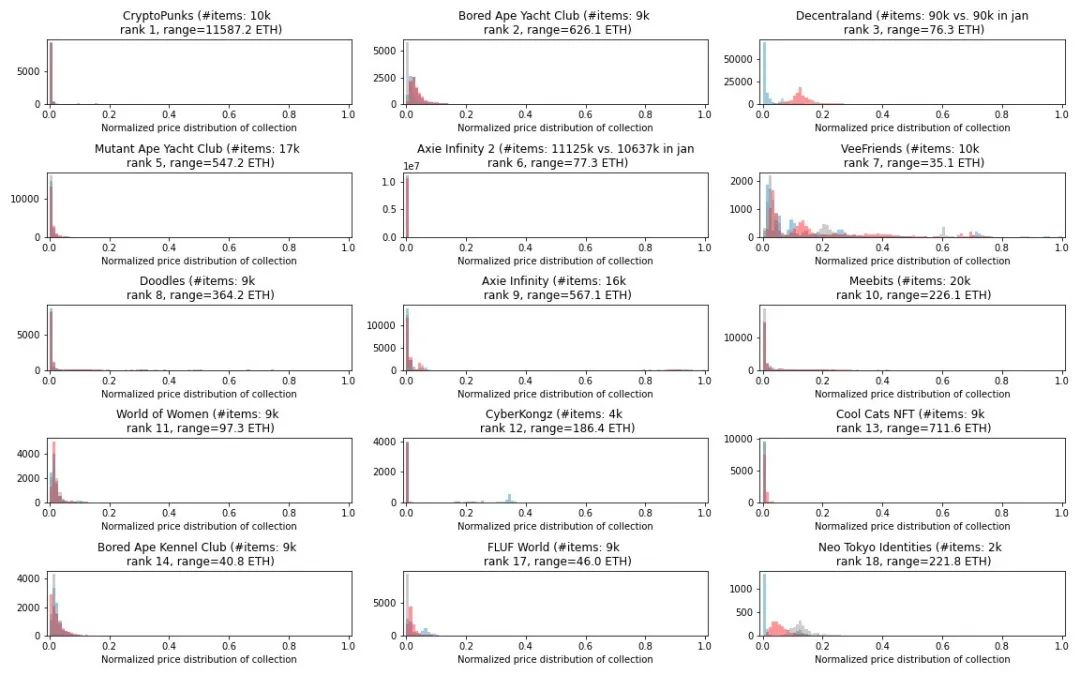
从包括在1月和2月数据中的537个nft系列中,166个在价格分布形状上发生了变化(30%)。从1月到12月,我们也看到了类似的部分变化(25%)。这听起来似乎很多,但请记住,以上对藏品分布形状的分类有点模糊,因为我们对截止日期的要求并不严格。

例如,人们可以在指数衰减和对数正态之间做出区分,"如果模式>底价=>对数正态"。看一下模式与底价的比率,我们选择了一个更宽松的定义,允许模式甚至比底价高10-20%,因为我们看的是拟合分布来分类它们的形状。
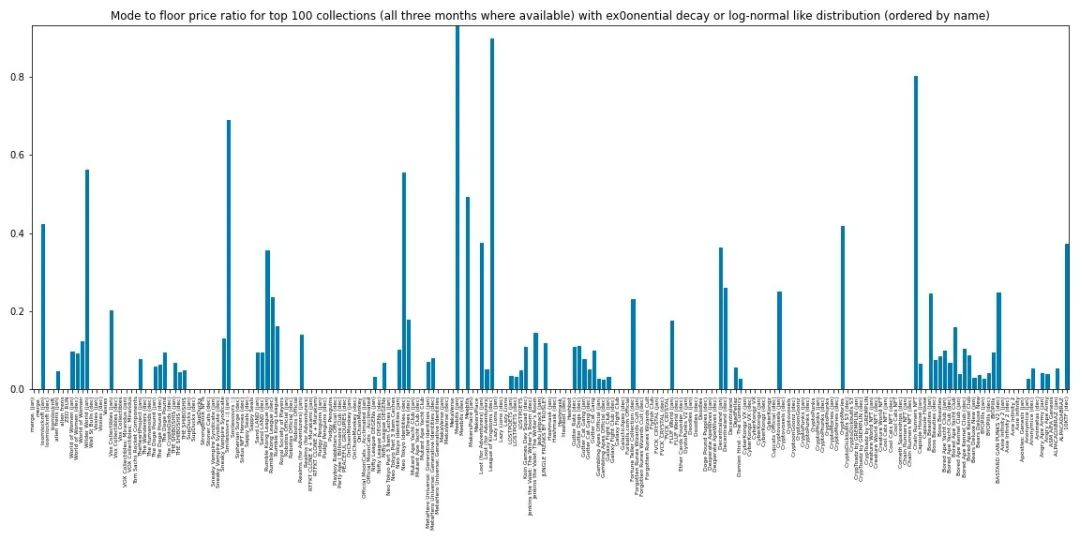
基于此,我们认为指数衰减和正态分布是"相关的"。

对于观察到价格分布变化的案例。

~42%改变为/从一个点分布,点分布具有其他四种形状中的一种,只是在一个非常狭窄的价格范围内

~26%从指数衰减或类似对数正态变为多模态,这一类的定义也比较柔和,因为我们的分布通常只有一个模式。我们定义这个形状是为了把像VeeFriends这样有几个凸起(模式)的分布与其他形状区分开来。

~22%是指数衰减到/从对数正态的变化(如果我们采用严格的方法,这个数字会高得多)

剩下的~10%的变化都是向/从对称分布,其中对数正态分布占主要份额(6%)。这又是由于对数正态分布和对称分布之间的界线定义相当软弱(即这两种形状也是"'相关的")。

定义价格层级

基于上述观察,我们寻找具有指数衰减和类似对数正态形状的集合来定义价格层级,因为底价可以作为这里的合理锚点。当然,由于"绝对"的底价可能只是一个最低上市价格的项目,我们想找到一个适当的乘数,在这个乘数下,更多的项目被归类为底价项目。

界定底价:我们研究了不同的下限量值以及它们与底价的比率。
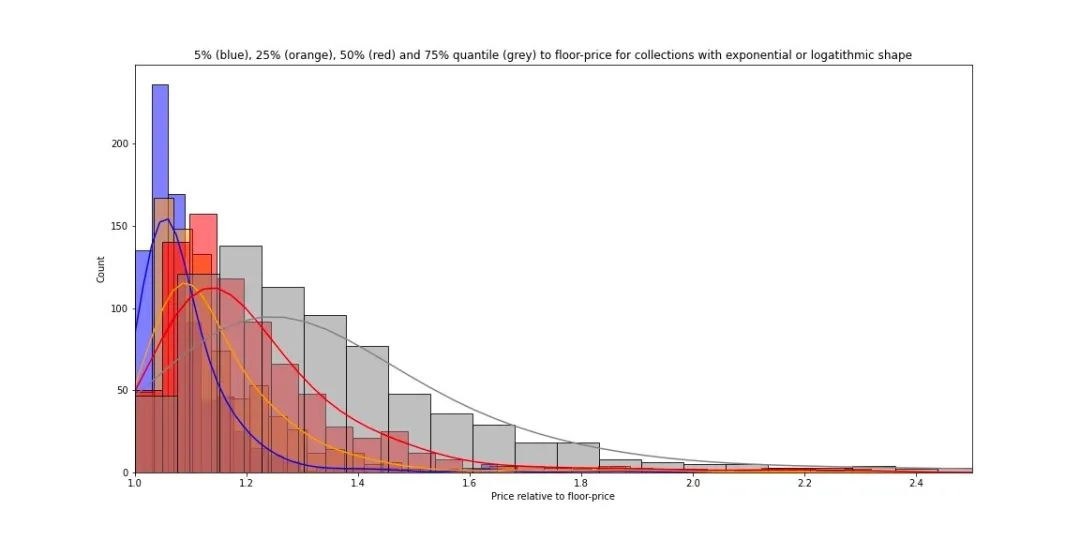
在这800个藏品中,大约90%的藏品的中位数低于1.4*底价。在这里选择一个阈值更多的是取决于我们所考虑的使用情况:如果我们向右走得更远,以包括更大份额的收藏品,我们就会以扩大其价格范围为代价,使这个收藏品的同质性降低。

为了使阈值适用于~90%的收藏品,阈值为

1.3给出~25%的四分位数(所以涵盖25%的项目)

1.4给出~50%的四分位数/中位数

1.75给出了~75%的四分位数

低于30%的藏品可能太少,而[地板价*1.75]的价格范围可能太宽。因此,我们选择了1.4的乘数作为底价的分界线。换句话说,"底层"物品被定义为那些在地板价格,地板价格*1.4]的价格范围内。

定义顶级物品:我们可以采用类似的路线,使用顶级量值。
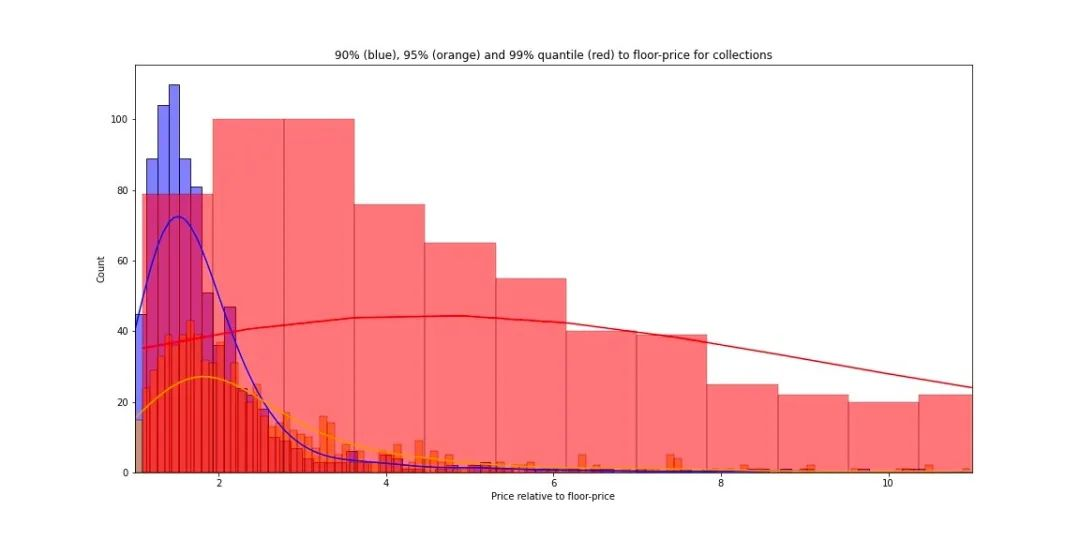
2.5的阈值涵盖了这些~800个藏品中90%的藏品~85%。它还包括其中2/3的收藏品的95%,甚至其中~20%的收藏品的99%。换句话说,2.5的门槛将把前10%的资产放在90%的收藏品的"顶级"中。

同样,我们可以对这个集合进行更多的排他性,例如将这个阈值提高到4。

根据这些对底层和高层项目的定义,我们可以把中层项目定义为那些价格在[地板价格*1.4,地板价格*2.5]之间的项目。现在我们来看看这些价格层级的特点。

定义的价格层级的特点:

1.地板价:价格在地板到地板价*1.4之间的物品。

地板价通常占一个收藏品中50-75%的物品,占其市值的25-50%。它们的数量和同质化的行为使它们适合于流动性池,它有效地充当了"地板AMM",用户可以从地板资产的交易活动中获得收益,与其他价格层相比,享受最深的流动性。

中。

2.价格为地板价*1.4至地板价*2.5的项目:

中层通常占物品的20-40%,占一个藏品市值的10-20%。就目前的情况来看,中层物品可能是最不赚钱的交易,因为它们的流动性比底价低,反射性上升的风险较小。收藏品,其模式是在中间层(那些具有对称价格分布的收藏品),可能是那些许多用户对资产本身的属性或效用而不是价格更感兴趣。例如,虚拟的土地楼层可能太小或位于无利可图的地方,而大型、高流量的土地则太贵或不出售。因此,土地买家猎取具有良好位置和土地尺寸以及价格的资产。

如果事实证明,中间包含一些'过渡性'的项目,即地板价或顶级失去价值,那么这可能是投机和相关对冲应用的层级。
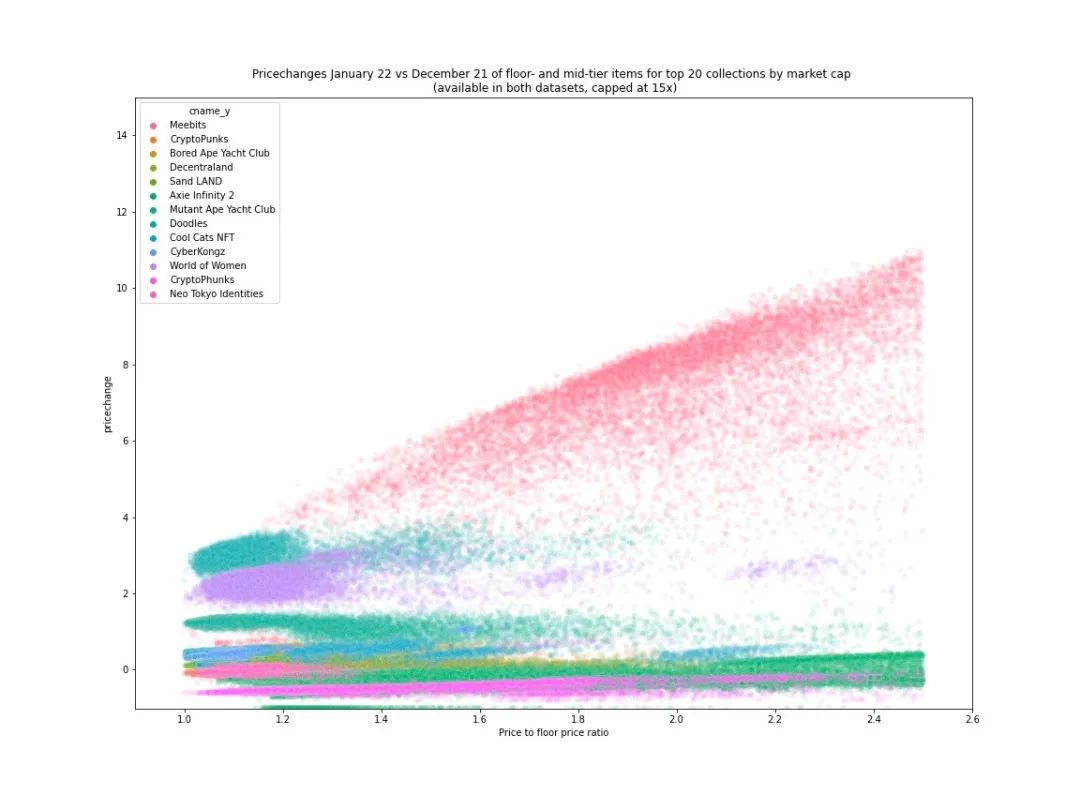
稀有或价格高于地板价的物品*2.5:

Grails通常占物品的5-10%,占收藏品市值的20-40%。稀有NFT有复杂的分布和巨大的价格变化,其行为类似于"传统"艺术或房地产中的高端项目。虽然他们的交易量和速度都很低,但有很好的潜力作为抵押品,或通过碎片化获得流动性。
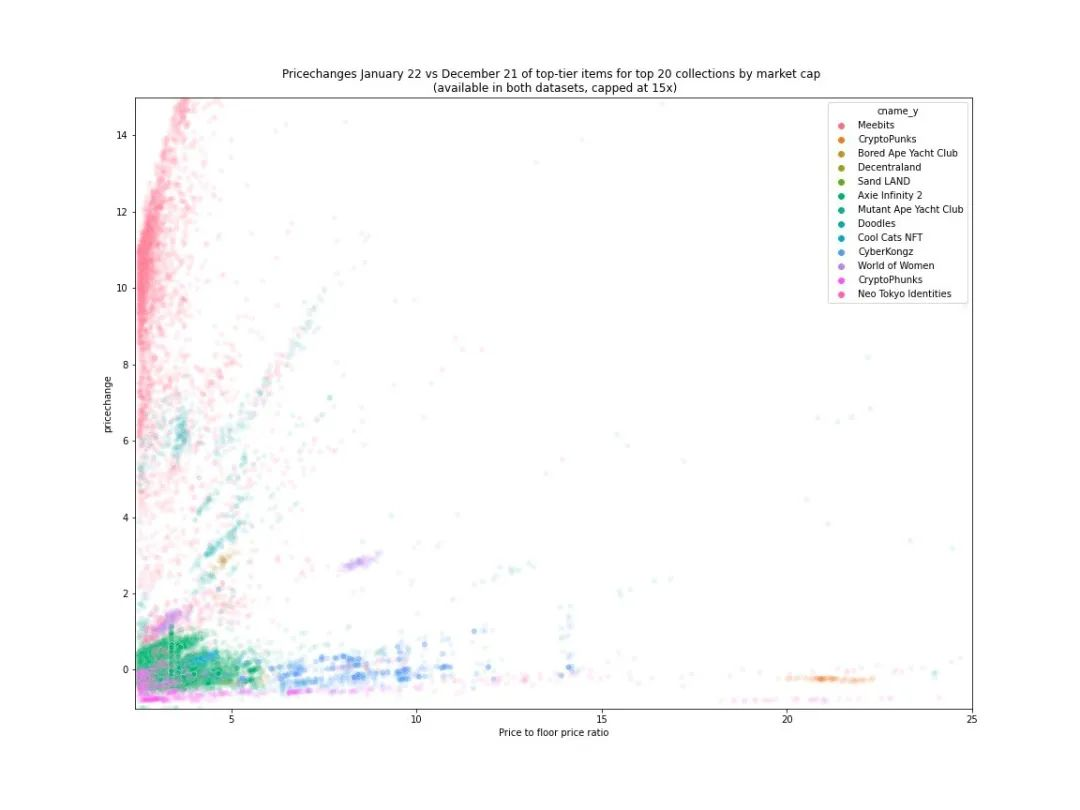
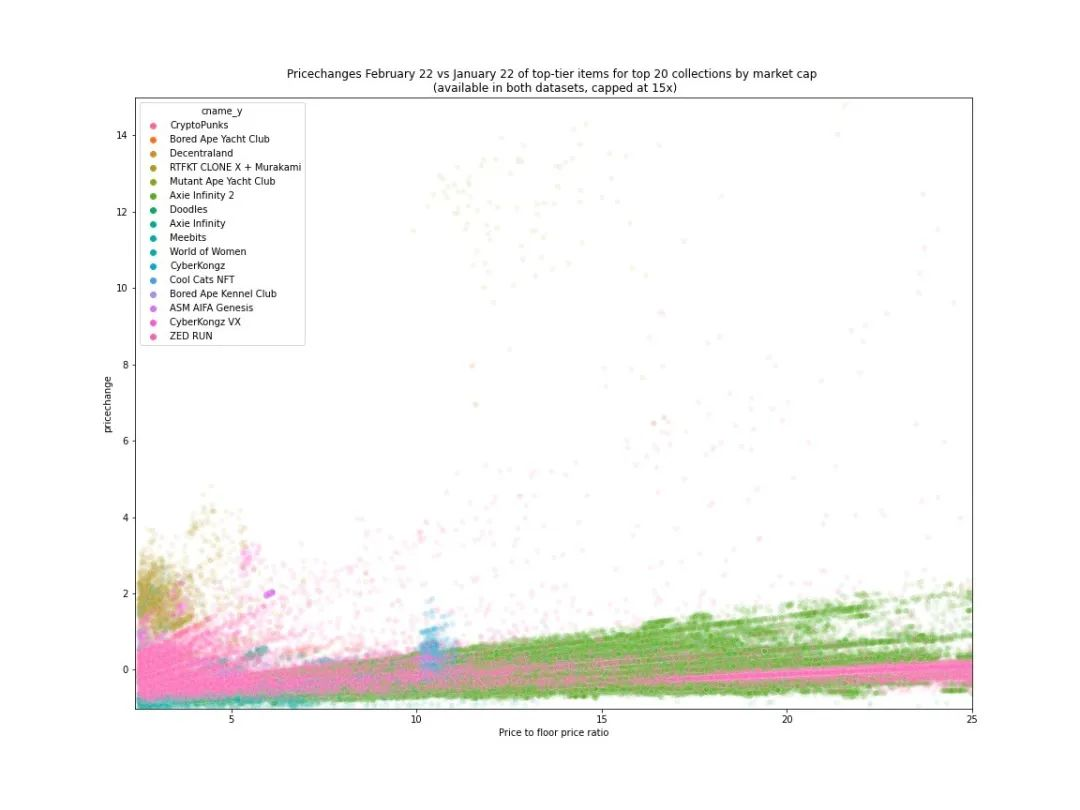
关于属于三个层级的物品的份额,我们看到地板价物品(蓝色)的份额很大。但这又与我们形状的模糊定义有关,例如,Meebits(第一条)并不完全遵循我们的层级逻辑,因为它有我们上面进一步显示的这些额外的凸起。
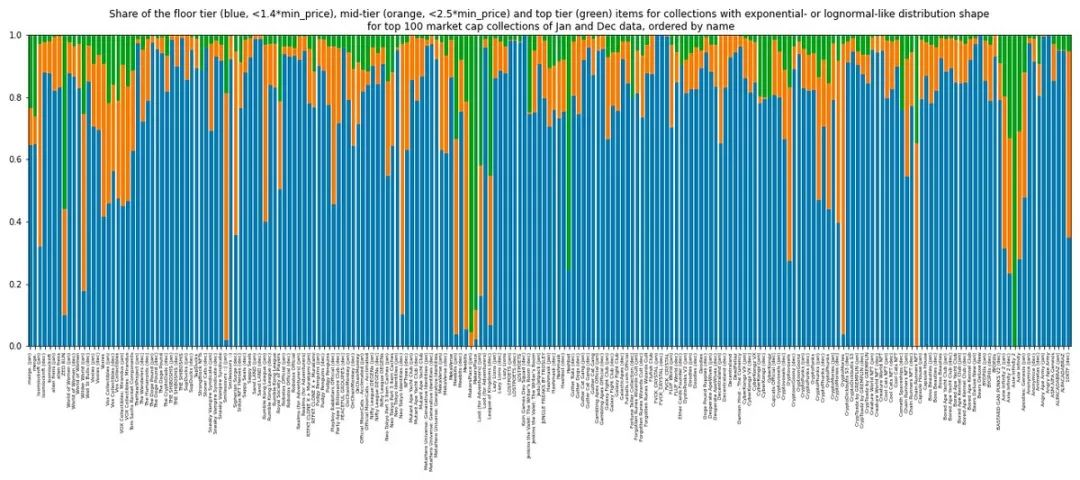
收藏品的名字很小,但名字后面的'('Jan)'或'(Dec)'分别说明它来自1月或12月的数据集。

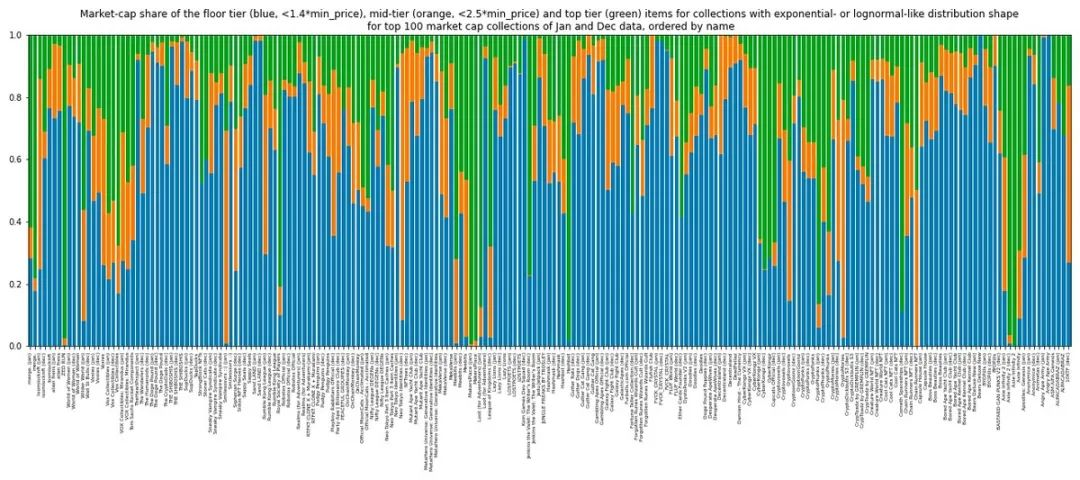
当我们看每个价格层的市场份额时,事情变得有点复杂。虽然地板价系列似乎仍占市场份额的大部分,但收藏品中普遍存在高于地板价10-1000倍的稀有NFT,侵蚀了收藏品的市值。

总的来说,大约25-50%的市值属于地板价,10-20%属于中层,20-40%属于稀有。
未来的工作

通过这篇文章,我们采取了一些初步措施,按照价格变动行为和在其各自集合中的层级对NFT进行分类。正如我们上面提到的,层级的划分可以根据使用情况来调整。对我们来说,其中一个目的是得出跨集合和资产类别的非金融期货的共同行为和特征,这将告知持有人寻找流动性的最佳途径。该分析有助于为该评估矩阵提供信息。
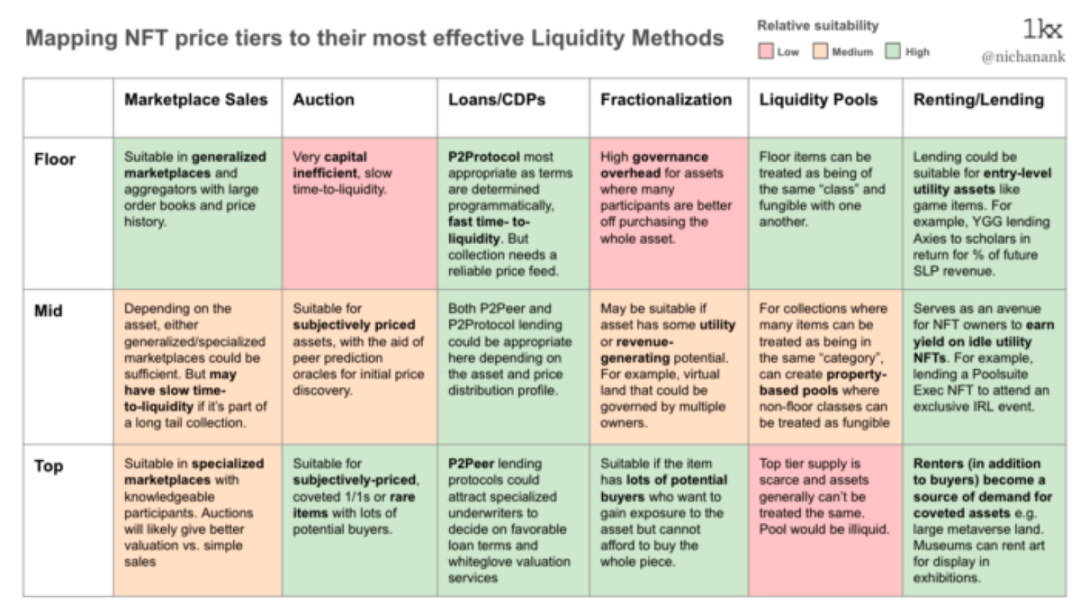
现在,我们对资产在不同收藏品中的表现有了一个不同层次的概述,我们可以进一步分析它。比如说:

某一收藏品的主要属性是什么,为什么导致它们具有这样的价格分布模式?

有哪些内部(如项目发展)或外部(如市场情绪)因素会导致特定的收藏品随着时间的推移改变其价格分布形态?

价格分布是否可以作为一个领先的指标或分析指标,用于一个特定的金融化协议,以登上一个特定的资产,例如用于抵押品或一个NFTAMM?

我们希望在未来的文章中探讨这些问题。目前,我们提供了定义价格层级的量化模型,以及一个初步的框架。

Trending Cryptos

Related Reads

Microsoft CEO Satya Nadella's Latest Warning: Betting Entirely on a Single AI Model Hands Over a Company's Lifeblood

Microsoft CEO Satya Nadella warns that companies relying solely on a single AI model could jeopardize their survival. He argues that over-dependence leads to "vendor lock-in," where businesses risk ceding control over their core data, memory, contextual history, and AI usage patterns. This dependence essentially outsources a company's critical thinking and operational know-how to an external provider. The deeper a company integrates with one AI system—feeding it prompts, internal data, and workflows—the more it reveals its unique business methods and competitive edge. This accumulated knowledge could become accessible to the AI supplier. Furthermore, switching providers becomes extremely costly and complex, as companies would need to rebuild their entire AI-augmented workflow, memory, and tool integrations from scratch. Nadella's solution is "decoupling." Companies should separate their proprietary data, memory, and control layer (or "harness") from the underlying AI models. By retaining metadata from every AI interaction, businesses can preserve their operational "brain" or institutional knowledge. This allows them to flexibly use different AI models (e.g., from OpenAI, Anthropic, Microsoft) for specific tasks without losing their accumulated expertise. The core idea: companies can rent the smartest models available, but they must keep their own "brain" and operational control firmly in-house.

marsbit40m ago

Microsoft CEO Satya Nadella's Latest Warning: Betting Entirely on a Single AI Model Hands Over a Company's Lifeblood

marsbit40m ago

Miners Advised Not to Buy GPUs for AI and to Focus on Infrastructure

A founder at an energy investment forum advises bitcoin miners not to purchase GPUs for AI themselves, but to instead focus on infrastructure like power and data center space. Mike Alfred of Alpine Fox stated that while AI infrastructure demand is a long-term, 20-30 year trend, it presents a key choice for miners. The first, riskier model involves owning and operating GPUs, which requires financing expensive hardware that quickly becomes obsolete. The second, more conservative model is akin to real estate: providing colocation services where clients bring their own servers, and the miner sells space, power, cooling, and water. Alfred noted this model is easier to finance. Most existing bitcoin mining sites are difficult and expensive to convert for AI, as AI data centers require far higher construction costs, redundant fiber connections, backup power, complex cooling, and near 100% uptime. A hybrid model, where mining acts as a flexible load to use excess power during AI data center construction or from generation facilities, was discussed. However, participants concluded this is only viable with very cheap power; otherwise, developers are better off focusing solely on AI. Miners are increasingly being evaluated for their available power capacity and project portfolios rather than just bitcoin output. Panelists also warned of risks in the AI sector, predicting at least one major default or contract breach among AI tenants, lenders, or landlords before bitcoin's next halving in 2028.

cryptonews.ru50m ago

Miners Advised Not to Buy GPUs for AI and to Focus on Infrastructure

cryptonews.ru50m ago

Millisecond 'Pay-to-Cut': How Did Hyperliquid's Priority Fee Turn into a Multi-Million Dollar Business?

"Millisecond 'Paid Queue-Jumping': How Hyperliquid's Priority Fee Became a Multi-Million Dollar Annual Business" In traditional finance, high-frequency trading firms spend millions on infrastructure for millisecond advantages. Hyperliquid has translated this race onto the blockchain with its "Priority Fee" system, creating an open economic game for speed. This system auctions two types of priority: **Gossip Priority** for faster data feeds (via a Dutch auction every 3 minutes), and **Order Priority** for front-of-queue trade execution (users bid a fee for lower latency). This converts a hardware race into a transparent, market-priced mechanism. Since launch, this feature has generated over $5M in protocol revenue. Projected annualized buybacks from this income exceed $30M, accounting for ~7% of total protocol revenue. The demand stems from large traders and market makers on Hyperliquid, for whom milliseconds can mean the difference between profit/loss or avoiding liquidation. Market makers pay these fees as "protection" to ensure their orders execute first, which in turn improves liquidity for all users. Crucially, Hyperliquid internalizes Maximum Extractable Value (MEV) that typically leaks to external validators or searchers, creating a new revenue stream beyond trading fees. The mechanism also strengthens HYPE's tokenomics. While 97% of trading fees fund secondary market buybacks (via the Assistance Fund), Priority Fees are **directly burned**, adding a second deflationary engine. Furthermore, fees for order priority are deducted from users' undelegated HYPE balances, encouraging large traders to hold and lock up tokens, reducing circulating supply. However, a key challenge remains: balancing the speed needs of institutional players with fair market access for retail users, as those who cannot pay high fees may suffer worse slippage during volatility. In summary, Hyperliquid's Priority Fee is a novel model that monetizes latency, captures MEV for the protocol, and enhances its native token's value through burning and lock-ups.

marsbit55m ago

Millisecond 'Pay-to-Cut': How Did Hyperliquid's Priority Fee Turn into a Multi-Million Dollar Business?

marsbit55m ago

Trading

Spot

Hot Articles

How to Buy NFT

Welcome to HTX.com! We've made purchasing AINFT (NFT) simple and convenient. Follow our step-by-step guide to embark on your crypto journey.Step 1: Create Your HTX AccountUse your email or phone number to sign up for a free account on HTX. Experience a hassle-free registration journey and unlock all features.Get My AccountStep 2: Go to Buy Crypto and Choose Your Payment MethodCredit/Debit Card: Use your Visa or Mastercard to buy AINFT (NFT) instantly.Balance: Use funds from your HTX account balance to trade seamlessly.Third Parties: We've added popular payment methods such as Google Pay and Apple Pay to enhance convenience.P2P: Trade directly with other users on HTX.Over-the-Counter (OTC): We offer tailor-made services and competitive exchange rates for traders.Step 3: Store Your AINFT (NFT)After purchasing your AINFT (NFT), store it in your HTX account. Alternatively, you can send it elsewhere via blockchain transfer or use it to trade other cryptocurrencies.Step 4: Trade AINFT (NFT)Easily trade AINFT (NFT) on HTX's spot market. Simply access your account, select your trading pair, execute your trades, and monitor in real-time. We offer a user-friendly experience for both beginners and seasoned traders.

7.6k Total ViewsPublished 2024.03.29Updated 2026.06.02

How to Buy NFT

What is Altura NFT?

Altura: Providing One-Stop NFT Solutions for Game Developers

56.2k Total ViewsPublished 2024.06.12Updated 2024.06.12

What is Altura NFT?

What is AINFT

EternaFi Agents and $AINFT: A Comprehensive Analysis of AI-Powered NFT Infrastructure in the Web3 Ecosystem The intersection of artificial intelligence (AI) and blockchain technology is rapidly evolving, establishing innovative platforms that redefine ownership models and economic participation. EternaFi Agents, along with its native token $AINFT, exemplifies a groundbreaking approach to the tokenization of AI infrastructures through the means of non-fungible tokens (NFTs). Launched in July 2025 by the development team at Nova Club, EternaFi merges the advancements of AI with the decentralized financial mechanisms of blockchain, presenting a unique investment opportunity for participants within the web3 ecosystem. This article aims to provide an in-depth assessment of EternaFi Agents, covering its core components, functionality, and significance within the crypto landscape. Introduction and Project Overview EternaFi Agents stands as a salient example of how blockchain technology can democratize access to advanced AI capabilities. The project endeavors to reshape the paradigm of AI ownership by diversifying economic participation, making sophisticated AI systems accessible to a larger pool of stakeholders. At its core, the project tokenizes a proprietary large language model (LLM) developed by Nova Club, allowing NFT holders to gain fractional exposure to the model's economic performance. By utilizing NFTs representing stakes in the LLM, EternaFi Agents fosters a model wherein stakeholders not only participate in AI service consumption but also enjoy sharing in the economic rewards generated by the platform. This transformative approach enables the development of sustainable revenue models for AI services, all the while promoting broad community engagement and facilitating transparent governance. What is EternaFi Agents? EternaFi Agents represents an AI-NFT infrastructure project that aims to blend the capabilities of AI with blockchain technology in a coherent ecosystem. The essential feature of this project is the creation of NFTs that serve as financial instruments, representing fractions of ownership in Nova Club's proprietary AI infrastructure. Each NFT symbolizes direct exposure to the economic performance of the underlying AI system, providing a lucrative opportunity for investors. The project operates on the Base blockchain, known for its scalability and efficiency, thus ensuring manageable transaction costs while facilitating a seamless operational experience. One of the notable features includes a revenue-sharing mechanism, wherein NFT holders can receive portions of subscription income generated by the AI services provided on the platform. This innovative approach establishes a connection between the success of the AI services and the economic dividends distributed among the holders, thus ensuring an alignment of interests across the community. Who is the Creator of EternaFi Agents? The creative force behind EternaFi Agents is Nova Club, a development team based in Singapore proficient in the amalgamation of AI and blockchain technology. Their prior experience in AI development and cryptocurrency analysis gives credence to the project, contributing a breadth of expertise to the creation of EternaFi Agents. Nova Club’s mission centers on democratizing access to cutting-edge AI technologies while building sustainable economic models that benefit users alongside developers. Their commitment to transparency, community governance, and innovation is reflected in the design and implementation of the EternaFi platform, aiming to establish a unique ecosystem that fosters positive engagement and long-term value creation. Who are the Investors of EternaFi Agents? The specific details concerning investors or investment organizations backing EternaFi Agents are not publicly available. However, EternaFi has adopted an inclusive approach to funding its development through the sale of NFTs to the public, allowing a wide array of participants to invest in the ecosystem. The project’s architecture ensures that core infrastructure is funded responsibly while allowing community members to partake in the ownership and economic returns generated from the AI services. This model emphasizes community engagement by aligning the interests of investors and project developers, creating a collaborative environment where long-term participation is incentivized. How Does EternaFi Agents Work? EternaFi Agents operates through a multifaceted ecosystem where NFTs serve as a primary means of ownership representation within the project. Each NFT holder is entitled to a share of the monthly subscription income produced by the underlying AI-powered platform, thereby positioning NFT ownership as a lucrative investment vehicle. Revenue Generation Mechanism The primary source of revenue generation for the EternaFi platform stems from subscription fees related to the AI services provided. Users can access various tiered services, ranging from basic market analysis tools to comprehensive AI-assisted trading solutions. These services are monetized and form the basis for the revenue-sharing framework, which distributes profits to NFT holders through automated smart contracts. An innovative feature of the EternaFi ecosystem is the revenue-sharing mechanism that operates transparently, ensuring that rewards are allocated based on verifiable metrics from the AI platform's operations. This creates a direct link between the performance of AI services and the returns available to community investors, establishing a sustainable economic model. Staking and Vesting Mechanisms Participants within EternaFi can engage in staking their NFTs to unlock additional economic benefits. The vesting schedule is designed to promote long-term commitment among participants, rewarding those who exhibit ongoing support for the project. This ensures a robust alignment of interests and fosters a sense of community engagement essential for achieving the project's long-term goals. Transparent Governance EternaFi Agents embraces decentralized governance, allowing NFT holders to play an active role in decision-making regarding the platform's development and future directions. The governing structure includes community voting mechanisms, providing NFT holders with the opportunity to influence significant decisions and contributing to a collaborative approach to project growth. Timeline of EternaFi Agents The development trajectory of EternaFi Agents showcases a systematic approach toward building a sustainable AI infrastructure while meeting the needs of community participants. Below is a timeline of important milestones in the project’s history: July 2025: Launch of EternaFi Agents, including the public sale of NFTs and deployment of the $AINFT token on the Base blockchain. Q4 2025: Establishment of market infrastructure including liquidity pools and launch of staking dashboards for NFT holders. 2026: Initiation of community engagement programs, expanding AI capabilities, and integration with cross-chain technologies. Q4 2026: Implementation of the dividend distribution system, allowing NFT holders to reap economic benefits from their investments. These milestones signify the focus on establishing a functional and participative ecosystem while ensuring continuous evolution to meet market demands. Technological Infrastructure and Blockchain Integration EternaFi Agents is anchored in an advanced technological framework combining AI systems with blockchain capabilities. Operating on the Base blockchain, the project leverages the advantages of scalability and low transaction costs. The underlying smart contract architecture governs the NFT ownership, revenue sharing, and community management features, ensuring efficiency and transparency. AI System Development The proprietary large language model underpinning EternaFi Agents has been independently developed and designed to cater to revenue-generating applications without reliance on proprietary external frameworks. This endeavor reflects a commitment to creating a versatile and adaptable AI infrastructure capable of delivering meaningful services to users, thus generating economic value for investors. Security Measures The robustness of EternaFi’s security infrastructure is paramount. Regular audits and stringent security measures ensure the integrity of the AI systems and blockchain mechanisms, safeguarding against potential vulnerabilities while fostering confidence among participants. Conclusion EternaFi Agents signifies a landmark innovation within the realm of artificial intelligence and blockchain technology, opening avenues for community ownership and economic participation in advanced AI capabilities. The project’s comprehensive strategy to tokenize AI infrastructure via NFTs establishes a precedent for future decentralized ecosystems. By harmonizing technical sophistication with user-centric economic models, EternaFi not only fosters engagement but also generates a sustainable revenue-sharing framework for community participants. The significance of EternaFi extends well beyond its operational success as it exemplifies how blockchain can democratize cutting-edge AI technologies, paving the way for future ventures in this intersectional space. The evolution of EternaFi Agents may herald a new era of AI development characterized by participant-driven governance, sustainable economic models, and transparent verification, ultimately contributing to the broader democratization of AI and technology accessibility across industries.

4.9k Total ViewsPublished 2025.08.14Updated 2025.08.14

What is AINFT

Discussions

Welcome to the HTX Community. Here, you can stay informed about the latest platform developments and gain access to professional market insights. Users' opinions on the price of NFT (NFT) are presented below.

活动图片