THETA, LIDO, KLAY and EGLD flash bullish signs as Bitcoin recaptures $23K

CointelegraphPublished on 2023-02-27Last updated on 2023-02-27

Abstract

BTC price is chasing after $24,000 again, raising the possibility of LDO, EGLD, THETA and KLAY targeting new year-to-date highs.

The cryptocurrency markets and the United States equities markets witnessed profit-booking this week as the macroeconomic data hinted toward continued rate hikes by the Federal Reserve. Bitcoin (BTC) is down more than 4% and the S&P 500 fell 2.7% to record its worst week of the year.

The CME FedWatch Tool shows a 73% probability of a 25 basis points rate hike by the Fed in the March meeting but after the hotter-than-expected inflation readings in two weeks, the probability of a 50 basis point rate hike has started to slowly gain traction.
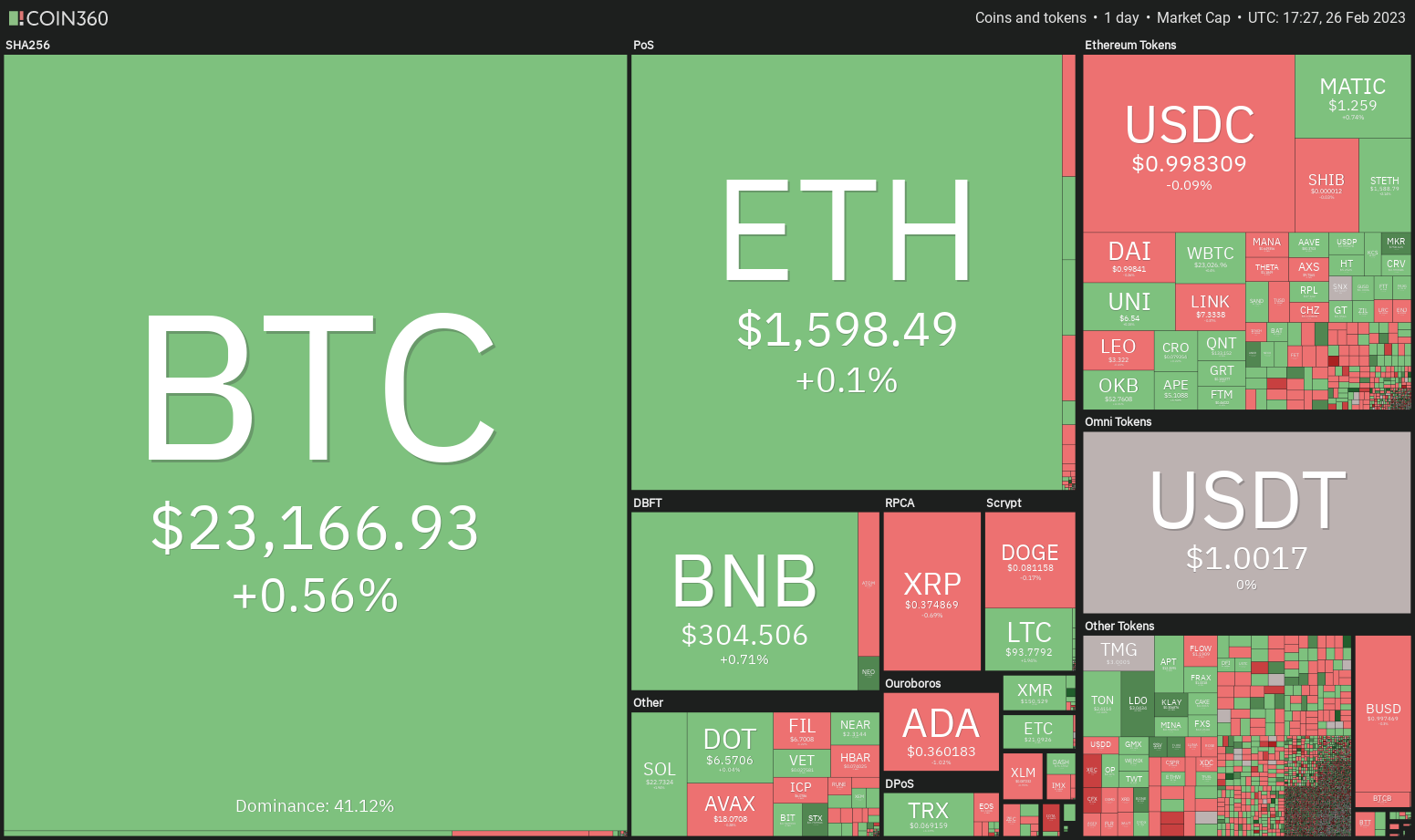
Crypto market data daily view. Source: Coin360

During periods of uncertainty, some coins enter a deeper correction while a few buck the trend and continue to outperform. Hence, it becomes important to select the right coins to trade.

A few coins that have witnessed a shallow correction or have bounced sharply off the support have been selected in this list. Let’s see their charts and determine the levels to watch out for.

BTC/USDT

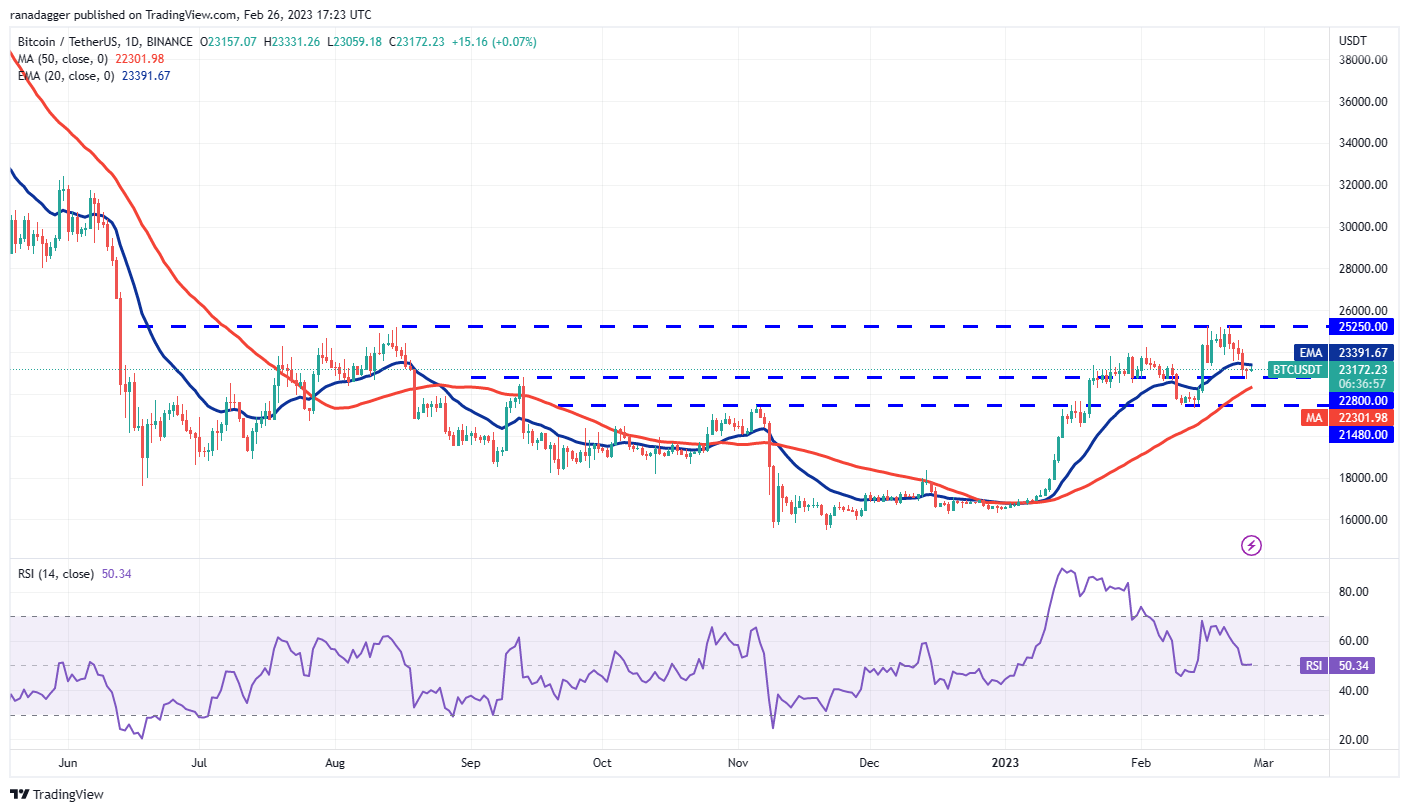
Bitcoin plunged below the 20-day exponential moving average ($23,391) on Feb. 24 but the bears could not build upon this advantage and sustain the price below the strong support at $22,800.
BTC/USDT daily chart. Source: TradingView

The price bounced off $22,800 on Feb. 25 and the bulls are trying to push the price above the 20-day EMA. If they manage to do that, it will indicate that the BTC/USDT pair may consolidate between $25,250 and $22,800 for a few days.

The flattening 20-day EMA and the relative strength index (RSI) near the midpoint also suggest a range-bound action in the near term.

Alternatively, if the price slips below $22,700, the selling could intensify and the pair may plummet to the next strong support at $21,480.
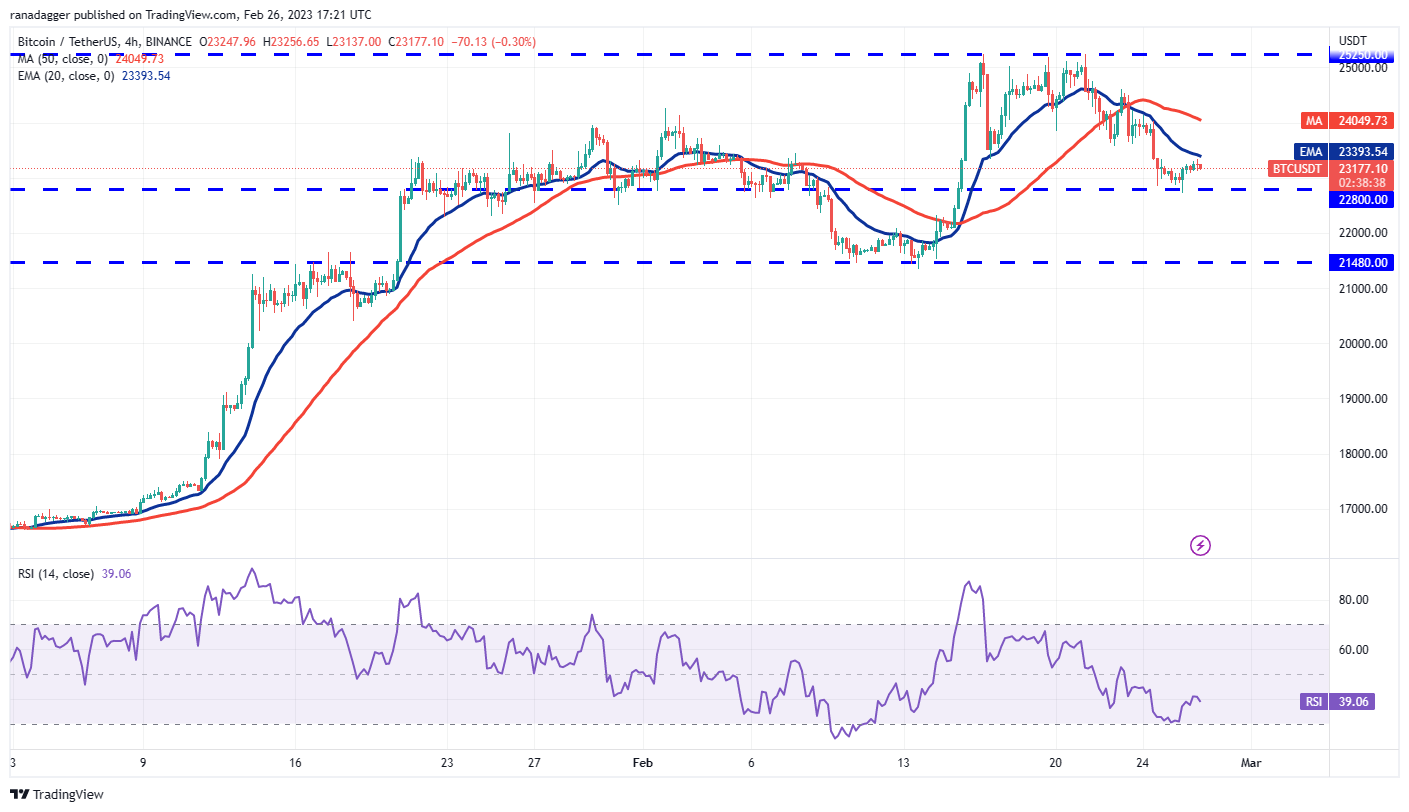
BTC/USDT 4-hour chart. Source: TradingView

The 20-EMA has turned down on the four-hour chart and the RSI is in the negative territory. This indicates an advantage to the bears. Sellers will try to protect the 20-EMA, and if the price turns down from this level, the likelihood of a break below $22,800 increases. If that happens, the selling may intensify and the pair may slide to $21,480.

On the contrary, if the price breaks above the 20-EMA, it will suggest that bulls are buying on dips. That could push the pair to the 50-simple moving average and keep the price stuck inside the range for some more time.

LDO/USDT

Lido DAO (LDO) did not sustain below the 20-day EMA ($2.75) during the recent correction, which is a positive sign. Another bullish sign is the formation of the pennant near the local highs.
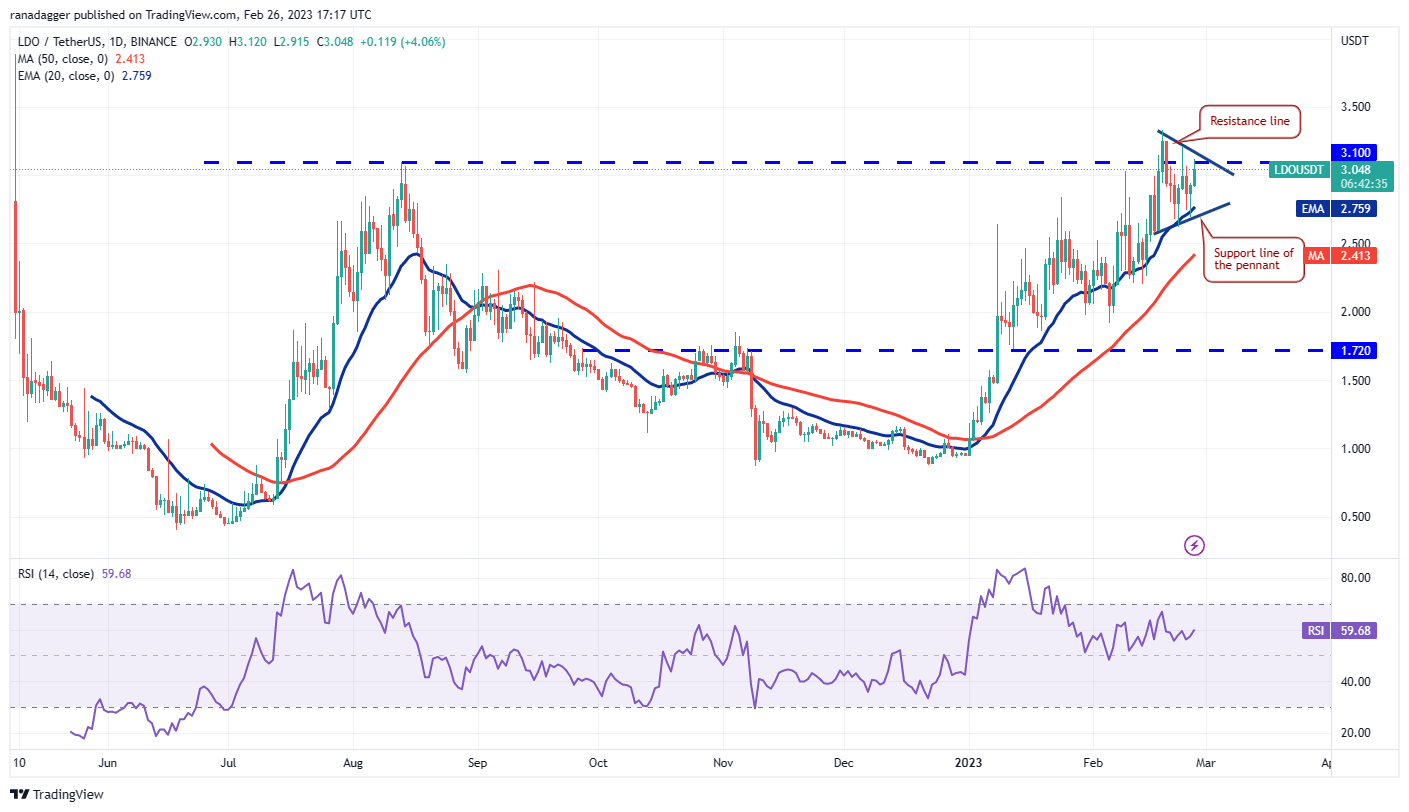
LDO/USDT daily chart. Source: TradingView

The bulls will try to propel the price above the resistance line of the pennant. If they succeed, the LDO/USDT pair could start the next leg of the up-move. The pair may first rise to $3.90 and thereafter attempt a rally to $4.24.

Conversely, if the price turns down from the resistance line, it will suggest that bears are selling on rallies. That could keep the price inside the pennant for a while longer. The bears will have to sink the price below the pennant if they want to signal a short-term trend reversal.
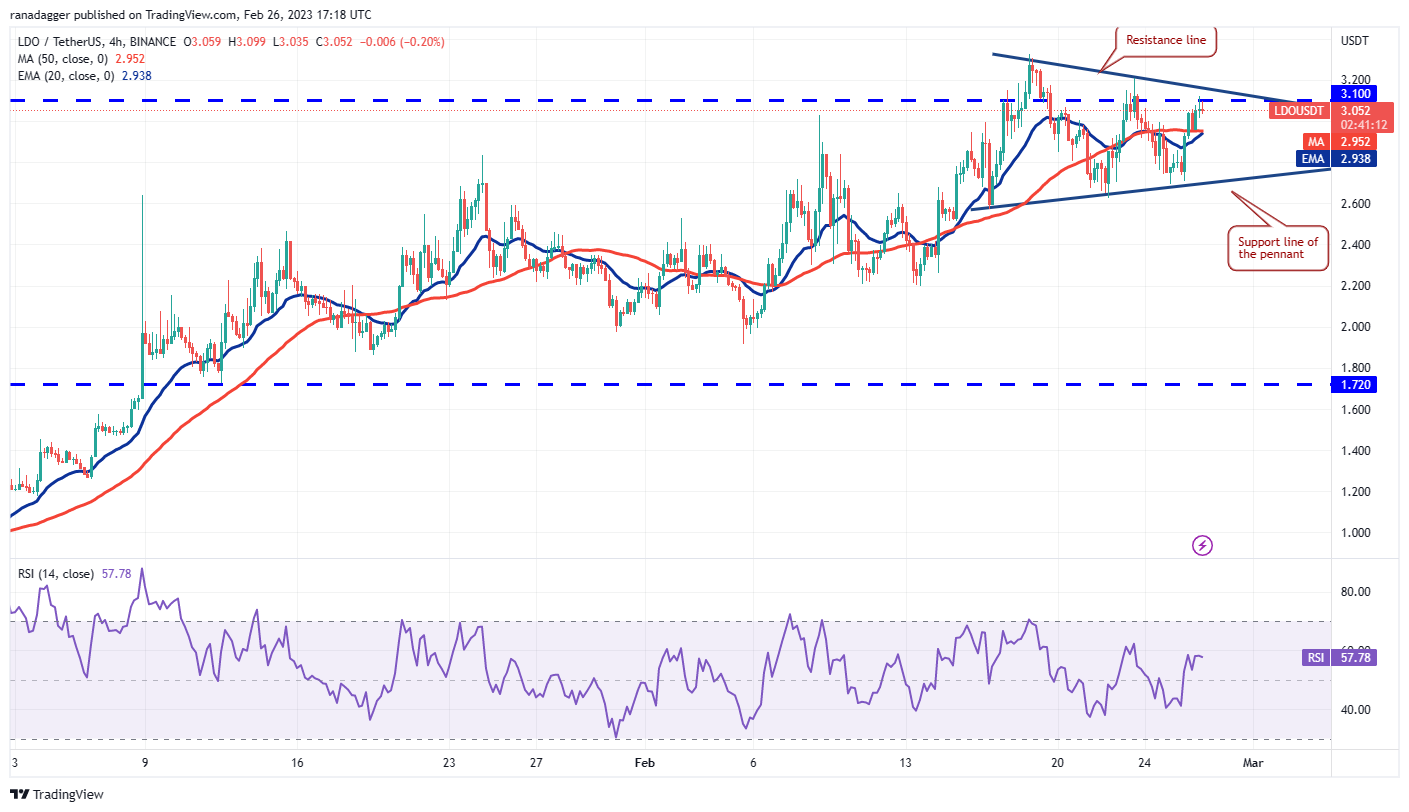
LDO/USDT 4-hour chart. Source: TradingView

The strong bounce off the support line of the pennant indicates aggressive buying on dips. Buyers will have to overcome the obstacle at the resistance line to regain control. If they do that, the pair may resume its uptrend.

However, the bears are likely to have other plans as they will try to protect the resistance line. If the price turns down from this level, the state of equilibrium may continue for some more time.

A break below the pennant could attract profit-booking by short-term traders. That may tug the price to $2.20 and later to $2.

EGLD/USDT

MultiversX turned down from the resistance line but an encouraging sign is that the bulls are trying to defend the 20-day EMA ($47).
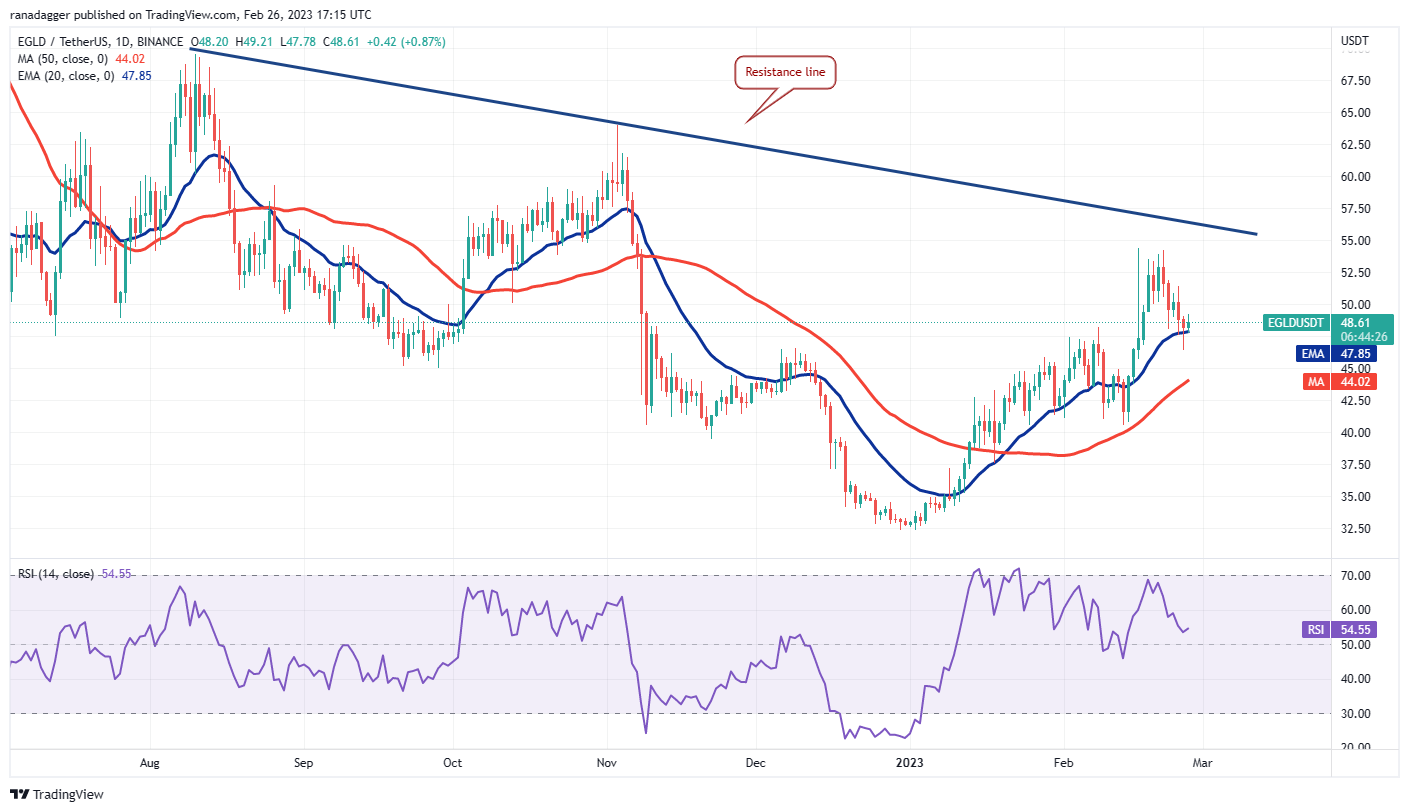
EGLD/USDT daily chart. Source: TradingView

Both moving averages are sloping up and the RSI is above 54, indicating that buyers have a slight edge. The bulls will try to push the price toward the resistance line where they are again likely to face strong opposition from the bears.

This bullish view could invalidate in the near term if the price turns down and plummets below the 20-day EMA. That will indicate selling by the bears on every minor rally. The EGLD/USDT pair could then tumble to the 50-day SMA ($44) and later to $40.
EGLD/USDT 4-hour chart. Source: TradingView

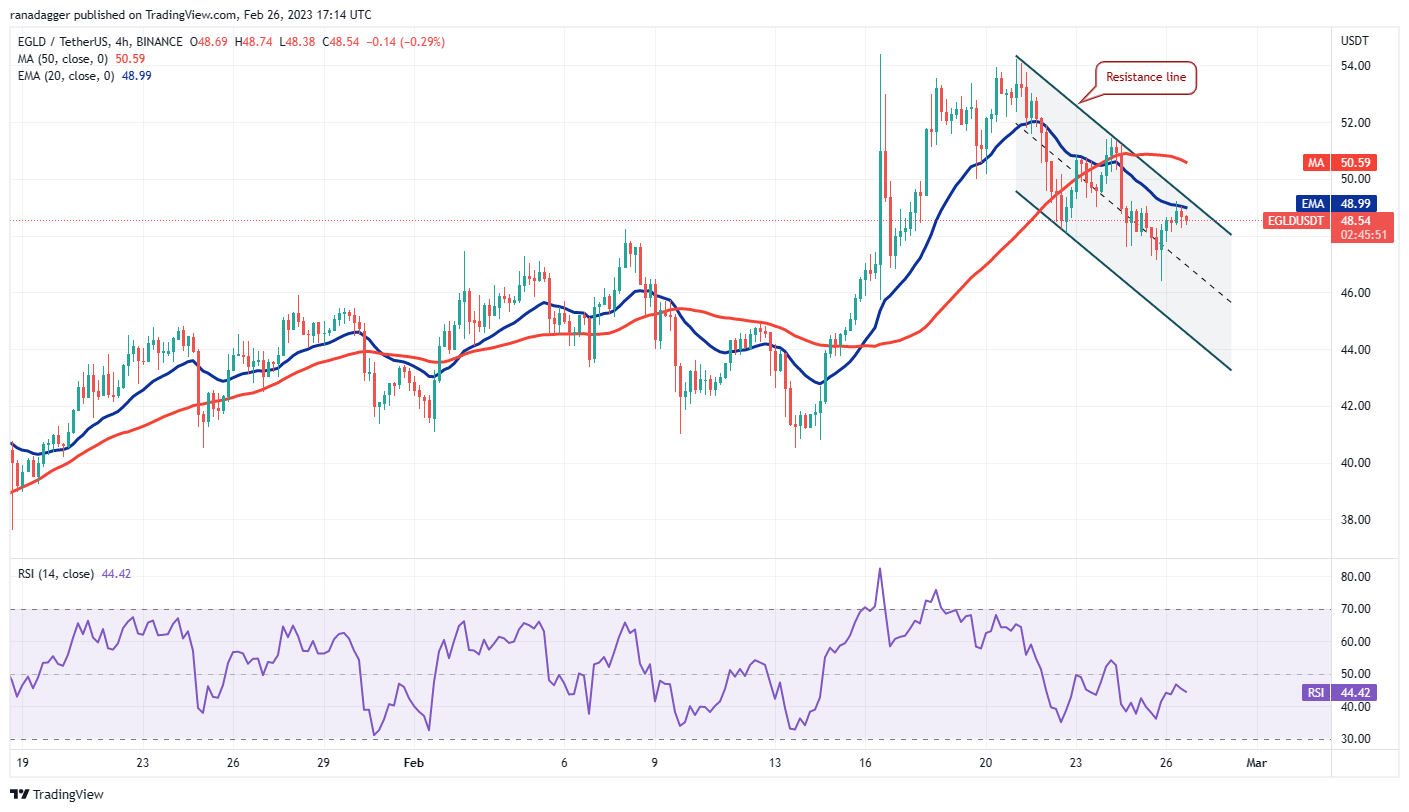
The four-hour chart shows that the price is falling inside a descending channel pattern. Buyers purchased at lower levels and have pushed the price to the resistance line of the channel. If this resistance gives way, the pair could rise to the 50-SMA and thereafter attempt a retest of the strong barrier at $54.

Contrarily, if the price turns down from the resistance line, it will suggest that the bears have not given up. That could result in a drop toward the support line of the channel.

THETA/USDT

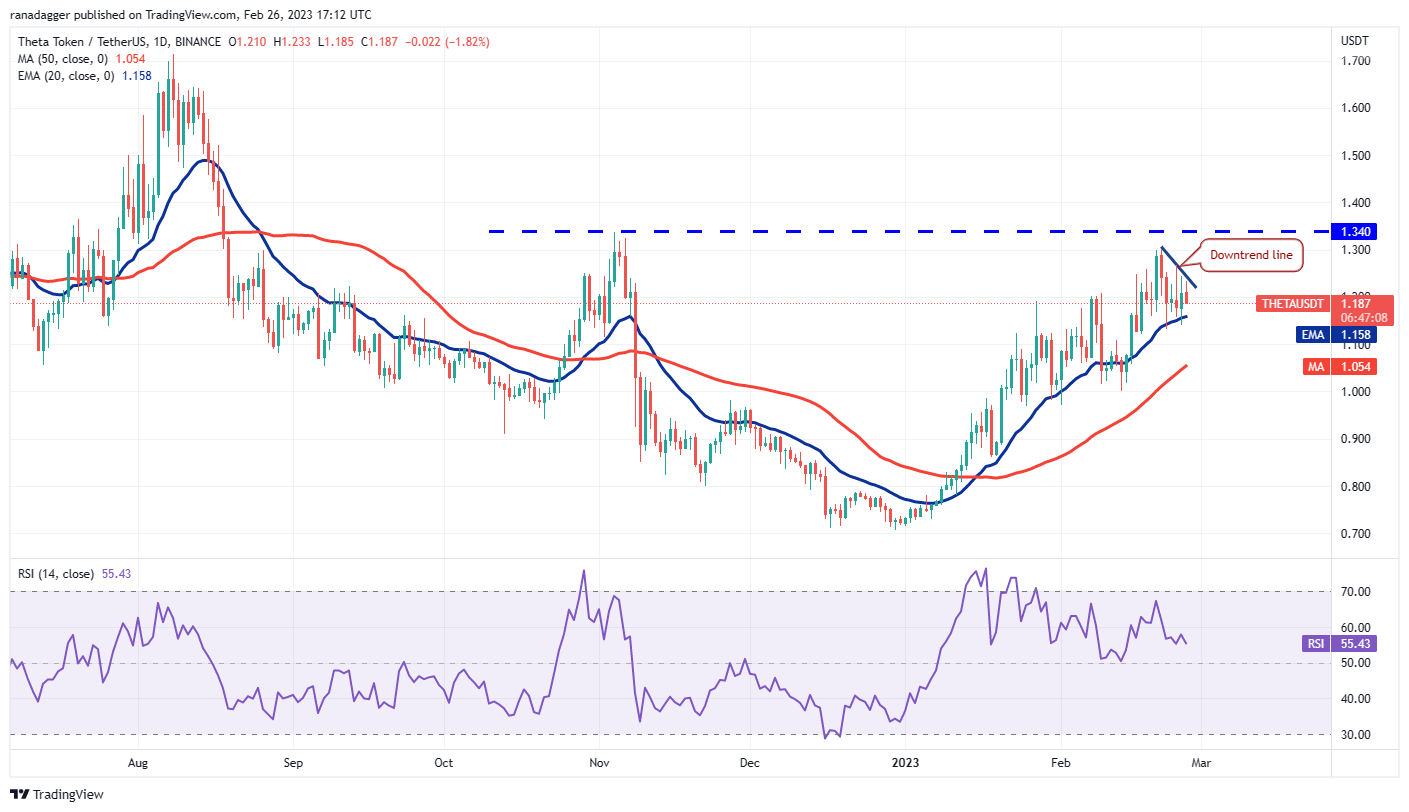
The bulls are trying to arrest Theta Network’s pullback at the 20-day EMA ($1.15). Both moving averages are sloping up and the RSI is in the positive territory, indicating advantage to the bulls.
THETA/USDT daily chart. Source: TradingView

If buyers thrust the price above the downtrend line, the THETA/USDT pair could climb to the overhead resistance at $1.34. This is a formidable resistance and a break above it could open the gates for a possible surge to $1.70.

Instead, if the price turns down and plunges below the 20-day EMA, it will suggest that the short-term bulls may be rushing to the exit. That may start a deeper correction to the 50-day SMA ($1.05) and then to the psychological support at $1.
THETA/USDT 4-hour chart. Source: TradingView

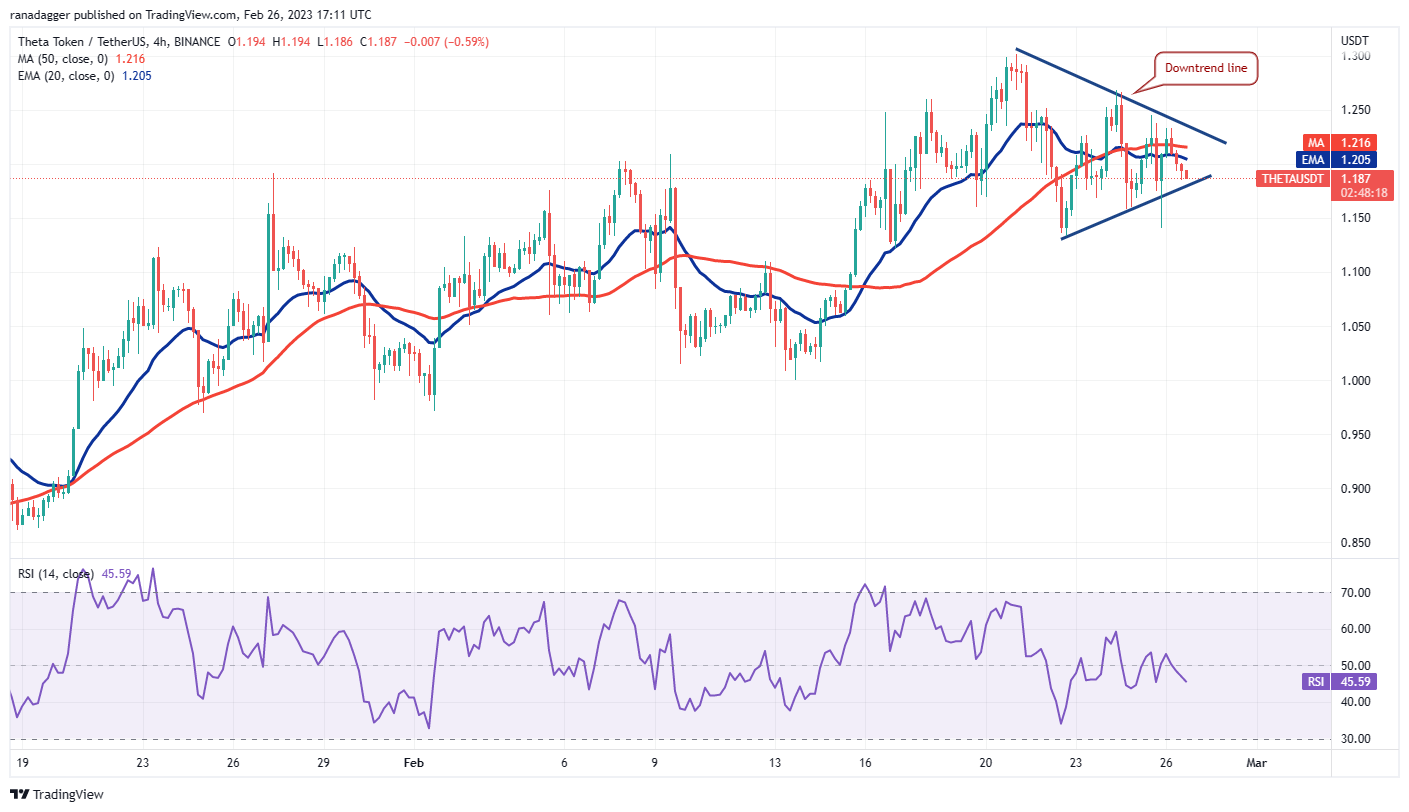
The four-hour chart shows the formation of a symmetrical triangle pattern. Both moving averages have flattened out and the RSI is oscillating near the center, indicating a balance between supply and demand.

A break below the triangle could tilt the short-term advantage in favor of the bears. The pair could first fall to $1.12 and then to $1.

If bulls want to prevent the decline, they will have to quickly propel the price above the triangle. That could start a journey to $1.27 and later to $1.30.

KLAY/USDT

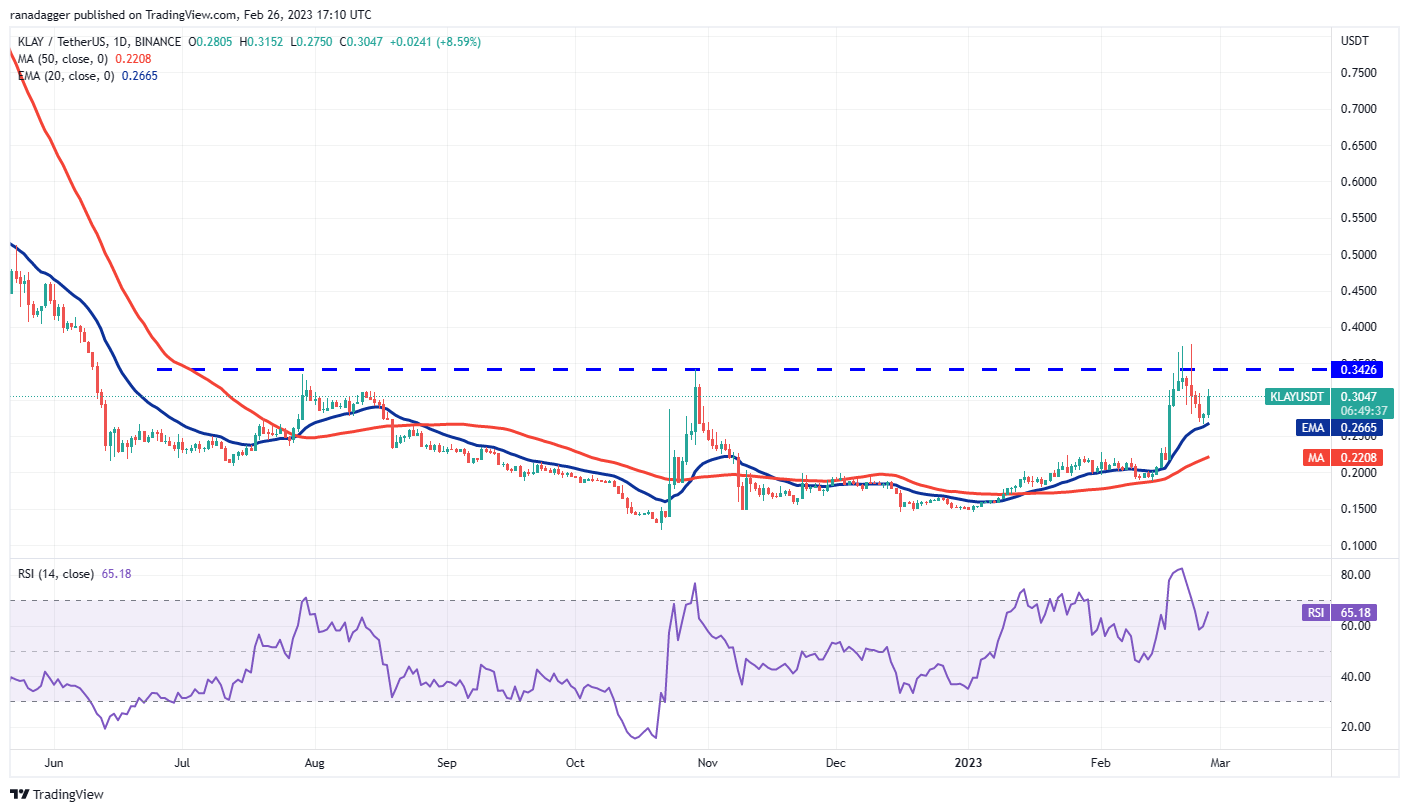
Klaytn (KLAY) is attempting to break out from a basing pattern. The price rebounded off the 20-day EMA ($0.26) on Feb. 25, indicating solid buying on dips.
KLAY/USDT daily chart. Source: TradingView

The bulls will try to pierce the overhead resistance at $0.34. If they do that, the KLAY/USDT pair could pick up momentum and soar to the psychological resistance at $0.50. Such a move will signal a potential trend change.

If the price turns down from $0.34, it will indicate that bears are fiercely protecting the level. That could again pull the price down to the 20-day EMA. A break below this level could indicate that the pair may spend some more time in the basing pattern.
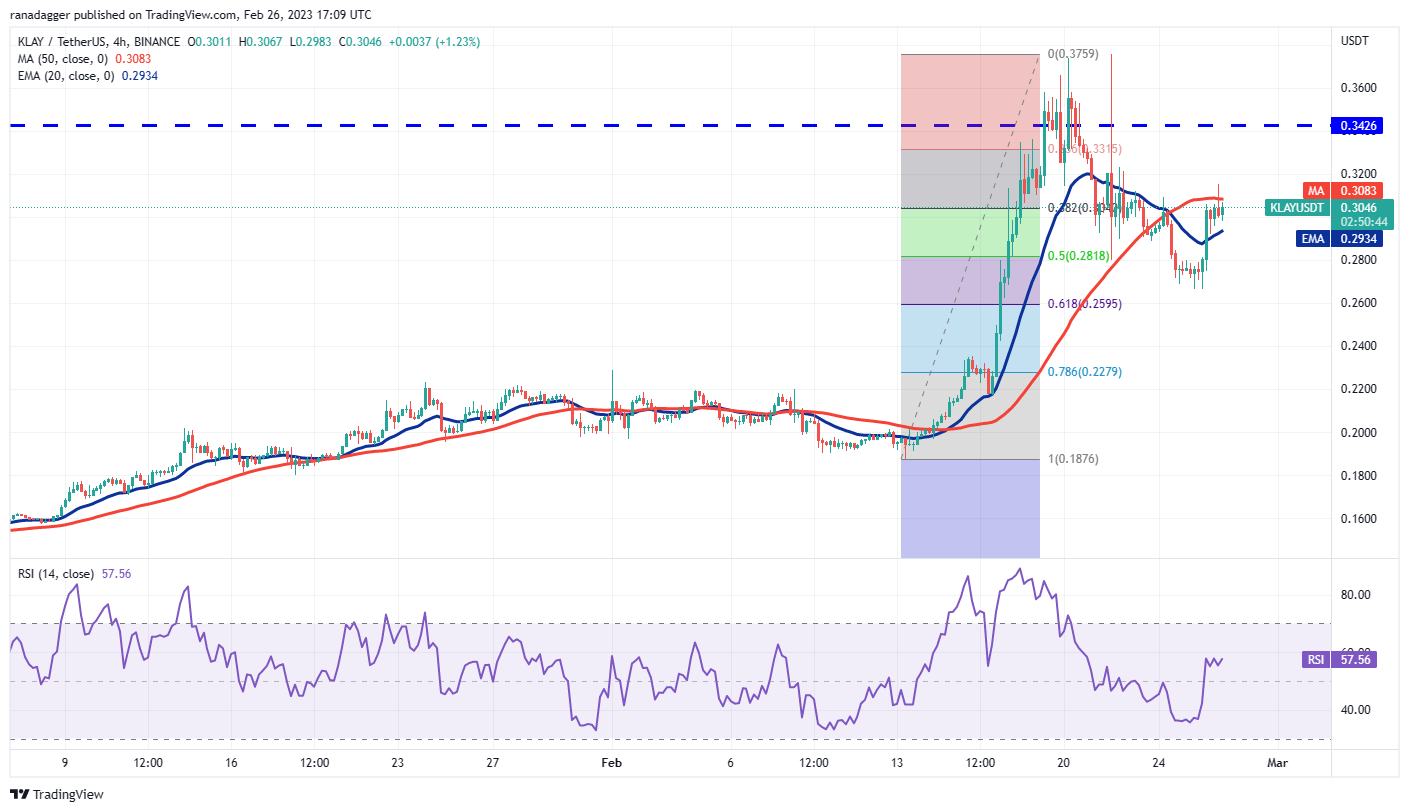
KLAY/USDT 4-hour chart. Source: TradingView

The bulls arrested the pullback near the 61.8% Fibonacci retracement of $0.26 and started a recovery. There is a minor resistance at $0.32 but if this level is crossed, the pair could attempt a rally to $0.34 and thereafter to $0.37.

On the other hand, if the price turns down from the overhead resistance, it will suggest that bears are selling on rallies. That may enhance the prospects of a break below $0.26. If that happens, the pair may slide to $0.22.


Trending Cryptos

Related Reads

Grayscale: Zcash, Financial Privacy in the Age of AI

Grayscale Research suggests a third wave of public focus on financial privacy is approaching, driven by stablecoin/blockchain adoption and new AI-powered surveillance tools. In this context, Zcash emerges as a decentralized digital currency, similar to Bitcoin but with built-in, robust privacy mechanisms via its "shielded" transactions that conceal sender, receiver, and amount using zero-knowledge proofs. While privacy is often seen as a niche feature, it is argued to be a core requirement for functional money, needed by individuals and businesses alike. Zcash's optional privacy is distinct from mixers or default-private chains like Monero. After years of development (Sapling, Orchard/NU5, Ironwood upgrades) to improve usability, key metrics show growing adoption: shielded transactions comprise ~90% of network activity, and ~25% of circulating ZEC is in shielded pools—a historical high. Despite this, ZEC's market valuation remains low (~0.6% of the "digital currency" sector), implying the market prices privacy as a marginal concern. The investment thesis hinges on a potential re-rating if the value of financial privacy is recognized more broadly. Risks include regulatory challenges around shielded transactions, legacy trusted setup pools, quantum computing threats, and execution risks for upcoming upgrades like Tachyon for scaling. In summary, Zcash represents a significant, technologically mature option in the privacy currency space, with current valuation offering potential upside if privacy demand grows.

marsbit26m ago

Grayscale: Zcash, Financial Privacy in the Age of AI

marsbit26m ago

The Bear Market Has Ended, A New Bull Cycle Has Begun

**Title: Bear Market Over, New Bull Cycle Begins** Bitcoin surged over 20% in just three days, from a low of $64,100 on August 19th to a high of $79,500 by August 21st, marking a dramatic shift in market sentiment. This rapid rise triggered massive liquidations exceeding $4 billion, with short positions accounting for $3.7 billion—the largest short squeeze since 2021. The rally was fueled by several key factors. Macroeconomic conditions improved as the US Treasury doubled its long-term bond buyback size, easing pressure. Significant regulatory developments included a White House meeting where former President Trump urged Senate action on the CLARITY Act and hinted at potential US Bitcoin reserves, followed by the CFTC Chairman stating the agency would establish crypto market rules if the bill stalls. On-chain data revealed a fierce battle: large whales faced substantial liquidations on short positions, while others took profits or doubled down on longs. Major altcoins like ETH and XRP also saw impressive gains. Analysts are divided but increasingly bullish. Many, including CryptoQuant's founder, declare the bear market over and a new bull cycle begun. Price targets range from $100k by year-end to ambitious long-term projections of $200k. However, some caution against immediate chasing, noting overbought conditions and viewing the move as a potential "trap" ahead of the crucial September 15th Senate vote on the CLARITY Act. The market's next test is sustaining the momentum with real buying pressure, holding above key resistance near $78k-$80k, and watching ETF inflows and the upcoming regulatory vote.

marsbit31m ago

The Bear Market Has Ended, A New Bull Cycle Has Begun

marsbit31m ago

Xiaomi Defended Its Smartphone Gross Margin, Yet to Find a Profit Successor

Xiaomi's Q2 2026 financial report reveals a company navigating a complex transition. While smartphone gross margin held steady at 8.5% through strategic product mix and a record-high average selling price (ASP), this came at the cost of a 26.5% year-over-year decline in global shipments, pressuring its core user acquisition engine. This illustrates Xiaomi's central challenge: managing the "timing gap" between its established and emerging growth engines. Its smartphone business is pivoting from scale to premiumization, but it's unclear if high-end models can fully offset the volume loss from more price-sensitive segments, especially in markets like India and Africa. Meanwhile, the electric vehicle segment has become a significant revenue contributor, delivering 104,200 units and generating ¥23.9 billion. However, its profit contribution remains unclear as it, along with AI investments, is still in a scaling and investment phase. The AI and humanoid robot initiatives, though strategically prioritized and tested in Xiaomi's own factories, are in early-stage validation with no near-term commercialization timeline. Financially, the company remains stable, supported by a robust cash position and its high-margin internet services business, which hit a new high in monthly active users. Management emphasized continued heavy investment in AI, chips, and robotics to fuel the next growth cycle. The key question is whether these new engines—cars, AI, robotics—can achieve commercial scale and profitability before the smartphone engine's growth slows further.

marsbit31m ago

Xiaomi Defended Its Smartphone Gross Margin, Yet to Find a Profit Successor

marsbit31m ago

Is RWA Still Meaningful Without DeFi?

The article "Would RWA Still Matter Without DeFi?" argues that tokenizing real-world assets (RWA) alone, like putting a barcode on a container, is not transformative. True value emerges when these tokenized assets are integrated into decentralized finance (DeFi) ecosystems, enabling valuation, financing, hedging, trading, and loss management in a programmable, automated manner. Tokenization provides digital representation, but DeFi provides utility through leverage, liquidity, and composability. The core challenge lies in aligning the different "time clocks" of blockchain (fast, 24/7), traditional markets (limited hours), and asset redemption (slow processes), which creates liquidation risks and gaps. Effective RWA integration requires more than a token; it needs a full stack: legally enforceable rights, reliable data oracles, clear transfer rules, executable secondary liquidity, appropriate collateral parameters, and credible loss resolution paths. Liquidity is defined not by total value locked (TVL) but by the ability to exit a position under stress within a required timeframe. Risk management for RWAs must be modeled as a dependency graph, monitoring interconnected nodes like issuers, custodians, oracles, and liquidity pools for early warning signs beyond just price data. While tokenized government bonds serve as an initial "ping test," the future lies in more complex assets like computing power and energy, which require bespoke risk models. Tokenized stocks paired with perpetual futures present a major test, combining global equity ownership with crypto-native leverage, necessitating robust architectural safeguards like isolation and dynamic collateral rules. The conclusion is that without DeFi, RWA tokenization offers limited value—improving distribution and transparency. The significant opportunity arises when tokenized assets become functional components within open, programmable capital markets, where they can be used as collateral and facilitate complex financial strategies. The token is merely the barcode; the market operating system is the real machine.

marsbit52m ago

Is RWA Still Meaningful Without DeFi?

marsbit52m ago

Trading

Spot

Hot Articles

What is $BITCOIN

DIGITAL GOLD ($BITCOIN): A Comprehensive Analysis Introduction to DIGITAL GOLD ($BITCOIN) DIGITAL GOLD ($BITCOIN) is a blockchain-based project operating on the Solana network, which aims to combine the characteristics of traditional precious metals with the innovation of decentralized technologies. While it shares a name with Bitcoin, often referred to as “digital gold” due to its perception as a store of value, DIGITAL GOLD is a separate token designed to create a unique ecosystem within the Web3 landscape. Its goal is to position itself as a viable alternative digital asset, although specifics regarding its applications and functionalities are still developing. What is DIGITAL GOLD ($BITCOIN)? DIGITAL GOLD ($BITCOIN) is a cryptocurrency token explicitly designed for use on the Solana blockchain. In contrast to Bitcoin, which provides a widely recognized value storage role, this token appears to focus on broader applications and characteristics. Notable aspects include: Blockchain Infrastructure: The token is built on the Solana blockchain, known for its capacity to handle high-speed and low-cost transactions. Supply Dynamics: DIGITAL GOLD has a maximum supply capped at 100 quadrillion tokens (100P $BITCOIN), although details regarding its circulating supply are currently undisclosed. Utility: While precise functionalities are not explicitly outlined, there are indications that the token could be utilized for various applications, potentially involving decentralized applications (dApps) or asset tokenization strategies. Who is the Creator of DIGITAL GOLD ($BITCOIN)? At present, the identity of the creators and development team behind DIGITAL GOLD ($BITCOIN) remains unknown. This situation is typical among many innovative projects within the blockchain space, particularly those aligning with decentralized finance and meme coin phenomena. While such anonymity may foster a community-driven culture, it intensifies concerns about governance and accountability. Who are the Investors of DIGITAL GOLD ($BITCOIN)? The available information indicates that DIGITAL GOLD ($BITCOIN) does not have any known institutional backers or prominent venture capital investments. The project seems to operate on a peer-to-peer model focused on community support and adoption rather than traditional funding routes. Its activity and liquidity are primarily situated on decentralized exchanges (DEXs), such as PumpSwap, rather than established centralized trading platforms, further highlighting its grassroots approach. How DIGITAL GOLD ($BITCOIN) Works The operational mechanics of DIGITAL GOLD ($BITCOIN) can be elaborated on based on its blockchain design and network attributes: Consensus Mechanism: By leveraging Solana’s unique proof-of-history (PoH) combined with a proof-of-stake (PoS) model, the project ensures efficient transaction validation contributing to the network's high performance. Tokenomics: While specific deflationary mechanisms have not been extensively detailed, the vast maximum token supply implies that it may cater to microtransactions or niche use cases that are still to be defined. Interoperability: There exists the potential for integration with Solana’s broader ecosystem, including various decentralized finance (DeFi) platforms. However, the details regarding specific integrations remain unspecified. Timeline of Key Events Here is a timeline that highlights significant milestones concerning DIGITAL GOLD ($BITCOIN): 2023: The initial deployment of the token occurs on the Solana blockchain, marked by its contract address. 2024: DIGITAL GOLD gains visibility as it becomes available for trading on decentralized exchanges like PumpSwap, allowing users to trade it against SOL. 2025: The project witnesses sporadic trading activity and potential interest in community-led engagements, although no noteworthy partnerships or technical advancements have been documented as of yet. Critical Analysis Strengths Scalability: The underlying Solana infrastructure supports high transaction volumes, which could enhance the utility of $BITCOIN in various transaction scenarios. Accessibility: The potential low trading price per token could attract retail investors, facilitating wider participation due to fractional ownership opportunities. Risks Lack of Transparency: The absence of publicly known backers, developers, or an audit process may yield skepticism regarding the project's sustainability and trustworthiness. Market Volatility: The trading activity is heavily reliant on speculative behavior, which can result in significant price volatility and uncertainty for investors. Conclusion DIGITAL GOLD ($BITCOIN) emerges as an intriguing yet ambiguous project within the rapidly evolving Solana ecosystem. While it attempts to leverage the “digital gold” narrative, its departure from Bitcoin's established role as a store of value underscores the need for a clearer differentiation of its intended utility and governance structure. Future acceptance and adoption will likely depend on addressing the current opacity and defining its operational and economic strategies more explicitly. Note: This report encompasses synthesised information available as of October 2023, and developments may have transpired beyond the research period.

2.0k Total ViewsPublished 2025.05.13Updated 2025.05.13

What is $BITCOIN

Discussions

Welcome to the HTX Community. Here, you can stay informed about the latest platform developments and gain access to professional market insights. Users' opinions on the price of BTC (BTC) are presented below.

活动图片