MicroStrategy says no plans to stop trading BTC as paper loss hits $1.3B

CointelegraphPublished on 2023-02-03Last updated on 2023-02-03

Abstract

The company also booked a loss of $34 million on its first-ever Bitcoin sale last quarter but said it was conducted to harvest a tax loss.

Software analytics company MicroStrategy recorded a paper loss of over a billion dollars on its Bitcoin holdings in 2022 but says it has no plans to stop trading the digital asset.

MicroStrategy released its 2022 Q4 and year-end earnings on Feb. 2 showing the recorded impairment charges on its BTC holdings, net of gains on sale, was nearly $1.3 billion over the full year 2022.

Despite the paper losses, on a Feb. 2 earnings call MicroStrategy’s chief financial officer, Andrew Kang, said:

“We may consider pursuing additional transactions that may take advantage of the volatility in Bitcoin prices, or other market dislocations that are consistent with our long-term Bitcoin strategy.”

On the call, MicroStrategy co-founder Michael Saylor said the company measures its stock performance against “a number of different benchmarks” saying “the most important benchmark is Bitcoin’s performance.”

Saylor added since MicroStrategy first announced it was buying Bitcoin in Aug. 2020 its “been able to outperform Bitcoin as an index” over that time.

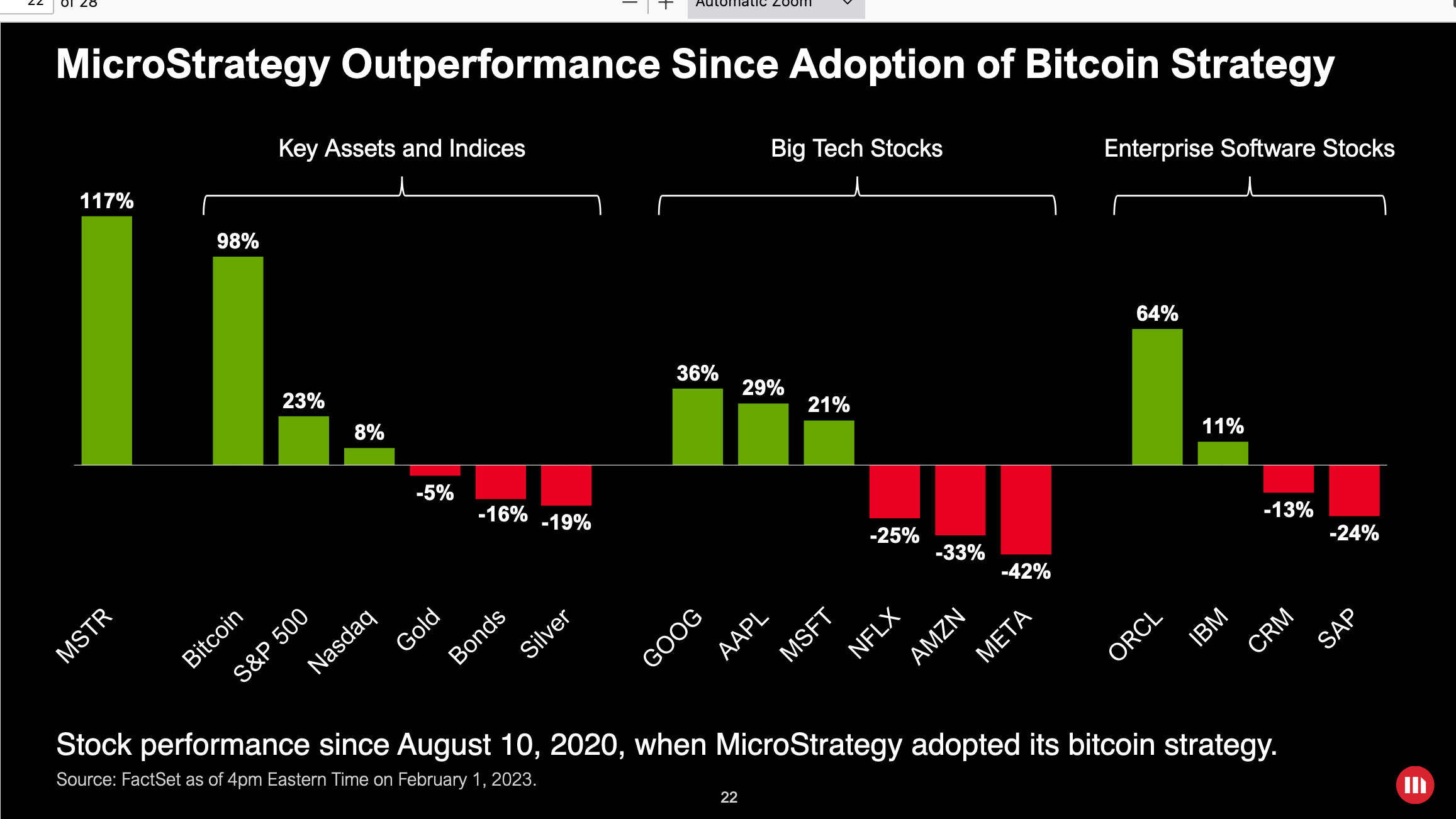
In its Q4 earnings presentation, the company shared its own analysis of its stock price performance compared to Bitcoin, indices and its competitors.

He said the company’s stock is up 117% since Aug. 2020 compared to Bitcoin’s gain of 98%, and added:

“The only real safe haven for an institutional investor is Bitcoin. Bitcoin is the only universally acknowledged digital commodity, and so if you're an investor, Bitcoin is your safe haven in this regard.”

Kang stated MicroStrategy held a total of 132,500 BTC worth $1.84 billion as of Dec. 31, 2022. 14,890 BTC were held directly by the business with the remaining held in its subsidiary MacroStrategy LLC.

Late last year the company sold a portion of its Bitcoin holdings for the first time. Discussing the sale, Kang said the 704 BTC were sold to harvest a tax loss of around $34 million.

He added even with the sale, the company “increased our net holdings by 2500 Bitcoin during the quarter.”

MicroStrategy's overall revenue for the fourth quarter was $132.6 billion, reportedly beating Wall Street expectations. Its Q4 loss per share came in at $21.93.

At the time of writing, MicroStrategy’s stock price had fallen over 4% in after-hours trading according to Yahoo Finance data.


Trending Cryptos

Related Reads

The Full Story of How Crypto Unicorn Blockstream Is Mired in Serious Fraud Allegations

This article details serious allegations of fraud against Bitcoin infrastructure company Blockstream, founded by Bitcoin pioneer Adam Back. In June 2024, investigative account NatInfoSec published a report accusing Blockstream's mining note (BMN) program of potentially operating a multi-billion dollar scheme with Ponzi-like characteristics. The core allegations focus on Blockstream Mining Notes (BMNs), which offer investors fixed annual yields up to approximately 20% from Bitcoin mining. NatInfoSec's investigation raises several key issues: 1. **Suspicious Hashrate & Payout Capacity**: The analysis suggests Blockstream would need 20-45 EH/s of mining power to cover its BMN obligations, but its public dashboard shows only around 15 EH/s. Furthermore, no verifiable public evidence (e.g., grid connection records, import data) was found to support the massive mining operation required. 2. **Questionable Payout Source**: The BMN contract allows Blockstream to use Bitcoin from *any source* (Substitute Performance BTC) to fulfill investor payouts, raising concerns that payouts may not come from actual mining revenue. 3. **High-Risk, Fixed Returns**: Offering ~20% fixed yields in the volatile, cyclical Bitcoin mining industry is viewed as highly unusual and requires clear explanation. 4. **Undisclosed Criminal Record of Key Figure**: Christopher William Cook, a key figure in Blockstream's mining operations and CEO of spin-off Exacore, was found to have a federal felony conviction for mail fraud in 2008, a fact not disclosed in BMN offering documents. His background was also allegedly embellished. 5. **Potential Contagion to BSTR SPAC**: Questions were raised about whether these liabilities and Cook's record should have been disclosed in the SEC filings for Bitcoin Standard Treasury Company (BSTR), a separate Adam Back-associated firm planning a SPAC merger. The crypto community is divided. BitMEX Research validated Cook's criminal record and expressed concern over the high yields but found other evidence lacking or misleading, noting the legal separation between BMN, Blockstream, and BSTR. Blockstream defenders, like Samson Mow, argue the mining is real. Critics, however, emphasize the lack of independent, verifiable proof of the mining operation's scale and the true source of investor payouts. The article concludes that BMN remains shrouded in key unanswered questions regarding its actual size, the verifiability of its underlying mining assets and payouts, the source of its high yields, and the full role and disclosure concerning Chris Cook. Blockstream had not issued a comprehensive response at the time of writing.

marsbit4h ago

The Full Story of How Crypto Unicorn Blockstream Is Mired in Serious Fraud Allegations

marsbit4h ago

Trading

Spot
Futures

Hot Articles

What is $BITCOIN

DIGITAL GOLD ($BITCOIN): A Comprehensive Analysis Introduction to DIGITAL GOLD ($BITCOIN) DIGITAL GOLD ($BITCOIN) is a blockchain-based project operating on the Solana network, which aims to combine the characteristics of traditional precious metals with the innovation of decentralized technologies. While it shares a name with Bitcoin, often referred to as “digital gold” due to its perception as a store of value, DIGITAL GOLD is a separate token designed to create a unique ecosystem within the Web3 landscape. Its goal is to position itself as a viable alternative digital asset, although specifics regarding its applications and functionalities are still developing. What is DIGITAL GOLD ($BITCOIN)? DIGITAL GOLD ($BITCOIN) is a cryptocurrency token explicitly designed for use on the Solana blockchain. In contrast to Bitcoin, which provides a widely recognized value storage role, this token appears to focus on broader applications and characteristics. Notable aspects include: Blockchain Infrastructure: The token is built on the Solana blockchain, known for its capacity to handle high-speed and low-cost transactions. Supply Dynamics: DIGITAL GOLD has a maximum supply capped at 100 quadrillion tokens (100P $BITCOIN), although details regarding its circulating supply are currently undisclosed. Utility: While precise functionalities are not explicitly outlined, there are indications that the token could be utilized for various applications, potentially involving decentralized applications (dApps) or asset tokenization strategies. Who is the Creator of DIGITAL GOLD ($BITCOIN)? At present, the identity of the creators and development team behind DIGITAL GOLD ($BITCOIN) remains unknown. This situation is typical among many innovative projects within the blockchain space, particularly those aligning with decentralized finance and meme coin phenomena. While such anonymity may foster a community-driven culture, it intensifies concerns about governance and accountability. Who are the Investors of DIGITAL GOLD ($BITCOIN)? The available information indicates that DIGITAL GOLD ($BITCOIN) does not have any known institutional backers or prominent venture capital investments. The project seems to operate on a peer-to-peer model focused on community support and adoption rather than traditional funding routes. Its activity and liquidity are primarily situated on decentralized exchanges (DEXs), such as PumpSwap, rather than established centralized trading platforms, further highlighting its grassroots approach. How DIGITAL GOLD ($BITCOIN) Works The operational mechanics of DIGITAL GOLD ($BITCOIN) can be elaborated on based on its blockchain design and network attributes: Consensus Mechanism: By leveraging Solana’s unique proof-of-history (PoH) combined with a proof-of-stake (PoS) model, the project ensures efficient transaction validation contributing to the network's high performance. Tokenomics: While specific deflationary mechanisms have not been extensively detailed, the vast maximum token supply implies that it may cater to microtransactions or niche use cases that are still to be defined. Interoperability: There exists the potential for integration with Solana’s broader ecosystem, including various decentralized finance (DeFi) platforms. However, the details regarding specific integrations remain unspecified. Timeline of Key Events Here is a timeline that highlights significant milestones concerning DIGITAL GOLD ($BITCOIN): 2023: The initial deployment of the token occurs on the Solana blockchain, marked by its contract address. 2024: DIGITAL GOLD gains visibility as it becomes available for trading on decentralized exchanges like PumpSwap, allowing users to trade it against SOL. 2025: The project witnesses sporadic trading activity and potential interest in community-led engagements, although no noteworthy partnerships or technical advancements have been documented as of yet. Critical Analysis Strengths Scalability: The underlying Solana infrastructure supports high transaction volumes, which could enhance the utility of $BITCOIN in various transaction scenarios. Accessibility: The potential low trading price per token could attract retail investors, facilitating wider participation due to fractional ownership opportunities. Risks Lack of Transparency: The absence of publicly known backers, developers, or an audit process may yield skepticism regarding the project's sustainability and trustworthiness. Market Volatility: The trading activity is heavily reliant on speculative behavior, which can result in significant price volatility and uncertainty for investors. Conclusion DIGITAL GOLD ($BITCOIN) emerges as an intriguing yet ambiguous project within the rapidly evolving Solana ecosystem. While it attempts to leverage the “digital gold” narrative, its departure from Bitcoin's established role as a store of value underscores the need for a clearer differentiation of its intended utility and governance structure. Future acceptance and adoption will likely depend on addressing the current opacity and defining its operational and economic strategies more explicitly. Note: This report encompasses synthesised information available as of October 2023, and developments may have transpired beyond the research period.

441 Total ViewsPublished 2025.05.13Updated 2025.05.13

What is $BITCOIN

Discussions

Welcome to the HTX Community. Here, you can stay informed about the latest platform developments and gain access to professional market insights. Users' opinions on the price of BTC (BTC) are presented below.

活动图片