Bitcoin, XRP left out – The S&P Digital Asset Index shows crypto’s biggest shift yet

ambcryptoPublished on 2026-07-22Last updated on 2026-07-22

Abstract

Pantera Capital and S&P Dow Jones Indices have launched the S&P Digital Asset Index, a basket of 18 cryptocurrencies focused on fundamental strength. Notably, Bitcoin and XRP are excluded from the initial confirmed assets, which include Ethereum, BNB, Solana, Hyperliquid, and Tron. This selection highlights a potential market shift, prioritizing Layer-1 networks with proven scalability, utility, and sustainable on-chain revenue—reportedly $3 billion annualized in the past six months—over mere market capitalization. Analysts suggest this "fundamental index for crypto" could guide institutional capital toward assets with real economic activity, possibly leading to a significant divergence in the next market cycle where fundamentals, not just price momentum, drive investment.

The market could be on the verge of its biggest divergence this cycle.

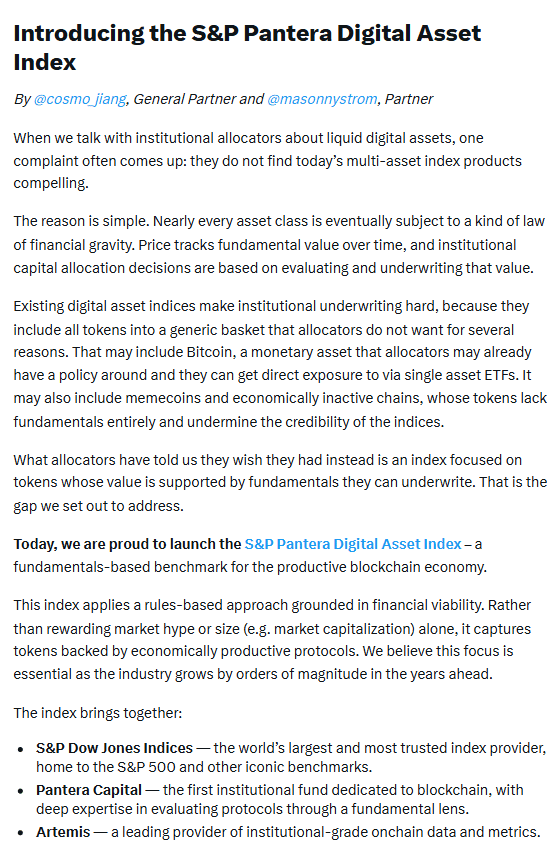
Pantera Capital, in partnership with S&P Dow Jones Indices, has launched the first-ever S&P Digital Asset Index, featuring a basket of 18 cryptocurrencies.

Naturally, the announcement sparked a market frenzy. It spread like wildfire across social media, and the timing couldn’t have been better. Bitcoin had just broken above $66,000, flipping the market back into risk-on mode.

Against this backdrop, Pantera’s announcement added another layer to the bullish narrative.
Source: X

However, the real discussion wasn’t about what made the S&P Digital Asset Index. It was about what didn’t.

For context, the index will hold 18 cryptocurrencies, but only the first five have been confirmed so far: Ethereum, BNB, Solana, Hyperliquid, and Tron. That’s where the market frenzy began.

Despite being the two biggest names in crypto, Bitcoin and XRP were left out. That immediately caught the market’s attention, sparking a broader debate over what the index is actually trying to capture.

According to AMBCrypto, this is exactly what could be setting up one of the biggest divergences in crypto’s next cycle. Until now, digital assets have largely traded as one high-beta risk trade, with Bitcoin leading the narrative.

But the exclusion of Bitcoin and XRP suggests the market may be underestimating a much bigger shift. If this is the direction institutional products are heading, the next cycle could look very different.

S&P Digital Asset Index puts fundamentals first

After years of scaling and network upgrades, it looks like those efforts are finally paying off.

Notably, all the confirmed assets in the S&P Digital Asset Index share one key trait – They are fundamentally strong networks.

Over the years, these Layer-1 ecosystems have scaled, upgraded, and hard-forked to improve throughput, utility, and on-chain activity, moving beyond the “speculative asset” narrative.

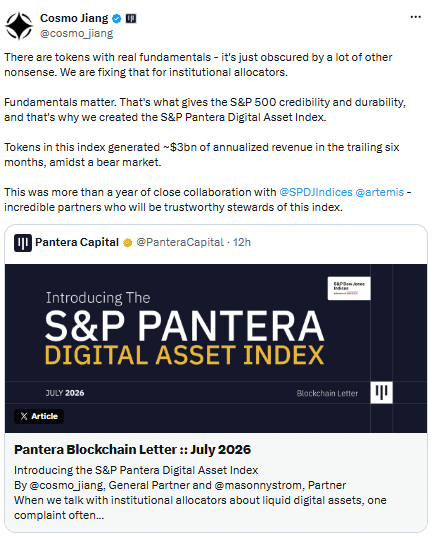
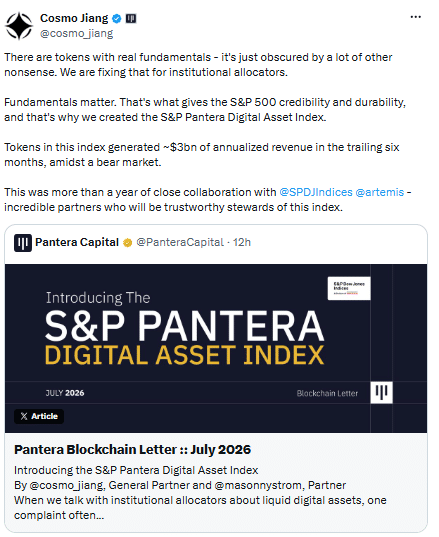
That shift is already showing up in the data. One analyst noted on X that the tokens included in the index generated $3 billion in annualized revenue over the past six months despite a bear market.

In other words, the index appears to reward networks generating real economic activity, not just the largest market caps.
Source: X

With most of the market focused on BTC and XRP, this may be the bigger takeaway that’s being overlooked.

Interestingly, Jon Ma, who worked with Pantera Capital and S&P Dow Jones Indices to build the S&P Digital Asset Index, called it the “fundamental index for crypto.”

His thesis is simple: The next $10 trillion entering crypto is more likely to flow toward networks with strong fundamentals, sustainable revenue, and real-world utility than toward assets driven by market cap alone.

In this context, the S&P Digital Asset Index launch could mark a major turning point for the broader crypto market.

As institutional capital gains exposure through these benchmarks, the gap between price-driven momentum and fundamental strength could become one of the biggest themes shaping future crypto cycles.


Final Summary

  • The S&P Digital Asset Index favors strong crypto projects: It focuses on networks with real growth, usage, and value.
  • Crypto’s next cycle could change as institutions may start choosing assets based on fundamentals, not just market trends.

Trending Cryptos

Related Questions

QWhat is the main focus of the newly launched S&P Digital Asset Index, and which two major cryptocurrencies were excluded from it?

AThe main focus of the S&P Digital Asset Index is on fundamentally strong cryptocurrency networks that demonstrate real economic activity, utility, and revenue. The two major cryptocurrencies excluded from the index are Bitcoin and XRP.

QAccording to the article, what key trait do all the confirmed assets in the S&P Digital Asset Index share?

AAll the confirmed assets in the S&P Digital Asset Index share the key trait of being fundamentally strong networks. They have scaled, upgraded, and improved throughput and on-chain activity, moving beyond being purely speculative assets.

QWhat potential shift in the crypto market does the article suggest the launch of this index might signal?

AThe article suggests the launch of this index might signal a major shift where institutional capital starts to prioritize and flow towards crypto networks with strong fundamentals, sustainable revenue, and real-world utility, rather than just following market cap or price-driven momentum. This could lead to a significant divergence in the next market cycle.

QWhat does the data mentioned in the article show about the tokens included in the index during the past six months?

AData mentioned in the article shows that the tokens included in the index generated $3 billion in annualized revenue over the past six months, despite being in a bear market. This highlights their ability to generate real economic activity.

QHow does Jon Ma describe the S&P Digital Asset Index, and what is his thesis for its importance?

AJon Ma describes the S&P Digital Asset Index as the 'fundamental index for crypto.' His thesis is that the next $10 trillion entering the crypto market is more likely to flow towards networks with strong fundamentals, sustainable revenue, and real utility, rather than assets driven primarily by market cap.

Related Reads

The Verdict in Choi Tae-won's Divorce Case: Revealing the Inheritance Undercurrent Behind SK Hynix's Trillion-Won Empire

SK Group Chairman Chey Tae-won's high-profile divorce case, involving a record 1.38 trillion won settlement, has drawn attention to the succession plans for Korea's second-largest conglomerate, especially its crown jewel, SK hynix. Unlike traditional chaebol scripts centered on the eldest son, Chey's three children from his marriage to former President Roh Tae-woo's daughter, Roh Soh-yeong, are carving distinct, non-traditional paths. Eldest daughter Chey Yun-jung (b. 1989) is seen as the most evident successor. With a scientific and consulting background, she holds executive roles at SK bioscience and SK Inc.'s growth support department, focusing on future strategy and biopharma. Her marriage is to an AI infrastructure entrepreneur, not a traditional business alliance. Second daughter Chey Min-jung (b. 1991) took a unique route, voluntarily serving as a South Korean naval officer, including an anti-piracy deployment. She later worked on policy and strategy for SK hynix in Washington D.C. before co-founding an AI-driven healthcare startup. She married a former U.S. Marine Corps officer, connecting her to U.S. defense and policy circles—networks crucial for a global semiconductor giant. The only son, Chey In-geun (b. 1995), who studied physics like his father, worked briefly at SK E&S before joining McKinsey. Despite fitting the traditional "heir" profile as the eldest son, he remains silent and holds no public position or shares in SK, suggesting the old succession playbook is obsolete. As SK hynix's valuation soars, becoming a geopolitical asset in the AI era, the heirs' legitimacy is no longer automatic. They must prove themselves in fields like AI biotech, global policy, and strategic consulting. Their marriages also reflect new elite networks in tech and defense, not old political alliances. Their inheritance is the complex challenge of navigating a globalized, tech-driven world, not just a corporate throne.

marsbitYesterday 09:06

The Verdict in Choi Tae-won's Divorce Case: Revealing the Inheritance Undercurrent Behind SK Hynix's Trillion-Won Empire

marsbitYesterday 09:06

From OpenSea to OpenRouter: Is Alex Atallah Repeating His 'Exit at the Peak' Playbook?

From OpenSea to OpenRouter: Is Alex Atallah Repeating His "Exit at the Peak" Playbook? According to the Wall Street Journal, payments giant Stripe is in talks to acquire the AI model aggregation platform OpenRouter in a potential deal valuing the company near $100 billion. This would mark founder Alex Atallah's second creation of a company reaching a $100 billion valuation, following his co-founding of NFT marketplace OpenSea. OpenRouter, founded just over three years ago, has grown rapidly by acting as a unified gateway for developers to access over 400 AI models. It currently has about 10 million users and processes over 200 trillion tokens monthly. While the platform's annualized revenue is around $50 million, its valuation has skyrocketed from $1.3 billion in March 2026. The potential acquisition by Stripe, a company OpenRouter's founder once likened it to, represents a major expansion into AI infrastructure for the payments leader. This move echoes Atallah's previous timing with OpenSea, where he departed before the NFT market's significant downturn. For OpenRouter, selling now may be strategic. Despite its scale, its business model—charging a 5-5.5% fee on AI inference calls—faces pressure from competition, open-source models, and potential price wars among model providers, limiting its profitability narrative for an IPO. A key asset for potential acquirers like Stripe is OpenRouter's vast repository of real-world AI usage data, which offers unique insights into model performance and developer preferences that are difficult to replicate. Whether this potential deal signifies a new valuation benchmark for AI infrastructure or another market peak signal remains to be seen.

链捕手Yesterday 08:42

From OpenSea to OpenRouter: Is Alex Atallah Repeating His 'Exit at the Peak' Playbook?

链捕手Yesterday 08:42

Trading

Spot

Hot Articles

Discussions

Welcome to the HTX Community. Here, you can stay informed about the latest platform developments and gain access to professional market insights. Users' opinions on the price of S (S) are presented below.

活动图片