From ANSEM to CZ, The Celebrity Coin Relay Race Between Solana and BSC

marsbitPublished on 2026-07-06Last updated on 2026-07-06

Abstract

The past week was a whirlwind of on-chain activity, sparked by the meteoric rise of $ANSEM, a Solana-based meme coin that surged 600x and hit a $100 million market cap in a single day. This rally began when crypto influencer Ansem announced his return to buying Solana meme coins and publicly advocated for an airdrop from the platform pump.fun. Ansem’s subsequent "soft claim" of the token—promising to airdrop creator revenue to followers—ignited a frenzy, drawing comparisons to past community-led token distributions. However, his dual role as a co-founder of the trading terminal Bullpen, which later hosted the $ANSEM airdrop, suggests a strategic promotional element. The narrative quickly shifted to "celebrity coins," where tokens named after influencers are sent to their public addresses in hopes of endorsement. While a similar coin, $TJR, briefly gained traction, it faltered after the influencer TJR urged focus back on $ANSEM. Attention then turned to projects Ansem endorsed and coins found in his wallet, like $manlet, but momentum on Solana began to stall. The action then migrated to BSC with the viral resurgence of a 2021 tweet from former Binance CEO CZ, referencing a "final form" bull. This sparked the explosive launch of $CZ, which briefly approached a $90 million market cap despite expectations that CZ wouldn't actively engage like Ansem. Another BSC token, $TCC, gained attention due to CZ's interactions with its promoter. The BSC ecosystem saw faster-paced, albeit ...

The past week was likely the busiest on-chain week ever. And it all started with $ANSEM, which astonishingly surged to a $100 million market cap in just 24 hours, achieving a staggering 600x increase in a single day.

The Return of Ansem, The On-Chain Kickoff

On June 9th, crypto KOL Ansem claimed it was his first time returning to buy Solana meme coins in over a year. Recently, he repeatedly mentioned the pump.fun airdrop, frequently interacting with pump.fun's tweets suggesting they issue an airdrop now, and publicly stated this on the Market Bubble podcast:
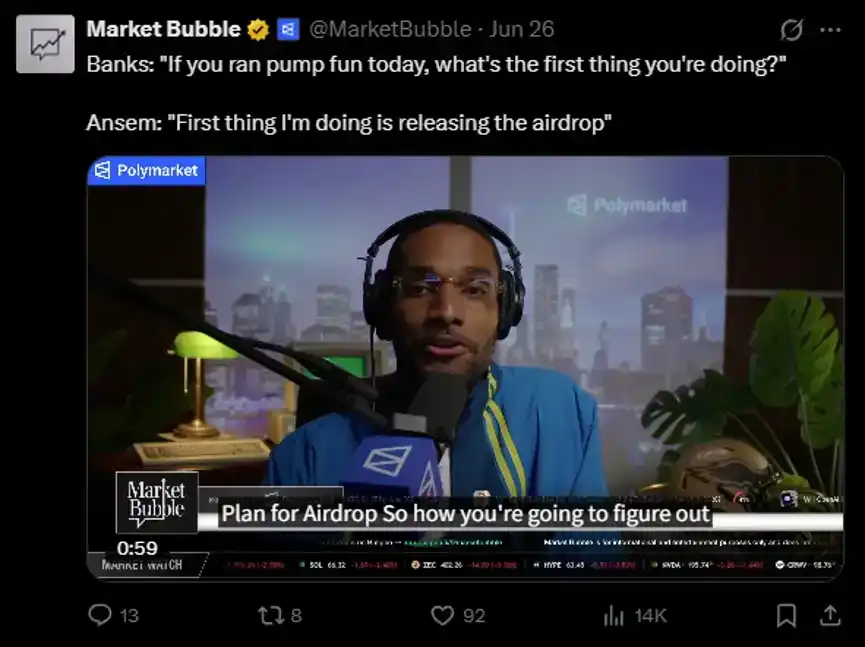
If you were running pump.fun today, what's the first thing you'd do? Ansem: An airdrop.

Since June 21st, he has continuously mentioned the concept of "RTM (Return to meme, let meme coins return)".

However, at that time, no one anticipated the start of this trend, nor did they imagine it would be initiated in the form of a "celebrity coin" like $ANSEM. Initially, Ansem's high popularity was largely because he played the role of a "meme justice warrior," leading the charge by suggesting to pump.fun, during a prolonged slump in the meme market, that an airdrop could re-activate market liquidity.

It wasn't until Ansem stated on X that he would randomly select lucky followers each week from those who retweeted his posts, followed him on pump.fun, and left their pump.fun profile links in the comments, and airdrop out this portion of creator revenue. This "soft endorsement" ignited the emotions of on-chain players.
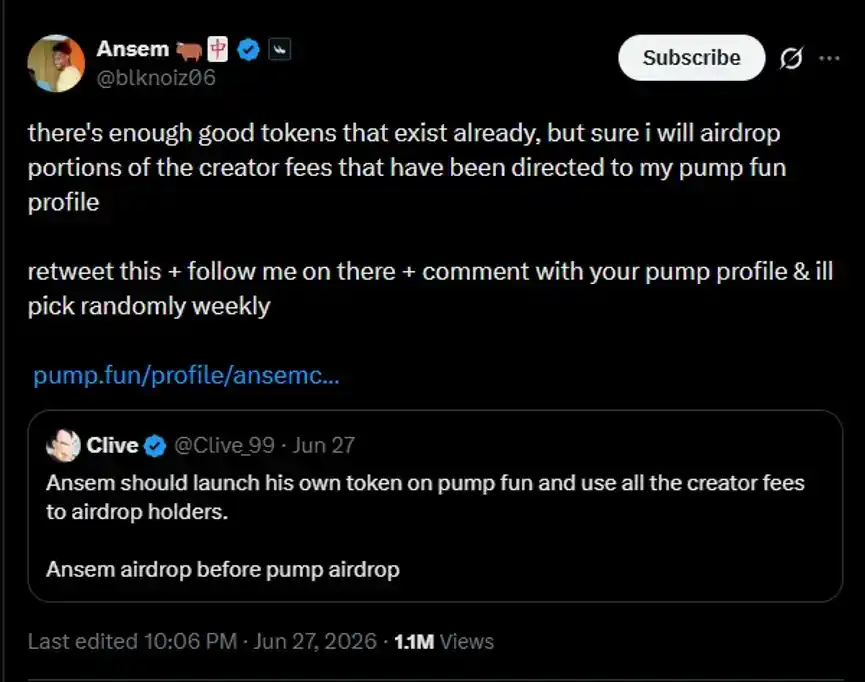
At the time, the feeling among many on-chain players was somewhat reminiscent of when OpenSea delayed its token, leading to the emergence of OpenDAO ($SOS) airdropping tokens to NFT players. Both had KOLs leading the charge, both capitalized on long-standing user dissatisfaction.

However, our estimation was, "It's hard to say if Ansem truly wants to return to the trenches as a pure meme hero. Because Ansem is no longer just a meme coin legend or crypto KOL. One of his identities now is co-founder of the trading terminal Bullpen."

Judging from Ansem later setting up an $ANSEM airdrop claim page on Bullpen, this estimation was correct. When he stepped forward to endorse the token, he likely already planned for it to become the best advertisement for his trading platform.

Rapid Narrative Shifts Within a Week

After $ANSEM broke the $100 million market cap, the narrative quickly shifted from confronting pump.fun and demanding airdrops to "celebrity coins."

Here, "celebrity coin" refers to the play of sending a token, with a ticker named after a crypto KOL and 60% or more of its supply, to the celebrity's public address, waiting for them to post on X to claim it. Soon after $ANSEM surpassed $100 million in market cap, $TJR, once nearing a $30 million market cap, emerged and was seen as the runner-up.

However, TJR ended all possibilities for this runner-up during his livestream that night. He stated that dilution is terrible and urged everyone to refocus their attention on $ANSEM, striving to push its market cap to $1 billion.

This caused $TJR to falter from then on, but it also prevented more severe dilution, redirecting attention and funds back to $ANSEM.

After this incident, the frenzy for launching new "celebrity coins" temporarily cooled, and everyone turned their attention to specific projects Ansem favored. Projects like the US stock stablecoin project Nest, Solana-based game Kintara, saw gains during this phase.

Next, people focused on Ansem's public address. $manlet appeared in a tweet where Ansem showed his wallet. Following this tweet, its market cap rapidly surged from $3 million to over $13 million, and even broke through $25 million that night.
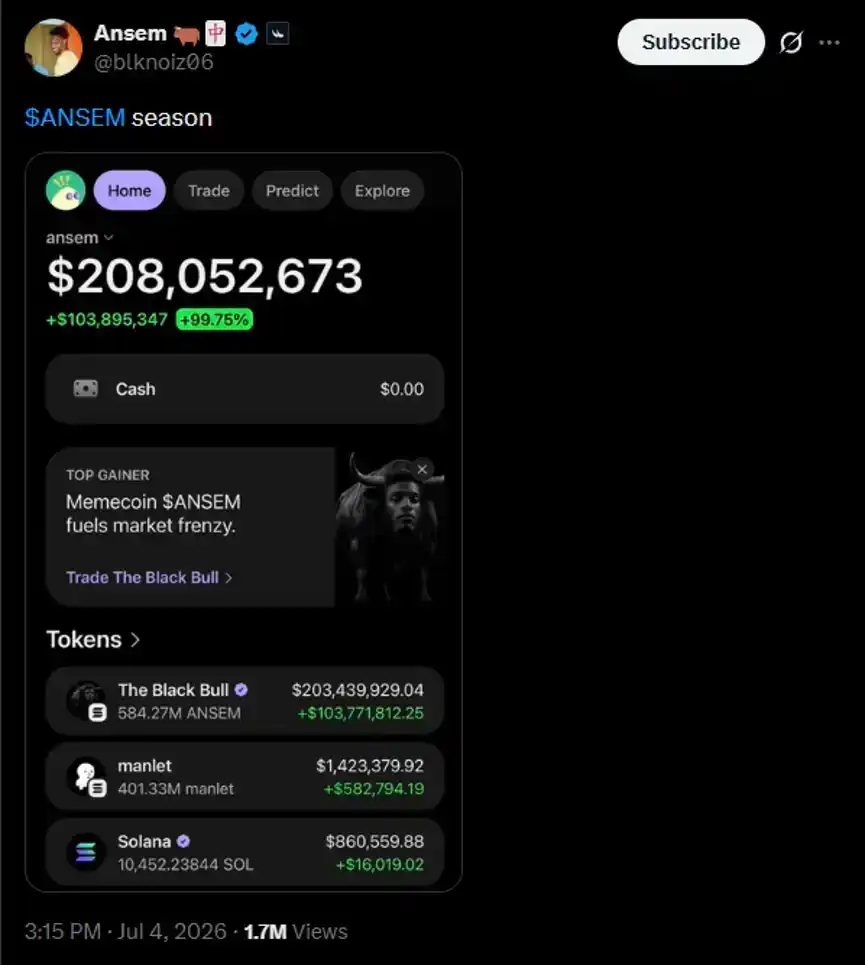
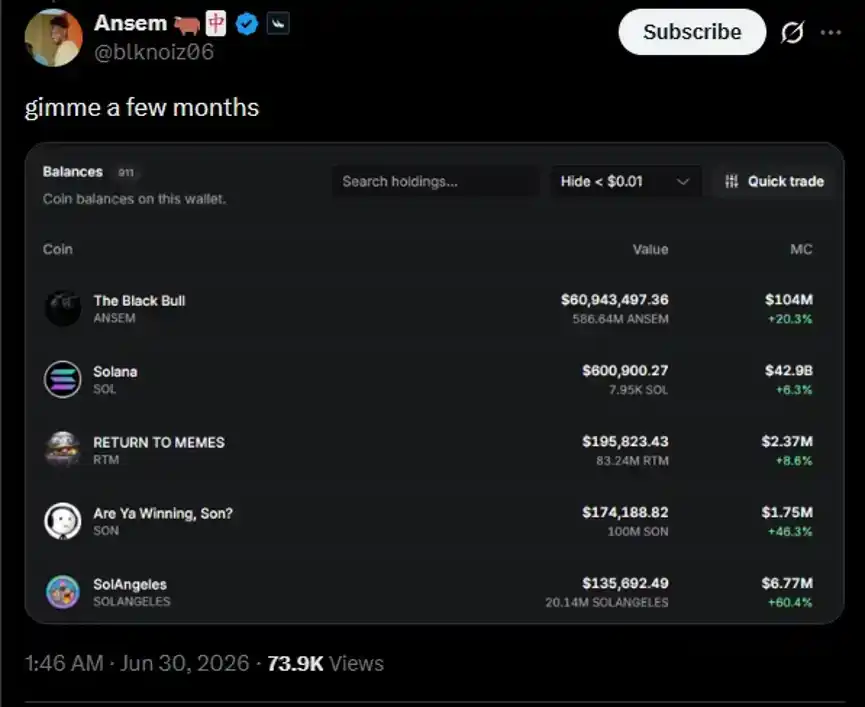
Overall, after $TJR, there was no clear main narrative on Solana, and there wasn't much liquidity overflow from $ANSEM to other narratives. In theory, the play of copying Ansem's portfolio like $manlet should have been captured by the market earlier, but earlier tweets from Ansem didn't spark speculation:
Since the relay for new launches on Solana wasn't performing well, it was BSC's turn to take the baton.

The Trend Moves to BSC

At 5 AM yesterday, a tweet from CZ in 2021 was dug up. Similar to the "big black bull" image associated with $ANSEM, CZ said 5 years ago, "Everyone knows I'm a bull, but you haven't seen my final form."
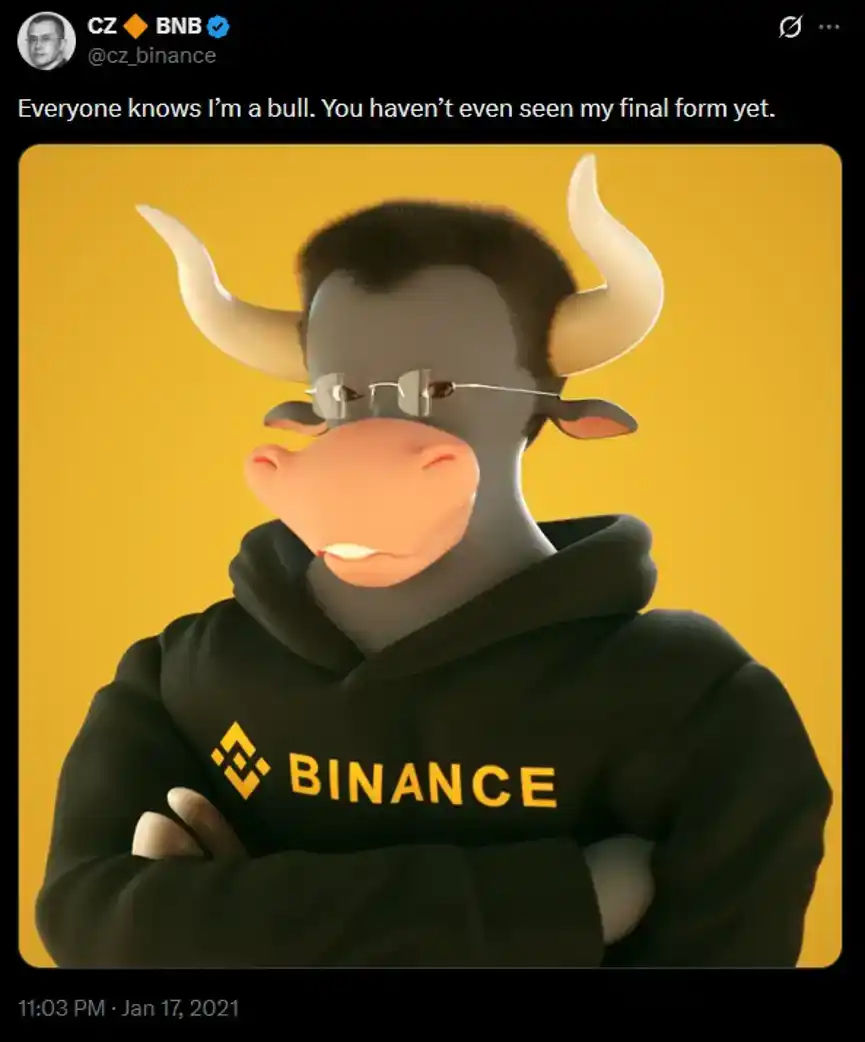
Thus, $CZ suddenly experienced a buying frenzy, surging nearly 200x within an hour. Although everyone thought CZ wouldn't personally jump in like Ansem, posting tweets daily and giving airdrops, the coin still rose. Moreover, it ultimately withstood copycat tokens (with the same ticker) and a rapid correction after the sharp increase (its market cap once dropped from around $40 million to under $6 million, also within an hour), eventually approaching a $90 million market cap.

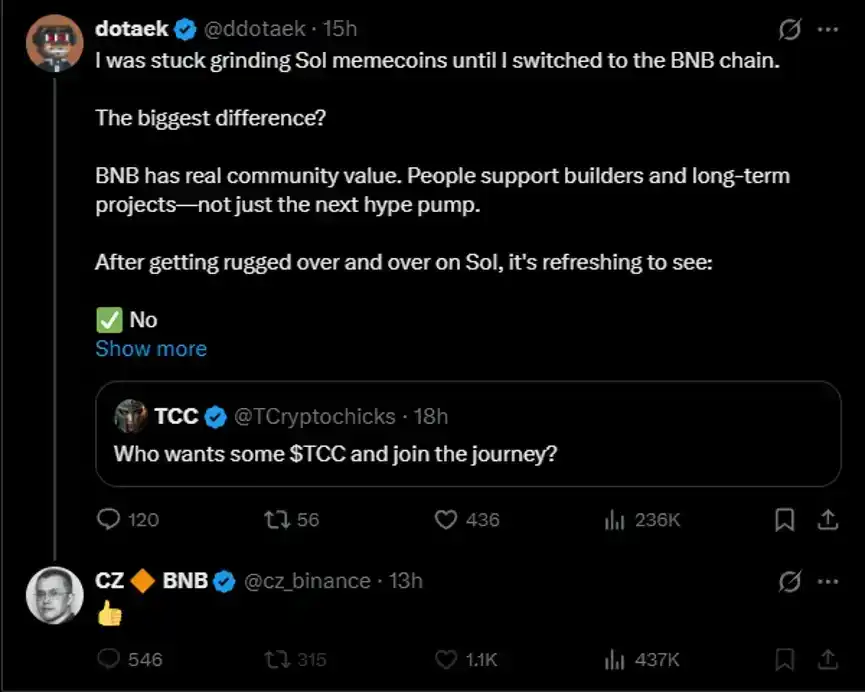
What more closely resembled BSC's $ANSEM was $TCC, because tokens were sent to @TCryptochicks, and he frequently promoted this coin on X. It gained attention due to CZ's multiple interactions with him on X, creating a sense that "this is the BSC Ansem endorsed by CZ":
"Ambushing celebrities" is also happening on BSC. This morning, $dingaling, without being claimed, was once FOMO'd to a $5 million market cap. It then quickly fell, currently holding less than $300,000 in market cap.

For now, the sentiment on BSC is already better than on Solana, especially for primary market launch players. The pace on BSC is faster, and currently offers more opportunities than Solana. How the trends on these two chains will develop afterwards is still uncertain. Hopefully, new narratives that can succeed "celebrity coins" will emerge.


Trending Cryptos

Related Questions

QWhat triggered the initial surge of the $ANSEM token according to the article?

AThe initial surge of the $ANSEM token was triggered by crypto KOL Ansem's 'soft claim' of the token. He announced on X that he would airdrop a portion of his creator earnings from pump.fun to followers who retweeted his post, followed him on pump.fun, and left a link to his pump.fun profile in the comments. This action ignited excitement among on-chain players.

QHow did the 'celebrity coin' narrative evolve on the Solana blockchain after $ANSEM's success?

AAfter $ANSEM's success, the narrative shifted briefly to other 'celebrity coins' like $TJR. However, TJR himself discouraged the split of attention, causing $TJR to fade. The focus then shifted to projects Ansem publicly endorsed (like Nest and Kintara) and later to tokens found in Ansem's public wallet, such as $manlet. However, the article states there was no clear, sustained secondary narrative on Solana, and the momentum for launching new 'celebrity coins' cooled down.

QWhat event marked the shift of the 'celebrity coin' trend from Solana to BSC?

AThe shift from Solana to BSC was marked by the 'archaeological' discovery of a 2021 tweet from former Binance CEO CZ. In the tweet, CZ likened himself to a bull that hadn't revealed its 'final form,' which was similar to the 'big black bull' imagery associated with $ANSEM. This led to a rapid and massive pump of the $CZ token on the BSC chain.

QAccording to the article, what was a key reason behind Ansem's potential motivation to champion the $ANSEM token?

AA key reason behind Ansem's potential motivation was his role as a co-founder of the trading terminal Bullpen. The article suggests that by claiming and promoting $ANSEM, he likely planned to use the token as a powerful advertisement for his own trading platform, Bullpen, which later hosted an airdrop claim page for $ANSEM.

QHow does the article compare the current opportunities for 'celebrity coin' plays on BSC versus Solana?

AThe article suggests that, at the time of writing, the sentiment and opportunities for 'celebrity coin' plays, especially for primary market (new launch) participants, were better on BSC than on Solana. It states that BSC had a faster pace and more opportunities, as the momentum for new launches on Solana had waned without a clear narrative to succeed the initial 'celebrity coin' trend.

Related Reads

The Verdict in Choi Tae-won's Divorce Case: Revealing the Inheritance Undercurrent Behind SK Hynix's Trillion-Won Empire

SK Group Chairman Chey Tae-won's high-profile divorce case, involving a record 1.38 trillion won settlement, has drawn attention to the succession plans for Korea's second-largest conglomerate, especially its crown jewel, SK hynix. Unlike traditional chaebol scripts centered on the eldest son, Chey's three children from his marriage to former President Roh Tae-woo's daughter, Roh Soh-yeong, are carving distinct, non-traditional paths. Eldest daughter Chey Yun-jung (b. 1989) is seen as the most evident successor. With a scientific and consulting background, she holds executive roles at SK bioscience and SK Inc.'s growth support department, focusing on future strategy and biopharma. Her marriage is to an AI infrastructure entrepreneur, not a traditional business alliance. Second daughter Chey Min-jung (b. 1991) took a unique route, voluntarily serving as a South Korean naval officer, including an anti-piracy deployment. She later worked on policy and strategy for SK hynix in Washington D.C. before co-founding an AI-driven healthcare startup. She married a former U.S. Marine Corps officer, connecting her to U.S. defense and policy circles—networks crucial for a global semiconductor giant. The only son, Chey In-geun (b. 1995), who studied physics like his father, worked briefly at SK E&S before joining McKinsey. Despite fitting the traditional "heir" profile as the eldest son, he remains silent and holds no public position or shares in SK, suggesting the old succession playbook is obsolete. As SK hynix's valuation soars, becoming a geopolitical asset in the AI era, the heirs' legitimacy is no longer automatic. They must prove themselves in fields like AI biotech, global policy, and strategic consulting. Their marriages also reflect new elite networks in tech and defense, not old political alliances. Their inheritance is the complex challenge of navigating a globalized, tech-driven world, not just a corporate throne.

marsbitYesterday 09:06

The Verdict in Choi Tae-won's Divorce Case: Revealing the Inheritance Undercurrent Behind SK Hynix's Trillion-Won Empire

marsbitYesterday 09:06

From OpenSea to OpenRouter: Is Alex Atallah Repeating His 'Exit at the Peak' Playbook?

From OpenSea to OpenRouter: Is Alex Atallah Repeating His "Exit at the Peak" Playbook? According to the Wall Street Journal, payments giant Stripe is in talks to acquire the AI model aggregation platform OpenRouter in a potential deal valuing the company near $100 billion. This would mark founder Alex Atallah's second creation of a company reaching a $100 billion valuation, following his co-founding of NFT marketplace OpenSea. OpenRouter, founded just over three years ago, has grown rapidly by acting as a unified gateway for developers to access over 400 AI models. It currently has about 10 million users and processes over 200 trillion tokens monthly. While the platform's annualized revenue is around $50 million, its valuation has skyrocketed from $1.3 billion in March 2026. The potential acquisition by Stripe, a company OpenRouter's founder once likened it to, represents a major expansion into AI infrastructure for the payments leader. This move echoes Atallah's previous timing with OpenSea, where he departed before the NFT market's significant downturn. For OpenRouter, selling now may be strategic. Despite its scale, its business model—charging a 5-5.5% fee on AI inference calls—faces pressure from competition, open-source models, and potential price wars among model providers, limiting its profitability narrative for an IPO. A key asset for potential acquirers like Stripe is OpenRouter's vast repository of real-world AI usage data, which offers unique insights into model performance and developer preferences that are difficult to replicate. Whether this potential deal signifies a new valuation benchmark for AI infrastructure or another market peak signal remains to be seen.

链捕手Yesterday 08:42

From OpenSea to OpenRouter: Is Alex Atallah Repeating His 'Exit at the Peak' Playbook?

链捕手Yesterday 08:42

Trading

Spot

Hot Articles

Discussions

Welcome to the HTX Community. Here, you can stay informed about the latest platform developments and gain access to professional market insights. Users' opinions on the price of SOL (SOL) are presented below.

活动图片















