Solana AI token Ava hit by launch sniping tied to deployer: Bubblemaps

cointelegraphPublished on 2025-12-19Last updated on 2025-12-19

Abstract

Blockchain analytics firm Bubblemaps reported that 23 wallets linked to the deployer of the Solana-based AI token Ava accumulated around 40% of the token’s supply at launch, indicating potential insider coordination. These wallets, funded via Binance and Bitget in a short timeframe, showed no prior blockchain activity before purchasing AVA. The activity, described as "sniping," involved coordinated buying at launch, leading to significant supply concentration—a red flag for potential market manipulation like rug pulls. Since its November 2024 launch, AVA’s price has fallen 79%, and it is down 96% from its January 2025 all-time high of $0.33.

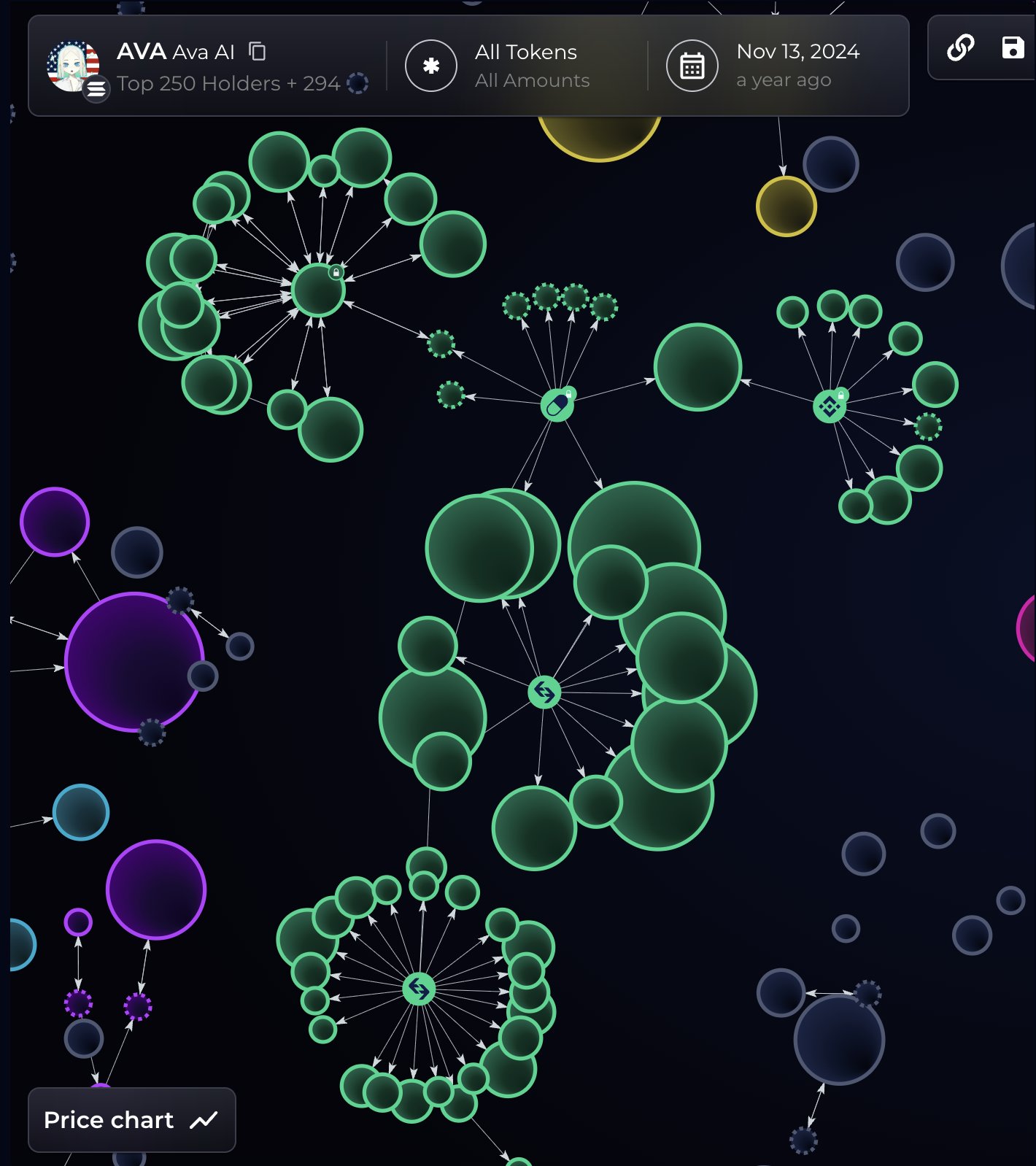
Blockchain analytics firm Bubblemaps said a cluster of 23 wallets linked to the deployer of the Solana-based AI token Ava accumulated around 40% of the token’s supply at launch, raising new questions about insider coordination around the project’s debut.

The sybil wallet cluster related to the deployer shared similar patterns, including being funded in a tight time window through Bitget and Binance, receiving similar amounts of Solana (SOL) and having no blockchain activity before buying up the Ava AI (AVA) token supply at launch, Bubblemaps claimed in a Thursday X post.

“Connected to these snipers are other wallets that also bought $AVA early. Similar funding sources, sizes, and timing strongly suggest coordination across these clusters,” they said.

In crypto slang, sniping refers to employing crypto trading bots to automatically purchase new token supply as soon as the tokens become publicly available, aiming to buy at lower prices before the general public.

While the token was launched on memecoin launch platform Pump.fun, aiming for a decentralized, community-driven debut, the wallet cluster’s activity suggests acquisitions that led to a single entity holding 40% of the token’s supply.
Source: Bubblemaps

Related: Crypto nears its ‘Netscape moment’ as industry approaches inflection point

A large token supply concentrated across a few wallets can help investors detect scams such as rug pulls, where insiders remove liquidity or stage a mass sell-off, resulting in a steep price collapse that leaves investors with worthless tokens.

The coordinated activity was uncovered through Bubblemaps’ Time Travel feature, a forensic-grade analytics tool launched in May that enables Web3 users to reconstruct the historical distribution of tokens, aiming to detect early insider activity.

Related: Bubblemaps challenges PEPE’s fair launch, alleges 30% of genesis supply bundled

AVA AI token falls 96% from all-time high

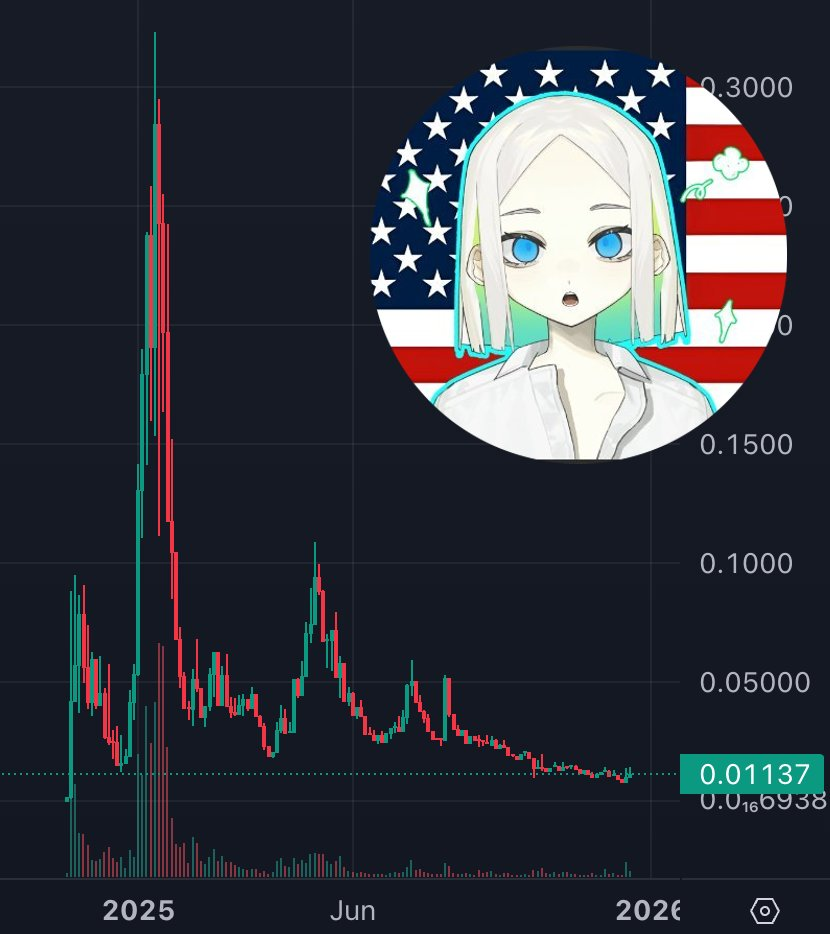
The coordinated buying activity was revealed over a year after the AVA token’s launch on Nov. 13, 2024. The token reached a fully diluted valuation (FDV) of $300 million by January 2025, making it a popular autonomous AI agent utility token native to Solana.

The AVA token is down over 79% since launch and over 96% from its all-time high of $0.33 breached on Jan. 15, 2025, CoinGecko data shows.
Source: Bubblemaps

Ava, also known as “the HOLO AI intern,” was the first AI agent built on the decentralized AI launchpad Holoworld AI. The platform allows users to create, play, or raise funds for agentic AI applications.

Holoworld claims to have over 1 million users and 700,000 AI “creations” to date.

Cointelegraph has approached Holoworld for comment on the sybil wallet cluster’s activity during the token launch.

Magazine: Memecoin degeneracy is funding groundbreaking anti-aging research

Trending Cryptos

Related Questions

QWhat did blockchain analytics firm Bubblemaps discover about the Solana-based AI token Ava's launch?

ABubblemaps discovered that a cluster of 23 wallets linked to the token's deployer accumulated around 40% of the token's supply at launch, indicating potential insider coordination.

QWhat are the common patterns identified in the sybil wallet cluster related to the AVA token deployer?

AThe wallets were funded in a tight time window through Bitget and Binance, received similar amounts of Solana (SOL), and had no prior blockchain activity before buying the AVA tokens.

QWhat is 'sniping' in the context of crypto token launches?

ASniping refers to using crypto trading bots to automatically purchase a new token supply as soon as it becomes available, aiming to buy at lower prices before the general public.

QHow much has the AVA token fallen from its all-time high, according to CoinGecko data?

AThe AVA token is down over 96% from its all-time high of $0.33, which was reached on January 15, 2025.

QWhat is the potential risk associated with a large token supply being concentrated in a few wallets?

AIt can indicate potential scams like rug pulls, where insiders remove liquidity or stage a mass sell-off, causing a steep price collapse and leaving investors with worthless tokens.

Related Reads

The Verdict in Choi Tae-won's Divorce Case: Revealing the Inheritance Undercurrent Behind SK Hynix's Trillion-Won Empire

SK Group Chairman Chey Tae-won's high-profile divorce case, involving a record 1.38 trillion won settlement, has drawn attention to the succession plans for Korea's second-largest conglomerate, especially its crown jewel, SK hynix. Unlike traditional chaebol scripts centered on the eldest son, Chey's three children from his marriage to former President Roh Tae-woo's daughter, Roh Soh-yeong, are carving distinct, non-traditional paths. Eldest daughter Chey Yun-jung (b. 1989) is seen as the most evident successor. With a scientific and consulting background, she holds executive roles at SK bioscience and SK Inc.'s growth support department, focusing on future strategy and biopharma. Her marriage is to an AI infrastructure entrepreneur, not a traditional business alliance. Second daughter Chey Min-jung (b. 1991) took a unique route, voluntarily serving as a South Korean naval officer, including an anti-piracy deployment. She later worked on policy and strategy for SK hynix in Washington D.C. before co-founding an AI-driven healthcare startup. She married a former U.S. Marine Corps officer, connecting her to U.S. defense and policy circles—networks crucial for a global semiconductor giant. The only son, Chey In-geun (b. 1995), who studied physics like his father, worked briefly at SK E&S before joining McKinsey. Despite fitting the traditional "heir" profile as the eldest son, he remains silent and holds no public position or shares in SK, suggesting the old succession playbook is obsolete. As SK hynix's valuation soars, becoming a geopolitical asset in the AI era, the heirs' legitimacy is no longer automatic. They must prove themselves in fields like AI biotech, global policy, and strategic consulting. Their marriages also reflect new elite networks in tech and defense, not old political alliances. Their inheritance is the complex challenge of navigating a globalized, tech-driven world, not just a corporate throne.

marsbit14h ago

The Verdict in Choi Tae-won's Divorce Case: Revealing the Inheritance Undercurrent Behind SK Hynix's Trillion-Won Empire

marsbit14h ago

From OpenSea to OpenRouter: Is Alex Atallah Repeating His 'Exit at the Peak' Playbook?

From OpenSea to OpenRouter: Is Alex Atallah Repeating His "Exit at the Peak" Playbook? According to the Wall Street Journal, payments giant Stripe is in talks to acquire the AI model aggregation platform OpenRouter in a potential deal valuing the company near $100 billion. This would mark founder Alex Atallah's second creation of a company reaching a $100 billion valuation, following his co-founding of NFT marketplace OpenSea. OpenRouter, founded just over three years ago, has grown rapidly by acting as a unified gateway for developers to access over 400 AI models. It currently has about 10 million users and processes over 200 trillion tokens monthly. While the platform's annualized revenue is around $50 million, its valuation has skyrocketed from $1.3 billion in March 2026. The potential acquisition by Stripe, a company OpenRouter's founder once likened it to, represents a major expansion into AI infrastructure for the payments leader. This move echoes Atallah's previous timing with OpenSea, where he departed before the NFT market's significant downturn. For OpenRouter, selling now may be strategic. Despite its scale, its business model—charging a 5-5.5% fee on AI inference calls—faces pressure from competition, open-source models, and potential price wars among model providers, limiting its profitability narrative for an IPO. A key asset for potential acquirers like Stripe is OpenRouter's vast repository of real-world AI usage data, which offers unique insights into model performance and developer preferences that are difficult to replicate. Whether this potential deal signifies a new valuation benchmark for AI infrastructure or another market peak signal remains to be seen.

链捕手14h ago

From OpenSea to OpenRouter: Is Alex Atallah Repeating His 'Exit at the Peak' Playbook?

链捕手14h ago

Trading

Spot

Hot Articles

Discussions

Welcome to the HTX Community. Here, you can stay informed about the latest platform developments and gain access to professional market insights. Users' opinions on the price of AI (AI) are presented below.

活动图片