Tron Founder Justin Sun Addresses Controversy After Bitcoin Removal From USDD’s Collateral

bitcoinistPublished on 2024-08-23Last updated on 2024-08-23

Abstract

Amid the memecoin frenzy on the Tron network, Justin Sun is facing backlash for the controversial removal of over $700...

Amid the memecoin frenzy on the Tron network, Justin Sun is facing backlash for the controversial removal of over $700 million in Bitcoin (BTC) as USDD’s collateral without the Tron DAO Reserve’s vote. Sun has now addressed the situation after the move raised concerns about the stablecoin’s decentralization.

12,000 Bitcoin Removed From USDD Collateral

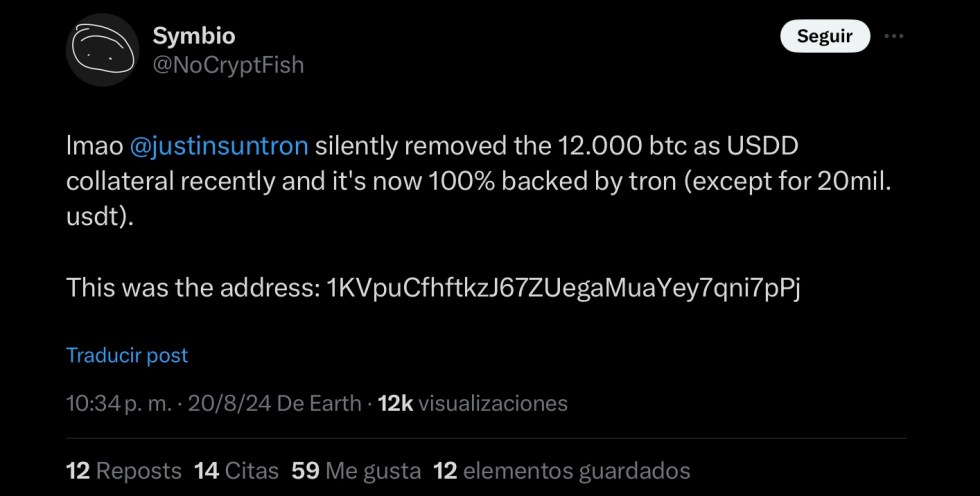
On Wednesday, online reports revealed that 12,000 Bitcoin, worth around $732 million, were removed from Tron’s Decentralized USD (USDD) stablecoin collateral reserves.

USDD is a decentralized over-collateralized stablecoin pegged to the US Dollar through TRX and governed by the Tron DAO Reserve. According to the report, the significant change means the stablecoin is now almost fully backed by TRX, except for 20 million USDT.
Tron

Online reports unveil BTC removal from USDD collateral. Source: Symbio on X

The modification was done “silently” without the DAO’s consultation or approval despite the continued emphasis on community governance. Reportedly, the USDD transparency page listed 12,000 Bitcoin under an address, which has now been removed.

The removal raised questions among investors who criticized the lack of transparency. Many X users questioned the “decentralized stablecoin” narrative claim by the Tron Foundation.

Other community members drew parallels between Sun’s “shady” actions and the behavior that led to the collapses of UST or FTX. Meanwhile, others noted that the news seemed like “100 red flags.”

Veritas Protocol alleged this is not the first issue with USDD’s collateral. Per the post, it “has also faced issues with its collateral, such as storing significant amounts of HTX without consulting the DAO.”

Justin Sun Addresses Concerns

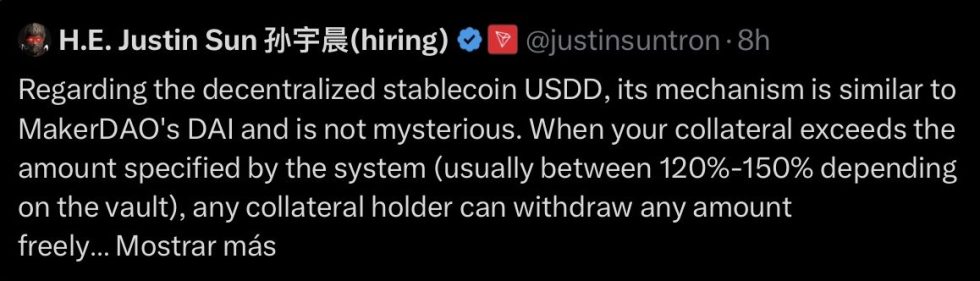
Following the criticism, Justin Sun addressed users’ concerns in an X post. Tron’s founder claimed that USDD’s mechanism is “not mysterious” since it works like MakerDAO’s DAI.

Sun explained that when the collateral exceeds the amount specified by the system, collateral holders can move the funds. Per the post, this amount is usually set between 125% and 150%, and if the collateral falls below a certain level, “it needs to be topped up; otherwise, the collateral may trigger liquidation.”
Tron

Tron's Founder addresses BTC removal without DAO's vote. Source: Justin Sun on X

Based on it, Sun alleges that “any collateral holder can withdraw any amount freely without anyone’s approval.” He also noted that USDD currently “has a long-term collateralization rate exceeding 300%,” which is inefficient for capital utilization and is planned to be upgraded.

Currently, USDD has a long-term collateralization rate exceeding 300%, which means that the capital utilization is not very efficient. The TRON DAO Reserve plans to spend time upgrading USDD in the future to make it a more competitive decentralized stablecoin in the market. Remember, Tron is also a kingdom of stablecoins.

USDD’s X account cited Sun’s response, echoing TRD’s plans to upgrade and enhance the stablecoin. Nonetheless, Bennet Tomlin, co-host of Crypto Critic Pod, questioned Tron founder’s statement. Tomlin claims Sun’s description does not match the issuance process described on USDD’s page.

Moreover, he stated that, according to the whitepaper, the removed Bitcoin is “explicitly supposed to be managed by the TRON DAO Reserve (…), not whatever collateral holders Sun is imagining. At the time of writing, Sun has not responded to the apparent discrepancies raised by Tomlin.
Tron, TRX, TRXUSDT

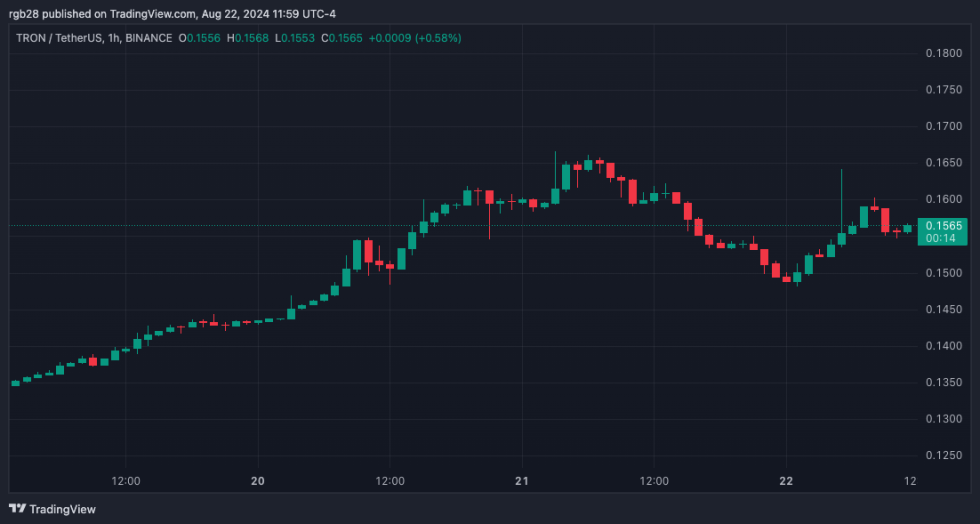
TRX is trading at $0.15 in the three-day chart. Source: TRXUSDT on TradingView
Featured Image from Unsplash.com, Chart from TradingView.com
Rubmar Garcia

Rubmar Garcia

Rubmar is a crypto enthusiast who likes learning and improving constantly. She enjoys reporting on the latest news and developments in the crypto industry. Rubmar also enjoys scrapbooking, crafting, simulation games, and watching football.

Trending Cryptos

Related Reads

The Verdict in Choi Tae-won's Divorce Case: Revealing the Inheritance Undercurrent Behind SK Hynix's Trillion-Won Empire

SK Group Chairman Chey Tae-won's high-profile divorce case, involving a record 1.38 trillion won settlement, has drawn attention to the succession plans for Korea's second-largest conglomerate, especially its crown jewel, SK hynix. Unlike traditional chaebol scripts centered on the eldest son, Chey's three children from his marriage to former President Roh Tae-woo's daughter, Roh Soh-yeong, are carving distinct, non-traditional paths. Eldest daughter Chey Yun-jung (b. 1989) is seen as the most evident successor. With a scientific and consulting background, she holds executive roles at SK bioscience and SK Inc.'s growth support department, focusing on future strategy and biopharma. Her marriage is to an AI infrastructure entrepreneur, not a traditional business alliance. Second daughter Chey Min-jung (b. 1991) took a unique route, voluntarily serving as a South Korean naval officer, including an anti-piracy deployment. She later worked on policy and strategy for SK hynix in Washington D.C. before co-founding an AI-driven healthcare startup. She married a former U.S. Marine Corps officer, connecting her to U.S. defense and policy circles—networks crucial for a global semiconductor giant. The only son, Chey In-geun (b. 1995), who studied physics like his father, worked briefly at SK E&S before joining McKinsey. Despite fitting the traditional "heir" profile as the eldest son, he remains silent and holds no public position or shares in SK, suggesting the old succession playbook is obsolete. As SK hynix's valuation soars, becoming a geopolitical asset in the AI era, the heirs' legitimacy is no longer automatic. They must prove themselves in fields like AI biotech, global policy, and strategic consulting. Their marriages also reflect new elite networks in tech and defense, not old political alliances. Their inheritance is the complex challenge of navigating a globalized, tech-driven world, not just a corporate throne.

marsbit17h ago

The Verdict in Choi Tae-won's Divorce Case: Revealing the Inheritance Undercurrent Behind SK Hynix's Trillion-Won Empire

marsbit17h ago

From OpenSea to OpenRouter: Is Alex Atallah Repeating His 'Exit at the Peak' Playbook?

From OpenSea to OpenRouter: Is Alex Atallah Repeating His "Exit at the Peak" Playbook? According to the Wall Street Journal, payments giant Stripe is in talks to acquire the AI model aggregation platform OpenRouter in a potential deal valuing the company near $100 billion. This would mark founder Alex Atallah's second creation of a company reaching a $100 billion valuation, following his co-founding of NFT marketplace OpenSea. OpenRouter, founded just over three years ago, has grown rapidly by acting as a unified gateway for developers to access over 400 AI models. It currently has about 10 million users and processes over 200 trillion tokens monthly. While the platform's annualized revenue is around $50 million, its valuation has skyrocketed from $1.3 billion in March 2026. The potential acquisition by Stripe, a company OpenRouter's founder once likened it to, represents a major expansion into AI infrastructure for the payments leader. This move echoes Atallah's previous timing with OpenSea, where he departed before the NFT market's significant downturn. For OpenRouter, selling now may be strategic. Despite its scale, its business model—charging a 5-5.5% fee on AI inference calls—faces pressure from competition, open-source models, and potential price wars among model providers, limiting its profitability narrative for an IPO. A key asset for potential acquirers like Stripe is OpenRouter's vast repository of real-world AI usage data, which offers unique insights into model performance and developer preferences that are difficult to replicate. Whether this potential deal signifies a new valuation benchmark for AI infrastructure or another market peak signal remains to be seen.

链捕手18h ago

From OpenSea to OpenRouter: Is Alex Atallah Repeating His 'Exit at the Peak' Playbook?

链捕手18h ago

Trading

Spot

Hot Articles

How to Buy SUN

Welcome to HTX.com! We've made purchasing SUN (SUN) simple and convenient. Follow our step-by-step guide to embark on your crypto journey.Step 1: Create Your HTX AccountUse your email or phone number to sign up for a free account on HTX. Experience a hassle-free registration journey and unlock all features.Get My AccountStep 2: Go to Buy Crypto and Choose Your Payment MethodCredit/Debit Card: Use your Visa or Mastercard to buy SUN (SUN) instantly.Balance: Use funds from your HTX account balance to trade seamlessly.Third Parties: We've added popular payment methods such as Google Pay and Apple Pay to enhance convenience.P2P: Trade directly with other users on HTX.Over-the-Counter (OTC): We offer tailor-made services and competitive exchange rates for traders.Step 3: Store Your SUN (SUN)After purchasing your SUN (SUN), store it in your HTX account. Alternatively, you can send it elsewhere via blockchain transfer or use it to trade other cryptocurrencies.Step 4: Trade SUN (SUN)Easily trade SUN (SUN) on HTX's spot market. Simply access your account, select your trading pair, execute your trades, and monitor in real-time. We offer a user-friendly experience for both beginners and seasoned traders.

7.5k Total ViewsPublished 2024.03.29Updated 2026.06.02

How to Buy SUN

Discussions

Welcome to the HTX Community. Here, you can stay informed about the latest platform developments and gain access to professional market insights. Users' opinions on the price of SUN (SUN) are presented below.

活动图片














