Vitalik's Algorithmic Stablecoin Vision: Interpreting the Mechanism and Challenges from an Options Perspective

marsbitPublished on 2026-06-21Last updated on 2026-06-21

Abstract

Vitalik Buterin's recent algorithmic stablecoin proposal envisions using an option-like mechanism to create a stablecoin without the liquidation risks inherent in traditional collateralized debt position (CDP) models. The design splits one unit of ETH into two components: a 'stable' leg (P) that maintains value up to a certain strike price, and an 'upside' leg (N) that captures any appreciation above that price. Together, they always sum to one ETH, eliminating the need for debt or liquidation mechanisms. From an options perspective, the stable leg essentially functions as a synthetic, covered call position. However, significant challenges exist. For the stable asset to maintain its peg, it must continuously roll deep in-the-money call options, leading to potential rollover slippage, predictable trading paths vulnerable to front-running, and liquidity issues. Crucially, the system's scalability depends on a constant demand for the upside leg—a form of leveraged ETH long position without funding rates or liquidation risk. It's unclear if such persistent, specific demand will materialize from speculators or market makers who have simpler alternatives like perpetual swaps. The author, drawing from experience with Rysk, argues that DeFi options have struggled as standalone trading products due to complexity and fragmented liquidity. Their potential lies instead as foundational infrastructure underpinning more complex financial primitives like stablecoins, structured yields, or ...

Author: Dan Rysk

Translation: Peggy, BlockBeats

Editor's Note: For a long time, DeFi options have not become a mainstream trading category. Compared to perpetual contracts, they are more complex, have more fragmented liquidity, and struggle to form stable natural demand.

However, the algorithmic stablecoin vision recently proposed by Vitalik opens up another possibility for options: they are no longer treated as an independent trading product but become the underlying financial building blocks for stablecoins, yield products, and structured assets.

The author of this article interprets this scheme from an options perspective. He believes that the stable-side asset in Vitalik's design is essentially similar to a synthetic covered call: users split 1 ETH into two parts, one part obtains 'stable value' below a certain strike price, and the other part obtains upside gains above the strike price. Since these two parts always sum to 1 ETH, the system does not need to introduce debt, margin, or liquidation mechanisms, thus avoiding the core liquidation risk of traditional CDP stablecoins.

But the challenges of this design are also evident. To make the stable-side asset approximate a stablecoin, it needs to continuously roll deep in-the-money call options, which brings issues like rollover slippage, front-running of fixed trading paths, and insufficient liquidity. More importantly, behind each unit of stable asset, someone must continuously hold the corresponding upside-side asset, which is a leveraged ETH long position with no funding rates and no liquidation risk. Whether this demand can exist long-term determines whether the system can truly scale.

Finally, drawing on Rysk's experience, the author points out that DeFi options have been difficult to scale in the past because they are too complex as direct trading products, and user demand is not natural enough. However, if their position is changed—placing options at the bottom layer of more complex assets like stablecoins, structured yields, and index products—they might be more suitable as infrastructure for DeFi. In other words, the opportunity for options in DeFi may not be to become the next perpetual contract, but to become the pricing and risk distribution engine behind the next generation of on-chain financial products.

Below is the original text:

For years, I've heard the same phrase: 'Options don't work in DeFi.'

After building Rysk, I admit there's some truth to that. Most DeFi options products struggle to grow. Liquidity is fragmented, attracting natural trading flow is difficult, and traders consistently opt for simpler products. Perpetual contracts became the default tool for expressing directional views, while prediction markets became the easier way to trade event outcomes.

That's exactly why Vitalik's recent proposal caught my attention. He suggested that an option-like rights structure could be used to build an algorithmic stablecoin without a liquidation mechanism.
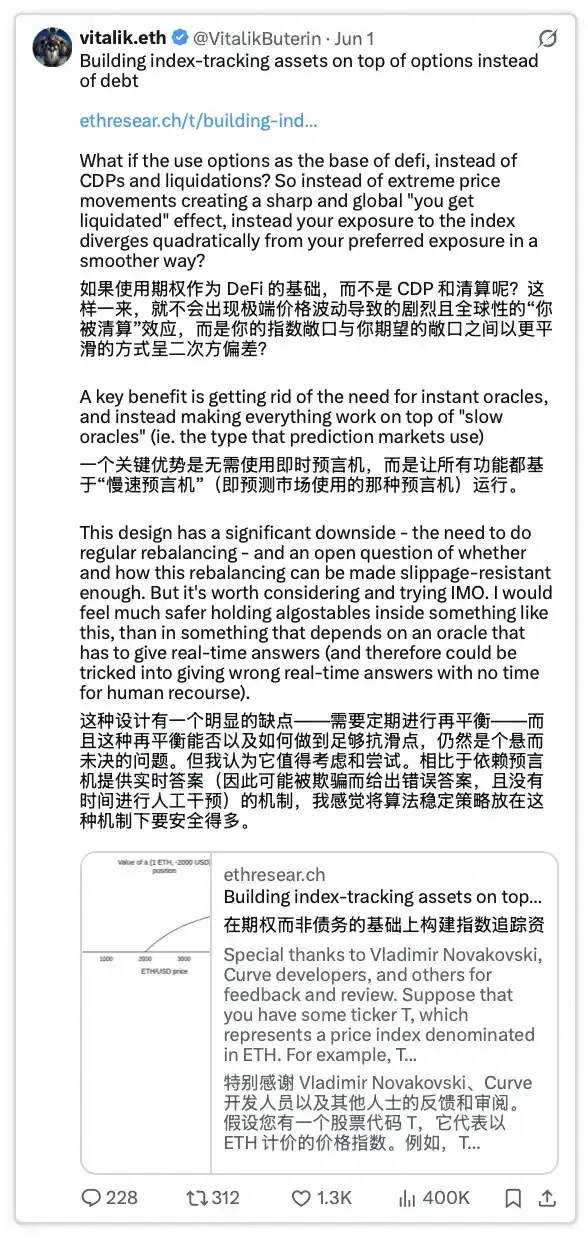
What really intrigued me was the perspective: options not as a product to be traded, but as underlying infrastructure for a product.

This is the view I've been advocating for the past few years and is the core idea behind our construction of Rysk V12. For us, the product is yield; for Vitalik, the product is stability. The more I think about it, the more familiar this design feels.

The stable side he describes is essentially a covered call.

Why It Is a Covered Call

His design splits one unit of ETH into two types of rights. One side is P, which holds the value up to a certain strike price; the other side is N, which receives all gains above that strike price. Together they always equal one unit of ETH, so there is no debt, no margin, and nothing to liquidate.

Assume the current ETH price is $2,500 and the strike price is $1,500. As long as ETH stays above $1,500, P behaves like an asset stable at $1,500; P only starts bearing downside risk if ETH falls below $1,500. N receives all the upside gains above $1,500.

This is precisely the payoff structure of a covered call.

The holder retains the asset itself, sells the upside above a certain strike price, and collects the option premium. P replicates exactly this covered call payoff. N corresponds to the long call option held by the buyer.

More accurately, it's a synthetic covered call. No one is selling an option externally; instead, the same payoff is reconstructed by splitting the rights.

This is the same thesis behind Rysk V12. Users hold ETH, BTC, or HYPE and obtain upfront yield by selling covered calls. Vitalik applies the same foundational module to stability.

Same engine, different product.

The Problem: It Is Deep In-the-Money and Must Be Continuously Rolled

Today, most Rysk users sell out-of-the-money covered calls. The holder owns ETH, then selects a strike price above the current price: either betting the price won't reach there, or being willing to sell and take profits at a higher price if it does, while keeping the premium regardless.

But the stable side in Vitalik's vision requires a different structure. To behave like a stable amount, the strike price must be far below the spot price, making this call deep in-the-money, with most of its value being intrinsic value.

With a spot price of $2,500 and a strike of $1,500, $1,000 of that is intrinsic value the buyer must pay upfront. This makes the transaction much more capital intensive.

But a call option can only stay stable for an instant. Once ETH moves down towards the strike, it starts bearing ETH's downside risk, so it must be continuously adjusted to a lower strike price, rolled over again and again.

Therefore, this stable asset is essentially a continuously rolling covered call program.

Vitalik himself pointed out this risk. The slippage from repeated rollovers is the biggest threat to the entire design, and how to execute the rollover is the truly difficult part.

And any mechanism that trades on a fixed, public schedule is easily front-run. This was exactly the problem faced by DeFi Options Vaults (DOVs): they sold options with the same tenor and same strikes every week at the same time, so the market knew exactly what was coming and positioned ahead, extracting value from that trade flow.

Regardless, each rollover requires a buyer. The question is: Who buys? At what price?

The Hardest Part Is Who Provides the Funding

In Vitalik's model, someone must deposit a full unit of ETH, split it, sell the stable side, and hold the upside side. This depositor is the person the entire system relies on to function.

The most obvious candidates are market makers.

But the position they end up holding is actually a leveraged ETH long. And anyone wanting leveraged long ETH exposure could just buy a call option or go long a perpetual contract. That's simpler, more efficient, and more familiar. This depositor is taking a more difficult path to get a position they could obtain more easily elsewhere.

The upside side does have one genuine advantage: it offers real leverage with no funding rates and no liquidation risk, something perpetuals cannot provide.

But it still needs to find buyers, and not just once. For every unit of stable asset that exists, someone must be holding the corresponding upside side.

To scale, this model needs a persistent group of people willing to hold ETH leveraged longs in this specific form, consistently, in any market environment.

Market makers are essentially resource optimizers. Without a clear reason, they won't readily adopt something new, capital intensive, and with heavy integration costs. 'Speculators and market makers will provide liquidity' is the assumption the entire design relies on. But that behavior doesn't just happen spontaneously.

What We Learned at Rysk

At Rysk, we learned this the hard way. Earlier versions of the protocol struggled to scale, lacked natural demand, and never found product-market fit.

In the current protocol, Rysk V12, both sides of the trade have strong reasons to participate. Therefore, Rysk starts with two groups of people who already want to be involved. Holders want yield from assets they already hold, and their assets themselves are the collateral.

Market makers compete to buy this trade flow via an RFQ (Request for Quote) mechanism. They only pay the option premium, don't need to provide collateral, and ultimately get the option risk exposure they actually want, which they can price and hedge on their own books. This is the more capital-efficient side of the trade, which is why trading teams integrate spontaneously.

No party is required to hold a position they could more easily obtain elsewhere.

The system also doesn't rely on incentives or token emissions.

Worth Building

I'm glad to see this design being seriously explored. The challenges are real, but they are the interesting kind. This is exactly the design space DeFi should explore.

What feels validating is that this proposal further reinforces the same choices we made at Rysk: fully collateralized, no liquidation, no counterparty risk, and physical settlement at expiry only requiring an oracle.

Use case differs, foundation is the same. This foundation is live and proven on HyperEVM, with market makers competing for flow. We've also deployed to Ethereum mainnet and will soon open to the public.

If you are exploring stablecoins, structured products, index products, or anything with an optionality profile underneath, feel free to reach out.

Options are building blocks. What's truly interesting is what gets built on top.

Related Questions

QWhat is the core mechanism of the stable-side asset in Vitalik's algorithmic stablecoin proposal, and how is it compared to an option?

AThe stable-side asset in Vitalik's proposal is a mechanism that splits one unit of ETH into two parts: a 'stable side' (P) and an 'upside side' (N). P provides stable value up to a certain strike price, while N captures all gains above that price. The sum of P and N always equals one ETH, eliminating the need for debt, margin, or liquidation. From an options perspective, the stable side (P) essentially replicates the payoff structure of a synthetic covered call. The holder effectively sells the upside potential above the strike price, similar to writing a covered call option, while the upside side (N) holds the corresponding long call option.

QWhat are the main operational challenges for Vitalik's algorithmic stablecoin design, according to the author?

AThe main challenges are related to the need for the stable-side asset to behave like a stablecoin. It requires continuously rolling deep in-the-money covered calls, which introduces several problems: 1. Rollover slippage from frequently adjusting the position to a lower strike price. 2. The risk of being front-run if the rollover follows a fixed, predictable schedule. 3. Liquidity constraints, as each rollover needs a willing buyer for the new upside side (N). The most critical challenge is ensuring there is a sustainable demand for the upside side asset—a leveraged ETH long position without funding rates or liquidation risk—to support the expansion of the entire system.

QHow does the author's experience with Rysk inform their view on the role of options in DeFi?

AThe author's experience with Rysk shows that DeFi options have struggled to scale when positioned as a direct trading product for end-users, due to complexity and lack of natural demand compared to instruments like perpetuals. However, the author believes the real opportunity for options lies in becoming a foundational financial primitive or infrastructure layer underneath more complex products. This is exemplified by Rysk V12, where options are the engine for yield products, and by Vitalik's proposal, where they are the engine for stability. The author concludes that options are better suited as a risk distribution and pricing engine for next-generation on-chain financial products like stablecoins, structured yields, and indices.

QWhat is the key difference between the typical covered call sold on Rysk and the one required for Vitalik's stable asset?

AThe key difference lies in the moneyness and purpose. On Rysk, users typically sell out-of-the-money (OTM) covered calls, choosing a strike price above the current asset price to earn premium, betting the price won't reach that level, or being willing to sell at a profit if it does. For Vitalik's stable asset to mimic a stable value, it requires selling deep in-the-money (ITM) covered calls, with a strike price significantly below the current price. This structure has high intrinsic value, making it more capital-intensive. Furthermore, this ITM call must be continuously rolled over to a lower strike price to maintain its 'stable' characteristic as the underlying asset price fluctuates.

QWho does the author identify as the potential provider of liquidity (the 'depositor') for Vitalik's system, and what is the challenge in attracting them?

AThe author identifies market makers as the most obvious potential providers of liquidity (the 'depositors'). They would deposit the full unit of ETH, sell the stable side (P), and hold the upside side (N). However, the challenge is that the upside side (N) represents a leveraged long ETH position. Market makers or speculators can obtain similar exposure more simply and efficiently through direct long calls or perpetual contracts. While the N position offers the advantage of real leverage without funding rates or liquidation risk, it is a more complex and capital-intensive path. The system's scalability depends on finding a persistent group willing to hold this specific form of ETH leveraged long across various market conditions, which is not a given.

Related Reads

The Hunter Becomes the Hunted: The Most Profitable MEV Bot Gets Hacked

A well-known and highly profitable Ethereum MEV Bot, Jaredfromsubway.eth, suffered a sophisticated on-chain attack this Saturday, losing over $7.5 million. Analysis by Blockaid and others reveals this was not a conventional phishing or smart contract exploit, but a targeted "counter-MEV honeypot attack." The attacker meticulously laid a trap over several weeks, deploying 66 fake token contracts and liquidity pools disguised as major assets like WETH and USDC. These pools created the illusion of arbitrage opportunities. The MEV Bot's automated system detected these signals, executed trades, and in the process, granted approval permissions to attacker-controlled contracts. These approvals were not revoked, creating a persistent vulnerability. The attacker then exploited this in a single transaction, draining the bot's ETH, USDC, and USDT holdings. Jaredfromsubway.eth is notorious as one of Ethereum's most active and profitable MEV Bots, primarily known for executing "sandwich attacks" to profit from transaction slippage. Estimates suggest it has earned tens of millions in MEV revenue. The incident highlights escalating crypto security threats, demonstrating that even top-tier automated "predators" are vulnerable to novel, logic-based attacks designed to exploit their own operational rules. Following the hack, an unverified X account impersonating Jaredfromsubway.eth emerged, falsely offering a bounty for the return of funds, prompting developer warnings for users to stay vigilant.

marsbit34m ago

The Hunter Becomes the Hunted: The Most Profitable MEV Bot Gets Hacked

marsbit34m ago

The Reality of Payments in Latin America Is Not What You Think

The payment landscape in Latin America is undergoing a fundamental shift, driven by on-the-ground realities that challenge common perceptions. Based on over 500 hours of field research across the region, key insights emerge. Firstly, QR code payments, like Brazil's Pix, are becoming the dominant payment method in most emerging markets, overtaking cards. However, these domestic instant payment systems lack international interoperability, creating a significant gap for cross-border users. Secondly, the narrative around crypto cards is often misunderstood; their primary volume comes from high-net-worth professionals using them for salary conversions (e.g., USDT to local currency via Pix), not retail micro-payments. Competition in payments is shifting from customer acquisition to controlling the settlement layer, leading fintechs to acquire banking licenses for efficiency. Thirdly, treating "Latin America" as a single market is a mistake. Countries like Argentina, Brazil, and Mexico have distinct economic realities, user segments, and regulatory approaches. Brazil alone has at least five distinct user segments with different financial flows. Overlooked markets like Guatemala, Honduras, and El Salvador (the "forgotten five") offer high remittance volumes with lower competitive density. Finally, regulation in Latin America is often ahead of the US, with clearer frameworks for digital assets and a pragmatic approach from regulators focused on safety rather than obstruction. The margin on stablecoin forex is rapidly compressing toward zero, meaning future winners will be those building value-added services on top of the infrastructure, not just the cheapest exchange.

marsbit49m ago

The Reality of Payments in Latin America Is Not What You Think

marsbit49m ago

Making Music in a Bear Market: The Survival Experiment of a Bitcoin Band

"Orange Pill Jam: A Bitcoin Band's Survival in the Bear Market" Orange Pill Jam is a musical group exploring themes of financial sovereignty and privacy, born from the Bitcoin community. Formed after singer Mermaid performed her song "Dollar Apocalypse" at a 2022 conference, the band creates music intended for both Bitcoin enthusiasts and general audiences. Their creative process involves Mermaid writing lyrics and melodies, which producer/multi-instrumentalist Michi then shapes with a precise, rhythm-focused approach, often demanding numerous retakes to achieve his unique standard of timing. Their songs, like "Cypherpunks' Manifesto" and "Fire of Freedom," tackle concepts of digital privacy, the pitfalls of "free" services, and personal sovereignty, influenced by experiences in places like El Salvador. Despite operating in a crypto bear market with a Copyleft model (offering music for free sharing/remixing and accepting optional Bitcoin donations), they face practical challenges. Their growth is slow on platforms like YouTube and Spotify, which aren't optimized for their niche content. The band also navigates the rise of AI-generated music. While acknowledging AI's efficiency for certain tasks, they believe human creativity occupies a unique space that algorithms cannot replicate—the ability to create new genres and capture intangible rhythmic feeling. For Orange Pill Jam, the core argument for both Bitcoin in a downturn and human artistry in the AI age lies in this irreplaceable, intentional, and imperfectly human creative process. Their project persists as an anti-algorithm experiment, valuing the unquantifiable impact of music over scalable metrics.

marsbit56m ago

Making Music in a Bear Market: The Survival Experiment of a Bitcoin Band

marsbit56m ago

Trading

Spot
Futures
活动图片