Trends in US Stocks (June 22): Strait of Hormuz Agreement Changes Course, Thursday's PCE and Micron to Determine Chip Sector Direction

marsbitPublished on 2026-06-22Last updated on 2026-06-22

Abstract

U.S. Stock Market Outlook (June 22): Strait of Hormuz Deal Falters, Thursday's PCE & Micron to Set Chip Sector Direction. Geopolitical tensions resurged over the weekend as Iran's IRGC announced the closure of the Strait of Hormuz, and its negotiation team walked out after threats from Trump, pausing U.S.-Iran talks. This renewed risk premium is weighing on U.S. equity futures ahead of the open. Last week's market was driven by chip stocks, with the Philly Semiconductor Index hitting a record high. While the Fed's hawkish tone was overshadowed by initial deal optimism, the S&P 500 gained 0.9% for the week. SpaceX debuted strongly but ended with two down days. Key events this week: The status of U.S.-Iran negotiations remains the immediate variable for oil and energy stocks. Monday sees Marvell and Flex added to the S&P 500. Tuesday's MSCI reclassification could benefit South Korean semiconductors and memory stocks. **Thursday, June 25th, is the critical day**, featuring the May Core PCE report and Micron's earnings. Hotter PCE data could solidify expectations for two 2024 rate hikes, while softer data would rapidly reprice rate cut bets. Micron's report is a key test for the AI narrative; the market will scrutinize its 2027 HBM supply visibility, HBM4 progress, and its position in Nvidia's Vera Rubin supply chain. Nvidia's AGM and a potential OpenAI GPT-5.6 release will make Thursday a pivotal 24 hours for AI. Friday concludes with the Russell reconstitution, elevating sm...

Author: Tide Research
Over the weekend, the US-Iran agreement has already begun to falter. Iran's IRGC announced the closure of the Strait of Hormuz on Saturday, and the negotiation delegation walked out angrily on Sunday after Trump issued threats. The US-Iran talks in Switzerland are currently still suspended. US stock futures for the three major indices were all lower in pre-market trading, with geopolitical risk premiums starting to accumulate again. The direction of the negotiations is the most immediate pricing variable for today's market open.

Market Performance

Last week, chip stocks were the main theme. The Philadelphia Semiconductor Index hit a record high on Thursday, overshadowing the hawkish FOMC with the US-Iran deal signing. The S&P 500 gained 0.9% for the week. SpaceX finished its debut week up 37%, but ended with two consecutive down days; a $20 billion bond issuance plan was revealed, indicating its honeymoon period is over. Accenture plunged 18% on Thursday, making it the worst-performing large-cap blue-chip last week.

Macro & Outlook

Latest status of US-Iran talks: The Strait of Hormuz remains closed. The Iranian delegation left the venue on Sunday in protest of Trump's threatening remarks. US media reports indicate Iranian personnel are still in contact with the US, but talks are effectively suspended. Iran's condition is for Israel to halt military operations in Lebanon, while Trump publicly warned of potentially taking over the Strait to collect tolls and threatened more severe strikes. Both sides are applying pressure. Progress in negotiations before today's market open is the most direct pricing variable for oil and energy stocks.

Marvell and Flex are added to the S&P 500 effective Monday. Most passive fund weight alignment was completed by last Friday's close. Today's open will see residual position adjustments; watch for liquidity premiums in the first few minutes for these two stocks.

MSCI's annual market classification review is announced Tuesday. If South Korea enters the watchlist for developed markets, billions in passive funds could flow into semiconductor ETFs. SK Hynix ADR application is expected to receive SEC approval as early as this week. Both events share a beneficial direction, likely creating a resonance effect in the memory sector.

Thursday, June 25th is the heaviest day of the week, with May PCE and Micron's earnings report landing on the same day. Core PCE is expected to rise year-over-year from 3.3% to 3.4%. Deutsche Bank already predicts two rate hikes totaling 50 bps this year, with the first potentially in July. If PCE data comes in hot, a September hike moves from probability to consensus, giving the hawkish Waller a data-backed boost; if it softens, the repricing of rate cut expectations could be faster than anyone expects.

Micron's earnings are the most direct litmus test for the AI narrative this week. Wall Street currently expects Q3 revenue around $34.5B, EPS around $19.72, and gross margin around 81%. Its full-year HBM capacity is reportedly locked by customers through late 2026 and into early 2027. The market is most focused this time on 2027 HBM supply visibility, HBM4 mass production ramp progress, and whether Micron can maintain its share in Nvidia's Vera Rubin supply chain. Micron has confirmed being included as a certified HBM4 supplier for Vera Rubin, the biggest narrative upgrade last quarter. Any language suggesting capacity constraints or conservative guidance will be amplified by bears, as the Philly Semiconductor Index just hit a record high, leaving little room for error.

Nvidia's annual shareholders meeting is held at Beijing time early morning. Blackwell and Vera architecture ramp-up is the core focus; any below-expectations commentary will directly impact the AI capital expenditure narrative. OpenAI's GPT-5.6 is expected to debut this week, evolving from model to executable Agent. If its timing overlaps with Micron's earnings and Nvidia's meeting, Thursday will be the most intensive 24 hours for the AI narrative this week.

The Russell Reconstitution takes effect at Friday's close, systematically raising volatility for small-cap stocks.

Tide's Perspective

Last week's answer was temporary; this week is the real test for the pricing framework. Two lines are running simultaneously: the geopolitical line watches if US-Iran talks can restart, and the AI line watches Micron's guidance and Nvidia's capacity. Chip stocks hit a record high last week. Whether this level can hold depends on the outcome of two key reports landing simultaneously on Thursday. Deutsche Bank has already capitulated to Waller, predicting 50 bps of hikes within the year. If PCE comes in hot again and Micron offers conservative guidance, last week's biggest gainers could become this week's deepest decliners. If both deliver the answers the market wants, the pricing framework for the AI narrative will be re-established, and this week's volatility will present an entry window.

Trending Cryptos

Related Questions

QWhat is the most direct pricing variable for the market opening on June 22nd, according to the article?

AThe most direct pricing variable for the market opening is the progress of US-Iran negotiations regarding the Strait of Hormuz, as the talks are currently paused and their direction will impact oil prices and energy stocks.

QWhat two major events are happening on Thursday, June 25th, that make it the heaviest day of the week?

ATwo major events on Thursday, June 25th are: 1) The release of the May Core PCE inflation data, and 2) Micron Technology's earnings report.

QWhat key information is the market focused on in Micron's upcoming earnings report?

AThe market is focused on Micron's visibility for HBM supply in 2027, the progress of HBM4 mass production ramp-up, and whether Micron can maintain its share in Nvidia's Vera Rubin supply chain.

QAccording to the article, what will be the consequence for the Russell 2000 small-cap stocks on Friday?

AOn Friday, the Russell Reconstitution will take effect at the market close, which will systematically increase volatility for small-cap stocks.

QHow does Deutsche Bank's forecast relate to the upcoming PCE data and Federal Reserve policy?

ADeutsche Bank has forecast two rate hikes totaling 50 basis points this year, possibly starting in July. If the upcoming PCE data comes in hotter than expected, this forecast would gain stronger support, solidifying market consensus for a September rate hike.

Related Reads

Financing Weekly Report | 11 Public Financing Events, Stablecoin Payment Infrastructure Company Trace Finance Completes $32 Million Series A Round Led by CoinFund

Financing Weekly Report | 11 public funding events recorded, with a total scale exceeding $264 million. The stablecoin payment infrastructure sector remains a hot spot. Key Deals: - Trace Finance, a stablecoin payment infrastructure firm, raised $32 million in a Series A round led by CoinFund to expand in Latin America and Asia-Pacific. - Galaxy Ventures co-led a $140 million Series A round for Karta, a US credit card provider for global travelers without requiring an SSN. - Instant payment platform Interchecks completed a $50 million Series C round. - Paradigm led a $9 million Series A for Latin American cross-border payment app El Dorado. - Range, a stablecoin compliance startup, raised $8.3 million in an oversubscribed Series A. - RWA infrastructure project Renaiss raised $1.5 million to expand its on-chain collectibles platform. Sector Breakdown: - Infrastructure & Tools: 6 deals, including the above-mentioned Trace Finance, Range, and Renaiss. - Centralized Finance (CeFi): 3 deals, led by Karta's $140 million round. - DeFi: 1 deal – reinsurance protocol Re secured strategic investment from Coinbase Ventures. - Prediction Markets: 1 deal – K25.ai completed a $10 million Pre-A round from NewGen. Other notable transactions include digital asset depository RDC raising $7 million, ad-tech startup EarnOS securing $6 million, and a $1 million strategic investment in LitVM, a ZK Layer 2 for Litecoin. The report highlights sustained investor interest in stablecoin payment infrastructure, compliant on-chain finance, and real-world asset (RWA) tokenization.

marsbit10m ago

Financing Weekly Report | 11 Public Financing Events, Stablecoin Payment Infrastructure Company Trace Finance Completes $32 Million Series A Round Led by CoinFund

marsbit10m ago

When Transfers Become Truly Frictionless: How Sui Uses 'Zero Gas' to Become the Underlying Infrastructure for Stablecoin Payments

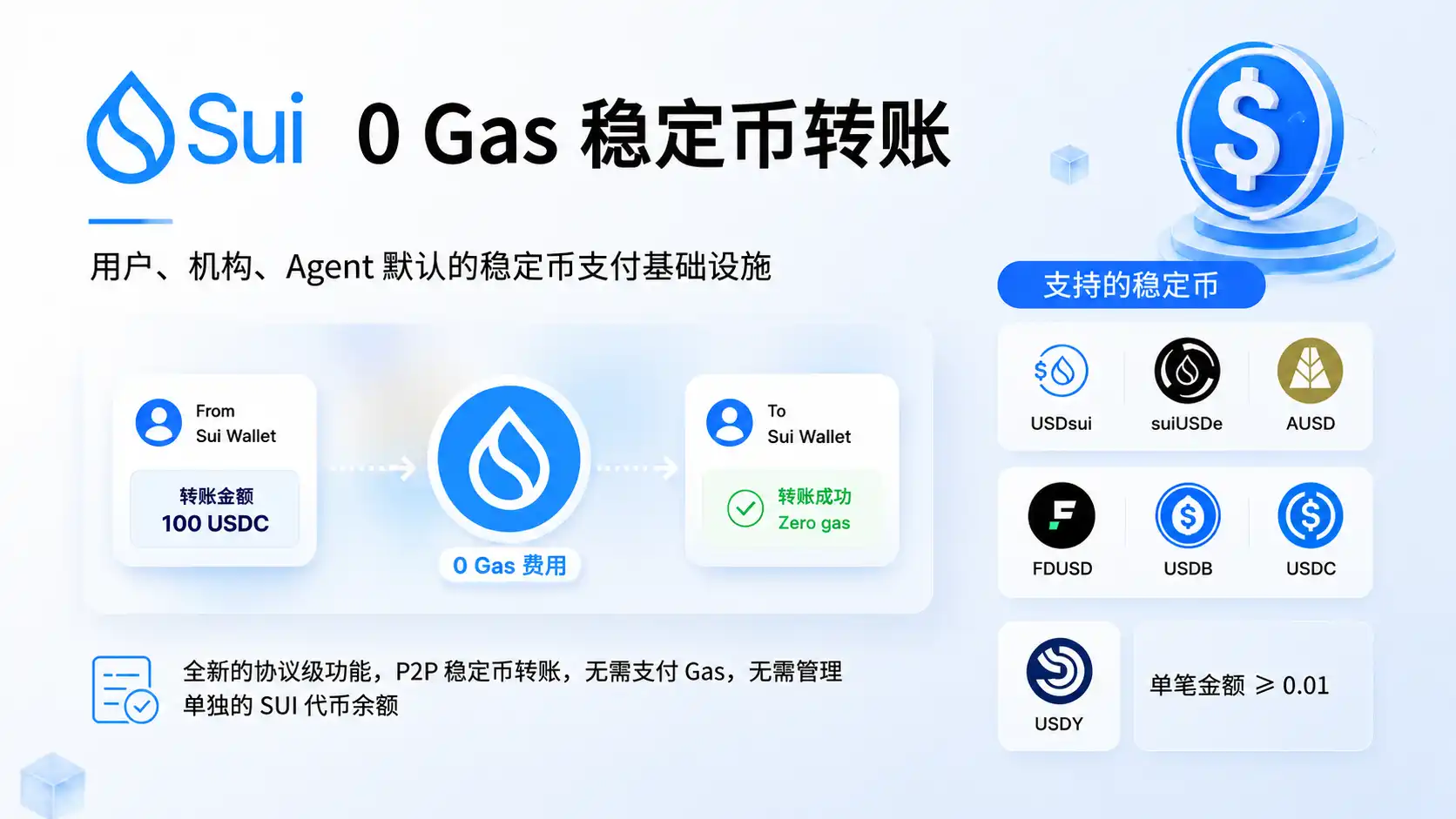
Title: Sui Launches Zero-Gas Stablecoin Transfers to Become the Foundation for Stablecoin Payments Sui has introduced a zero-gas fee feature for peer-to-peer stablecoin transfers, eliminating the need for users or businesses to hold separate SUI tokens to pay transaction costs. This innovation, built on a new underlying account architecture called Address Balances, significantly reduces validator processing costs for eligible transactions. Currently, the feature applies to a whitelist of stablecoins for transfers meeting a minimum amount, effectively preventing spam. This development aims to unlock mainstream payment use cases for stablecoins—such as everyday purchases, remittances, and subscriptions—by removing cost and complexity barriers. It is also positioned to benefit high-frequency micro-payments for AI agents and institutional B2B payments, reducing operational friction. Major custody provider Fireblocks has already announced support. The move follows Sui processing over $1 trillion in stablecoin transfer volume since August 2025. Looking ahead, Sui plans to enhance this infrastructure with protocol-level confidential transactions later in 2026, aiming to provide scalable, free, and privacy-preserving payments. Together, these advancements strengthen Sui's goal of becoming the default settlement layer for stablecoin payments.

marsbit12m ago

When Transfers Become Truly Frictionless: How Sui Uses 'Zero Gas' to Become the Underlying Infrastructure for Stablecoin Payments

marsbit12m ago

Ethereum Is Retracing the Path of the Internet and Linux: No One Yields, and the Neutral Party Ultimately Prevails

This article argues that Ethereum is following the historical path of open, neutral systems like the Internet and Linux, which eventually triumphed over proprietary, centrally-controlled alternatives. Major financial institutions like JPMorgan, Stripe, and Circle are building their own proprietary blockchains or networks (e.g., Tempo, Arc), but will never agree to build on a competitor's controlled infrastructure. This creates the perfect opportunity for Ethereum as the only neutral, credibly neutral settlement layer that no single entity controls. The piece draws parallels to the 1990s, when experts like Bill Gates predicted proprietary networks (from Microsoft, Oracle) would win over the open Internet, and when Sun Microsystems' Unix lost to the open-source "bazaar" development model of Linux. This model, described in Eric Raymond's "The Cathedral and the Bazaar," thrives on permissionless innovation where countless contributors improve the system, outpacing any centralized competitor. Ethereum embodies this through its decentralized development, broad validator distribution, and credible neutrality—rules that are transparent, equally applied, hard to change, and open to all. This has attracted over a million developers and major institutions like Coinbase, BlackRock, and JPMorgan, who choose Ethereum for its security, ecosystem, and sovereignty (the inability of any single party to change the rules). While proprietary chains offer initial speed and control, they inherit the downsides of both centralization and decentralization without the long-term innovation benefits. The article concludes that, just as open systems historically win, Ethereum is poised to become the foundational, neutral settlement layer for global finance.

marsbit21m ago

Ethereum Is Retracing the Path of the Internet and Linux: No One Yields, and the Neutral Party Ultimately Prevails

marsbit21m ago

Kalshi's Biggest Rival is Not Polymarket

Kalshi's CEO Tarek Mansour has identified the company's primary competitors not as the crypto-based prediction market Polymarket, but as established financial and gaming giants: CME Group, Robinhood, and DraftKings. This reflects a shift in the prediction market landscape, where the 2026 FIFA World Cup is expected to bring massive new trading volume. Traditional platforms are increasingly integrating prediction markets as a feature within their existing ecosystems. Robinhood has seen rapid growth with its prediction markets, contributing significantly to its "other transaction revenue." Similarly, Interactive Brokers (IBKR) integrates contracts from Kalshi and CME Group, while DraftKings and FanDuel (via CME) have launched their own prediction products. This allows these firms to leverage their vast user bases and infrastructure at low marginal cost, turning prediction markets from standalone apps into embedded functionalities. In response, prediction market platforms are evolving along two paths. First, they are expanding into new event categories like sports (e.g., the World Cup) and financial data to reduce reliance on election cycles. Second, they are moving towards becoming infrastructure and liquidity providers for distribution platforms. Kalshi's lead over Polymarket in trading volume is partly attributed to this channel strategy, integrating with brokers like Robinhood, Coinbase, and Webull. However, this strategy faces a challenge as distributors like Robinhood begin building their own in-house prediction market capabilities (e.g., Rothera), potentially threatening the value of pure infrastructure providers. The situation parallels historical tech battles, such as Zoom competing with Microsoft Teams and Google Meet, where embedded features in larger platforms reshape market dynamics. The future of standalone prediction market leaders like Kalshi and Polymarket will depend on their ability to navigate this new competitive landscape dominated by integrated financial and gaming titans.

链捕手29m ago

Kalshi's Biggest Rival is Not Polymarket

链捕手29m ago

Trading

Spot
Futures

Hot Articles

How to Buy CHIP

Welcome to HTX.com! We've made purchasing USD.AI (CHIP) simple and convenient. Follow our step-by-step guide to embark on your crypto journey.Step 1: Create Your HTX AccountUse your email or phone number to sign up for a free account on HTX. Experience a hassle-free registration journey and unlock all features.Get My AccountStep 2: Go to Buy Crypto and Choose Your Payment MethodCredit/Debit Card: Use your Visa or Mastercard to buy USD.AI (CHIP) instantly.Balance: Use funds from your HTX account balance to trade seamlessly.Third Parties: We've added popular payment methods such as Google Pay and Apple Pay to enhance convenience.P2P: Trade directly with other users on HTX.Over-the-Counter (OTC): We offer tailor-made services and competitive exchange rates for traders.Step 3: Store Your USD.AI (CHIP)After purchasing your USD.AI (CHIP), store it in your HTX account. Alternatively, you can send it elsewhere via blockchain transfer or use it to trade other cryptocurrencies.Step 4: Trade USD.AI (CHIP)Easily trade USD.AI (CHIP) on HTX's spot market. Simply access your account, select your trading pair, execute your trades, and monitor in real-time. We offer a user-friendly experience for both beginners and seasoned traders.

1.8k Total ViewsPublished 2026.04.21Updated 2026.06.02

How to Buy CHIP

Discussions

Welcome to the HTX Community. Here, you can stay informed about the latest platform developments and gain access to professional market insights. Users' opinions on the price of CHIP (CHIP) are presented below.

活动图片