How to View the Divergence Between Gold and Oil Prices?

marsbitPublished on 2026-03-23Last updated on 2026-03-23

Abstract

The article analyzes the divergence between gold and oil prices following the outbreak of the U.S.-Iran war. While oil prices surged significantly, gold experienced a decline, contrary to expectations given its traditional role as a safe-haven asset during geopolitical crises. Gold serves three primary hedging functions: against geopolitical risk, inflation risk, and U.S. dollar risk. Since late 2023, gold had been in a strong bull market, rising from $1,800 to over $5,000, driven by simultaneous geopolitical tensions (e.g., Russia-Ukraine war, Middle East conflicts), inflationary pressures, and a weakening dollar due to the Fed's premature rate cuts. However, after the U.S. "decapitation" strike on Iran, gold prices fell sharply. This was attributed to two main factors: a shift of capital from gold to oil, as investors repositioned portfolios to capitalize on rising oil prices, and a liquidity crisis in U.S. financial markets that forced large-scale sell-offs of gold—a highly liquid asset—to meet redemption demands. More critically, growing pessimism about a prolonged U.S.-Iran conflict raised fears of sustained high oil prices, potential global economic disruption, and a possible reversal of Fed monetary policy (delayed cuts or even renewed hikes). This expectation of tighter policy caused gold’s dollar-related hedging function to reverse, overwhelming its geopolitical and inflation hedging roles and leading to a severe correction. Oil prices also experienced volatility...

Since the outbreak of the US-Iran war, as two commodities highly correlated with geopolitics, crude oil and gold have shown completely different trends: the former has risen sharply, while the latter has fallen slightly. Why is this?

As a natural currency, gold has three major hedging functions: hedging against geopolitical risks, inflation risks, and US dollar risks. The price of gold is simultaneously influenced by these three forces, thus playing varying degrees of hedging roles at different stages.
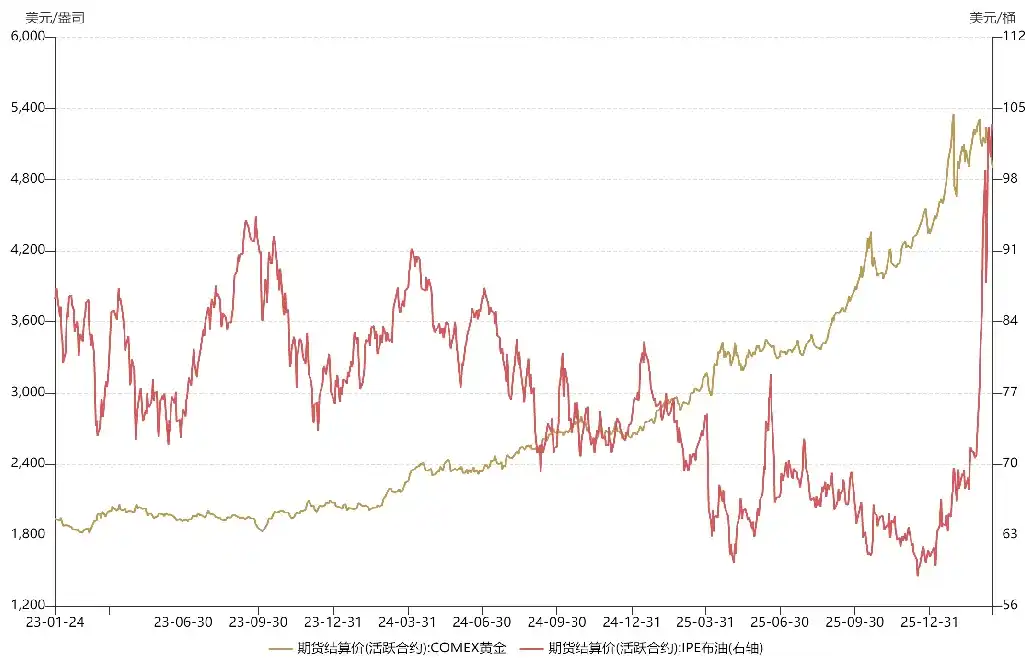
Since the end of 2023, precious metals have experienced a super bull market, with the price of gold soaring from $1,800 to over $5,000. The reason for such strong upward momentum is that gold simultaneously served as a hedge against geopolitical risks, inflation risks, and US dollar risks.

In October 2023, on top of the Russia-Ukraine war, large-scale conflicts broke out between Israel and Palestine, plunging the Middle East into turmoil. In 2024, the Red Sea crisis erupted, and the Bab el-Mandeb Strait was blockaded. In 2025, Trump took office, and the international order became precarious. These are all manifestations of chaotic geopolitical situations, providing strong support for the price of gold.

On the other hand, in 2023, the US economy shifted from overheating to stagflation. By 2024, influenced by political factors, the Federal Reserve boldly initiated an interest rate-cutting cycle before inflation issue was fully resolved, leading to a resurgence of US dollar liquidity. On one hand, there was mid-cycle easing, and on the other, the risk of secondary inflation. Gold simultaneously served as a hedge against US dollar risks and inflation risks, fueling the takeoff of gold prices.

With all three hedging functions in place, how could the price of gold not rise? In addition, benefiting from the Federal Reserve's easing cycle, both emerging and developed markets, whether in A-shares or US stocks, experienced a bull market.

Now, regarding oil prices, last year's average oil price was significantly lower than the previous year. This was because after Trump took office, he persuaded OPEC to significantly increase crude oil production in an attempt to force Russia to make concessions at the negotiating table. This strategy initially worked, with Putin repeatedly softening his stance on peace talks. If not for the US-Iran war, it was expected that Russia and Ukraine would sign a ceasefire agreement in the first half of this year.

Since the outbreak of the Middle East war, the prices of gold and oil have experienced multiple fluctuations, with their trends diverging due to different causes.

For gold, in mid-to-late January (half a month before the war), as the probability of a US-Iran conflict continued to rise, the price of gold increased, reflecting its geopolitical hedging attribute. According to the market's mainstream expectations at the time, this conflict might be similar to last year's "Midnight Hammer" operation, with a short duration, making it more of a temporary trend.

After the US carried out a "decapitation" strike on Iran, the price of gold rebounded briefly but soon plummeted. This was because the main force shifted from gold to crude oil. Due to the excessive concentration of gold holdings earlier, the main funds chose to sell gold to obtain liquidity for going long on crude oil. In other words, the "position switching" from gold to crude oil led to a fall in gold and a rise in oil.

On the other hand, as overseas markets began to price in a prolonged US-Iran war, risk assets such as US stocks came under pressure, triggering a wave of redemptions. The US financial market faced a liquidity crisis, and as an asset with liquidity second only to cash, gold was heavily sold. In other words, the selling pressure on gold in early March was not because international investors were bearish on gold but rather a self-preservation strategy amid the liquidity crisis.

If it were just a liquidity crisis, the price of gold would often form a "deep V" trend, providing buying opportunities. However, the more troublesome part came later. Since mid-March, overseas expectations for the US-Iran conflict have become more pessimistic, with concerns not only about the potential long-term blockade of the strait but also about the possibility of warring parties launching large-scale attacks on each other's energy facilities. This would keep oil prices at relatively high levels for an extended period, dealing a devastating blow to the global economy and even causing the collapse of the international order. In such a scenario, the Federal Reserve might delay its interest rate-cutting pace or even restart a rate-hiking cycle as it did in 2022. Based on this expectation, the price of gold plummeted, with the extent of the correction breaking the highest record in recent years.

In other words, gold's geopolitical hedging function is still at play, but the current sharp decline in gold prices is driven by expectations of a reversal in the Federal Reserve's monetary policy. The US dollar anti-hedging attribute of gold has overshadowed its geopolitical and inflation hedging attributes, becoming its main driver. Compared to previous declines, the fundamentals of gold have changed. It is no longer a liquidity crisis or profit-taking but rather overseas concerns about the tightening of the Federal Reserve's monetary policy. These concerns are also reflected in risk assets such as A-shares and US stocks, as no one is spared when disaster strikes.

Since the outbreak of the US-Iran war, oil prices have also experienced twists and turns. The reason for this volatility is that overseas investors' perception of geopolitics has deviated. After the "decapitation" strike, oil prices continued to rise, reaching nearly $120 per barrel. However, in early March, as Trump hinted that "the war will end soon," the market began executing "TACO" trades, believing that the Iran situation might ease, and oil prices once plummeted by 30%. However, unlike tariff issues, the initiative in a geopolitical crisis does not lie with Trump. He cannot extricate himself easily while the strait is blockaded. Eventually, the market corrected its expectations for oil, and prices returned to an upward trend.

On geopolitical issues, the market sometimes makes misjudgments, but such pricing deviations are not necessarily bad. A drop in oil prices can反而 provide opportunities to add positions, making it easier for latecomers to enter the market.

Looking ahead, the trends of gold and oil prices will depend on the pace of the US-Iran conflict. If it evolves into a prolonged war like the Russia-Ukraine conflict, gold may lack配置 value in the first half of the year, and in the short term, one might focus on the energy chain. However, the situation could still reverse. The US-Iran war may reach a critical turning point, which will determine whether the Strait of Hormuz can be unblocked in the short term. It all depends on Trump's choice.


Related Questions

QAccording to the article, what are the three main safe-haven functions of gold?

AThe three main safe-haven functions of gold are: hedging against geopolitical risks, hedging against inflation risks, and hedging against U.S. dollar risks.

QWhat event in 2025 is mentioned as a factor contributing to the chaotic geopolitical situation that supported gold prices?

ADonald Trump taking office in 2025 is mentioned as a factor that made the international order precarious, contributing to the chaotic geopolitical situation.

QWhy did the price of gold fall sharply after the U.S. 'decapitation' strike on Iran, as explained in the article?

AThe price fell because major funds switched from gold to crude oil, selling gold to obtain liquidity for oil positions. Additionally, a liquidity crisis in U.S. financial markets led to large-scale selling as gold is a highly liquid asset.

QWhat was the main reason for the significant drop in gold prices from mid-March onwards, according to the analysis?

AThe main reason was the market's expectation that the Federal Reserve might delay interest rate cuts or even restart a rate hike cycle due to concerns that the U.S.-Iran conflict could keep oil prices high and severely impact the global economy.

QWhat does the article suggest is the key factor that will determine the future trends of gold and oil prices?

AThe future trends of gold and oil prices will depend on the pace and development of the U.S.-Iran conflict, specifically whether it becomes a protracted war like in Ukraine and the critical issue of whether the Strait of Hormuz can be unblocked in the short term.

Related Reads

North Korean Hackers Loot $500 Million in a Single Month, Becoming the Top Threat to Crypto Security

North Korean hackers, particularly the notorious Lazarus Group and its subgroup TraderTraitor, have stolen over $500 million from cryptocurrency DeFi platforms in less than three weeks, bringing their total theft for the year to over $700 million. Recent major attacks on Drift Protocol and KelpDAO, resulting in losses of approximately $286 million and $290 million respectively, highlight a strategic shift: instead of targeting core smart contracts, attackers are now exploiting vulnerabilities in peripheral infrastructure. For instance, the KelpDAO attack involved compromising downstream RPC infrastructure used by LayerZero's decentralized validation network (DVN), allowing manipulation without breaching core cryptography. This sophisticated approach mirrors advanced corporate cyber-espionage. Additionally, North Korea has systematically infiltrated the global crypto workforce, with an estimated 100 operatives using fake identities to gain employment at blockchain companies, enabling long-term access to sensitive systems and facilitating large-scale thefts. According to Chainalysis, North Korean-linked hackers stole a record $2 billion in 2025, accounting for 60% of all global crypto theft that year. Their total historical crypto theft has reached $6.75 billion. Post-theft, they employ specialized money laundering methods, heavily relying on Chinese OTC brokers and cross-chain mixing services rather than standard decentralized exchanges. Security experts, while acknowledging the increased sophistication, emphasize that many attacks still exploit fundamental weaknesses like poor access controls and centralized operational risks. Strengthening private key management, limiting privileged access, and enhancing coordination among exchanges, analysts, and law enforcement immediately after an attack are critical to improving defense and fund recovery chances. The industry's challenge now extends beyond secure smart contracts to safeguarding operational security at the infrastructure level.

marsbit35m ago

North Korean Hackers Loot $500 Million in a Single Month, Becoming the Top Threat to Crypto Security

marsbit35m ago

Circle CEO's Seoul Visit: No Korean Won Stablecoin Issuance, But Met All Major Korean Banks

Circle CEO Jeremy Allaire's recent activities in Seoul indicate a strategic shift for the company, moving away from issuing a Korean won-backed stablecoin and instead focusing on embedding itself as a key infrastructure provider within Korea’s financial and crypto ecosystem. Despite Korea accounting for nearly 30% of global crypto trading volume—with a market characterized by high retail participation and altcoin dominance—Circle has chosen not to compete for the role of stablecoin issuer. Instead, Allaire met with major Korean banks (including Shinhan, KB, and Woori), financial groups, leading exchanges (Upbit, Bithumb, Coinone), and tech firms like Kakao. This approach reflects a broader industry transition: the core of stablecoin competition is shifting from issuance rights to systemic positioning. With Korean regulators still debating whether banks or tech companies should issue stablecoins, Circle is avoiding regulatory uncertainty by strengthening its role as a service and technology partner. The company is deepening integration with trading platforms, building connections, and promoting stablecoin infrastructure. This positions Circle to benefit regardless of which entity eventually issues a won stablecoin. Allaire also noted the potential for a Chinese yuan stablecoin in the next 3–5 years, underscoring a regional trend of stablecoins becoming more regulated and integrated with traditional finance. Ultimately, Circle’s strategy highlights that future influence in the stablecoin market will belong not necessarily to the issuers, but to the foundational infrastructure layers that enable cross-system transactions.

marsbit1h ago

Circle CEO's Seoul Visit: No Korean Won Stablecoin Issuance, But Met All Major Korean Banks

marsbit1h ago

SpaceX Ties Up with Cursor: A High-Stakes AI Gambit of 'Lock First, Acquire Later'

SpaceX has secured an option to acquire AI programming company Cursor for $60 billion, with an alternative clause requiring a $10 billion collaboration fee if the acquisition does not proceed. This structure is not merely a potential acquisition but a strategic move to control core access points in the AI era. The deal is designed as a flexible, dual-path arrangement, allowing SpaceX to either fully acquire Cursor or maintain a binding partnership through high-cost collaboration. This "option-style" approach minimizes immediate regulatory and integration risks while ensuring long-term alignment between the two companies. At its core, the transaction exchanges critical AI-era resources: SpaceX provides its Colossus supercomputing cluster—one of the world’s most powerful AI training infrastructures—while Cursor contributes its AI-native developer environment and strong product adoption. This synergy connects compute power, models, and application layers, forming a closed-loop AI capability stack. Cursor, founded in 2022, has achieved rapid growth with over $1 billion in annual revenue and widespread enterprise adoption. Its value lies in transforming software development through AI agents capable of coding, debugging, and system design—positioning it as a gateway to future software production. For SpaceX, this move is part of a broader strategy to evolve from a aerospace company into an AI infrastructure empire, integrating xAI, supercomputing, and chip manufacturing. Controlling Cursor fills a gap in its developer tooling layer, strengthening its AI narrative ahead of a potential IPO. The deal reflects a shift in AI competition from model superiority to ecosystem and entry-point control. With programming tools as a key battleground, securing developer loyalty becomes crucial for dominating the software production landscape. Risks include questions around Cursor’s valuation, technical integration challenges, and potential regulatory scrutiny. Nevertheless, the deal underscores a strategic bet: controlling both compute and software development access may redefine power dynamics in the AI-driven future.

marsbit1h ago

SpaceX Ties Up with Cursor: A High-Stakes AI Gambit of 'Lock First, Acquire Later'

marsbit1h ago

Trading

Spot
Futures

Hot Articles

How to Buy WAR

Welcome to HTX.com! We've made purchasing WAR (WAR) simple and convenient. Follow our step-by-step guide to embark on your crypto journey.Step 1: Create Your HTX AccountUse your email or phone number to sign up for a free account on HTX. Experience a hassle-free registration journey and unlock all features.Get My AccountStep 2: Go to Buy Crypto and Choose Your Payment MethodCredit/Debit Card: Use your Visa or Mastercard to buy WAR (WAR) instantly.Balance: Use funds from your HTX account balance to trade seamlessly.Third Parties: We've added popular payment methods such as Google Pay and Apple Pay to enhance convenience.P2P: Trade directly with other users on HTX.Over-the-Counter (OTC): We offer tailor-made services and competitive exchange rates for traders.Step 3: Store Your WAR (WAR)After purchasing your WAR (WAR), store it in your HTX account. Alternatively, you can send it elsewhere via blockchain transfer or use it to trade other cryptocurrencies.Step 4: Trade WAR (WAR)Easily trade WAR (WAR) on HTX's spot market. Simply access your account, select your trading pair, execute your trades, and monitor in real-time. We offer a user-friendly experience for both beginners and seasoned traders.

1.7k Total ViewsPublished 2024.03.29Updated 2026.03.18

How to Buy WAR

Discussions

Welcome to the HTX Community. Here, you can stay informed about the latest platform developments and gain access to professional market insights. Users' opinions on the price of WAR (WAR) are presented below.

活动图片