World's Largest Crypto ATM Operator Bitcoin Depot Files for Bankruptcy, All 9,700 Machines Shut Down

marsbitPublished on 2026-05-20Last updated on 2026-05-20

Abstract

Bitcoin Depot, once the world's largest cryptocurrency ATM operator with roughly 9,700 machines, has filed for Chapter 11 bankruptcy and ceased operations. The company cited an unsustainable business model due to intensified regulatory pressure across multiple U.S. states. Crackdowns included new transaction limits, license suspensions, and direct bans, driven by concerns over the machines facilitating fraud. The FBI reported $389 million in consumer losses via crypto ATMs in 2025. Over the past six months, states like Connecticut, Missouri, Nevada, and Massachusetts took action against Bitcoin Depot, including lawsuits alleging it profited from scams. This regulatory assault caused the company's quarterly revenue to plunge nearly 50% year-over-year. Stricter anti-fraud measures, such as mandatory identity verification implemented in February, further reduced user activity. Additionally, the company faced mounting legal fees from multiple lawsuits and a nearly $19 million arbitration ruling related to a Canadian subsidiary dispute.

Author:Ben Dooley

Compiled by:Deep Chao TechFlow

Deep Chao Insight: Crypto ATMs, once ubiquitous in convenience stores across the United States, are now retreating en masse under regulatory pressure. The world's largest crypto ATM operator, Bitcoin Depot, filed for Chapter 11 bankruptcy protection on May 18th, with approximately 9,700 of its machines ceasing operations. The direct cause is a wave of state-level regulations, including transaction limits, license suspensions, and anti-fraud lawsuits—FBI data shows consumers lost $389 million through crypto ATM scams in 2025. This report from the ICIJ (International Consortium of Investigative Journalists) reviews the journey of this publicly traded company from expansion to collapse.
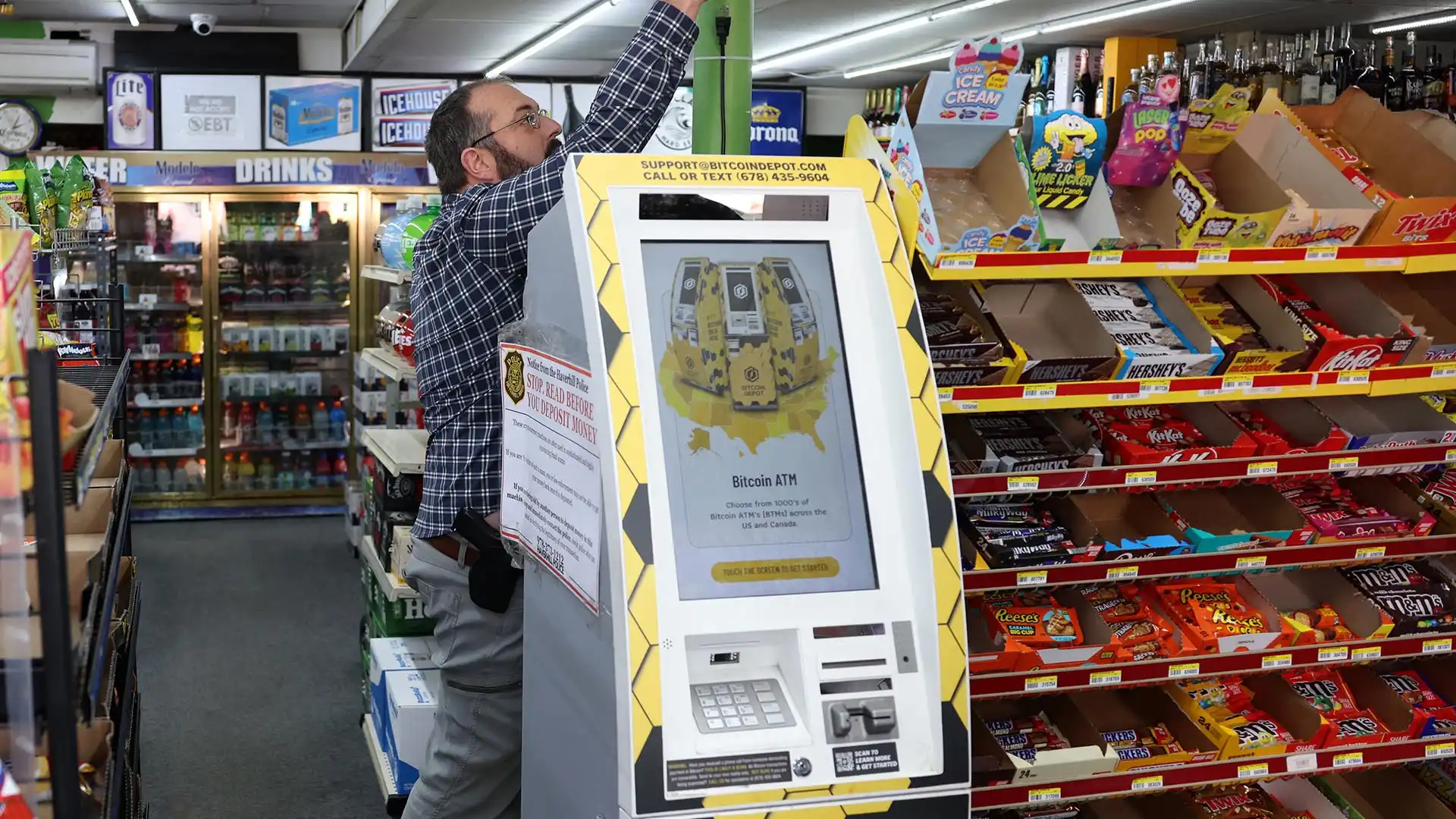
Caption: A police officer disconnecting the power to a Bitcoin Depot ATM inside a convenience store in Haverhill, Massachusetts, on April 6, 2026.

Image source: Jessica Rinaldi/The Boston Globe via Getty Images

Bitcoin Depot, once the world's largest cryptocurrency ATM operator, officially filed for bankruptcy protection on May 18th. This company, long accused of facilitating scams, delivered another blow to the industry.

CEO Alex Holmes stated in a declaration on the company's website that all approximately 9,700 crypto ATMs operated by the company have been taken offline and operations will cease.

Holmes attributed the failure to "increasingly stringent compliance requirements, including new transaction limits, and direct restrictions or bans on crypto ATMs in certain jurisdictions," which made the business model unsustainable.

Over the past year, local and state governments across the U.S. have significantly tightened regulations on crypto ATMs. These machines function similarly to bank ATMs but are used to exchange cash for cryptocurrency. Due to concerns that these machines are being used as tools for scams, regulators have launched investigations into operators.

FBI data shows that consumers lost $389 million through crypto ATM scams in 2025. Scammers use these machines to quickly transfer victims' funds overseas, beyond the reach of U.S. law enforcement.

Crackdown by Multiple States in Six Months, Quarterly Revenue Plunges Nearly 50%

As the largest crypto ATM operator, Bitcoin Depot became a prime target for regulators. How intensive was the crackdown in the past six months?

Connecticut revoked Bitcoin Depot's banking license for inadequate anti-money laundering controls; the Missouri Attorney General launched an investigation into the company and other crypto ATM businesses; Nevada and Maine reached enforcement settlements with the company, requiring fines and compliance with state rules. The Massachusetts Attorney General directly sued Bitcoin Depot, alleging that a significant portion of its revenue came from crypto scams. The Iowa Attorney General's office also filed a lawsuit.

The impact on financial reports is startling. A filing Bitcoin Depot submitted to the SEC earlier this month showed revenue for the quarter ending in March plummeted nearly 50% year-over-year. The primary reasons cited were "state and municipal regulations prohibiting or restricting crypto ATMs, capping fees, limiting transaction amounts," as well as the company's own, necessary implementation of "stricter" compliance and anti-fraud measures, such as enhanced KYC (Know Your Customer) processes.

In February of this year, the company announced that all transactions would require customer identity verification. This made it harder for scammers to use the machines but also drove away a large number of users.

Bogged Down in Lawsuits, Mounting Legal Fees

While revenue plummeted, Bitcoin Depot was also burdened with massive legal fees. Bankruptcy filings show the company faces multiple lawsuits all pointing to the same issue: failing to take sufficient measures to prevent scam transactions from occurring through its machines. Additionally, an arbitration ruling related to a business dispute with a Canadian subsidiary in late 2025 saddled the company with nearly $19 million in damages.

A joint investigation by ICIJ and CNN in 2025 found that at least $1.5 million in scam transactions were completed through hundreds of Bitcoin Depot machines installed inside Circle K convenience stores. Bitcoin Depot paid millions in leasing fees to Circle K while taking a cut from each transaction.

The investigation found that Circle K management was aware of the problem but continued its partnership with Bitcoin Depot.


Trending Cryptos

Related Questions

QWhat was the primary reason cited by Bitcoin Depot's CEO for the company's decision to file for bankruptcy and cease operations?

AThe primary reason cited by CEO Alex Holmes was 'increasing compliance demands, including new transaction limits, and outright restrictions or bans on cryptocurrency ATMs in some jurisdictions,' which made the company's business model unsustainable.

QAccording to the article, how much money did consumers lose through scams via crypto ATMs in 2025 based on FBI data?

AAccording to FBI data, consumers lost $389 million through scams via cryptocurrency ATMs in 2025.

QWhat specific regulatory actions did various US states take against Bitcoin Depot in the six months leading to its bankruptcy?

AConnecticut revoked its banking license for weak anti-money laundering controls; Missouri's attorney general launched an investigation; Nevada and Maine reached enforcement settlements requiring fines and rule compliance; Massachusetts sued it, alleging most revenue came from crypto scams; and Iowa's attorney general also filed a lawsuit.

QWhat major operational change did Bitcoin Depot implement in February, and what was its impact?

AIn February, Bitcoin Depot announced it would require identity verification for all transactions. While this made it harder for scammers to use the machines, it also drove away a significant number of users.

QWhat did a 2025 investigation by ICIJ and CNN reveal about Bitcoin Depot's machines in Circle K stores?

AThe investigation revealed that at least $1.5 million in fraudulent transactions were conducted through hundreds of Bitcoin Depot machines installed in Circle K convenience stores, and that Circle K management was aware of the problem but continued the partnership.

Related Reads

The Verdict in Choi Tae-won's Divorce Case: Revealing the Inheritance Undercurrent Behind SK Hynix's Trillion-Won Empire

SK Group Chairman Chey Tae-won's high-profile divorce case, involving a record 1.38 trillion won settlement, has drawn attention to the succession plans for Korea's second-largest conglomerate, especially its crown jewel, SK hynix. Unlike traditional chaebol scripts centered on the eldest son, Chey's three children from his marriage to former President Roh Tae-woo's daughter, Roh Soh-yeong, are carving distinct, non-traditional paths. Eldest daughter Chey Yun-jung (b. 1989) is seen as the most evident successor. With a scientific and consulting background, she holds executive roles at SK bioscience and SK Inc.'s growth support department, focusing on future strategy and biopharma. Her marriage is to an AI infrastructure entrepreneur, not a traditional business alliance. Second daughter Chey Min-jung (b. 1991) took a unique route, voluntarily serving as a South Korean naval officer, including an anti-piracy deployment. She later worked on policy and strategy for SK hynix in Washington D.C. before co-founding an AI-driven healthcare startup. She married a former U.S. Marine Corps officer, connecting her to U.S. defense and policy circles—networks crucial for a global semiconductor giant. The only son, Chey In-geun (b. 1995), who studied physics like his father, worked briefly at SK E&S before joining McKinsey. Despite fitting the traditional "heir" profile as the eldest son, he remains silent and holds no public position or shares in SK, suggesting the old succession playbook is obsolete. As SK hynix's valuation soars, becoming a geopolitical asset in the AI era, the heirs' legitimacy is no longer automatic. They must prove themselves in fields like AI biotech, global policy, and strategic consulting. Their marriages also reflect new elite networks in tech and defense, not old political alliances. Their inheritance is the complex challenge of navigating a globalized, tech-driven world, not just a corporate throne.

marsbit2 days ago 09:06

The Verdict in Choi Tae-won's Divorce Case: Revealing the Inheritance Undercurrent Behind SK Hynix's Trillion-Won Empire

marsbit2 days ago 09:06

From OpenSea to OpenRouter: Is Alex Atallah Repeating His 'Exit at the Peak' Playbook?

From OpenSea to OpenRouter: Is Alex Atallah Repeating His "Exit at the Peak" Playbook? According to the Wall Street Journal, payments giant Stripe is in talks to acquire the AI model aggregation platform OpenRouter in a potential deal valuing the company near $100 billion. This would mark founder Alex Atallah's second creation of a company reaching a $100 billion valuation, following his co-founding of NFT marketplace OpenSea. OpenRouter, founded just over three years ago, has grown rapidly by acting as a unified gateway for developers to access over 400 AI models. It currently has about 10 million users and processes over 200 trillion tokens monthly. While the platform's annualized revenue is around $50 million, its valuation has skyrocketed from $1.3 billion in March 2026. The potential acquisition by Stripe, a company OpenRouter's founder once likened it to, represents a major expansion into AI infrastructure for the payments leader. This move echoes Atallah's previous timing with OpenSea, where he departed before the NFT market's significant downturn. For OpenRouter, selling now may be strategic. Despite its scale, its business model—charging a 5-5.5% fee on AI inference calls—faces pressure from competition, open-source models, and potential price wars among model providers, limiting its profitability narrative for an IPO. A key asset for potential acquirers like Stripe is OpenRouter's vast repository of real-world AI usage data, which offers unique insights into model performance and developer preferences that are difficult to replicate. Whether this potential deal signifies a new valuation benchmark for AI infrastructure or another market peak signal remains to be seen.

链捕手2 days ago 08:42

From OpenSea to OpenRouter: Is Alex Atallah Repeating His 'Exit at the Peak' Playbook?

链捕手2 days ago 08:42

Trading

Spot

Hot Articles

Discussions

Welcome to the HTX Community. Here, you can stay informed about the latest platform developments and gain access to professional market insights. Users' opinions on the price of S (S) are presented below.

活动图片