Ripple Joins Top 10 Global Private Companies With A $50B Valuation

bitcoinistPublished on 2026-02-10Last updated on 2026-02-10

Abstract

Ripple has been ranked among the top 10 most valuable private companies globally, with an estimated valuation of $50 billion, according to a widely shared "unicorn companies" list on X. This positions Ripple alongside major AI and fintech firms like OpenAI, ByteDance, and SpaceX. The valuation marks a significant increase from its $40 billion late-2025 financing, suggesting a sharp upward revaluation. Unlike public companies, Ripple's value is shaped by private transactions, including share buybacks at lower valuations in 2022 and 2024. The ranking reframes Ripple as a large-scale payments infrastructure business rather than a crypto-focused narrative. However, with no imminent IPO plans, its valuation remains subject to periodic private market activity. At the time of reporting, XRP was trading at $1.40.

Ripple has been slotted into the global top 10 of the most valuable private companies at an estimated $50 billion valuation, according to a widely shared “unicorn companies” table circulating on X.

The ranking matters because it reframes Ripple less as a single-token narrative and more as a scaled private-market franchise: a payments infrastructure firm that, at least in secondary valuation terms, is now being discussed in the same breath as the largest AI and fintech “super-unicorns.”

Ripple Ranks #9 Among World’s Largest Private Companies

The image that has been widely reposted on X presents a “List of unicorn companies” with Ripple highlighted at a $50 billion valuation. In that snapshot, Ripple appears alongside a cohort dominated by AI, fintech, and consumer platforms, including OpenAI ($500B), ByteDance ($480B), SpaceX ($400B), Anthropic ($350B), xAI ($230B), Databricks ($100B), Revolut ($75B), Stripe ($70B), and Shein ($66B).
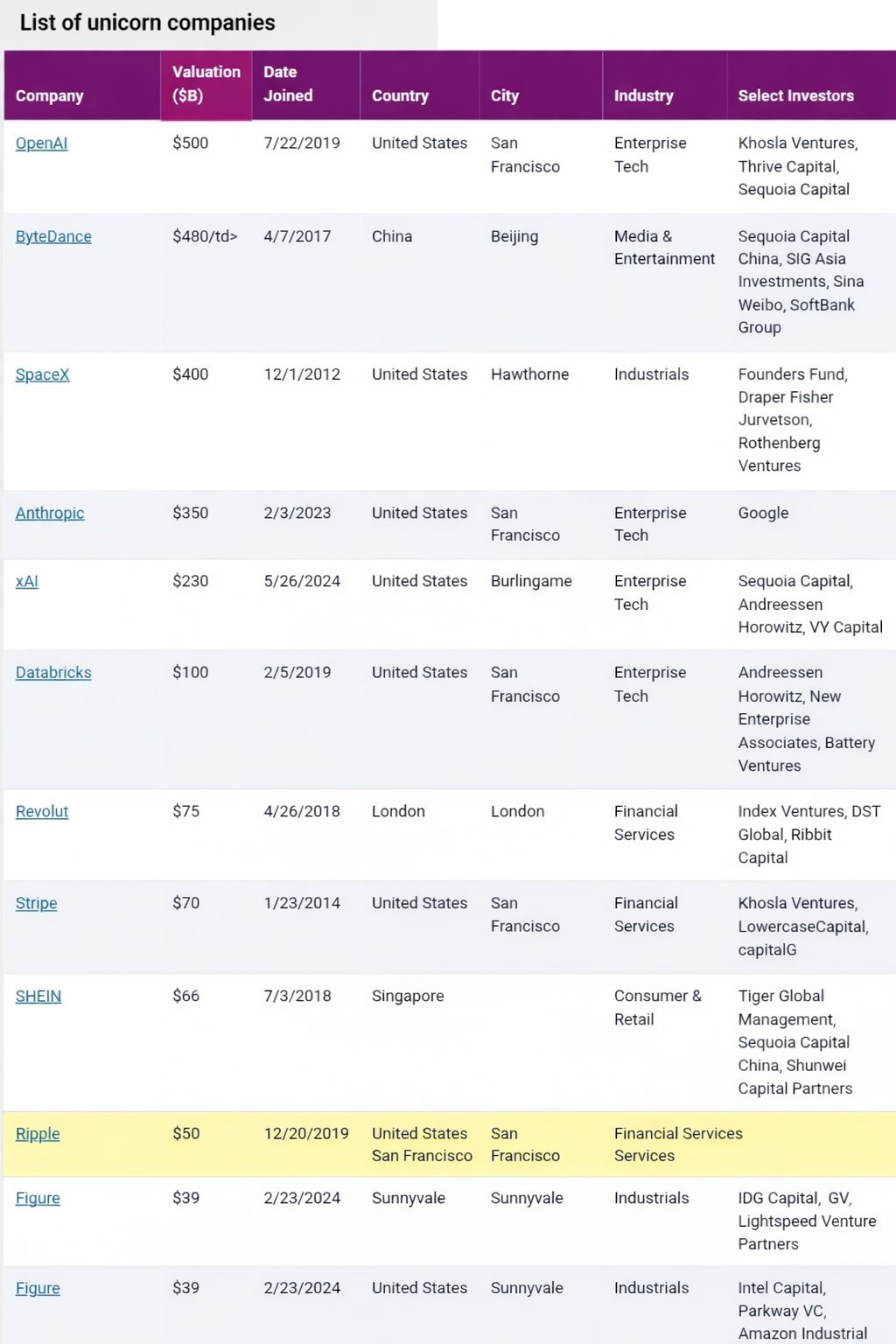
Ripple valuation enters top 10 | Source: X @Xaif_Crypto

A $50 billion tag implies a step-up from a $40 billion post-money valuation associated with a late-2025 equity financing. Taking those two marks at face value, the move to $50 billion represents roughly a 25% increase in implied enterprise value in a short window, an unusually sharp change for a late-stage private company unless secondary markets are repricing aggressively or a new transaction has reset expectations.

Ripple’s private valuation history has also been shaped by company-led liquidity events. The firm has previously conducted share repurchases that effectively created valuation reference points for employees and early investors, including buybacks at an implied $15 billion valuation in 2022 and $11.3 billion in early 2024. Against that backdrop, the late-2025 jump to $40 billion and the current $50 billion figure depict a company whose private-market value has been re-marked upward in distinct steps rather than through the continuous feedback loop of public markets.

That context also matters for how traders and allocators interpret the headline. Private valuations are not the same thing as liquid market prices, and they can reflect transaction structure, preferred terms, or limited float dynamics as much as broad investor consensus. Still, when a company starts appearing on top-10 private-company lists dominated by AI and mega-fintech, it signals that the market increasingly views it as an infrastructure-scale business rather than a niche crypto-adjacent story.

The valuation narrative is also colliding with IPO expectations and Ripple’s consistent stance that a listing is not imminent. With no near-term plan or timeline to go public, Ripple’s price discovery remains anchored to episodic financings and tender offers, meaning the next meaningful datapoint could come from another private round, a new buyback, or secondary transactions that leak into the market.

For crypto markets, the immediate implication isn’t a direct token catalyst so much as a reframing of Ripple’s corporate footprint. If the $50 billion valuation is true, it sets a higher bar for how investors model the company’s optionality: whether that’s future capital raising, M&A capacity, or leverage in institutional partnerships. If it doesn’t, the episode will still have demonstrated how quickly private-market narratives can harden into “consensus” once a single, shareable number hits the timeline.

At press time, XRP traded at $1.40.
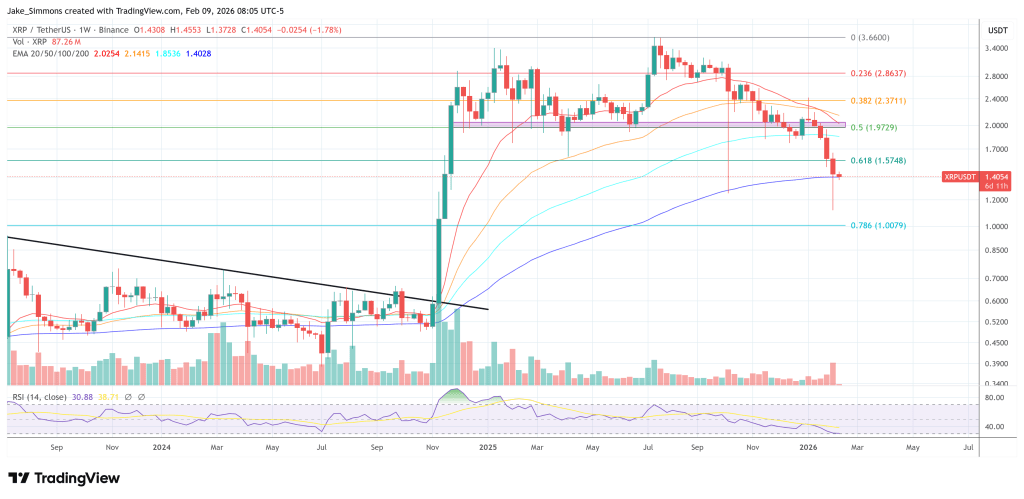
XRP holds above the 200-week EMA, 1-week chart | Source: XRPUSDT on TradingView.com

Trending Cryptos

Related Questions

QWhat is Ripple's estimated valuation according to the widely shared 'unicorn companies' table?

ARipple's estimated valuation is $50 billion.

QHow does the $50 billion valuation rank Ripple among global private companies?

AIt ranks Ripple as the #9 most valuable private company in the world.

QWhat type of companies dominate the top 10 list alongside Ripple?

AThe list is dominated by AI, fintech, and consumer platform companies.

QWhat does the article say about Ripple's plans for an IPO?

ARipple has a consistent stance that an IPO is not imminent, with no near-term plan or timeline to go public.

QWhat was the price of XRP at the time the article was published?

AXRP traded at $1.40 at press time.

Related Reads

27-Year Reign Ends: SK Hynix Market Cap Surpasses Samsung for First Time, an AI-Driven Reshuffle of Korean Chip Power

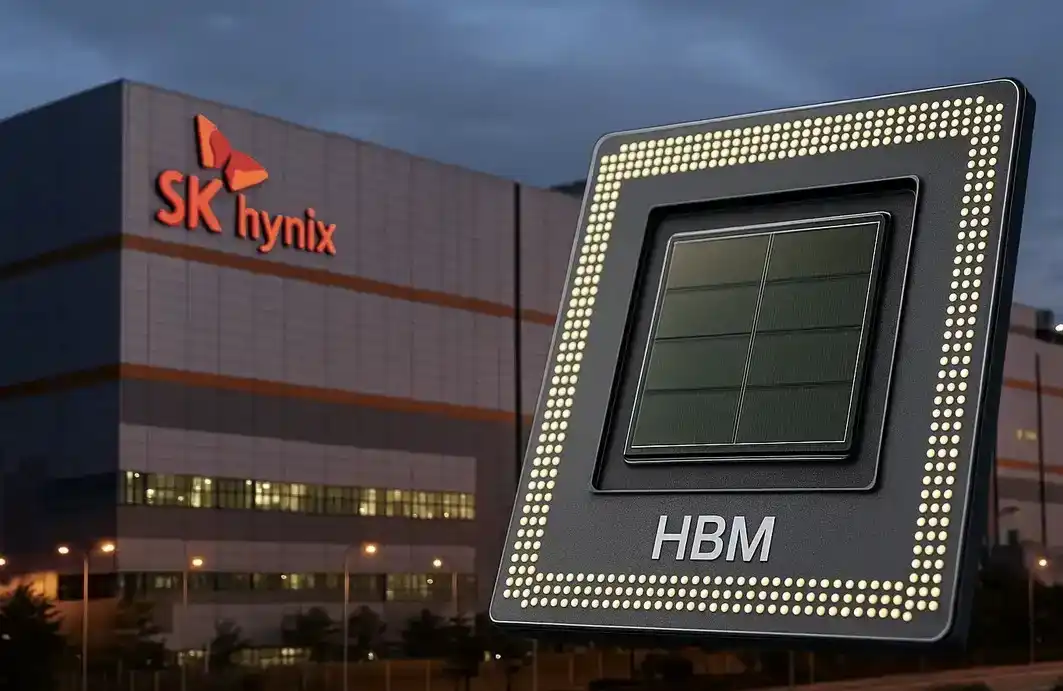
On June 22, 2026, SK Hynix made history by surpassing Samsung Electronics in market capitalization, ending Samsung's 27-year reign as South Korea's most valuable company. This dramatic reversal is powered by the AI boom and SK Hynix's dominant position in High Bandwidth Memory (HBM), a critical component for AI model training. Once a heavily indebted firm on the brink of bankruptcy, SK Hynix bet early on HBM, which has evolved from a niche product to essential AI infrastructure. It now commands a 59% share of the global HBM market. Its financial performance is staggering, with Q1 2026 net profit soaring nearly fourfold year-over-year to KRW 40.35 trillion, translating to over 2 billion RMB in daily net profit. HBM now drives roughly 40% of its revenue with exceptionally high margins. In contrast, Samsung, with its broad portfolio spanning memory chips, smartphones, and foundry services, has lagged in the HBM race while facing headwinds in other divisions. This shift signifies a deeper restructuring of South Korea's economy, moving from consumer electronics to AI-driven growth. However, the future remains competitive. With major capacity expansions planned industry-wide by 2028 and Samsung aiming to catch up in HBM technology, the new market leader cannot afford complacency. This event marks a pivotal moment in the global semiconductor industry's ongoing power realignment.

marsbit9m ago

27-Year Reign Ends: SK Hynix Market Cap Surpasses Samsung for First Time, an AI-Driven Reshuffle of Korean Chip Power

marsbit9m ago

Why Does 'AGI Godfather' Ben Goertzel Believe the Future of AI Relies on Blockchain?

Ben Goertzel, known as the "AGI Godfather," argues that the future of Artificial General Intelligence (AGI) must be built on blockchain to prevent its control by a few corporations or venture capital firms. He believes the core AGI code should be free and open-source, but that this alone is insufficient without a decentralized infrastructure to run it affordably. His blockchain project, SingularityNET, and the broader Artificial Superintelligence Alliance aim to create a user-owned, decentralized network for hosting and deploying AGI, contrasting with the closed models of companies like OpenAI and Anthropic. Goertzel criticizes the shift of other labs from open to closed development. He argues that while a closed path is simpler, an open, decentralized model—akin to Linux and the internet—is both possible and ultimately better for humanity. He envisions an "Agent economy" where individuals orchestrate teams of AI agents to perform tasks, including transactions, on an open network rather than corporate clouds. While his current model relies on cryptocurrency, plans include offering paid AI services to businesses with the decentralized blockchain as the backend. Goertzel predicts human-level AGI could arrive by 2029 and warns that a gap in understanding and access to AGI could drastically worsen inequality. The first test of his decentralized approach will be the upcoming release of the Agent Omega Claw.

Foresight News40m ago

Why Does 'AGI Godfather' Ben Goertzel Believe the Future of AI Relies on Blockchain?

Foresight News40m ago

Trading

Spot
Futures

Hot Articles

How to Buy COMP

Welcome to HTX.com! We've made purchasing Compound (COMP) simple and convenient. Follow our step-by-step guide to embark on your crypto journey.Step 1: Create Your HTX AccountUse your email or phone number to sign up for a free account on HTX. Experience a hassle-free registration journey and unlock all features.Get My AccountStep 2: Go to Buy Crypto and Choose Your Payment MethodCredit/Debit Card: Use your Visa or Mastercard to buy Compound (COMP) instantly.Balance: Use funds from your HTX account balance to trade seamlessly.Third Parties: We've added popular payment methods such as Google Pay and Apple Pay to enhance convenience.P2P: Trade directly with other users on HTX.Over-the-Counter (OTC): We offer tailor-made services and competitive exchange rates for traders.Step 3: Store Your Compound (COMP)After purchasing your Compound (COMP), store it in your HTX account. Alternatively, you can send it elsewhere via blockchain transfer or use it to trade other cryptocurrencies.Step 4: Trade Compound (COMP)Easily trade Compound (COMP) on HTX's spot market. Simply access your account, select your trading pair, execute your trades, and monitor in real-time. We offer a user-friendly experience for both beginners and seasoned traders.

3.8k Total ViewsPublished 2024.03.29Updated 2026.06.02

How to Buy COMP

Discussions

Welcome to the HTX Community. Here, you can stay informed about the latest platform developments and gain access to professional market insights. Users' opinions on the price of COMP (COMP) are presented below.

活动图片