Author: Stacy Muur
Compiled by: Deep Tide TechFlow
Original link: https://x.com/stacy_muur/status/2019325467116126348
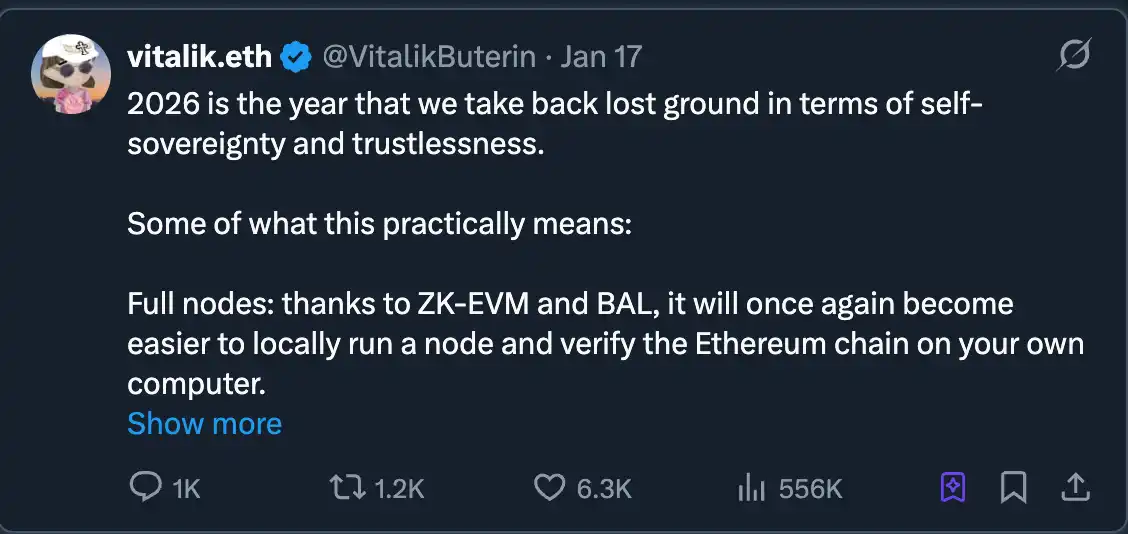
Deep Tide Guide: Over the past decade, Ethereum has made carefully calculated compromises. It traded trustlessness for convenience, self-sovereignty for user experience, and decentralization for mainstream adoption. But 2026 marks a turning point. This is the year Ethereum stops asking, "Is it worth diluting ourselves for mainstream adoption?" The answer is—no longer worth it. Stacy Muur details Vitalik's vision: Making full nodes easy to run again with ZK-EVM + block-level access lists, achieving verifiable RPC with Helios light client, enabling private payments with ORAM/PIR, moving beyond fragile seed phrases with social recovery, creating unstoppable dapp UIs with IPFS hosting, and achieving censorship-resistant block building with FOCIL. The recentralization of the infrastructure layer must end.
Over the past decade, Ethereum has made carefully calculated compromises. It traded trustlessness for convenience, self-sovereignty for user experience, and decentralization for mainstream adoption.
Every time you check your wallet balance, you are trusting a company like Alchemy or Infura. Every time you use a dapp, your data leaks to servers you never chose.
But 2026 marks a turning point. This is the year Ethereum stops asking, "Is it worth diluting ourselves for mainstream adoption?" The answer is—no longer worth it.

Vision
- Full nodes easy to run again (ZK-EVM + block-level access lists)
- Verifiable RPC instead of blind trust (Helios light client)
- Private payments with a public payment experience
- Wallets beyond fragile seed phrases (social recovery)
- Unstoppable dapp UIs (IPFS hosting)
- Censorship-resistant block building (FOCIL)
Problem: Recentralization of Infrastructure
Even if the base layer remains decentralized, Ethereum's infrastructure has become increasingly centralized.
Nodes went from laptop-friendly to requiring 800+ GB of storage and 24-hour sync times. Dapps evolved from simple HTML pages to server-side monsters that leak your data everywhere. Wallets shifted from user-controlled RPCs to hardcoded providers that track everything you do.
Most strikingly, 80-90% of Ethereum blocks are now produced by just 2 builders. This concentration puts transaction inclusion under the control of a few entities who can censor anything they want.
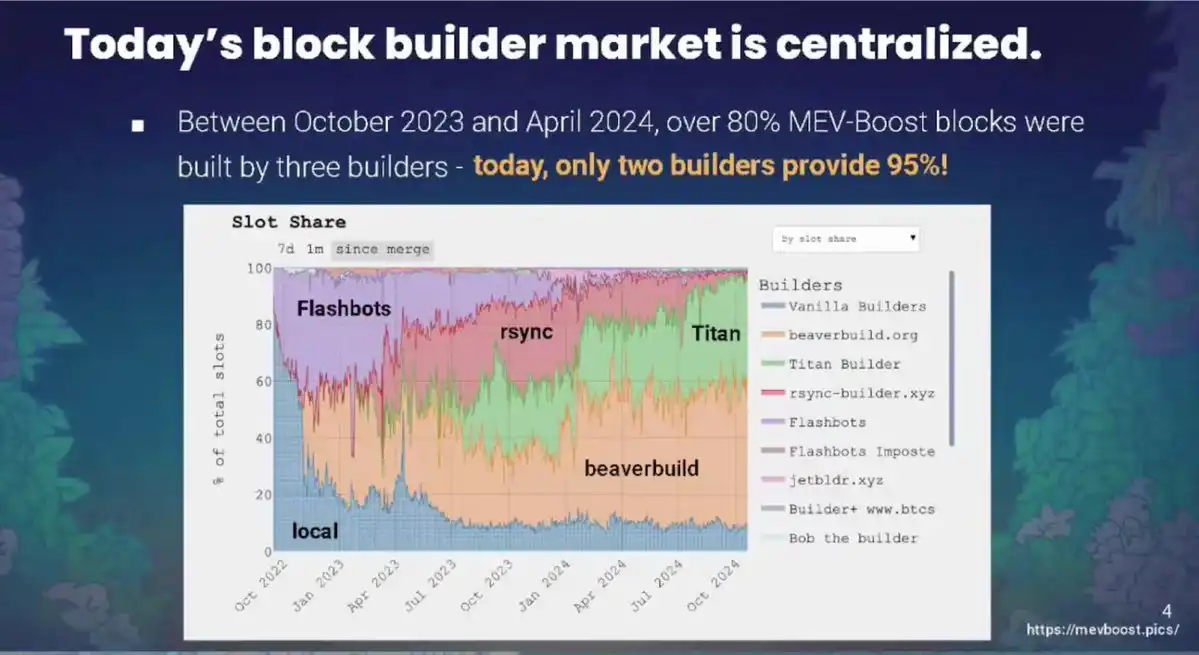
These are not mistakes; they were pragmatic choices made when scaling under Proof-of-Work constraints.
But the costs are real: trust assumptions crept into "trustless" systems, single points of failure proliferated, and users lost true self-sovereignty. We decentralized the ledger but recentralized the access layer.
The 2026 Landscape
Full Nodes
Today's reality: 800+ GB storage, 24-hour sync, requires constant operation. Most users give up.
Block-level access lists (BAL) fundamentally change this. Think of BAL as a directory for each block; it tells you in advance which state the block will touch. Your computer prefetches everything in parallel before execution begins. Non-conflicting transactions run concurrently on separate cores. Analysis shows 60-80% of transactions have no overlap.
Combined with ZK proofs that verify blocks without re-executing everything, sync times plummet and storage becomes manageable. Running a node shifts from "infrastructure companies only" back to "decent laptop territory."
Helios: Verifiable RPC
Imagine this attack: You swap on Uniswap. Your malicious RPC shows you a fake price. You sign to accept fewer tokens than you deserve. The RPC executes a sandwich attack and keeps the profit. You never see it coming.
This hasn't happened with major providers yet, but it's technically possible. The problem: you're trusting someone else to tell you the blockchain state.
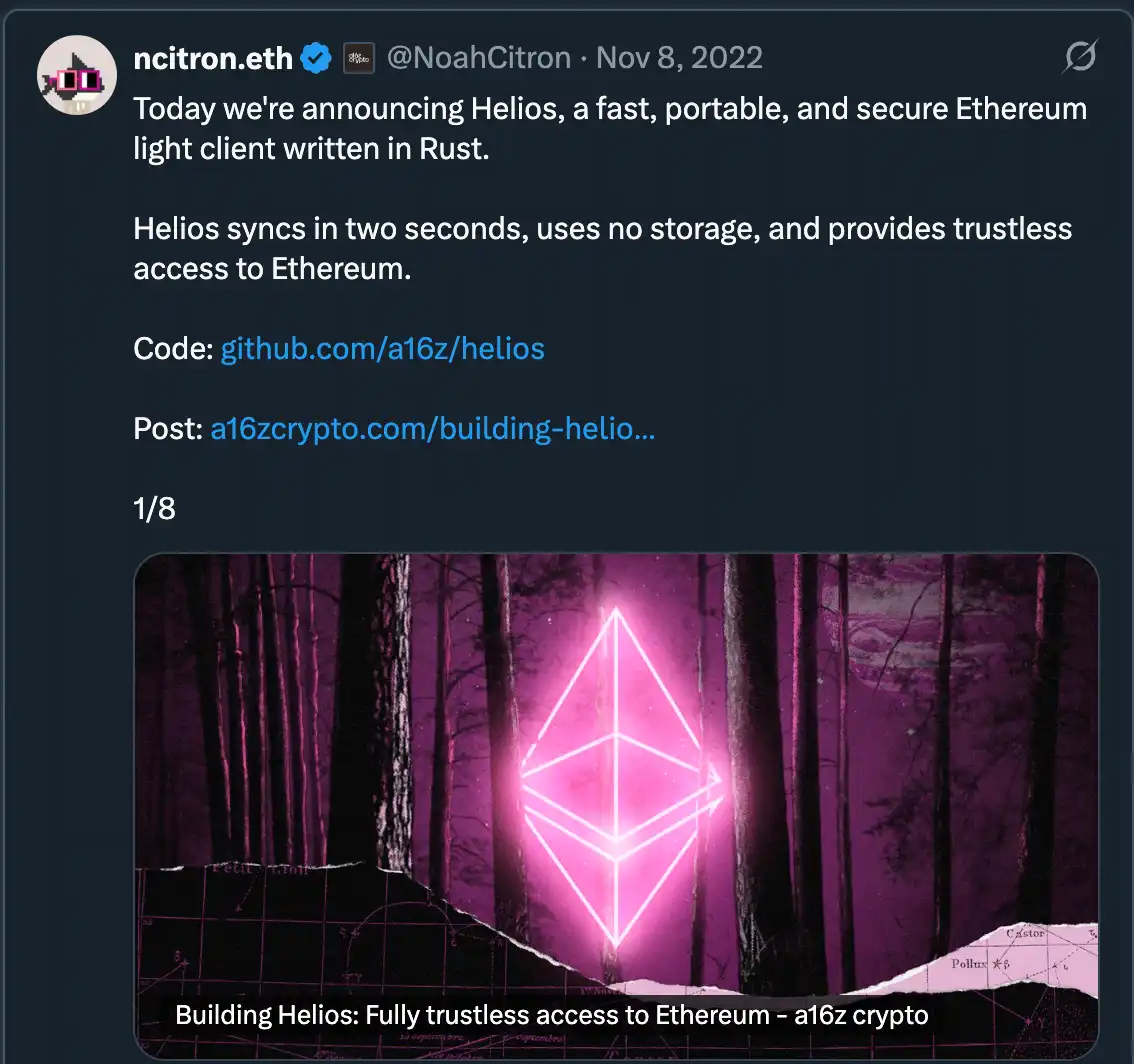
Helios solves this in 2 seconds. It's a light client that tracks validator "sync committees" (512 validators, ~27-hour cycles). If 2/3+ sign a block header, it's canonical. When you check your balance, Helios requests a Merkle proof from an untrusted RPC and verifies it locally. The RPC can refuse to answer but cannot lie.
It can run anywhere: laptops, phones, browser extensions. Use it as your MetaMask RPC, and every dapp becomes trustless without changing anything else.
The technology exists today, open-source and ready for integration.
ORAM/PIR: Private RPC Queries
Every RPC query leaks your behavior—which addresses you watch, which protocols you use, when you use them.
ORAM (Oblivious RAM) uses a tree structure to hide access patterns. The server sees you accessing data but cannot tell which data. Signal messenger uses this, reducing costs 100x (from 500 servers to 6).
PIR (Private Information Retrieval) lets you query a database without revealing what you want. You send an encrypted query, the server processes the encrypted data, and you decrypt the answer. Response size remains constant (~3KB) regardless of database size.
Real implementations exist today:
- Oblivious Labs: Private WBTC balance checker
- Private ENS resolution
- QuietRPC: Private RPC exploration
The challenge is dynamic state: re-encoding 33 million elements takes 4-20 minutes. The solution involves periodic snapshots with on-chain proofs. For most uses (balance checks, voting eligibility), a few minutes of staleness is acceptable for the privacy guarantee.
Social Recovery: Beyond Fragile Seed Phrases
Current wallets force impossible choices:
- Lose seed phrase → Lose everything
- Seed phrase stolen → Lose everything
- Cloud backup → Sovereignty backdoored
Social recovery disperses trust. You have an everyday signing key plus "guardians" (friends, family, other devices). Recovery requires 3/5 guardian approval. Timelocks (48-72 hours) prevent instant theft while allowing legitimate recovery.
Dropped your phone in a lake? Contact guardians, they approve a new key, the timelock starts, and you regain access. If someone steals your key and tries this, you cancel during the timelock.
Security: An attacker needs to compromise 3/5 guardians simultaneously. You have days to respond. Each guardian has only partial power. No tech company backdoor.
Wallets like Argent support this today. 2026 goal: Make it standard everywhere, with UX anyone can use.
Private Payments with Public UX
Privacy tools exist but are painful: different apps, poor UX, 3-5x gas costs, limited support. Almost no one uses them.
2026 goal: Private = public experience. Same wallet, same interface, comparable cost. Privacy becomes a checkbox, not a research project.
Technology: zkSNARKs (prove you have funds without revealing which), stealth addresses (one-time addresses per transaction), account abstraction integration.
FOCIL: Censorship-Resistant Privacy
Private payments are worthless if builders refuse to include them. With 80-90% of blocks from 2 builders, censorship is easy.
FOCIL (Fork-Choice Obligatory Inclusion List) makes censorship impossible:
Each slot, 16 validators are randomly selected to build an "inclusion list" from mempool transactions (8KB each). Block builders must include these transactions. Proposers only vote for blocks that satisfy the inclusion list. Without votes, a block cannot become canonical.
Why it works:
- Committee-based: Only needs 1 honest validator out of 16
- Fork-choice enforced: Built into consensus, cannot be bypassed
- Same-slot: No delay
- Anywhere in block: Builders optimize MEV but cannot censor
For privacy: If one validator includes your private transaction, it must be in the block. Builders cannot censor without losing money.
IPFS Hosting for Dapps
When you access Uniswap, you load the web app from their servers. If the server goes down, you're locked out. If hacked for a second, a malicious UI drains your wallet. If pressured, they serve different UIs to different users.
IPFS solution: Host the UI using content addressing (identified by hash, not server). Anyone can serve the content. Changing the UI changes the hash. ENS maps friendly names to hashes.
Benefits: No single point of failure, impossible to hijack, censorship-resistant, verifiable.
Challenge: Updates mean new hashes. Solution: ENS records point to the latest hash, gradually decentralizing to DAO governance.
Why This Matters
"In the world computer, there is no centralized overlord. No single point of failure. Only love." — Vitalik
If Ethereum is just another platform requiring trusted intermediaries, why not use AWS?
The answer must be that Ethereum offers something truly different: true ownership, true permissionlessness, actual censorship resistance, true self-sovereignty.
But these only matter if accessible. A theoretically decentralized but accessed through centralized bottlenecks is just decentralization theater.
The stakes:
- Success: Ethereum becomes the infrastructure for an open internet, users control their wealth/data, privacy is default
- Failure: Regulatory capture of the access layer, users abandon crypto for honest CBDCs, the cypherpunk dream dies
Conclusion
The pragmatic decade proved blockchains work. Now we prove they work without abandoning principles.
This won't all ship in the next release. Building trustless systems with great UX takes time. Coordinating hundreds of developers takes longer.
But the commitment is absolute. Every decision is evaluated against the criteria: Does it increase trustlessness and self-sovereignty?
2026 is when we decide mainstream adoption at the cost of core values isn't worth it. "Good enough" decentralization isn't good enough. Users deserve better than trusting infrastructure providers to access a "trustless" network.
The technical pieces are falling into place. Helios delivers verifiable RPC today. ORAM/PIR proves private queries work. Social recovery exists in production. FOCIL's censorship resistance is specified. The path is clear.
Now let Ethereum build.