Behind the Rejection of the $17M CRV Grant: Founder's Proposal Power Weakened, Convex and Yearn Become Key Players

marsbitPublished on 2025-12-25Last updated on 2025-12-25

Abstract

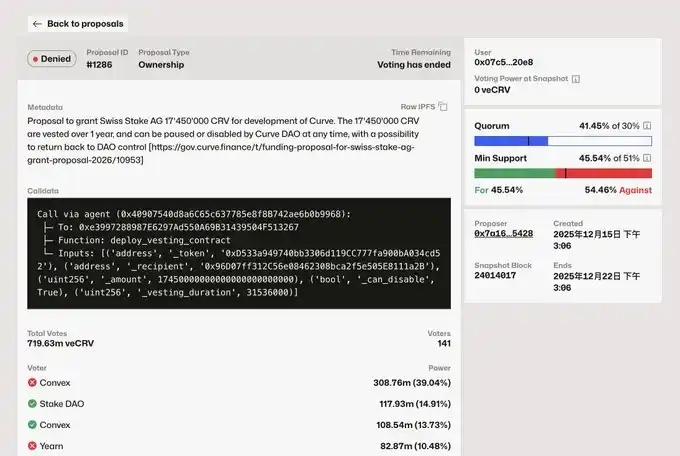
A proposal to grant 17 million CRV tokens (worth approximately $1.7 million) to Swiss Stake AG, a long-time core development team, was rejected in a Curve Finance governance vote. Major veCRV holders, including Convex and Yearn, voted against it, wielding enough voting power to determine the outcome. The rejection reflects two key shifts in DAO governance: First, communities are demanding greater accountability, transparency, and measurable results for treasury grants, moving beyond unconditional funding. Second, large veCRV holders, motivated by self-interest, are resistant to proposals that dilute their token value without clear, foreseeable benefits to them. The incident highlights the evolving power dynamics within Curve's governance. The veToken model, which ties voting rights to long-term locked capital, inherently concentrates power among large, capital-rich entities like Convex and Yearn. As users delegate their tokens to these protocols for yield and liquidity, governance is increasingly shifting from founders and communities to a form of "governance capitalism" dominated by major stakeholders.

A few days ago, a funding proposal on Curve was rejected, which involved allocating 17M $CRV to the development team (Swiss Stake AG) for development expenses. Both Convex and Yearn voted against it, and their voting power was sufficient to influence the final outcome.

Since the Aave governance issue began to gain attention, governance has started to be scrutinized by the market, and the habit of approving funding requests without question is being broken. This Curve proposal highlights two key points:

1. Some voices in the community are not opposed to funding AG, but they want clarity on how previous funds were used, how future funds will be utilized, whether the approach is sustainable, and whether it has generated returns for the project. At the same time, this overly simplistic grant model lacks accountability once funds are disbursed. In the future, the DAO needs to establish a Treasury, ensure transparency in income and expenditures, or add governance constraints.

2. The major veCRV holders do not want to dilute their value. This is a clear conflict of interest. If the projects supported by CRV grants cannot foreseeably benefit veCRV holders, they are unlikely to gain support. Of course, Convex and Yearn also have their own agendas and influence, but that’s a separate issue.

This proposal was initiated by Curve founder Mich. AG is one of the teams that has been maintaining the core codebase since 2020. The roadmap presented by AG for this funding includes advancing llamalend, supporting PT and LP, as well as expanding the on-chain foreign exchange market and crvUSD. These seem like worthwhile initiatives, but whether they justify a 17M $CRV grant is another calculation. Particularly, Curve’s governance differs significantly from Aave’s, with power distributed among several teams with distinct stances.

Comparing ve with conventional governance models:

First, the conclusion: most conventional governance models, by design, have little to no advantage. Of course, if a DAO is mature enough, traditional structures can function well, but unfortunately, no crypto project has reached that level of maturity yet, as even market-consensus leaders like Aave have encountered issues.

If we focus solely on model design, ve has some advanced aspects. Firstly, it generates cash flow and is backed by liquidity control rights. When there is external demand for liquidity, this power is subject to bribes. So even if you don’t want to lock your tokens long-term, you can delegate them to proxy projects like Convex/Yearn to earn yields.

Thus, ve is a model where voting rights are tied to cash flow. Its future evolution will likely follow the path of “governance capitalism.” Vetoken binds voting rights with “long-term locking,” essentially筛选 those with large capital, ability to bear liquidity loss, and capacity for long-term博弈. Over time, this means governance will shift from ordinary users to “capital groups.”

At the same time, due to the presence of proxy layers like Convex/Yearn, many ordinary users, even loyal ones, who want to retain liquidity and flexibility while earning yields, will gradually choose to delegate their governance to these projects.

This vote also offers some insight: in the future, Mich may not be the key player in Curve’s governance; instead, power lies with these major token holders. When Aave faced governance issues, some proposed the idea of “delegated governance/elite governance,” which is quite similar to Curve’s current structure. As for whether this is good or bad, only time will tell.
Trending Cryptos

Related Questions

QWhy was the proposal to grant 17M $CRV to the development team Swiss Stake AG rejected by the Curve community?

AThe proposal was rejected primarily because major veCRV holders, such as Convex and Yearn, voted against it. They were concerned about the dilution of their token value and the lack of transparency and accountability regarding the use of funds. The community also demanded clearer details on past fund usage, future plans, and measurable benefits to the project before approving such a grant.

QWhat are the key concerns raised by the Curve community regarding grant proposals like this one?

AThe community emphasized the need for transparency in treasury management, including clear reporting on how funds are used and how they generate value for the project. They also called for sustainable and constrained grant models rather than unconditional funding, ensuring that grants align with the long-term interests of veCRV holders and the ecosystem.

QHow does Curve's ve token model differ from traditional governance models in crypto?

ACurve's ve (vote-escrowed) model binds voting rights to long-term token lockups, creating a system where governance power is coupled with financial incentives like yield and bribes. This contrasts with traditional governance models, which often lack built-in economic alignment. The ve model tends to concentrate governance influence among large, long-term capital providers rather than ordinary users.

QWhat role do Convex and Yearn play in Curve's governance structure?

AConvex and Yearn act as major vote aggregators in Curve's governance by accumulating veCRV tokens from users who delegate to them. They wield significant voting power, often enough to sway governance outcomes, as seen in the rejection of the 17M $CRV grant proposal. Their influence highlights the shift toward 'governance capitalism,' where large capital entities dominate decision-making.

QWhat does the rejection of this proposal indicate about the future of Curve's governance?

AThe rejection signals that Curve's governance is increasingly dominated by large veCRV holders and proxy platforms like Convex and Yearn, rather than individual founders or small stakeholders. This reflects a broader trend toward capital-driven governance, where decisions are made based on economic incentives and long-term value preservation for major stakeholders.

Related Reads

Vitalik's Algorithmic Stablecoin Vision: Interpreting the Mechanism and Challenges from an Options Perspective

Vitalik Buterin's recent algorithmic stablecoin proposal envisions using an option-like mechanism to create a stablecoin without the liquidation risks inherent in traditional collateralized debt position (CDP) models. The design splits one unit of ETH into two components: a 'stable' leg (P) that maintains value up to a certain strike price, and an 'upside' leg (N) that captures any appreciation above that price. Together, they always sum to one ETH, eliminating the need for debt or liquidation mechanisms. From an options perspective, the stable leg essentially functions as a synthetic, covered call position. However, significant challenges exist. For the stable asset to maintain its peg, it must continuously roll deep in-the-money call options, leading to potential rollover slippage, predictable trading paths vulnerable to front-running, and liquidity issues. Crucially, the system's scalability depends on a constant demand for the upside leg—a form of leveraged ETH long position without funding rates or liquidation risk. It's unclear if such persistent, specific demand will materialize from speculators or market makers who have simpler alternatives like perpetual swaps. The author, drawing from experience with Rysk, argues that DeFi options have struggled as standalone trading products due to complexity and fragmented liquidity. Their potential lies instead as foundational infrastructure underpinning more complex financial primitives like stablecoins, structured yields, or index products—transforming from a direct product into a core pricing and risk distribution engine for the next generation of on-chain finance.

marsbit1h ago

Vitalik's Algorithmic Stablecoin Vision: Interpreting the Mechanism and Challenges from an Options Perspective

marsbit1h ago

GPT-5.6 Countdown: Abandon the Illusion of a Single API, Computational Iteration Can't Outpace a Single Page of Compliance

In mid-June, three seemingly independent industry events—the compliance-driven throttling of Fable 5, the open-sourcing of GLM-5.2, and the leaked release timeline for GPT-5.6—are pushing the global AI industry toward a watershed moment. These shifts signal a fundamental restructuring of the industry's underlying logic. First, **"usability" has substantially overtaken "advanced capabilities"** as the primary weight, pushing the global large language model (LLM) supply chain into a "dual-track" phase of controlled closed-source and local open-source coexistence. Second, **the competitive moats of closed-source giants are shifting**. Their technical focus is moving from "language intelligence" toward "spatial intelligence (world models)"—a domain heavily reliant on computing power. Third, faced with常态化 transnational compliance risks, **a "model-agnostic" decoupled design has become a survival necessity for application-layer developers to maintain business continuity.** The article details how Anthropic's Fable 5, despite its advanced engineering feats, was restricted for non-U.S. citizens within 72 hours of launch, highlighting how geopolitical compliance can instantly limit even the most advanced models. In response, the open-source camp, exemplified by Zhipu AI's MIT-licensed GLM-5.2, is gaining market share by offering stable performance improvements and significant cost advantages (up to 70% savings for enterprises), while achieving full adaptation with domestic semiconductor platforms. Meanwhile, closed-source leaders like OpenAI are pivoting. The anticipated GPT-5.6 reportedly shifts focus from language to spatial intelligence and world models, aiming to rebuild a generational gap in areas like 3D understanding, simulation, and industrial design that demand immense compute. The core conclusion is that the LLM supply chain's logic has changed. Enterprises must now evaluate infrastructure based on a composite of technical performance and policy compliance. For developers, complete reliance on a single closed-source API poses unacceptable risk. Implementing a truly model-agnostic architecture—enabling swift switches to compliant, locally deployable open-source alternatives—is no longer just good practice but a fundamental baseline for business continuity.

marsbit3h ago

GPT-5.6 Countdown: Abandon the Illusion of a Single API, Computational Iteration Can't Outpace a Single Page of Compliance

marsbit3h ago

Is the 'Token Subsidy War' Among AI Giants Almost Over?

The article discusses the ongoing "token subsidy war" among AI giants like OpenAI and Anthropic, questioning whether it's nearing its end. It reveals that current AI subscription prices are heavily subsidized, with some plans offering tokens at up to 70 times the actual cost to attract and retain heavy users, especially developers and enterprises. This strategy mirrors past internet-era subsidy battles, but with a key difference: AI tokens lack "lock-in" effects. Unlike ride-hailing or food delivery apps, users can easily switch between AI providers as APIs become standardized, making it difficult for companies to raise prices post-subsidy. The piece highlights a structural asymmetry in the competition. Giants like Google, with massive advertising revenue, can afford to subsidize tokens indefinitely, akin to using "tokens as a weapon." In contrast, venture-backed companies like OpenAI and Anthropic face pressure to become profitable, especially as they approach IPO. The article cites Google Ventures founder Bill Maris, who suggests Google could slash token prices by 80%, putting immense pressure on competitors. Two potential endgames are presented: the "internet service" model (subsidize, monopolize, then raise prices) and the "utility" model (tokens become a standardized, low-margin commodity like electricity). Given the low switching costs, the latter seems more likely. The competition may not have a single winner but could instead accelerate AI's evolution into a foundational, infrastructure-level technology, akin to a public utility. For now, users continue to benefit from heavily subsidized token costs.

marsbit4h ago

Is the 'Token Subsidy War' Among AI Giants Almost Over?

marsbit4h ago

Trading

Spot
Futures

Hot Articles

Discussions

Welcome to the HTX Community. Here, you can stay informed about the latest platform developments and gain access to professional market insights. Users' opinions on the price of S (S) are presented below.

活动图片