Hong Kong proceeds with licensing regimes for virtual asset dealers and custodians

cointelegraphPublished on 2025-12-24Last updated on 2025-12-24

Abstract

Hong Kong regulators are moving forward with new licensing requirements for cryptocurrency dealers and custodians following the conclusion of consultations. The Financial Services and the Treasury Bureau (FSTB) and the Securities and Futures Commission (SFC) announced the decision, which is part of a broader effort to strengthen oversight of the digital asset sector. This builds on the city’s existing regulatory framework, which already mandates licensing for crypto trading platforms and recently enacted a stablecoin licensing regime. Hong Kong aims to position itself as a trusted crypto hub with comprehensive regulations covering stablecoins, tokenization, and now dealer and custody services. Separately, the SFC also launched a consultation for licensing crypto advisory and management service providers, linking the proposals to anti-money laundering and counter-terrorist financing rules.

Hong Kong regulators will proceed with legislating licensing regimes for crypto dealers and custodians after wrapping up consultations, as part of a broader push to tighten oversight.

In a Wednesday announcement, the city’s Financial Services and the Treasury Bureau (FSTB) and the Securities and Futures Commission (SFC) said that they had concluded consultations on proposed licensing regimes, which would require firms providing crypto dealings or custody services in Hong Kong to obtain licenses once the framework takes effect.

The move adds to the city’s expanding crypto licensing framework. Earlier in 2025, Hong Kong brought its Stablecoin Ordinance into force, opening a new licensing regime for stablecoin issuers.

Hong Kong already requires crypto trading platforms to be licensed. The current mandatory regime builds on earlier opt-in framework introduced in 2020, with 11 companies having received approval from the SFC to date.
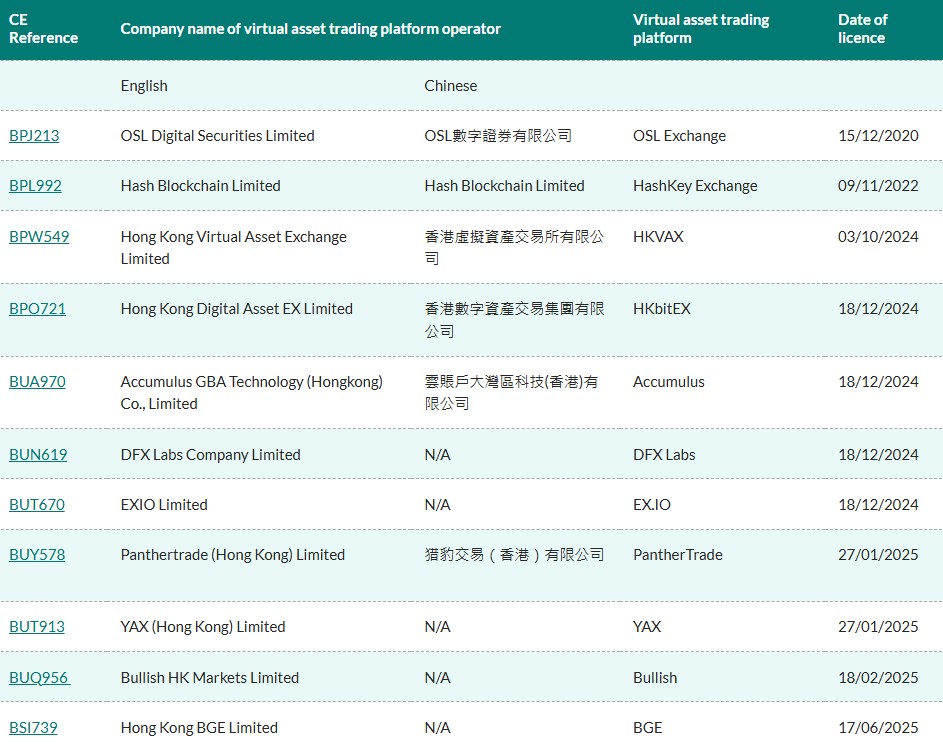
Hong Kong has rejected more applicants for its crypto exchange license than it approved. Source: SFC

Related: Crypto may enter insurers’ portfolios as Hong Kong reviews capital rules

Hong Kong’s broader crypto initiatives

Hong Kong has long expressed its ambitions to develop into a crypto hub. The city already functions as a financial hub with its business-friendly tax regimes and its reputation as a finance gateway between mainland China and global capital markets.

Beyond crypto licensing rules, Hong Kong has also tested tokenization initiatives. In Thursday’s announcement, regulators added that the pending introduction of licensing regimes for crypto dealers and custodians is part of the city’s effort to establish a comprehensive regulatory framework for digital assets alongside stablecoins and tokenization.

​Julia Leung, CEO of the SFC, said that the further development of Hong Kong’s crypto regulatory framework would help the city maintain its position in global digital asset market developments by “fostering a trusted, competitive and sustainable ecosystem.”

Related: Hong Kong launches CARF crypto tax consultation to combat evasion

New advisory and management consultation

The SFC also published a consultation paper on the same day, seeking public feedback on proposals to introduce licensing regimes for crypto advisory service providers and management service providers.

The consultation links the proposed regimes to Hong Kong’s existing Anti‐Mone‐Laundering (AML) framework and Counter‐Terrorist Financing Ordinance, and sets out how advisory and management activities involving digital assets will be brought within the regulatory framework.

It also invites comments on matters such as licensing scope, regulatory powers, sanctions and appeal arrangements, which will be taken into account in finalizing the proposals.

Trending Cryptos

Related Questions

QWhat are the key licensing regimes that Hong Kong is proceeding with for virtual assets?

AHong Kong is proceeding with licensing regimes for virtual asset dealers and custodians, as well as for advisory service providers and management service providers.

QWhich regulatory bodies announced the conclusion of consultations on the proposed licensing frameworks?

AThe Financial Services and the Treasury Bureau (FSTB) and the Securities and Futures Commission (SFC) announced the conclusion of consultations on the proposed licensing regimes.

QWhat earlier crypto-related licensing regime did Hong Kong bring into force in 2025?

AIn early 2025, Hong Kong brought its Stablecoin Ordinance into force, which opened a new licensing regime for stablecoin issuers.

QAccording to the SFC CEO, what is the goal of further developing Hong Kong's crypto regulatory framework?

AAccording to SFC CEO Julia Leung, the goal is to help Hong Kong maintain its position in global digital asset market developments by 'fostering a trusted, competitive and sustainable ecosystem'.

QWhat existing frameworks are the proposed licensing regimes for advisory and management services linked to?

AThe proposed regimes are linked to Hong Kong's existing Anti-Money Laundering (AML) framework and Counter-Terrorist Financing Ordinance.

Related Reads

Investors Begin 'Switching Tables'

Investors Begin to “Change Tables” A notable shift is occurring in China's venture capital landscape. While the hard tech sector, especially AI, experiences a funding frenzy with record-breaking investment rounds, many investors are opting to leave traditional investment firms to join portfolio companies. This movement, termed "changing tables," marks a departure from past downturns where such moves were often a last resort. Currently, the trend is driven by proactive choice. Seasoned investors, including partners and managing directors, are being lured by attractive salaries, equity incentives, and core roles like VP, General Manager, or even co-founder at fast-growing startups in hot sectors like AI, embodied intelligence, and aerospace. This "going ashore" to companies is seen as a strategic career move. The shift is a two-way street. Booming fundraising and feverish investment activity have created intense competition among VCs for a narrow set of "star projects." Simultaneously, these high-flying tech companies, engaged in rapid, multi-round financing, urgently need talent with deep capital market expertise and institutional connections to manage their complex funding needs. Companies like Zhiyuan Robot, MoonDark AI, and MiniMax are actively recruiting from investment firms. For investors, the move also reflects concerns about the sustainability of the current market. Risks like valuation inversion between primary and secondary markets, high IPO破发 rates, increased regulatory scrutiny, and the uncertainty of eventual exits are prompting a reevaluation of the traditional VC path. While this transition offers new opportunities, it is not without challenges. Success requires adapting from evaluating companies to operating within one, focusing on execution over analysis. Nevertheless, this trend underscores the expanding career boundaries and fluidity within China's innovation ecosystem.

marsbit18m ago

Investors Begin 'Switching Tables'

marsbit18m ago

Ethereum Community in Uproar! Whose Cake is EIP-8363 Cutting Into?

**Ethereum Community Debates Controversial Staking Proposal EIP-8363** A new Ethereum proposal, EIP-8363, dubbed "Tapered Issuance Burn," has ignited heated debate within the community. The core idea is to reduce and eventually eliminate new issuance rewards for validators as the total amount of staked ETH approaches 50% of the total supply (around 60.25 million ETH). The authors, including EthCC founder Jérôme de Tychey and Ethereum Foundation researcher Justin Drake, argue the current system perpetually incentivizes more staking, potentially leading to centralization as stake flows to large custodians and liquid staking tokens (LSTs). They also aim to reduce dilution pressure on non-staking ETH holders. Under the proposal, validator rewards from consensus-layer issuance would be partially burned based on a formula tied to the total staked amount. Net rewards would gradually approach zero as staking nears the 50% threshold. Notably, execution-layer rewards (tips, MEV) are unaffected. A proposed 18-month transition period would soften the initial impact. The community reaction has been predominantly critical. Key concerns include: * **Centralization Risk:** Critics like Obol's Oisín Kyne argue very low rewards could drive out solo stakers and smaller operators, leaving only large, cost-insensitive institutions, thus increasing validator centralization. * **Ecosystem Impact:** Aave's Stani Kulechov warns it could hurt ETH's predictable yield appeal for institutions and compress yields for LST-based DeFi strategies (e.g., recursive lending). * **Process & Timing:** Some, like ether.fi's Mike Silagadze, criticize the proposal's late submission ahead of a key upgrade deadline, limiting discussion time. Supporters believe the change is necessary to maintain ETH as a neutral reserve asset and avoid excessive security costs and holder dilution. If implemented, solo stakers would face higher relative operational costs and longer recovery times from penalties. LST yields would converge with native ETH, challenging their value proposition. The entire DeFi interest rate ecosystem, built around staking yield, could be pressured. While all ETH holders would benefit from reduced dilution, the net effect on ETH's price and adoption remains uncertain due to potential demand-side impacts from lower yields. The proposal is currently an early-stage draft and has not been officially slated for inclusion in any upcoming network upgrade.

marsbit48m ago

Ethereum Community in Uproar! Whose Cake is EIP-8363 Cutting Into?

marsbit48m ago

Trading

Spot

Hot Articles

How to Buy VIRTUAL

Welcome to HTX.com! We've made purchasing Virtuals Protocol (VIRTUAL) simple and convenient. Follow our step-by-step guide to embark on your crypto journey.Step 1: Create Your HTX AccountUse your email or phone number to sign up for a free account on HTX. Experience a hassle-free registration journey and unlock all features.Get My AccountStep 2: Go to Buy Crypto and Choose Your Payment MethodCredit/Debit Card: Use your Visa or Mastercard to buy Virtuals Protocol (VIRTUAL) instantly.Balance: Use funds from your HTX account balance to trade seamlessly.Third Parties: We've added popular payment methods such as Google Pay and Apple Pay to enhance convenience.P2P: Trade directly with other users on HTX.Over-the-Counter (OTC): We offer tailor-made services and competitive exchange rates for traders.Step 3: Store Your Virtuals Protocol (VIRTUAL)After purchasing your Virtuals Protocol (VIRTUAL), store it in your HTX account. Alternatively, you can send it elsewhere via blockchain transfer or use it to trade other cryptocurrencies.Step 4: Trade Virtuals Protocol (VIRTUAL)Easily trade Virtuals Protocol (VIRTUAL) on HTX's spot market. Simply access your account, select your trading pair, execute your trades, and monitor in real-time. We offer a user-friendly experience for both beginners and seasoned traders.

6.9k Total ViewsPublished 2024.12.23Updated 2026.06.02

How to Buy VIRTUAL

Discussions

Welcome to the HTX Community. Here, you can stay informed about the latest platform developments and gain access to professional market insights. Users' opinions on the price of VIRTUAL (VIRTUAL) are presented below.

活动图片