At the 2026 World Economic Forum in Davos, crypto moved away from price cycles and ideological debates toward a more practical focus: how blockchain is being used inside the global financial system.
Across panels, side events, and executive interviews, tokenization of real-world assets (RWAs) emerged as the clearest signal of where crypto is heading next. With the value of tokenized assets now exceeding $22 billion, Davos framed tokenization less as an experiment and more as infrastructure in active use.
The shift was evident in both the tone and the participants. Rather than startups pitching concepts, conversations featured central bank officials, large asset managers, and executives from firms in the tokenization space. The emphasis shifted from whether blockchain belongs in finance to how quickly it can be scaled.
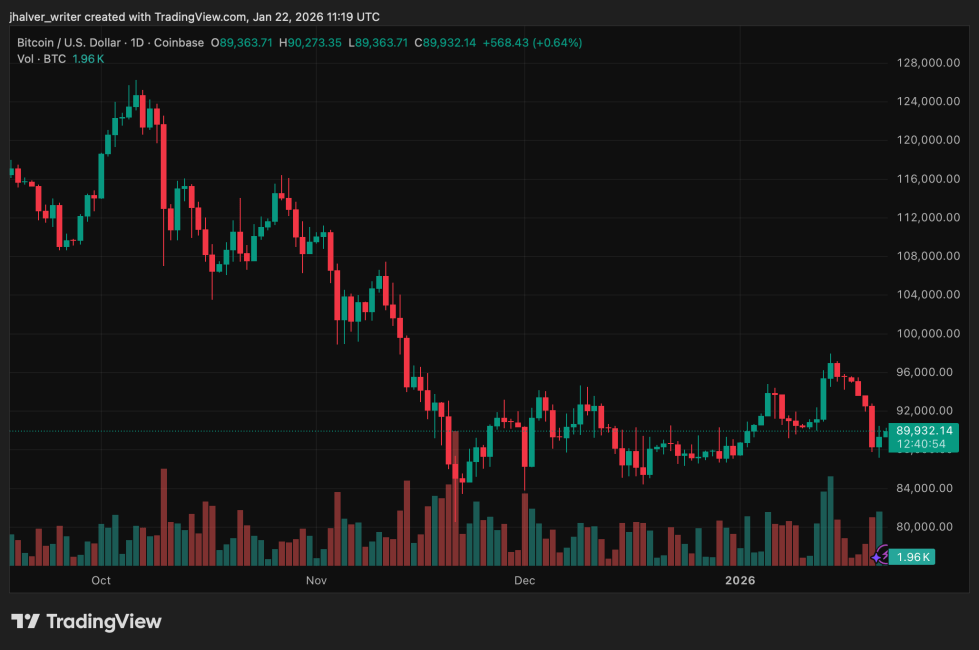
BTC's price trends sideways on the daily chart. Source: BTCUSD on Tradingview
Tokenization Moves From Concept to Financial Infrastructure
Panels such as “Is Tokenization the Future?” underlined how assets traditionally seen as illiquid, bonds, equities, funds, and real estate, are increasingly represented on-chain.
Executives from Coinbase and Ripple, alongside European Central Bank officials, described tokenization as a way to reduce settlement times, improve liquidity, and allow fractional ownership without rebuilding the financial system from scratch.
Institutions including BlackRock, BNY Mellon, and Euroclear confirmed they have moved beyond pilot programs and are deploying tokenized instruments at scale.
Data shared during the forum showed that the total value locked in tokenized RWAs has passed $22 billion, reflecting broader asset coverage and growing institutional participation. Ethereum currently hosts more than 65% of these assets, underlining its role as the main settlement layer for tokenization activity.
Regulation and Stablecoins Shape the Next Phase
Regulatory clarity was repeatedly cited as the key factor behind this momentum. Frameworks finalized in 2025 in the US and parts of Europe provided banks and custodians with clearer rules on issuance, custody, and compliance.
In Davos, US President Donald Trump reinforced this direction by pointing to the GENIUS Act, which established a federal framework for payment stablecoins.
Stablecoins were described as the “plumbing” connecting traditional finance, decentralized finance, and tokenized assets. Rather than competing with banks, they are increasingly used for settlement, treasury operations, and cross-border transfers.
What Davos 2026 Signals for Crypto Investors
For investors, Davos 2026 suggested that crypto’s next growth phase may be less speculative and more structural.
Consulting firms such as McKinsey and Boston Consulting Group estimate that tokenized assets could reach between $2 trillion and $16 trillion by 2030. The focus on regulated products, institutional adoption, and market infrastructure points to a longer-term shift.
Tokenization’s rise at Davos indicates that crypto’s role in global finance is being defined less by volatility and more by utility, an important signal for how the sector may evolve in the years ahead.
Cover image from ChatGPT, BTCUSD chart from Tradingview